


 Golam Rabiul Alam, PhD
Note: This article discusses patent data and USPTO examination trends for informational purposes only. It is not legal or financial advice. See disclaimer below.
A headline share of global patent filings and a lead in globally enforceable rights are not the same thing. In the US vs China Quantum Computing Race 2026, China holds the largest share of raw filing volume. The United States and its allies hold the deeper position in patents that are actually protected in multiple major markets. If you are developing quantum hardware, algorithms, or cryptographic technology, understanding which of these two data pictures applies to your competitors, and to you, is the difference between a sound IP strategy and a false sense of security. Below is what the primary patent data actually shows, where each side leads, and the recurring pattern in how the USPTO treats quantum software claims under Section 101.
At A Glance: The State of Quantum IP in 2026
Quantum technology patent data is one of the earliest signals of where commercial and strategic advantage in the field will land. Two figures from the MIT Quantum Index Report and QuIC’s international patent landscape research frame the picture:
The Two Numbers That Matter
- China holds approximately 60% of global quantum technology patent filings as of 2024, per the MIT Quantum Index Report.
- The United States holds the largest share of internationally protected quantum computing patent families, per QuIC and QED-C assignee-level data.
Quantum technology bears directly on secure communications, post-quantum encryption migration, and future computing infrastructure. Patent concentration in either the computing layer or the communications layer affects who can set technical standards, license critical components, and control key parts of the supply chain. Readers evaluating strategic or security implications should also review primary government and standards-body guidance directly, since patent data alone does not capture deployment timelines, export controls, or classified programs.
Key Takeaways
- Two different questions, two different answers. “Who files the most quantum patents” and “who holds internationally enforceable quantum patent rights” are separate measurements, and conflating them is the single most common error in coverage of this space. China leads the first measurement decisively. The United States leads the second.
- International reach is where the real signal is. QuIC’s patent landscape analysis and QED-C’s independent cross-check both identify IBM, Google, Microsoft, and Intel among the top holders of internationally protected quantum computing patent families, alongside NEC of Japan. QuIC’s own data (see the table below) puts a specific number on this gap: only 7% of Chinese-origin patent families extend internationally, against 49% for the United States.
- The split runs along segment lines, not just country lines. The US Patent and Trademark Office has issued more quantum computing patents than any other national office, while the China National Intellectual Property Administration has issued more quantum communications patents than any other office, according to QED-C’s 2024 analysis. China’s lead in quantum key distribution (QKD) patents specifically is well documented; the precise share of the QKD sub-segment varies by methodology and dataset.
- Corporate concentration: IBM, Google, Microsoft, and Intel anchor US private-sector filing activity. Origin Quantum and Baidu are consistently identified as leading Chinese filers, alongside significant university and state-institution activity.
- Section 101 has a consistent pattern. USPTO outcomes in this space follow a recognizable shape once you’ve seen enough of them side by side — see the analysis below for what that pattern looks like across published examination results.
The Data Gap in the US vs China Quantum Computing Race 2026
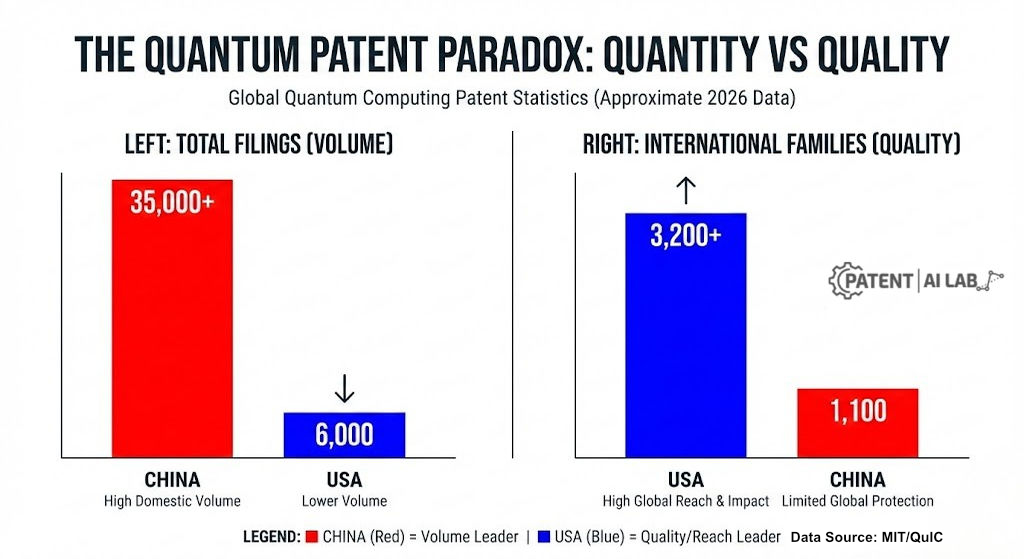
Understanding the actual state of quantum patent competition between the US and China requires separating two different measurements that are frequently conflated in headlines: total filing volume, and the smaller subset of filings that are protected as international patent families. The numbers above give you the headline shape of that gap. What follows is where those figures come from, how they were checked, and what they do and don’t tell you.
Where the 60% Figure Comes From, and What It Includes
The MIT Quantum Index Report 2025, a joint research effort between the MIT Initiative on the Digital Economy and Accenture, is the primary dataset behind this figure, and it holds up under direct verification. The trajectory matters as much as the current snapshot: China’s share expanded from 42% in 2014 to 60% in 2024, a sustained fifteen-point climb rather than a single-year spike, which is worth noting because it rules out the possibility that one large filing wave is distorting the current picture.
What’s inside that share: Chinese filing volume includes substantial domestic-only activity, consistent with government research funding and academic output incentives common to large-scale national R&D programs. That composition does not by itself indicate low quality. It does mean raw volume should not be read as a proxy for global commercial reach without the international-family data below, which is measuring a functionally different thing: not “how many patents were filed” but “how many were filed in enough places to matter commercially outside the home market.”
What International Patent Family Data Actually Shows
An international patent family is a single invention protected across multiple major patent offices, such as the USPTO, EPO, and JPO. Because international filing carries substantial additional cost, typically several times the cost of a single domestic filing once translation, local counsel, and prosecution fees at each office are included, it is a reasonable indicator that the applicant expects commercial value outside its home market. A company does not pay that multiple unless it believes the invention is worth defending in more than one jurisdiction.
A note on the figures that follow: A specific 48% United States / 11% China split of international quantum patent families circulates in some secondary coverage of this topic, attributed to QuIC. That precise split does not appear in QuIC’s published white paper, “A Portrait of the Global Patent Landscape in Quantum Technologies,” or in QED-C’s independent replication of QuIC’s methodology. Readers who have seen that 48%/11% figure elsewhere should not treat it as sourced; neither primary publication states those percentages or the family counts behind them. QuIC’s report does, however, publish a directly comparable figure using its own methodology, given in the table below.
- Assignee-level leadership: QuIC’s white paper identifies IBM, Microsoft, Intel, Google, and NEC among the top ten assignees of international quantum computing patent families. QED-C’s independent 2024 analysis, which cross-checked QuIC’s findings using a separate keyword-based methodology, corroborates this list and adds D-Wave Systems, Northrop Grumman, IonQ, Beijing Baidu Netcom Science and Technology, and Hefei Origin Quantum to the broader top-ten set for quantum computing patent families generally.
- Internationalization rate: QuIC’s 2025 white paper reports that only 7% of Chinese-origin patent families are extended internationally (that is, filed in at least one additional major office beyond China, or filed via the PCT), compared with a 49% share for the United States when the corpus is limited to international families alone. In practice this means that although China originates 51% of all quantum technology patent families, its share drops to roughly 7% once the comparison is restricted to families that were actually pursued outside the home market, while the US share rises to roughly 49% of that same international corpus.
- Patent office-level confirmation: QED-C’s independent analysis states directly that the US patent office has issued the most quantum computing patents worldwide, with China’s patent office second, and Japan’s patent office third.
What this means in practice: The available primary data supports the conclusion that the United States leads in internationally protected quantum computing patent families, both by assignee ranking and by the much higher internationalization rate of its filers. The specific 48%/11% figure that circulates in secondary coverage is not traceable to either primary source and should not be cited as such. The 7%/49% figures above are traceable to QuIC’s published white paper directly and are given with that citation for anyone who wants to verify them independently.
Filing Volume vs. International Protection: A Side-by-Side Comparison
The table below consolidates the figures discussed throughout this article into a single reference, cross-referencing the MIT Quantum Index Report’s country-level filing data against QuIC’s international patent family analysis. Reading these two datasets side by side is what makes the volume-versus-value distinction concrete rather than abstract.
| Metric | China | United States | Source |
|---|---|---|---|
| Share of all quantum technology patent filings (2024) | ~60% | ~19% | MIT Quantum Index Report 2025 |
| Share of quantum patent families, all filings (2024 corpus) | 51% | 26% | QuIC White Paper 2025 |
| Ratio of international families to total families, by country of origin | 7% | Not stated as a single ratio; see relative weight below | QuIC White Paper 2025 |
| Relative weight within the international-families-only corpus | 7% | 49% | QuIC White Paper 2025 |
| Leading national patent office, quantum computing | 2nd (CNIPA) | 1st (USPTO) | QED-C, 2024 analysis |
| Leading national patent office, quantum communications | 1st (CNIPA) | 2nd (USPTO) | QED-C, 2024 analysis |
Note on reading this table: the first two rows measure the same underlying activity (share of total filings) using two different research groups’ corpora, which is why the percentages differ slightly, MIT’s 2014-2024 country-of-filing dataset versus QuIC’s 2024 patent-family corpus, rather than because the two organizations disagree. The third and fourth rows are the more decision-relevant numbers for anyone assessing enforceable IP position rather than raw filing count, since they isolate only the families that were actually pursued outside the home market.
Segment Analysis: Computing vs. Communications
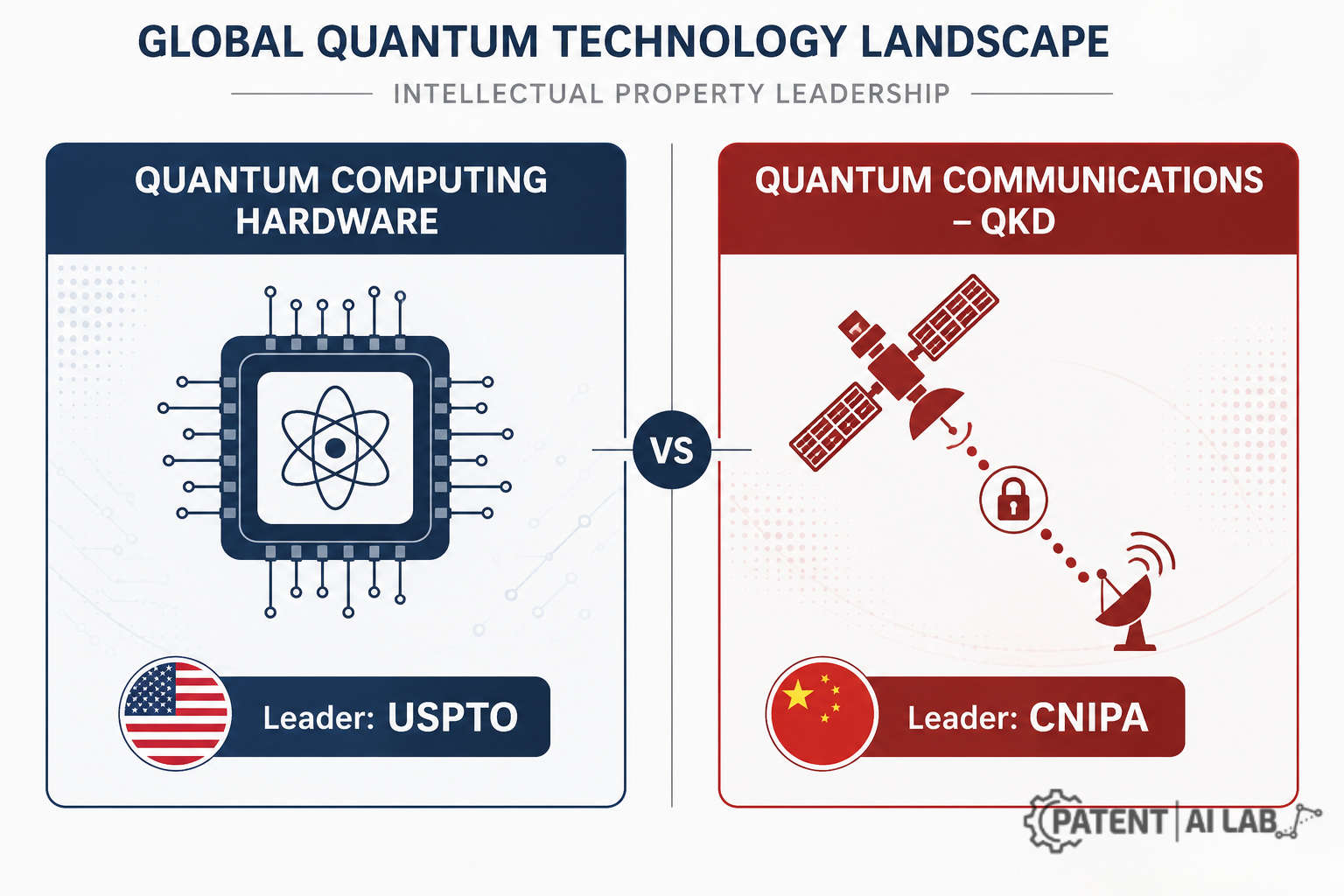
“Quantum” patent data is not a single category. Evaluating leadership in this race requires splitting the field into two distinct segments, computing and communications, which have different leaders, different players, and different strategic stakes. The country-level totals in the sections above are really an average of these two segments pulling in opposite directions, which is part of why a single “who’s ahead” framing tends to mislead.
Quantum Computing: Hardware and Algorithms
Leading office: United States (USPTO)
Leading assignees: IBM, Google, Microsoft, Intel, with Origin Quantum, Baidu, and Alibaba among the top Chinese filers.
QED-C’s patent trend analysis confirms that the US patent office has issued the highest volume of quantum computing patents globally, with China’s office second and Japan’s office third. The same analysis, cross-checked against QuIC’s independent dataset, finds IBM, Google, D-Wave Systems, Microsoft, Beijing Baidu Netcom Science and Technology, Northrop Grumman, Intel, IonQ, and Hefei Origin Quantum among the leading assignees by patent family count, using two different search methodologies that produced largely consistent results, which is itself worth noting since independently converging methodologies are a stronger signal than either alone.
- Hardware innovation: Filing activity is concentrated in qubit implementation approaches, including superconducting circuits and trapped-ion architectures, reflecting the different physical platforms companies are pursuing toward fault-tolerant computing. Neither approach has yet demonstrated a clear scaling advantage at commercial volume, which is part of why filing activity remains split across both rather than consolidating around one.
- Error correction: Quantum error correction is a widely cited priority area in current-generation filing activity, since scaling beyond the noisy intermediate-scale quantum (NISQ) era depends on it. This is the layer most analysts point to as the likeliest source of the next wave of foundational patents, since a workable error-correction approach becomes load-bearing for everything built on top of it.
Quantum Communications: QKD and Networking
Leading office: China (CNIPA)
Leading assignees: University of Science and Technology of China (USTC), QuantumCTek, State Grid, Toshiba, Huawei.
China’s lead in quantum communications patent activity is well corroborated across sources. QED-C’s analysis states directly that the Chinese patent office has issued the most quantum communications patents of any national office, with the US office second and Japan’s office third. This is the inverse of the computing segment above, and the gap is reinforced by physical infrastructure that has already been built rather than filings alone.
- Infrastructure lead: China has deployed the Beijing-Shanghai quantum-secured backbone line, among the longest terrestrial QKD networks in operation, and demonstrated satellite-based QKD through the Micius satellite program. Deployed infrastructure of this kind tends to generate its own follow-on filing activity, since operators file continuation and improvement patents around systems that are already running.
- Assignee concentration: QuIC’s international family data for quantum communications identifies Toshiba, Huawei, Arqit, LG Electronics, Alibaba, and NEC among the top ten assignees, spanning Chinese, Japanese, UK, and Korean filers rather than a single-country sweep. That spread is a useful check against treating this as a purely bilateral US-China contest; Japanese and UK assignees have a real, filed position in this segment.
- On the specific “~80% of QKD patent families” figure: This figure appears across several secondary sources discussing QuIC data but does not appear in QuIC’s own published report. China’s leadership in this segment is well documented through the patent office data above; readers should not treat the 80% figure as sourced unless it can be traced to a specific page in QuIC’s current white paper.
Funding Models and Standards Competition
The divergence in filing patterns reflects two different funding and strategic architectures, and understanding which one a competitor is operating under tells you something about how durable their current filing pace is likely to be.
State-Led vs. Corporate-Led Funding
The statistical divergence in patent data tracks two different funding structures. State-directed funding tends to produce high, steady domestic volume because filing incentives are built into research grants and academic output requirements; corporate R&D funding tends to produce lower volume but a higher share of internationally filed families, because a company only pays the added cost of foreign filing where it expects to sell or license the underlying technology.
| Feature | China | United States |
|---|---|---|
| Primary capital source | Direct government and state-institution funding | Private VC, corporate R&D, and federal grants |
| Filing pattern | High domestic volume, communications-heavy | Higher internationalization rate, computing-heavy |
| Leading segment | Quantum communications (QKD, networking) | Quantum computing (hardware, algorithms) |
Standard Essential Patents and Technical Standards
As quantum standardization progresses, ownership of Standard Essential Patents (SEPs) for qubit interconnects or QKD protocols will matter for who influences international technology standards. This is a developing area; readers tracking specific standards bodies (ITU-T, ETSI, ISO/IEC) should monitor those organizations’ published work items directly rather than relying on secondary patent commentary for standards-track status.
Leading Filers and Corporate Strategy
The leading quantum computing patent holders reflect differing maturity levels and strategic approaches across the industry, and the pattern of who files where says as much about corporate strategy as it does about raw technical capability.
IBM and Google
- IBM: Consistently identified as the leading assignee in quantum computing patent families across MIT’s Quantum Index, QuIC’s white paper, and QED-C’s independent analysis. IBM’s Qiskit software stack is widely cited as a factor in its ecosystem position alongside its hardware and patent portfolio, since a widely adopted open-source toolchain tends to shape what future filers build around, and by extension what they end up needing to license.
- Google: Also ranks among the top assignees by family count across the same sources, with particular emphasis in error correction research, an area that stands to matter disproportionately as hardware moves past the NISQ era toward fault tolerance.
Origin Quantum and Baidu
- Origin Quantum: Consistently identified across MIT, QuIC, and QED-C data as a leading Chinese filer, with activity spanning hardware and software layers, one of the few Chinese assignees with a filing footprint across both.
- Baidu: Identified as a leading filer in quantum computing patent families in independent analyses; Baidu transferred its quantum hardware lab to the Beijing Academy of Quantum Information Sciences in early 2024 and continues software and algorithm development, including its Paddle Quantum framework. The hardware transfer is itself informative: it suggests Baidu’s own strategic bet is weighted toward the software and algorithm layer going forward rather than owned hardware.
Japan and the United Kingdom
- Japan: Ranks third globally by national patent office filing volume in both computing and communications, per QED-C’s analysis. Toshiba and NEC are consistently identified as leading assignees, particularly in QKD and international patent families, a dual-segment presence that neither the US nor China’s leading filers fully match.
- United Kingdom: UK-based Arqit appears among the top ten assignees of international quantum communication patent families in QuIC’s data, indicating a concentrated but internationally active position in that segment, filing narrowly but deliberately outside its home market rather than building broad domestic volume first.
The Section 101 Pattern in Quantum Software Claims
The practical challenge for founders is not just tracking competitor filings, but understanding the examination environment their own applications will face, and that environment has become genuinely difficult for software and algorithm claims. What follows is a general, historical observation about how published USPTO decisions in this space have trended, offered strictly as background context, in the same way a market report might note that a sector has trended toward stricter regulatory review. It describes what has already happened in past, publicly available cases. It is not legal analysis of any claim, current or future, is not organized around claim language, and cannot be used as a guide, checklist, or template for drafting or amending a filing. Anyone with an actual or pending application should rely solely on a qualified, licensed patent attorney, not on this summary.
How the Alice/Mayo Framework Has Been Applied to Quantum Claims
Quantum encryption and algorithm patents face significant scrutiny under the USPTO’s Alice/Mayo eligibility framework, which asks first whether a claim is directed to an abstract idea, and if so, whether the claim adds an “inventive concept” sufficient to transform it into something more than the abstract idea itself. Looking back across published examination outcomes in this space, one general trend is visible at the level of overall case results, not claim wording: filings that examiners characterized as centered on a mathematical result alone were more often found ineligible at the first step of that analysis, while filings characterized as tied to a broader technical system were more often not. This is offered purely as a retrospective observation about how past cases were decided, comparable to noting that a court has trended toward a particular reading of a statute. It says nothing about how any specific claim should be written, is not organized by claim element or drafting technique, and is not a substitute for review by qualified patent counsel before any filing decision.
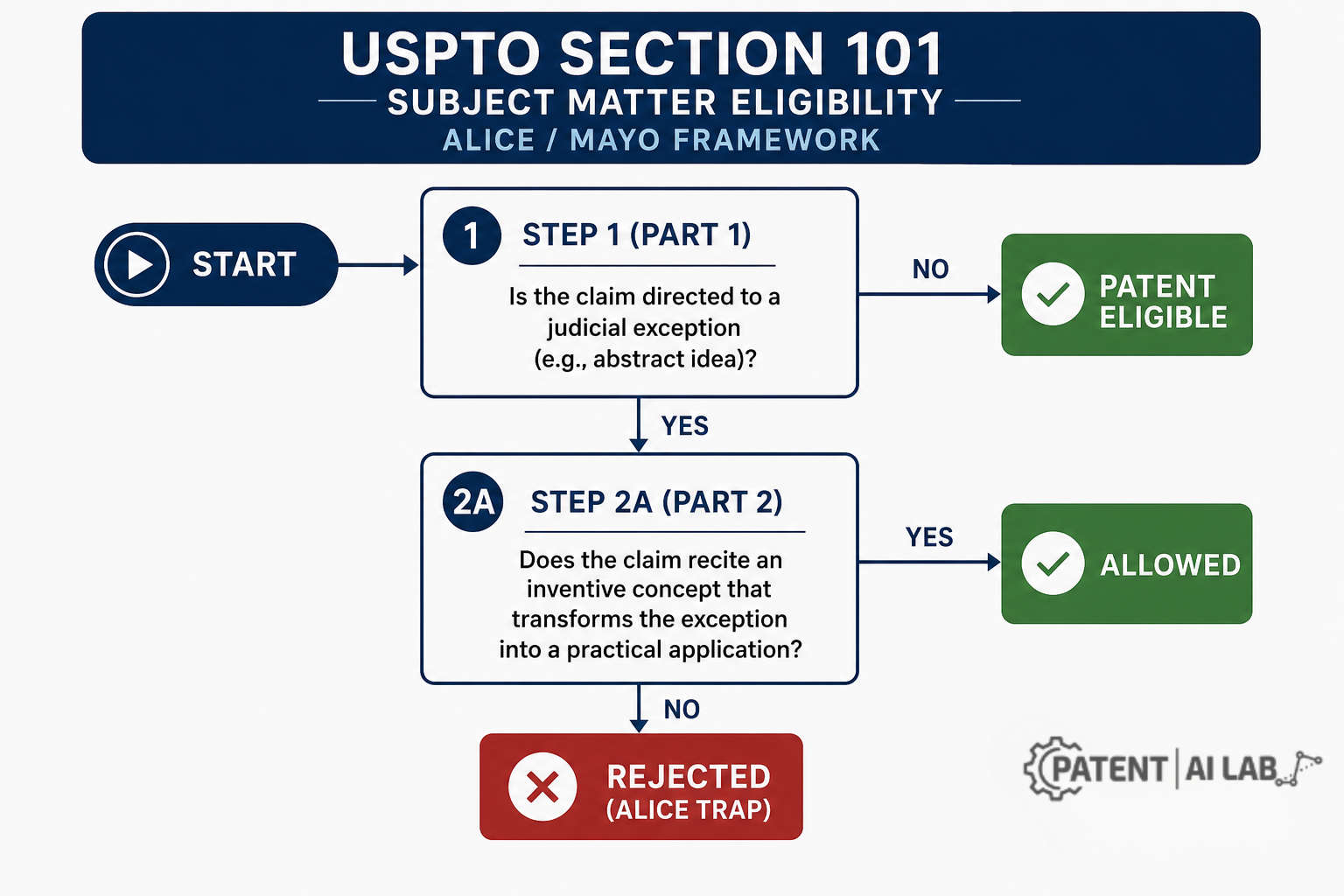
The framework itself proceeds in two steps, per USPTO guidance: Step 1 asks whether the claim falls within a statutory category (process, machine, manufacture, or composition of matter) and, if directed to a judicial exception such as an abstract idea, whether the claim as a whole nonetheless integrates that exception into a practical application. Step 2 asks whether the claim, considered as an ordered combination, includes an element or combination of elements sufficient to ensure the claim amounts to significantly more than the judicial exception itself. Readers evaluating a specific application against this framework should consult the USPTO’s Manual of Patent Examining Procedure, which contains the operative sections (2103 through 2106.07) implementing this guidance, and qualified patent counsel directly, rather than relying on this or any secondary summary.
AI-Assisted Circuit Compilation and Inventorship
Using AI tools to help design or compile quantum circuits raises an inventorship question. Current USPTO guidance requires a human inventor; AI-generated output on its own cannot be listed as an inventor or hold patent rights. This has become a live issue specifically in quantum compilation, where AI-assisted tools are increasingly used to search the very large space of possible gate orderings for a given circuit. The USPTO’s 2024 patent eligibility guidance update addressing artificial intelligence is the current reference point for how the office is approaching AI-assisted inventions generally, and the eligibility considerations discussed above apply here as well. As with the rest of this section, this is offered as background rather than as guidance for drafting a specific claim. Founders working in this area should raise inventorship and eligibility questions with patent counsel early, before an application is drafted, rather than after.
Outlook Toward 2030
Beyond the current filing data, this race highlights a few structural trends worth tracking as the field matures.
- Enforcement activity may increase as fault-tolerant hardware approaches commercial viability. Companies holding foundational patents in error correction and qubit architecture will have stronger grounds to license or litigate as the addressable market grows. This is a directional expectation based on typical patent lifecycle behavior in maturing technology sectors, not a specific forecast.
- Divergent technology stacks are plausible given China’s communications-infrastructure focus and the US’s computing-and-cloud focus. Companies operating in both markets should expect to navigate two different regulatory and IP environments rather than one unified global standard, at least in the near term.
- Quality signals matter more as the field consolidates. Forward citation counts, claim character (foundational chemistry or hardware vs. downstream application), and continuation filing activity are all more informative than raw filing counts when evaluating a specific company’s actual IP position.
Reading Patent Data Alongside Other Signals
Patent filing and family data is one input among several for anyone evaluating a company’s technology position, including analysts, corporate development teams, and prospective licensees. Raw patent counts in isolation, without international family data, citation context, or claim-level review, provide limited signal. Cross-referencing a company’s public disclosures, verified international family counts, and technology-specific citation impact gives a more complete picture than any single number. This is general informational framing, not investment advice, and should not be used as the basis for a financial decision.
Podcast
Note: This audio is a condensed intelligence brief. Please review the specific metrics above for granular patent data.
FAQs
Why is international patent filing so much more expensive than domestic filing?
Protecting a single invention across multiple major offices, such as the USPTO, EPO, and JPO, means paying separate filing, translation, and local counsel fees at each office, which typically runs several times the cost of one domestic filing. That cost structure is why an international filing is read as a stronger commercial signal than a domestic one: applicants only pay the multiple when they expect the invention to have value in that market, which is why the international-family data in this article carries more weight than raw filing counts.
Can an AI tool be listed as the inventor on a quantum patent?
No. Current USPTO guidance requires a human inventor, so output generated by an AI tool cannot be listed as an inventor or independently hold patent rights. This has become a live issue in quantum circuit compilation specifically, where AI-assisted tools are increasingly used to search large spaces of possible gate orderings, and it is a question founders working in this area should raise with patent counsel before drafting an application.
Who are the top quantum computing patent holders in 2026?
IBM, Google, Microsoft, and Intel are consistently identified as leading US assignees across MIT, QuIC, and QED-C data. Origin Quantum and Baidu are consistently identified as leading Chinese assignees. Toshiba and NEC of Japan are significant global players, particularly in communications and international family filings.
Why does China lead in Quantum Communications (QKD)?
China has treated Quantum Key Distribution as a strategic priority, backed by state-directed funding that financed large-scale infrastructure including the Beijing-Shanghai quantum backbone and the Micius satellite program. QED-C’s independent analysis confirms the Chinese patent office has issued more quantum communications patents than any other national office. A specific percentage share of QKD-related international patent families circulates in some secondary sources but does not appear in QuIC’s published report and should not be cited as sourced.
How reliable are patent counts as a measure of quantum leadership?
Patent counts are one useful signal among several. Filing volume, international family counts, forward citation impact, and claim character each answer a different question. A complete assessment of a country’s or company’s quantum IP position should weigh all of these together rather than relying on a single figure, and readers should verify any specific statistic against the named primary source before treating it as settled.
Sources and Legal References
The patent metrics and IP data points in this article are drawn from the following primary sources. Each was checked directly during this revision, and each link below points to the specific report page or document containing the cited figures.
-
1. MIT Quantum Index Report 2025
Source for China’s 60% share of global quantum technology patent filings in 2024 and the 2014–2024 growth trajectory (42% to 60%). Produced jointly by the MIT Initiative on the Digital Economy and Accenture Research.
Review MIT Quantum Index Report (Full PDF) -
2. QuIC White Paper — A Portrait of the Global Patent Landscape in Quantum Technologies (2025 edition)
Source for international patent family assignee rankings in both quantum computing and quantum communications, and for the 7%/49% China/US international-family relative weight figures cited in this article (Table 3, page 10).
Review QuIC White Paper (Full PDF) -
3. QED-C — State of Quantum Industry Innovation: What Patents Tell Us
Independent analysis cross-checking QuIC’s methodology; source for national patent office rankings by segment (US leads computing, China leads communications) and for assignee-level corroboration.
Review QED-C Analysis -
4. USPTO — Subject Matter Eligibility Guidance
Source for the two-step Alice/Mayo eligibility framework described above, including the 2024 AI-focused update referenced in the inventorship section. Readers evaluating a specific claim should consult this guidance directly and with qualified patent counsel.
Review USPTO Eligibility Guidance
Disclaimer & Legal Notice
This article reflects an editorial review of publicly available patent metrics, corporate intellectual property strategies, and publicly available USPTO subject matter eligibility outcomes. It is intended for informational and educational purposes and does not constitute legal or financial advice, and should not be used as the basis for an investment or filing decision, or as a guide for drafting or structuring any patent claim. It is not a substitute for the counsel of a qualified, licensed intellectual property attorney. Patent eligibility standards, particularly regarding software and Section 101, change frequently, and any specific claim or application should be developed and evaluated by qualified patent counsel before filing, not on the basis of this or any other secondary summary. Always consult qualified legal counsel before drafting claims or initiating patent prosecution, and verify any statistic in this article against its named primary source before relying on it.





Add comment