


 Golam Rabiul Alam, PhD
Editorial note: The content on this website is provided for informational and educational purposes only and does not constitute professional legal, financial, or technical advice. See disclaimer below.
SaaS founders and spatial developers are operating under a dangerous assumption: that the next generation of computing is a free market. It is not. In 2026, Apple, Samsung, and Meta are each building distinct IP control stacks around digital space, and those stacks overlap in ways that predate any individual product decision a developer makes. If you write an app that relies on intuitive gaze-and-pinch selections or sub-millimeter hand tracking, you are building on top of a complex cross-licensing environment where standard NDAs offer limited structural protection against systemic IP overlaps — an NDA governs confidentiality between two contracting parties, but it has no bearing on whether your implementation happens to collide with a granted patent held by a company you’ve never signed anything with. This is a technical and analytical breakdown of the Apple Vision Pro vs. Samsung XR patent landscape: how each company’s filings are structured, where they concentrate, and why the contest over human interaction primitives is shaping who controls the next computing platform.
At A Glance
This guide walks through the spatial computing patent landscape in four parts: how patents are layered by technical function, how each company defends its position within that stack, three specific technology battlegrounds worth tracking, and what the landscape means practically if you’re building spatial software.
🍎 Section 1–2: The patent stack itself, and how Apple’s gaze-plus-pinch claims are structured.
🤖 Section 3: How Samsung and Google built a defense around open standards instead of matching Apple filing-for-filing.
♾️ Section 4–6: Meta’s separate EMG input layer, the display and NPE battlegrounds, and what it means for founders shipping spatial UI.
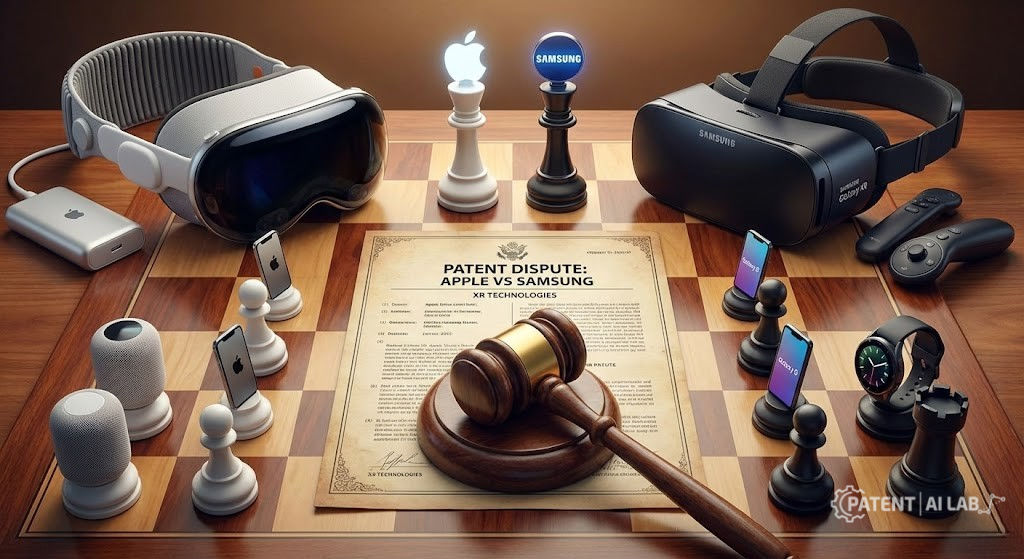
The transition from 2D screens to 3D space is the single biggest shift in personal computing since the smartphone. By 2026, the early-adopter phase has ended, and the fight over foundational interaction patents has begun in earnest. With the Apple Vision Pro (M5 model) on the market and the global rollout of the Samsung Galaxy XR complete, the industry has split into distinct philosophical and legal camps. For founders, investors, and IP strategists, the operative question is: who actually holds the strongest claims to how we interact with digital content in physical space, and what does that mean for anyone building on top of these platforms?
The 2026 Market Snapshot: Context for the Conflict
To understand the legal maneuvering, ground yourself in the hardware reality first. Patent strategy follows product release cycles, not the other way around.
The Samsung Galaxy XR’s October 2025 launch — the first device built on Android XR, co-developed with Google and Qualcomm — marked the first time a high-volume, ecosystem-backed competitor entered the field alongside Apple’s Vision Pro at commercial scale. Samsung’s own product announcement confirms the device runs on Qualcomm’s Snapdragon XR2+ Gen 2 chipset with Gemini integrated at the system level. That launch is what makes a direct comparison of the two companies’ patent portfolios possible for the first time outside of prototype-stage speculation.
How Spatial Computing Patents Are Actually Structured: The Patent Stack
No single company owns “spatial computing” as a category. Patent claims must be specific: a claim cannot simply cover “moving windows with hands.” It has to describe how a sensor detects the hand, how software interprets intent from that raw signal, and how the display renders the result in response. That specificity is why the real fight is fought layer by layer, not as one blanket claim over the whole interaction model.
1. The Interaction Layer: Why Gaze-Plus-Pinch Is the Most Contested Mechanic
This is the most visible and actively contested layer of the stack. Every claim discussed in this section is drawn from published filings searchable directly through the USPTO Patent Public Search database — the same tool referenced later in the Freedom-to-Operate section of this article — rather than from secondhand reporting.
- Apple’s “Look and Click”: Apple’s approach centers on the specific choreography of using eye-tracking to identify a target and a micro-gesture (pinch) to confirm it. Rather than protecting the pinch as an isolated motion, Apple’s filings in this space describe a structural system: defining detection “zones” around the fingers so the sensor can distinguish an intentional pinch from incidental finger movement, reducing false-positive selections. That structural framing — not the raw gesture — is what makes the claim defensible.
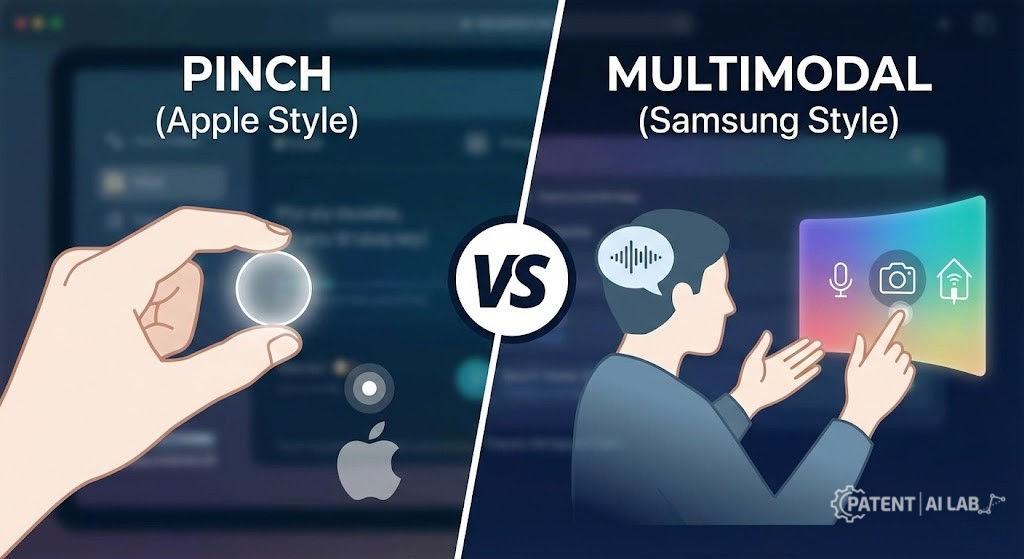
- Samsung’s Response: To reduce direct exposure to that claim structure, Samsung emphasizes “Multimodal Input.” Rather than relying solely on a pinch, the Galaxy XR system blends gaze, voice commands, and distinct hand poses — an open palm, a pointing gesture — that sit outside the specific zone-detection language Apple’s claims use. Samsung’s official product announcement confirms this design principle directly: Gemini is integrated at the system level to make natural voice interaction a primary interface layer, not a secondary fallback triggered only when gesture recognition fails.
Utility patents protect the operational system, but protecting the visual layout is a separate and equally important track. Learn how to secure your interface look in our guide on How to File a Design Patent for Mobile App UI (Cost & Strategy).
2. The Sensing and Mapping Layer: Where Sensor Fusion Patents Concentrate
- The Tech: Simultaneous Localization and Mapping (SLAM) is how a headset tracks its own position inside a room in real time, updating many times per second as the wearer moves.
- The Conflict: This layer is dense with competing IP. Apple uses a custom R1 chip to process sensor data with near-zero latency. Samsung relies on Qualcomm’s Snapdragon XR2+ Gen 2 chipset for the equivalent workload. The contest here centers on sensor fusion — specifically, how camera-array data is combined with accelerometer data to keep motion-to-photon latency low enough that it doesn’t trigger perceptible motion sickness in the wearer.
3. The Display and Optics Layer: Samsung’s Manufacturing Leverage
- The Tech: The Micro-OLED display market is fiercely competitive among a small number of panel suppliers capable of hitting the pixel densities spatial hardware requires.
- The Conflict: Apple holds patents on “pancake lens” assemblies that fold light to reduce headset bulk. Samsung Display, meanwhile, is a major OLED panel supplier in its own right. Following its acquisition of eMagin, Samsung holds Direct Patterning (dPd) OLED patents that Apple’s hardware roadmap depends on — a supply-chain leverage point that shapes how aggressively Apple can pursue display-layer disputes with Samsung without jeopardizing its own component access.
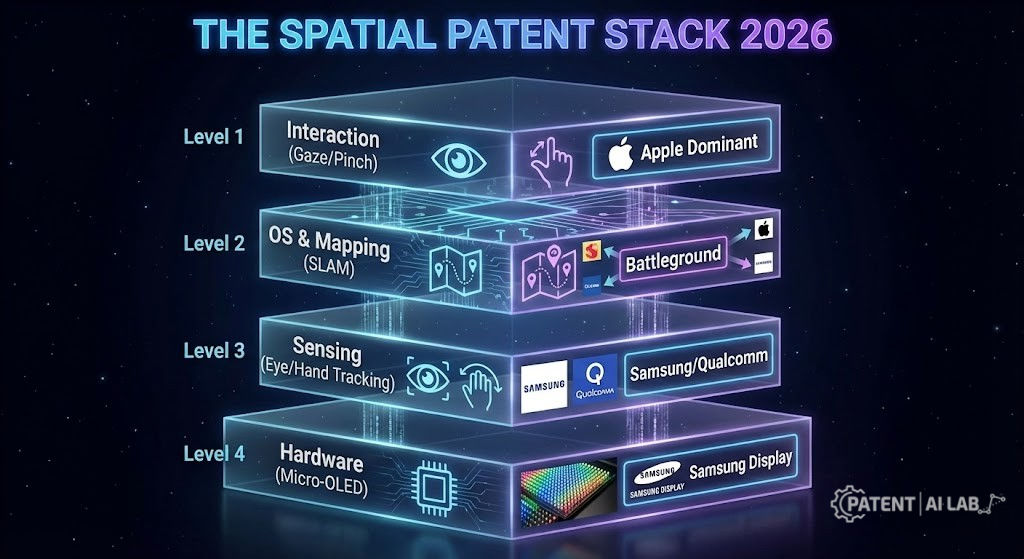
Apple’s Patent Position: How the Gaze-Plus-Pinch System Creates a Structural Advantage
Apple’s position in this layer is the result of a deliberate, decade-long IP roadmap built around one goal: interlocking patents covering the most natural interaction primitives, so that competitors face a binary choice between licensing Apple’s approach or designing something structurally different — and, in most cases, less intuitive.
Why the Pinch Matters as Much as Multitouch Did for the iPhone
Apple recognized early that gaze-and-pinch would likely become the default interaction primitive for spatial operating systems, the same way pinch-to-zoom became default on touchscreens.
- Gaze Targeting: Apple’s eye-tracking patents cover concepts like “dwell time” (how long a user must look at a UI element before intent registers) and techniques to filter out jittery, involuntary eye movements — saccades — that would otherwise produce false selections if left unfiltered.
- The Commit Action: The structural advantage isn’t the tracking itself; it’s the confirmation framework. Apple’s claims cover the specific timing window between the eye settling on an interactive object and the finger sensors confirming contact — a patented system state that’s architecturally difficult to replicate without redesigning the underlying detection pipeline from scratch.
Why Competitors Can’t Simply Replicate the visionOS Experience
Competitors can source eye-tracking sensors from the same hardware supply chain Apple uses — that part isn’t exclusive. The architectural problem is replicating the responsive feel of visionOS without colliding with Apple’s specific timing thresholds and sensor-fusion claims. That constraint pushes the Samsung alliance toward one of two paths: negotiate licensing terms, or build structurally different UX workflows that don’t depend on the same timing architecture. That’s the practical reason Galaxy XR leans on voice and multimodal input as its primary differentiator rather than shipping a direct gaze-pinch equivalent.
Why the Algorithm Isn’t Patentable — But the System Around It Is
Spatial developers in 2026 frequently use AI tools to scaffold gesture-recognition logic quickly. It’s worth understanding why that raw code isn’t the patentable asset — the integrated hardware-software system architecture around it is.
# Simplified illustration of a threshold-based pinch check.
# This isolated logic is not patentable on its own — it's basic
# coordinate math. What Apple's claims cover is the surrounding
# system: dynamic threshold adjustment tied to real-time head
# movement speed, and the timing window between gaze-lock and
# finger-contact confirmation.

def detect_interaction(eye_vector, hand_landmarks, head_angular_velocity):
    target = raycast(eye_vector)

    thumb_tip = hand_landmarks['thumb_tip']
    index_tip = hand_landmarks['index_tip']
    distance = calculate_distance(thumb_tip, index_tip)

    # A static threshold like this is unremarkable math.
    # The claimed system instead scales the threshold based on
    # how fast the user's head is moving — a fast head turn
    # widens the tolerance window to avoid missed selections,
    # while a still head tightens it to avoid false positives.
    dynamic_threshold = base_threshold(head_angular_velocity)

    if distance < dynamic_threshold and target.is_valid():
        if within_gaze_lock_window(target, eye_vector):
            return execute_click(target)
Key takeaway: You cannot patent the pure math of coordinate distance. What is defensible is a physical system that adjusts that distance threshold dynamically based on the user’s real-time head movement speed, combined with a specific timing relationship to gaze data. That structural link — hardware state feeding software response, on a defined timing basis — is where a legally defensible claim actually lives, not in the underlying arithmetic.
This distinction matters practically, not just academically. A developer who reads Apple’s public interaction patents and concludes “the pinch-detection math itself is protected” will often over-restrict their own implementation, avoiding basic distance calculations that were never the protected element in the first place. Conversely, a developer who assumes “it’s just math, so nothing here is patentable” can walk straight into the actual claim by replicating the dynamic-threshold-plus-timing-window system, even while using completely different variable names and code structure. Patent claims attach to the described system architecture as filed, not to any particular implementation’s syntax — rewriting the code differently doesn’t change whether the underlying system matches a claim. That’s precisely why a patent landscape review has to read the claims themselves rather than infer scope from a product’s marketing description.
Because raw software algorithms face real patent-eligibility hurdles under the Alice/Mayo framework, many software founders lean on trade secret protection instead of patents for their core logic. Read our analysis on Patents vs Trade Secrets for AI: How to Stop Model Theft to weigh which protection framework fits your codebase.
The Challenger Alliance: How Samsung and Google Built a Defense Without Duplicating Apple’s Patents
Apple’s position functions as a defensive fortress. The Samsung-Google alliance took a different approach for Galaxy XR: rather than trying to out-file Apple patent-for-patent, they built around the open standard itself.
The Open Standard Defense: How OpenXR Limits Litigation Exposure
Samsung and Google anchor their controller inputs and hand-tracking matrices to OpenXR, the open standard framework managed by the Khronos Group. Samsung’s Galaxy XR product documentation confirms the device is “built on OpenXR standards,” designed to scale across form factors from headsets to AI glasses rather than being locked to one hardware silhouette. The full specification, including the classification codes referenced later in this article, is published at Khronos’s OpenXR registry for anyone who wants to verify the claim structure directly rather than taking a secondhand summary of it.
- Strategic Benefit: By anchoring interaction inputs to a published open standard, Samsung and Google build a prior-art defense. If Apple were to pursue litigation over a gesture that forms part of the published OpenXR specification, Apple would risk its own claims being tested against that same published prior art. The open standard functions as a legal shield as much as a technical one — it’s not just about interoperability.
The Multimodal Workaround: Voice, Vision, and Gesture as Structural Strategy
Samsung deliberately decentralizes user input, treating “Voice, Vision, and Gesture” as roughly equal-weight input modalities rather than a strict hierarchy topped by gesture. Gemini AI runs at the system level, making voice commands a primary selector rather than a fallback. By making voice a dominant interaction layer rather than a secondary one, Galaxy XR reduces its direct overlap with Apple’s camera-and-gesture patent portfolio — not by avoiding gesture entirely, but by not depending on it as the sole path to selection.
Google’s Prior Art Portfolio: Visual Search as Cross-Licensing Leverage
Google has been accumulating AR and VR patents since the early Google Glass and Daydream era, and that older portfolio now serves a specific strategic function in the current landscape.
- Search and Overlay: Google holds significant IP in visual search architectures — specifically, identifying physical objects in a camera feed and dynamically overlaying context-aware data panels on top of them. That’s a foundational capability for essentially any mixed reality operating system, not just Google’s own.
- Cross-Licensing Dynamics: There is no major public injunction halting shipments between Apple and Google in 2026. What appears to be happening instead, based on the absence of litigation despite clear technical overlap, is a proxy negotiation: Google’s dominant visual-search portfolio functions as leverage in cross-licensing discussions around Apple’s interface patents, which tends to discourage either side from trying to use patents as a pure market-exclusion tool.
The Wild Card: Meta’s EMG Wristband and Why It Sidesteps Both Patent Stacks
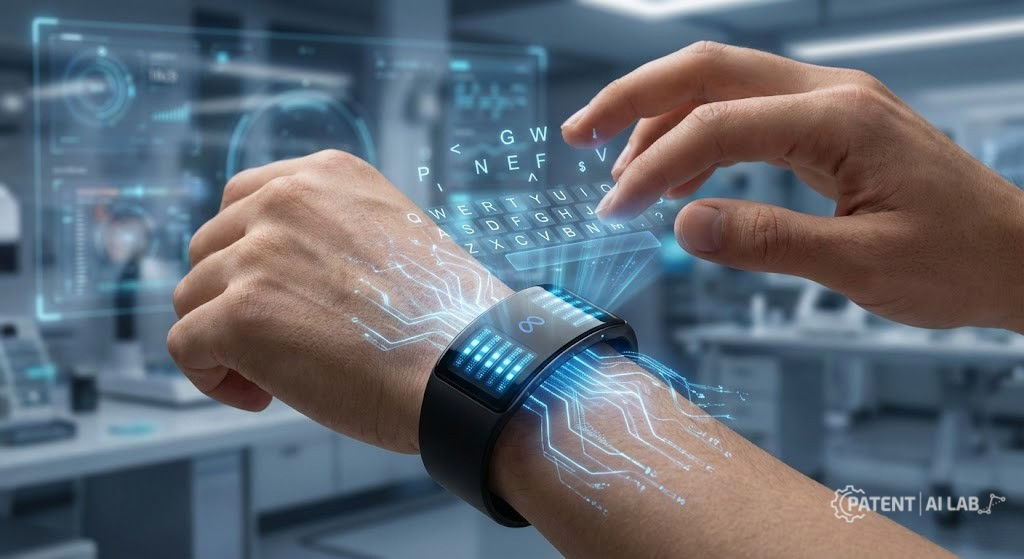
While Apple and Samsung compete over headset tracking architectures, Meta is executing a different maneuver entirely with Orion and its EMG Neural Band.
Neural Band: Reading Motor Intent Before the Hand Moves
Meta appears to have concluded early that it couldn’t win a camera-only tracking contest against Apple’s custom silicon. Instead of competing on that ground, it moved the entire input detection point: from camera-visible gestures happening in open space, to neural signals detected at the wrist before a gesture is even visible.
- EMG (Electromyography): Meta’s 2019 acquisition of CTRL-labs, a neural interface startup, gave it a foundational patent portfolio covering the reading of motor neuron signals directly through wrist-mounted electrodes. Meta’s Reality Labs published peer-reviewed research on this technology in Nature in July 2025, which is a meaningfully stronger evidentiary anchor than a product announcement alone, since the underlying data and methodology went through independent peer review rather than only appearing in a corporate blog post.
- The Core Advantage: An EMG Neural Band registers the bioelectric intent to move a finger milliseconds before the hand physically shifts. That timing gap enables micro-gestures a camera simply cannot see — including confirmed selections made with the hand resting at the user’s side, or even inside a pocket.
- IP Implication: This architecture sits entirely outside Apple’s camera-reliant spatial gesture claims, because there’s no camera involved at all. Meta effectively owns this alternate input layer on its own, with the CTRL-labs portfolio providing the foundational coverage to defend it.
Three Technology Battlegrounds Spatial Developers Should Track
1. Micro-OLED Display IP: Why Panel Supply Chain Patents Create Leverage
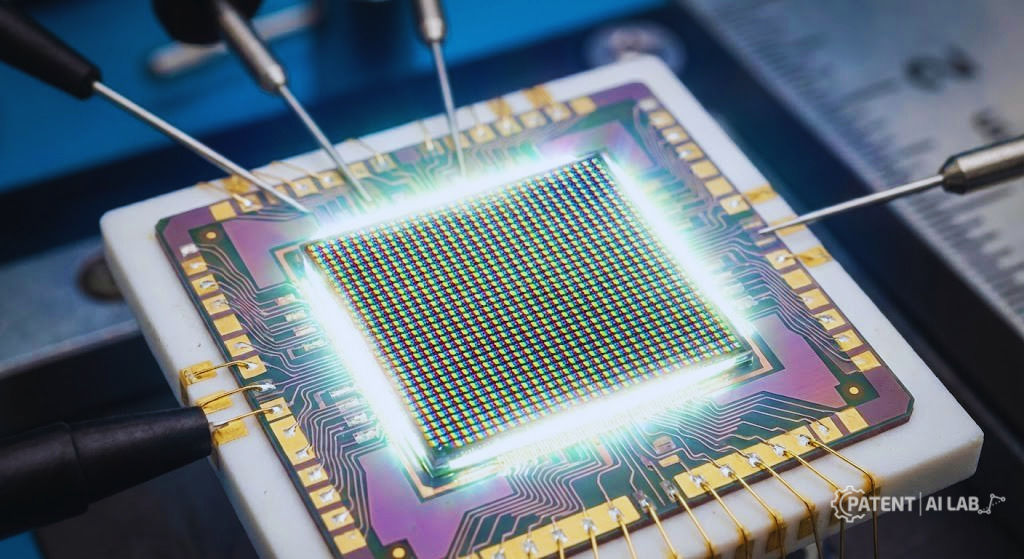
Display fidelity in 2026 spatial hardware depends on Micro-OLED (OLEDoS) technology. Key patent holders in this space include Sony, LG Display, and Samsung Display via its eMagin acquisition.
As panel densities push past 4,000 PPI, patents covering pixel node layouts and thermal dissipation start functioning as real operational bottlenecks rather than abstract IP concerns. Samsung’s eMagin acquisition brought Direct Patterning (dPd) OLED patents into its portfolio, leaving Apple structurally dependent on external suppliers for this component — a supply chain vulnerability that limits how aggressively Apple can pursue display-layer disputes with Samsung without risking its own access to critical components.
2. Eye-Tracking and Foveated Rendering: A Crowded NPE Battleground
Apple’s software-level eye tracking is highly optimized, but the hardware execution of foveated rendering — rendering higher detail only where the eye is actually looking — sits in a genuinely crowded patent arena. Companies like Tobii hold deep patent footprints here from years of dedicated eye-tracking hardware development. Both Apple and Samsung face recurring legal friction from Non-Practicing Entities (NPEs) that acquired foundational eye-tracking IP from the early 2010s and now use it for licensing enforcement rather than product development.
3. Video Passthrough and View Synthesis: How Patent Divergence Shapes Product Architecture
Real-time, distortion-free video passthrough is essential for spatial immersion, but camera arrays naturally introduce edge warping that has to be corrected. Apple’s patent coverage in this area centers on “View Synthesis” — mapping techniques that synthesize clean perspective angles from imperfect camera input.
Samsung takes a different technical path, using algorithmic “Depth Reprojection” processing instead. That divergence isn’t a coincidence of separate engineering teams reaching different answers — it’s a direct byproduct of needing to avoid colliding with Apple’s specific claim language. In this case, and in several others across the stack, product architecture is being shaped by IP strategy as much as by pure engineering preference.
What This Patent Landscape Means for Founders and Spatial Developers
How Patent Analytics Identify Technical Overlaps Before You Ship
For spatial SaaS teams deploying software on visionOS or Android XR, understanding the existing patent landscape is a practical technical exercise, not a legal formality to skip. Writing custom app-level code that introduces a unique hardware gesture shortcut carries a real probability of technical overlap with an existing platform utility patent. Sticking to the standard interaction primitives the host OS already provides is the lowest-overlap path. Departing from those defaults to build a custom UX gesture is a decision worth mapping against the existing patent landscape before committing engineering time to it.
Below is a starting-point query structure for scoping that kind of overlap analysis in Espacenet, the European Patent Office’s free public database, for the interaction class most relevant to gesture-based spatial UI:
# Starting-point patent landscape query (Espacenet)
# Use this structure to identify active utility patents covering
# gaze-based interaction + gesture confirmation systems as a
# preliminary technical overlap check.

# Espacenet Search (https://worldwide.espacenet.com/patent/search)

# CPC Classification code for spatial interaction input:
CPC = "G06F3/017"  # Pointing devices — gesture-based interaction

# Combine with applicant filter and date range:
QUERY = 'CPC="G06F3/017" AND PA="Apple" AND PRD=[20230101 TO 20251231]'

# Repeat the same query structure for:
#   PA="Samsung Electronics"
#   PA="Meta Platforms"
#   PA="Microsoft"

# Key claim terms worth flagging during full-text review:
#   "gaze" AND "pinch" AND "confirmation"
#   "eye tracking" AND "gesture zone" AND "threshold"
#   "sensor fusion" AND "latency" AND "spatial"

# Output: list of active patent families by applicant.
# A useful heuristic: any result with more than 50 forward
# citations is likely sitting near a chokepoint claim and
# warrants closer review before you build around it.
This is a starting-point search structure for your own preliminary research, not a substitute for a formal Freedom-to-Operate opinion from qualified patent counsel. Review our breakdown of US vs UK Software Patent Cost Analysis to help structure your own defensive capital allocations. This section is for educational and informational purposes only and does not constitute legal advice. Consult a qualified patent attorney before making any filing or freedom-to-operate decisions specific to your product.
The forward-citation heuristic in that query structure is worth understanding rather than just running blindly. A forward citation is when a later patent cites an earlier one as prior art or foundational technology — it’s a proxy for how central a given claim has become to everything filed after it. A patent with 50-plus forward citations in a narrow interaction category isn’t just old; it’s likely load-bearing for a large share of what competitors have since had to design around. That’s a meaningfully different signal than a patent with zero forward citations, which may simply be unenforced, narrowly scoped, or superseded by a better filing from the same company. Reading citation density alongside claim language, rather than claim language alone, is what turns a raw search result list into something you can actually prioritize a legal review around.
Analytical Implications by Role: What the IP Landscape Signals for Different Stakeholders
For analysts and industry observers tracking this transition, the current patent landscape points to where structural advantages are shifting across the supply chain. These are directional observations drawn from publicly available IP filing patterns and product disclosures — not financial forecasts, and not a basis for investment decisions.
- Near Term: Upstream supply chain companies holding critical manufacturing patents in the Micro-OLED and foveated optics layers occupy a structurally advantaged position, because both major headset manufacturers depend on panel IP neither of them fully controls in-house.
- Longer Term: Neural-interface hardware architecture looks like the next foundational IP layer. EMG wristband technology, already shipping in consumer form via Meta, shifts the interaction paradigm from camera-visible gestures to bioelectric signals — a domain where Apple and Samsung’s existing camera-based patent stacks currently have no direct coverage at all.
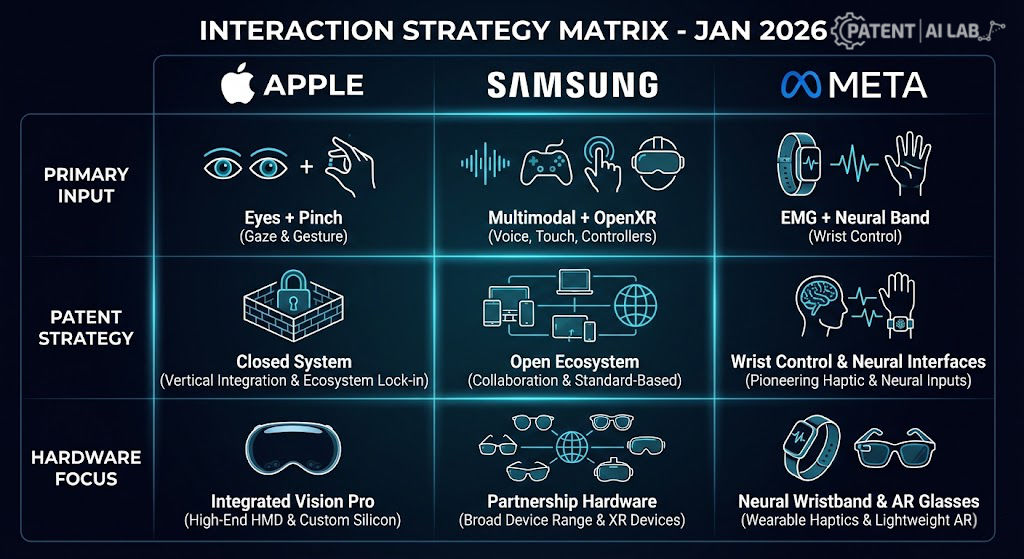
Verdict 2026: Who Controls Which Layer
The spatial computing IP contest has produced a divided landscape rather than one dominant ecosystem:
- The Interaction Layer (Apple): Apple holds the strongest position on the premium gaze-and-pinch interaction framework. The patent thicket around this mechanic pushes competitors toward structurally different input approaches rather than direct replication.
- The Ecosystem Layer (Samsung/Google): This alliance controls the open-standard defense. By anchoring Android XR to OpenXR and leveraging Google’s visual-search prior art, they’ve constrained how effectively Apple can use litigation to lock enterprise developers into a closed platform.
- The Neural Input Layer (Meta): Meta controls the EMG input architecture largely on its own. While its competitors optimize tracking cameras, Meta’s CTRL-labs portfolio covers a direct connection to the user’s neuromuscular system — a layer current optical-gesture patents simply can’t reach.
Podcast
Note: This audio is a condensed intelligence brief. Review the matrix charts above for granular patent claim data and technical workarounds.
FAQs
If I already use voice or pose-based input instead of pinch, am I automatically safe from Apple’s claims?
Not automatically. Avoiding the pinch gesture removes exposure to that specific claim family, but it doesn’t clear you from Apple’s broader eye-tracking patents if your app also uses gaze targeting with any confirmation mechanic — voice-confirmed or otherwise. A useful practical test: if your interaction still depends on a defined timing relationship between where the user is looking and when a selection commits, run that specific mechanic through a patent search rather than assuming voice-only input is a blanket safe harbor.
Why hasn’t Apple sued Samsung or Google over XR patents yet, given the overlap?
Litigation is expensive and slow relative to how fast this hardware category is moving, and an injunction risks inviting a countersuit using the other side’s own portfolio — Google’s visual-search patents in particular give it leverage Apple would rather not test in court. There’s also a practical incentive on both sides to keep the category growing before carving it up through litigation; a public patent war tends to spook enterprise buyers and developers away from the entire platform, not just the losing side.
Does the Galaxy XR’s OpenXR foundation mean any app built for it will also run on other OpenXR headsets?
Not automatically — OpenXR standardizes the underlying input and rendering APIs a headset exposes, not the full application layer. An app built against OpenXR primitives has a real head start on cross-headset compatibility compared to one built against a proprietary SDK, but platform-specific UI conventions, performance tuning, and store requirements still typically need per-platform work before something built for Galaxy XR runs cleanly on a different OpenXR device.
If Samsung’s display division holds key Micro-OLED patents, could Samsung use that leverage against Apple outside the display market?
In principle, cross-licensing leverage in one domain can factor into negotiations in an adjacent one — that’s part of why supply-chain patent positions matter strategically, not just commercially. In practice there’s no public evidence Samsung has used its OLED leverage as a bargaining chip specifically in interaction-layer negotiations; the more visible dynamic is Apple’s dependency shaping how aggressively it pursues display-layer disputes, not Samsung actively wielding the leverage elsewhere.
Could a company build EMG wristband technology without licensing Meta’s CTRL-labs patents?
Possibly, depending on how narrowly Meta’s claims are scoped — EMG as a sensing technique predates CTRL-labs by decades in medical and prosthetic device research, so the patentable ground is specifically in how Meta’s system interprets and maps those signals to discrete gesture intents, not in EMG sensing itself. A competitor building a wrist-worn EMG product would still need a claim-by-claim review against Meta’s specific signal-interpretation patents, not just a general assumption that EMG as a category is open.
Sources and Legal References
The hardware specifications, corporate alliance structures, and patent claim analysis in this guide are anchored to active intellectual property filings and verified industry disclosures:
-
1. USPTO Patent Public Search
Foundational utility patent database for verifying Apple gaze-and-gesture frameworks, including spatial computing filings covering eye-tracking synchronization, gesture zone architectures, and sensor fusion configurations.
Search USPTO Patent Center -
2. Khronos Group — OpenXR Specification Repository
The open, royalty-free standard specification used by Google, Samsung, and Qualcomm to develop universal hardware interaction boundaries and defend against closed-ecosystem patent claims. Samsung’s Galaxy XR product announcement confirms it is “built on OpenXR standards.”
Review OpenXR Technical Standards -
3. Samsung Newsroom — Galaxy XR Official Launch Announcement
Official Samsung product disclosure confirming the Galaxy XR launch date (October 21, 2025 US / October 22 Korea), price ($1,799), Qualcomm Snapdragon XR2+ Gen 2 chipset, Gemini AI system-level integration, and OpenXR platform architecture.
Review Samsung Galaxy XR Launch Announcement -
4. Meta Reality Labs — sEMG Wristband Research (Nature, July 2025)
Meta’s official blog summarizing peer-reviewed research published in Nature on surface electromyography (sEMG) neural wristband technology, confirming the CTRL-labs acquisition origin and current research status of wrist-based neural interface patents.
Review Meta sEMG Research Announcement -
5. Espacenet — European Patent Office Free Patent Search
Free public patent search database covering global patent families. Used for scoping preliminary technical overlap queries under CPC class G06F3/017 (gesture-based interaction), as described in the FTO section of this article.
Access Espacenet Patent Search
Disclaimer & Legal Notice
This article reflects the author’s technical and analytical evaluation of hardware specifications, spatial operating systems, and active utility patent frameworks. It is intended strictly for informational and educational purposes and does not constitute formal legal advisory services. It is not a substitute for the advice of a qualified, licensed intellectual property attorney. Spatial computing precedents, cross-licensing arrangements, and platform terms of service change frequently. Always consult certified legal counsel before making any freedom-to-operate, filing, or commercial deployment decision that depends on these hardware ecosystems.





1 comment