


 Golam Rabiul Alam, PhD
At A Glance: The 2026 Battle for Input
If you look closely at the neuralink vs meta 2026 rivalry, it is clear they are not fighting over a single “mind control” patent; they are constructing two entirely different technological moats. The real battle is not about reading complex thoughts, but about owning the signal-processing pipelines that decode human intention into digital commands.
- 🧠 Neuralink’s Moat: Building a medical fortress around invasive implants and surgical robotics to treat severe neurological conditions. Dominates in raw bandwidth and precision.
- ⌚ Meta’s Moat: Executing a consumer land-grab with non-invasive EMG wristbands designed to control Augmented Reality (AR) glasses. Poised to win the mass market through lower adoption friction.
Key Takeaways
- The Patent Myth: No company owns a patent for “Mind Control.” The USPTO only grants rights for specific technical implementations, like sensor architectures, noise-cancellation algorithms, and calibration loops, not the abstract idea of predicting intent.
- Neuralink’s Moat (The Fortress): Focuses on the “Input Problem” at the biological source. Their patents cover the N1 implant, the R1 surgical robot, and high-density electrode threads, creating a high barrier to entry that prioritizes medical capability over consumer scale.
- Meta’s Moat (The Land-Grab): Focuses on “Interaction Friction.” By utilizing CTRL-Labs technology, Meta’s patents cover wrist-based Electromyography (EMG) to decode motor signals, aiming to make the “neural click” the standard input for smart glasses.
- The Privacy Trade-Off: The biggest risk isn’t telepathy, but behavioral profiling. Patent analysis reveals that while Neuralink requires deep medical data, Meta’s wristbands could potentially track subconscious nervous system responses (stress, hesitation) for ad targeting.
- The 2026 Verdict: If “winning” means restoring human capability (e.g., curing paralysis), Neuralink leads. If “winning” means replacing the mouse and keyboard for billions of users, Meta holds the winning hand with its scalable, non-invasive approach.
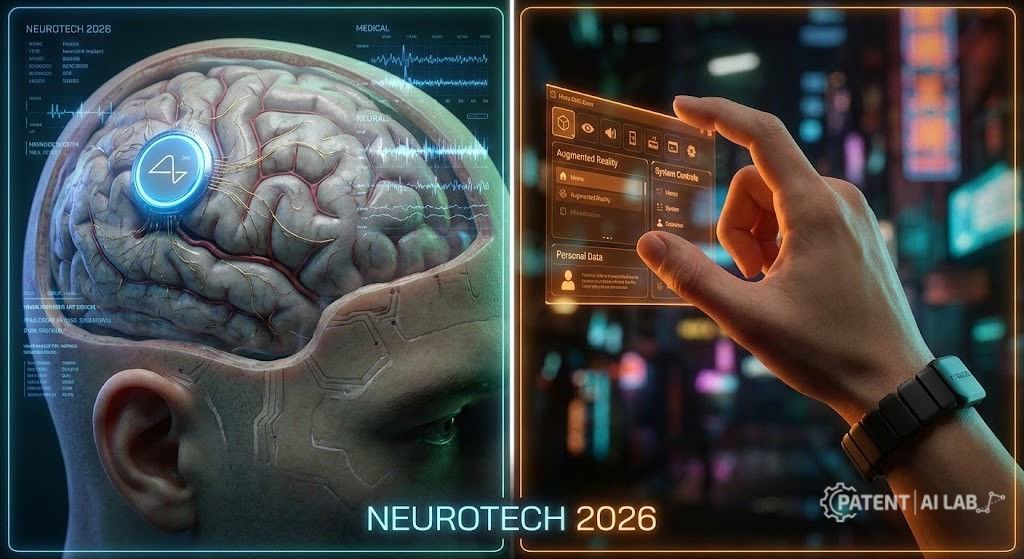
The Death of the Touchscreen
Imagine it is late 2026. You are walking down a busy street in New York or Dhaka. You see someone staring intently at a virtual display floating in the air through their Ray-Ban smart glasses. Their hands are in their pockets. They aren’t speaking. Yet, they are typing an email at 60 words per minute, scrolling through a map, and dismissing notifications.
How?
They aren’t using magic. They are using the “Intention UI”. This is the next great leap in human-computer interaction, a shift as monumental as the move from command-line prompts to the mouse in 1984, or from the click-wheel to the multi-touch screen in 2007.
For the last 15 years, the tech industry has been obsessed with screens, making them brighter, folding them, putting them on our wrists. But the Neuralink vs Meta BCI 2026 battle proves that the screen era is ending. The new competitive edge is Input.
This isn’t just a battle between Elon Musk and Mark Zuckerberg. It is a fundamental clash of philosophies:
- The Invasive Path (Neuralink): Merge with the machine physically to achieve superhuman bandwidth.
- The Non-Invasive Path (Meta): Decode the body’s electrical echoes to control the digital world effortlessly.
This article is your definitive guide to the neuralink vs meta 2026 war. We will tear down the patent portfolios, analyze the engineering trade-offs, scrutinize the privacy nightmares, and determine who, if anyone, will own the rights to your “intent.”
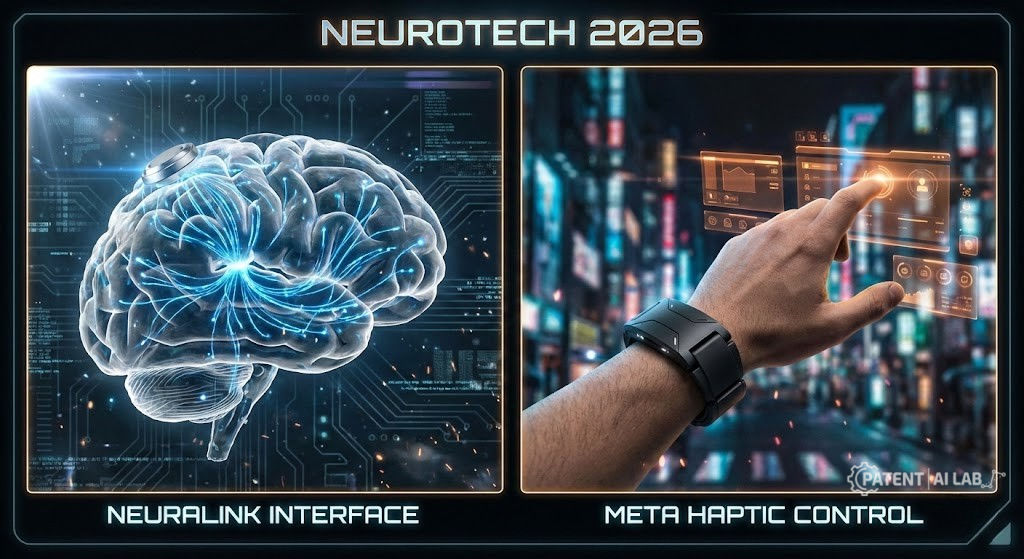
The New Interface War: Why “Intention” Is the New UI
To understand why billions of dollars are flowing into Brain chip vs wristband technology, you have to look at the “Input Bottleneck.”
Humans are high-bandwidth thinkers but low-bandwidth outputters. You can visualize a complex 3D cathedral in your mind in a split second, but to describe it, you have to slowly type words or draw lines with a clumsy hand. The goal of Brain-Computer Interfaces (BCI) is to widen that pipe to make the transfer of information from brain to cloud as fast as thought itself.
The Evolution of “The Click”
- The Mechanical Era: Punch cards and keyboards. High friction, high reliability.
- The Pointer Era: The mouse. Democratized computing but required a flat surface.
- The Touch Era: Capacitive glass. Intuitive, but your finger covers what you are looking at (the “occlusion problem”).
- The Intention Era (2026+): Direct neural signal processing. Zero latency. Zero motion.
In 2026, Neurotech market size and trends suggest a massive pivot. Investors are no longer funding “better screens”; they are funding “Investment in non-invasive BCI”. Why? Because whoever owns the input method owns the platform. If Meta’s wristband becomes the default way we interact with AR, Apple and Google lose their stranglehold on the interface.
Neuralink’s “Fortress”: The Invasive Strategy
“If you want to understand the brain, you have to go to the source.”
Neuralink’s strategy is built on a medical reality: The skull is a terrible filter. It blocks high-frequency electrical signals. To get the HD picture, you have to go inside.
1. The Tech: It’s Not Just a Chip, It’s a Process
Neuralink isn’t just building a chip; they are building a surgical franchise.
- The N1 Implant: A coin-sized device that sits flush with the skull. It doesn’t just “listen”; it processes. The Neuralink patent portfolio analysis reveals a heavy focus on “edge computing” on the chip itself to compress data before sending it wirelessly.
- The Threads: These are the real magic. Thinner than a human hair, carrying 1,024 electrodes.
- The R1 Robot: This is Neuralink’s most critical “moat.” The brain moves when you breathe and your heart beats. No human surgeon can insert a thread into a specific neuron while avoiding tiny blood vessels in a moving target. The R1 Robot is a sewing machine for the brain.
2. The Patent Strategy: The Medical Moat
Neuralink’s patents (specifically US Patent 11,291,508) focus on robotic neurosurgical navigation and automated insertion mechanics. They are locking down the physical ‘railway tracks’ into the brain.
- Core Claim: Systems for detecting blood vessels to avoid hemorrhage during insertion.
- Strategic Goal: Make it impossible for a competitor to perform this surgery safely without licensing Neuralink’s robotics IP.
3. The FDA Reality
In 2026, Neuralink is still primarily a medical device company. Their “Telepathy” product is a lifeline for quadriplegics. The FDA approval for commercial BCI for healthy humans is likely decades away, not years. The risk of infection, rejection, and scar tissue (gliosis) makes elective brain surgery a hard sell for the mass market. Following their initial successful human trials in 2024, Neuralink’s primary focus in 2026 remains strictly medical.
In the U.S. alone, approximately 300,000 people live with spinal cord injuries. Statistically, about 78% of new cases are male, and the incidence rate significantly impacts specific racial groups (for instance, African Americans account for roughly 24% of injuries despite being 13% of the general population). Neuralink’s immediate goal is to serve these highly specific demographics before expanding to a broader market.
Meta’s “Land-Grab”: The Non-Invasive Strategy
“The brain doesn’t end at the skull. It extends to the fingertips.”
Meta (formerly Facebook) realized they couldn’t convince 2 billion people to drill holes in their heads. So, they bought CTRL-Labs in 2019 and bet the farm on Electromyography (EMG).
1. The Tech: The Wrist as a Modem
Your brain sends electrical signals down your spine to your hand to tell your finger to move. This is a “Motor Unit.” Even if you don’t move your finger, if you just think about moving it—that electrical signal still travels to the wrist.
- The “Neural Band”: Meta’s device intercepts this signal at the wrist.
- The Micro-Gesture: You can “click” by moving your finger one millimeter. Or eventually, just by tensing the muscle without moving at all.
2. The Patent Strategy: The Interaction Layer
Meta EMG wristband patents are carpet-bombing the industry. They aren’t just patenting the sensor; they are patenting the User Interface (UI).
- Core Claim: “Method for modifying a virtual object based on neuromuscular signals.”
- Strategic Goal: To ensure that if Apple or Google wants to make an AR wristband, they have to pay Meta. They are trying to own the “double-tap” of the neural age.
3. The Consumer Edge
Building on their extensive developer demos in late 2024, Meta has the clearer path to the Neurotech market size 2026 dominance because they have the “iPhone moment” potential. Seamless integration with Ray-Ban smart glasses means you put it on, calibrate for 10 seconds, and go. No surgery, no shaved head.
Apple’s “Silent Move”: The Trojan Horse
While the loud battle is Brain chip vs wristband technology, Apple is playing a different game.
While Meta captures motion and Neuralink captures intent, Apple is quietly building a monopoly on biological context—a strategy we analyzed deeply in our breakdown of Apple’s Secret AI Agenda: On-Device Inference & 5 Hidden Patents.
1. Ear-EEG: The Invisible Sensor
Apple has filed patents (e.g., US 20230225659A1 ) for AirPods with biosensors.
- The Logic: The ear canal is a dark, conductive environment close to the brain. It’s perfect for reading EEG (brainwaves) and EOG (eye movement electrical signals).
- The Use Case: Apple isn’t aiming for “cursor control” immediately. They are aiming for “Passive Context.” Your AirPods will know if you are stressed, focused, or sleepy, and adjust your notifications or music accordingly. This is the “Health + Ecosystem” lock-in.
Data Visualization: The 2026 Comparative Analysis
To truly understand who is winning the neuralink vs meta 2026 race, we need to look at the data. I have compiled the following charts based on technical specs and patent filing trends.
1. Chart: “Invasive vs. Non-Invasive” Efficiency
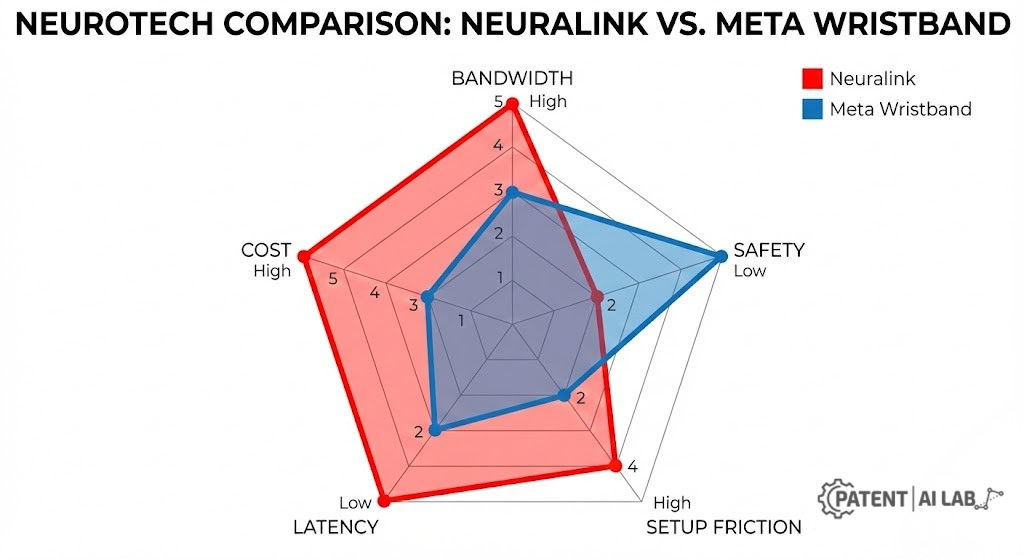
An analysis of the trade-off between raw power and user safety.
| Metric | Neuralink (Invasive Chip) | Meta (Wrist EMG) | Apple (Ear-EEG) |
| Bandwidth (Data Rate) | Ultra-High (~1 Megabit/s). Single neuron precision. | Medium (~10-100 Kilobits/s). Motor unit aggregation. | Low (<1 Kilobit/s). Global brain state only. |
| Latency | < 1ms (Direct hardware connection). | ~10-20ms (Transmission time + processing). | >50ms (Processing heavy). |
| Signal Stability | High, but degrades over years due to tissue scarring. | Variable. Affected by sweat, movement, and skin contact. | High, assuming a snug fit. |
| Setup Friction | Extreme. Neurosurgery + Recovery. | Low. Slip on a wristband + 30s calibration. | Zero. Already worn daily. |
| Consumer Safety | High Risk. Infection, hemorrhage, rejection. | Safe. Standard consumer electronics risks. | Safe. Standard consumer electronics risks. |
| Primary “Killer App” | Telepathy. Full computer control for paralyzed patients. | The “Click”. Interaction for AR/VR without controllers. | Wellness. Focus tracking, meditation, health monitoring. |
Key Takeaway: Neuralink is a Ferrari stuck in a garage (high performance, hard to access). Meta is a Toyota Camry (reliable, accessible, gets you there). In the consumer race, the Camry usually wins.
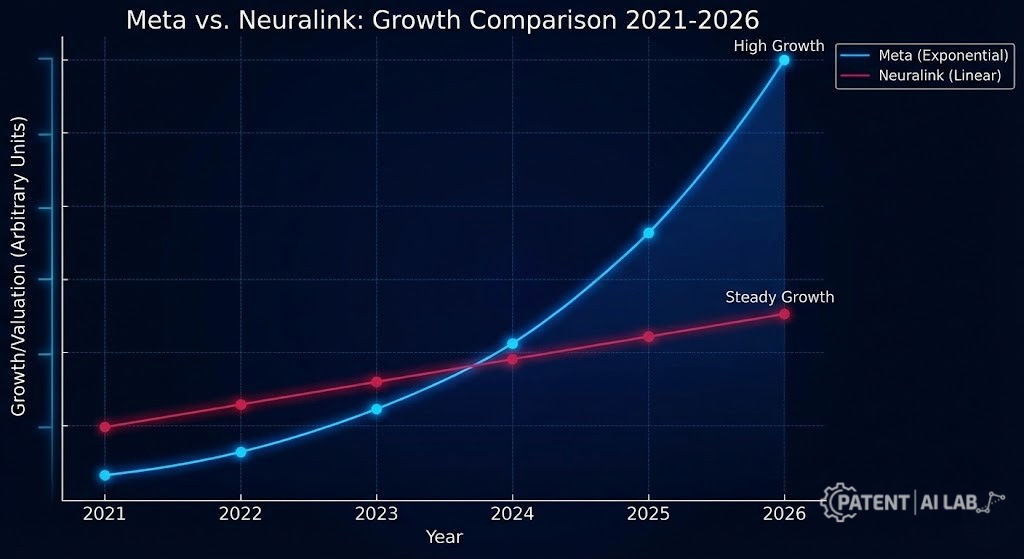
2. Chart: Patent Count Timeline (Last 5 Years)
A projection of global patent filings in the Neuro/EMG interface space.
| Year | Neuralink (Patents Filed) | Meta Reality Labs (Patents Filed) | Trend Analysis |
| 2021 | 3 | 600+ | Meta begins aggressive “land- grab” post-CTRL- Labs acquisition. |
| 2022 | 6 | 850+ | Meta expands into haptic feedback integration. |
| 2023 | 8 | 1,100+ | Neuralink focuses strictly on surgical robotics. |
| 2024 | 11 | 1,400+ | Explosion of “AI- based decoding” claims from Meta. |
| 2025 | ~15 | 1,800+ | 2026 Projection: Meta holds a 100:1 quantity advantage, but Neuralink holds the “crown jewels” of invasive tech. |
The “Privacy Scorecard”: The Hidden Cost
This is the section that usually goes viral on social media. When we analyze the patent claims, we see a disturbing picture of what data these companies want to collect. This isn’t just about privacy; it’s about “Cognitive Liberty.”
| Company | Primary Signal | What It Reveals (The Risk) | Viral Fear Factor | Real-World Danger |
| Neuralink | Cortical Spikes | Deep Intent & Emotion. Theoretically, it could detect a decision before you are consciously aware of it. | 10/10 (“Hacking my soul”) | Subpoenas. Could a court demand your neural data to prove you intended to commit a crime? |
| Meta | Wrist EMG | Nervous System State. Can detect micro-tremors, hesitation, stress, and arousal levels. | 8/10 (“Ad targeting based on anxiety”) | Behavioral Profiling. Meta could sell data on how “excited” you physically got when viewing an ad. |
| Apple | Ear Biosignals | Attention & Focus. Knows when you are zoning out, sleeping, or hyper-focused. | 6/10 (“Judging my productivity”) | Insurance Rates. Could health insurance change based on your daily stress/focus levels? |
Regulatory Context 2026
The legal landscape is shifting. Colorado and California (SB 1223) have pioneered “Neuro-Rights” legislation. These laws classify “neural data” as sensitive biological data, placing it in the same protected category as DNA. This means companies can no longer bury “we sell your brainwaves” in a 50-page Terms of Service. They need explicit, granular consent.
This rush for user data mirrors the generative AI battles regarding data sovereignty, similar to the conflicts explored in Google AI Patent Portfolio vs Microsoft : What I Learned Auditing Real GenAI Claims.
Technical Deep Dive: Can You Patent “Math”?
One of the biggest hurdles in Neuralink patent portfolio analysis is the USPTO’s Alice Standard. You cannot patent a mathematical concept or an abstract idea. You cannot simply claim “An AI that reads minds.”
So, how do they get patents?
They patent the “Technical Improvement.”
💻 AI-Generated Code Example: The Patentable Difference
This Python code snippet illustrates the difference between an abstract idea and a patentable implementation.
import numpy as np
from scipy.signal import butter, lfilter

# --- ABSTRACT IDEA (NOT PATENTABLE) ---
def predict_intent_magic(brain_data):
    # "Use AI to guess what user wants"
    # This claim would be rejected under 35 U.S.C. § 101
    return ai_model.predict(brain_data)

# --- CONCRETE INVENTION (PATENTABLE) ---
# Claim 1: A method for reducing motion artifacts in EMG signals
def process_emg_concrete(raw_signal, sampling_rate=2000):
    """
    Demonstrates a specific technical pipeline to improve signal-to-noise ratio.
    """
    # 1. Technical Constraint: Bandpass Filter (20-450Hz)
    # This limits the scope to specific muscle frequencies.
    nyquist = 0.5 * sampling_rate
    low = 20 / nyquist
    high = 450 / nyquist
    b, a = butter(4, [low, high], btype='band')
    filtered_signal = lfilter(b, a, raw_signal)

    # 2. Specific Feature Extraction: Root Mean Square over sliding window
    # This is a 'concrete step' that transforms data.
    window_size = 50 # ms
    rms_features = np.sqrt(np.mean(filtered_signal**2))

    # 3. Calibration Adjustment
    # Normalizing against a user-specific baseline reduces 'drift'.
    # This makes the system practical/usable, a key for patent eligibility.
    calibrated_output = (rms_features - USER_BASELINE) / USER_STD_DEV

    return calibrated_output
Why this matters: Founders in the Neurotech market need to know that their IP value lies in the preprocessing, the artifact rejection, and the hardware efficiency, not in the “Magic AI” model itself.
Is It Safe? The Radiation & Surgery Reality
Ethical concerns of mind reading patents often overshadow the physical safety questions.
- Invasive (Neuralink): The risk is Biology, not Technology. The brain is salty “soup.” Electronics hate salt water. The challenge is keeping the chip sealed for 10+ years without corroding. Furthermore, Gliosis (the brain’s scarring response) can coat the electrodes over time, insulating them and killing the signal.
- Non-Invasive (Meta): The risk is Comfort. Wearing a tight band on your wrist all day can compress nerves (Carpal Tunnel issues). Regarding radiation: These devices use standard Bluetooth/UWB frequencies. The SAR (Specific Absorption Rate) is negligible compared to holding a phone to your ear.
The 2026 Verdict: My Honest Take
After analyzing the technical specs and the sheer volume of patent filings, I have a hard prediction to make. It might not be what the die-hard transhumanists want to hear, but the data points in one direction.
The Short Game (2026–2030): Meta Wins by a Landslide. Let’s be real, friction allows adoption. Meta understands this better than anyone. I can see a path where the “Neural Band” becomes as ubiquitous as the Apple Watch within two years. It doesn’t require FDA approval, it doesn’t scare the average consumer, and it integrates immediately with the glasses we already want to wear. If “winning” means replacing the mouse and keyboard for the mass market, Meta holds the winning hand.
The Long Game (2035+): Neuralink Owns the Ceiling. However, physics is physics. The wrist can only tell you so much. If Neuralink can solve the robotic surgery bottleneck, and that is a massive “if”, they represent the only path to high-bandwidth communication. Meta is building a better keyboard; Neuralink is trying to build a new language.
However, decoding these massive neural signals in real-time requires immense edge-computing power, a sector currently dominated by the hardware giants we covered in NVIDIA’s Patent Strategy Analysis: The Hidden Pivot from Silicon to System.
Final Thought: We are standing on the edge of the “Intention Economy.” For the last decade, tech companies tracked where we clicked. In the next decade, they will track what we wanted to click.
As you read the rest of this deep dive, keep one question in mind: Convenience is the ultimate currency, but are we ready to trade the privacy of our nervous systems for the ability to type an email without moving our hands?
I’ll let the patent data speak for itself.
📚 Sources & Legal References
- US Patent 11,291,508: Neuralink robotic neurosurgical navigation and automated insertion mechanics.
- US Patent App 20230225659A1: Apple AirPods with biosensors (Ear-EEG).
- 35 U.S.C. § 101 (Alice Standard): USPTO guidelines on patentable subject matter and abstract ideas.
- Legislation (SB 1223): California “Neuro-Rights” legislation protecting neural data.
- NSCISC Data: National Spinal Cord Injury Statistical Center demographic statistics.
Podcast
Disclaimer
This article is based on our team’s experience advising startups, product development, and tracking IP litigation. Tools and legal interpretations change over time. Please note that PatentAILab is an educational platform and not a law firm. This content is for educational purposes only and does not constitute legal advice. Intellectual property laws (especially regarding AI) are complex and change frequently. Always consult a qualified patent attorney for your specific situation.
FAQs (People Also Ask)
Can Neuralink’s “Telepathy” actually read my private thoughts?
No. Currently, it decodes motor intent (e.g., “move cursor left”). It cannot decode abstract concepts like “I love this song” or “I am lying” with high reliability yet, though research is moving in that direction.
Is the surgery reversible?
Theoretically, yes, but removing 1,024 threads that have integrated with brain tissue is significantly more dangerous than putting them in. For now, treat it as permanent.
How much will the Meta wristband cost?
Analysts predict it will be bundled with AR glasses, likely in the $200-$300 range as a standalone accessory, following the price curve of high-end smartwatches.
Did Meta buy CTRL-Labs in 2014?
No, the acquisition was in 2019. The confusion often arises because the foundational patents for differential EMG date back to research started around 2014-2015.
Who controls the data if I use an Apple BCI?
Apple’s marketing leans heavily on “On-Device Processing.” This means your neural data is processed on the Neural Engine of the H2/H3 chip and theoretically never leaves your headphones, unlike Meta’s cloud-heavy approach.
Who will win the neuralink vs meta 2026 race?
In the short term, Meta is positioned to win the consumer mass market with its non-invasive AR wristbands. However, for severe medical applications requiring ultra-high bandwidth, Neuralink remains unmatched in the industry.




2 comments