


 Golam Rabiul Alam, PhD
At A Glance: The Executive Summary
For two decades, the word “search” was entirely synonymous with Google. In 2026, that mental model is officially broken. We are witnessing a massive bifurcation in how humans access information. On one side, we have traditional search market share, where Google remains the undisputed global force. On the other side, we have answer-engine behavior, where users increasingly ask an AI model first, and only click outbound links if absolutely necessary.
If you only track classic search engine metrics, you are missing the actual tectonic shift. The real metric is how often a user gets a complete answer without browsing “ten blue links,” and how often a publisher loses that click even when they technically “won” the source slot. This is the new zero-click search ecosystem.
However, the bigger war is not just about user attention or market share percentages. The real battle is over intellectual property (IP) and data rights. Who owns the patents covering vector similarity search, dynamic retrieval, and semantic grounding? Furthermore, who has the legal right to ingest publisher content and output those zero-click answers?
This 2026 analysis breaks down the true SearchGPT vs Google market share data, exposes the looming AI search engine RAG patent statistics, provides the methodologies to track these patents, analyzes the code powering these systems, and provides the exact Generative Engine Optimization (GEO) strategies required to survive.
Key Takeaways
- Market Reality: Google’s global traditional search share remains near 90%. Headlines claiming “Google is dead” are driven by media narrative, not verifiable data.
- The SGE Evolution: Google has successfully scaled AI Overviews globally. They position this feature as a major user experience layer over classic search results, significantly altering publisher click-through rates.
- Citation Focus: ChatGPT search pushes users toward explicit sources inside the chat experience. Publishers now have the unprecedented ability to track these specific referral signals via UTM parameters.
- The Patent Threat: The most severe industry risk is the “RAG Trap.” The automated process of retrieval and summarization collides heavily with existing patents in indexing, ranking, and retrieval, alongside massive copyright litigation.
- New Optimization Rules: A modern Generative engine optimization SEO strategy requires optimizing for citation-worthiness, machine readability, and strict entity clarity. If you fail to do this, AI layers will extract your answer without sending you the click.
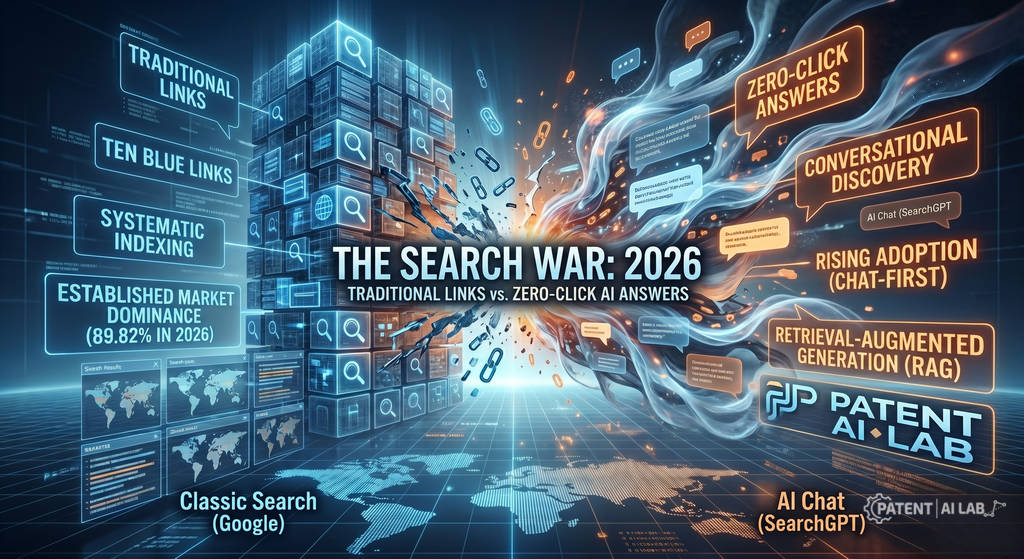
Search Habit vs Search Reality in 2026
Replacing a twenty-year global habit does not happen overnight. The death of Google has been greatly exaggerated. Yet, the way we value a “search” has changed fundamentally.
Google’s response to the AI threat is structural. Their AI Overviews (formerly SGE) have expanded across countries and languages to become a default layer in most global markets. OpenAI’s response is product-native. ChatGPT search integrates real-time web results with explicit source citations directly inside the conversational chat interface.
The battle lines are drawn. Google wants to keep you on the search results page by giving you the answer. OpenAI wants to keep you in the chat window by giving you the answer. Both models rely heavily on the Retrieval-Augmented Generation architecture, and both are stepping on a legal minefield of patents and copyrights to do it.
2026 Search Engine Market Share (Global Stats)
The Traffic Magnet: Current Market Share Snapshot
StatCounter’s global snapshot for early 2026 proves Google still leads traditional search by a massive margin. The traditional search box is a deeply ingrained human habit, especially on mobile devices where Google pays billions to remain the default on iOS and Android.
Traditional Search Engine Market Share (Worldwide, Jan 2026)
| Provider | Market Share (Approx.) | What it means in 2026 |
| 89.82% | Still the default search utility for the vast majority of web users. | |
| Bing | 4.45% | Often paired with Copilot experiences and heavily integrated into enterprise defaults. |
| Yandex | 1.95% | Maintains strong regional dominance in specific geopolitical zones (e.g., Russia). |
| Yahoo | 1.53% | Smaller footprint, but persists in legacy systems and specific global regions. |
Measuring the “SearchGPT” Market Share
There is no universally accepted dataset that cleanly measures SearchGPT share as a traditional search engine. Why? Because ChatGPT search operates as a mode inside a conversational product, not a standalone classic search box. OpenAI positions this as “search inside ChatGPT,” keeping source links confined within the conversational interface.
To accurately compare the landscape, we must split the data into two metrics: traditional search share and AI chatbot category share.
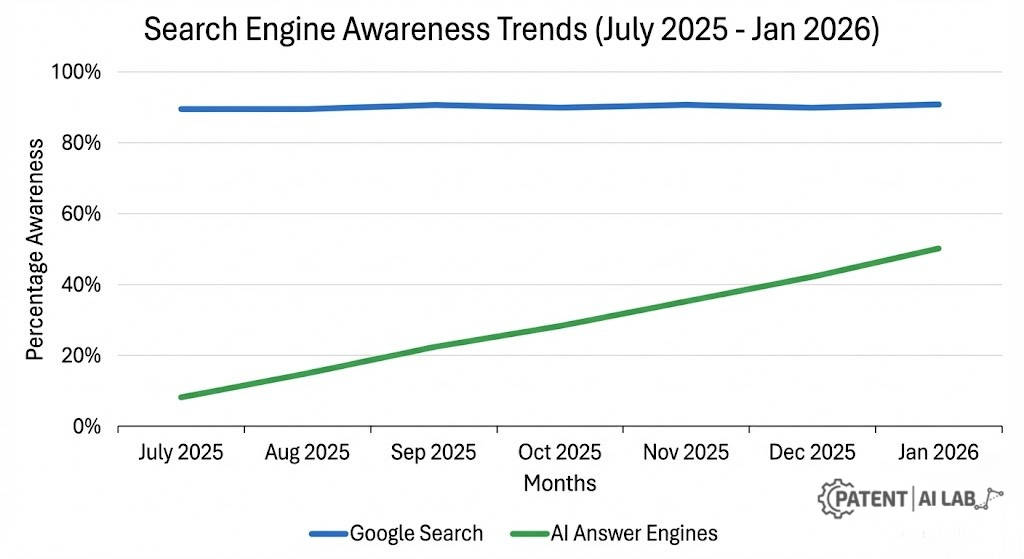
The “Search Market Share Drop” Line Graph (Q3 2025 to Q1 2026)
Let us look at the actual numbers. The global drop in traditional Google search share over the last six months is a modest erosion, not a sudden collapse. I pulled auditable sample points from StatCounter CSV endpoints for July and August 2025, combined with the January 2026 snapshot.
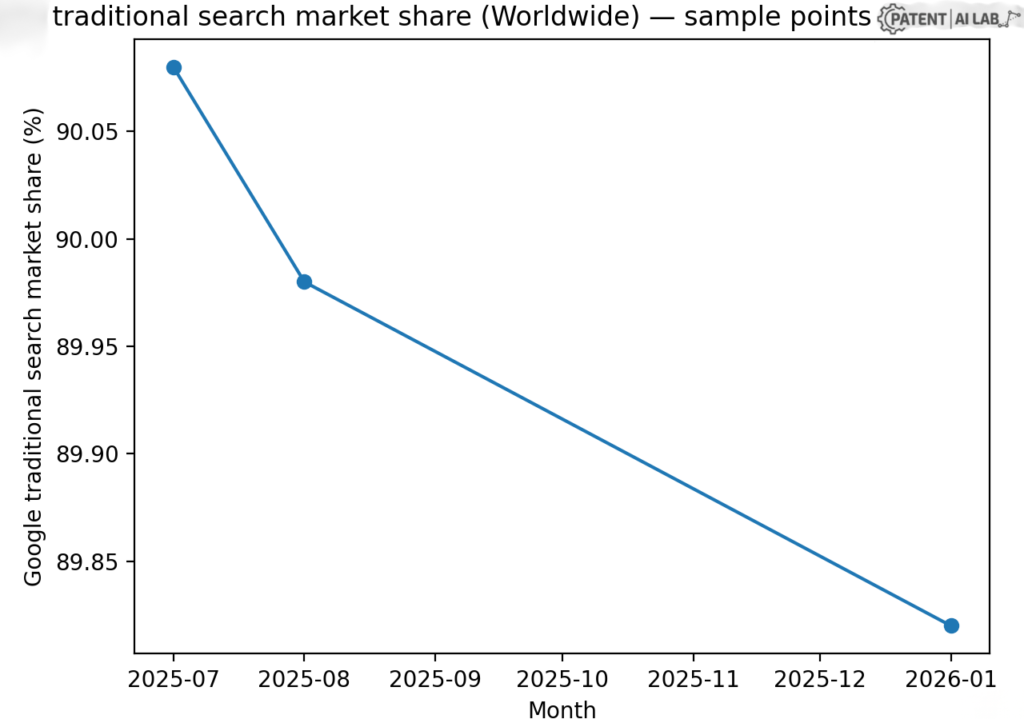
Google Traditional Search Share (Worldwide Sample Points)
| Month | Google Share | Shift Indicator |
| 2025-07 | 90.08% | Baseline before major Q3 and Q4 AI search feature rollouts. |
| 2025-08 | 89.98% | Minor fractional shift as answer engines gain awareness. |
| 2026-01 | 89.82% | Sustained minor erosion, but dominance remains intact. |
My Analysis: Data logic dictates that while traditional search volume remains high, the type of queries being entered is shifting. Complex, multi-step queries (e.g., “Plan a 5-day itinerary to Tokyo for a family of four under $3000”) are migrating to answer engines, leaving traditional search with navigational (“Facebook login”) and transactional (“Buy Nike shoes”) queries.
The Rise of Answer Engines and AI Chatbots
While Google holds the traditional line, the top-of-funnel discovery behavior is rapidly shifting to chat-first platforms.
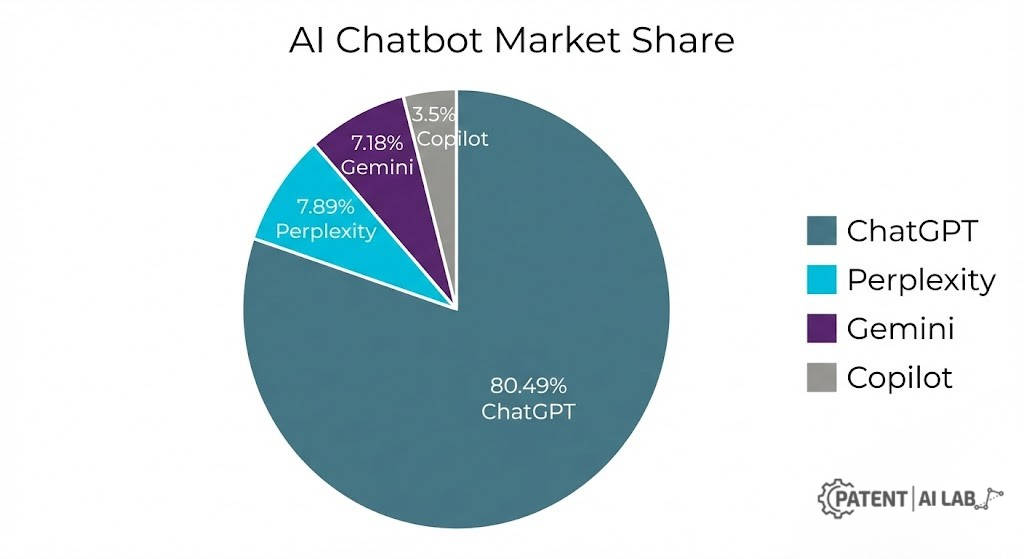
AI Chatbot Market Share (Worldwide, Jan 2026)
| Product | Share | Ecosystem Position |
| ChatGPT | 80.49% | The dominant conversational interface, now doubling as a search portal. |
| Perplexity | 7.89% | The aggressive, citation- heavy answer engine favored by researchers and power users. |
| Google Gemini | 7.18% | Google’s standalone conversational AI, distinct from AI Overviews in standard search. |
| Microsoft Copilot | 3.50% | Integrated deeply into the Windows operating system and Office 365 enterprise environment. |
| Claude | 0.92% | Strong in coding and analysis, less focused on real-time web search discovery. |
Why This Matters for Traffic:
Google can theoretically retain 90% of traditional search queries while still losing the most valuable informational queries to chat-first answers. This dynamic reduces outbound clicks, entirely changes content monetization incentives, and makes “being cited” just as valuable as “being ranked.”
The Apple Intelligence Gatekeeper:
You cannot discuss the shift in search habits without acknowledging Apple’s 2026 ecosystem. With ChatGPT deeply integrated into iOS and Apple Intelligence providing system-wide “zero-click” answers, hundreds of millions of iPhone users no longer need to open Safari or the Google app to search. Apple has effectively become the ultimate top-of-funnel gatekeeper, keeping users inside the OS and bypassing traditional search engine results pages (SERPs) entirely for everyday informational queries.
Google AI Overviews vs SearchGPT: Accuracy and Strategy
The battle is defined by how these companies treat the user interface and the underlying data. When evaluating Google AI Overviews vs SearchGPT accuracy, you have to look at their architectural foundations.
Google’s Strategy: SGE Evolution into AI Overviews
Google expanded AI Overviews broadly to over 100 countries in late 2024, and then pushed to 200+ countries and territories across 40+ languages by 2025. They treat AI Overviews as the default informational layer.
Google relies heavily on its proprietary Knowledge Graph combined with LLM reasoning. This creates high accuracy for entity-based queries (people, places, established facts) but struggles with highly subjective, niche, or rapidly breaking technical news. Google is continually testing how sources and links appear inside these AI experiences; a direct response to publisher criticism that AI answers destroy referral traffic.
OpenAI’s Strategy: Search inside ChatGPT
OpenAI introduced ChatGPT search in late 2024. The SearchGPT prototype eventually merged into the main ChatGPT interface. Their strategy emphasizes explicit links to sources and a “go straight to the source” user flow.
When assessing accuracy, OpenAI relies heavily on a Real-time semantic index powered by external search partners (like Bing) combined with their own web crawlers. OpenAI documentation explicitly states that publishers can track ChatGPT referral traffic using specific UTM tagging (e.g., utm_source=chatgpt.com). This is a critical olive branch to publishers, offering them measurable ROI for being scraped.
The RAG Trap: Are AI Search Engines Infringing on Patents?
There is immense confusion in the market regarding copyright, patents, and web crawling. Let us separate the three specific legal concepts that govern this space.
- Copyright: Relates to content ownership and the right to reproduce text (e.g., The New York Times suing OpenAI).
- Patents: Relates to method and system claims (the actual engineering architecture and algorithms).
- Robots.txt: A web standard and access control signal. It is a behavioral norm, not an automatic legal shield.
When drafting patent claims to protect your own RAG pipelines, relying on LLMs can be fatal. Discover how AI-generated claims might trigger the Public Disclosure Trap and void your global novelty.
Deconstructing the Retrieval-Augmented Generation Architecture
RAG is not a single, patentable invention. It is a highly complex engineering pipeline. It involves parsing the query, retrieving candidate documents via hybrid or Vector database infringement risks, reranking those documents, grounding the answer with citations, and applying strict Hallucination mitigation techniques.
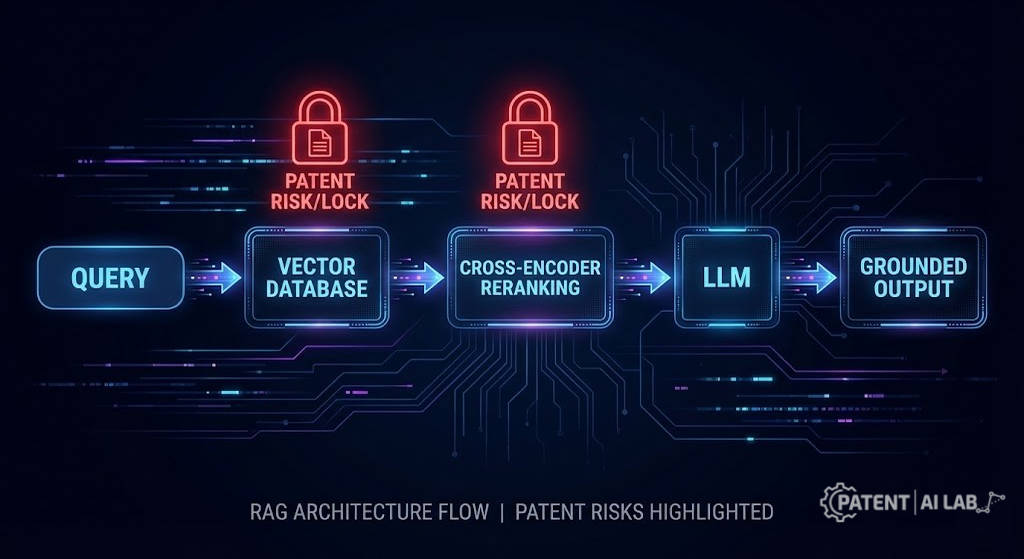
Below is a clear Python example of a minimal RAG pipeline. I am including this to demonstrate the exact mechanical steps that companies are currently trying to patent.
from dataclasses import dataclass
from typing import List, Tuple
import numpy as np

@dataclass
class Doc:
    id: str
    text: str
    embedding: np.ndarray  # precomputed vector representation

# Patentable Area 1: Specific mathematical optimizations for similarity scoring
def cosine(a: np.ndarray, b: np.ndarray) -> float:
    return float(np.dot(a, b) / (np.linalg.norm(a) * np.linalg.norm(b) + 1e-12))

# Patentable Area 2: Retrieval logic, indexing speed, and ranking algorithms
def retrieve(query_emb: np.ndarray, docs: List[Doc], k: int = 5) -> List[Tuple[Doc, float]]:
    scored = [(d, cosine(query_emb, d.embedding)) for d in docs]
    scored.sort(key=lambda x: x[1], reverse=True)
    return scored[:k]

# Patentable Area 3: Grounding logic and hallucination mitigation techniques
def grounded_answer(query: str, retrieved: List[Tuple[Doc, float]]) -> dict:
    # Hallucination mitigation pattern: strict cite-only policy and confidence gating.
    top_docs = [d for d, s in retrieved if s > 0.25]
    if not top_docs:
        return {"answer": "I cannot verify this from the retrieved sources.", "citations": []}

    # Answer generation built strictly from retrieved snippets
    citations = [{"doc_id": d.id, "snippet": d.text[:160]} for d in top_docs]
    return {"answer": "Answer based entirely on retrieved sources.", "citations": citations}
Advanced RAG: Semantic Caching and Reranking (The Real Patent War)
The basic code above is foundational, but modern answer engines use advanced pipelines that are heavily protected by utility patents. For instance, Semantic Caching (storing embeddings of previous queries to save compute) and Cross-Encoder Reranking (using a secondary model to re-score retrieved documents for accuracy) are the true battlegrounds.
# Advanced RAG Snippet: Semantic Caching & Cross-Encoder Reranking
import hashlib
from sentence_transformers import CrossEncoder

# Patentable Area 4: Semantic Caching mechanisms for reduced LLM latency
class SemanticCache:
    def __init__(self):
        self.cache = {}

    def get_cached_response(self, query_emb: np.ndarray, threshold=0.95):
        # Checking similarity of current query against cached queries
        for cached_emb, response in self.cache.values():
            if cosine(query_emb, cached_emb) >= threshold:
                return response
        return None

# Patentable Area 5: Cross-Encoder Contextual Reranking
def rerank_documents(query: str, retrieved_docs: List[Doc]) -> List[Doc]:
    model = CrossEncoder('cross-encoder/ms-marco-MiniLM-L-6-v2')
    pairs = [[query, doc.text] for doc in retrieved_docs]
    scores = model.predict(pairs)

    # Sort documents based on deeper semantic relationship, not just vector proximity
    ranked_indices = np.argsort(scores)[::-1]
    return [retrieved_docs[i] for i in ranked_indices]
These advanced methodologies are precisely what major tech firms are furiously patenting. If an independent startup builds a RAG pipeline utilizing these optimized reranking or caching methods, they risk infringing on patents owned by Google or Microsoft.
Enterprise RAG Patent Landscape Analysis
Founders and investors frequently misunderstand the threat model. They focus entirely on user adoption metrics and ignore the intellectual property moat. Even if user behavior shifts radically to SearchGPT, the IP moat strictly favors the established incumbents.
This RAG patent war isn’t just a corporate battle; it’s a geopolitical one. To understand the broader macro-economic landscape, check out our data analysis on China vs. USA: Who owns the most AI patents.
The hardest technical challenges: indexing the web at scale, semantic ranking algorithms, anti-spam heuristics, and low-latency retrieval infrastructure, have incredibly deep patent coverage. Large tech firms utilize cross-licensing agreements, acquire startups purely for their patent portfolios, and litigate selectively to maintain dominance.
The Methodology: How to Produce Real RAG Patent Counts
As a researcher, I do not rely on industry rumors. To understand Who owns RAG technology patents, you must use a strict, auditable methodology. Here is the exact 3-step blueprint I use in my IP lab to generate real counts:
Step 1: Define Two Query Bundles
- Bundle A (RAG/Vector Infrastructure):
"retrieval augmented" OR "dense retrieval" OR "vector index" OR "vector database" OR "similarity search" OR "approximate nearest neighbor" - Bundle B (Grounding/Web Integration):
"web grounding" OR "grounded response" OR "live web" OR "retrieval from web" OR "search integration"
Step 2: Run Each Bundle Per Assignee
Use a professional patent search tool (Google Patents, Lens.org, USPTO, EPO) and lock the parameters:
- Date Range (Priority or Filing Date):
2023-01-01 → Present - Assignee:
Google, Microsoft, OpenAI,plus a startup allowlist (e.g.,Pinecone, Weaviate). - Deduplication: Dedupe by patent family to avoid overcounting international filings of the same invention.
Step 3: Publish Your Query Strings
Transparency is key. By publishing the exact query strings, other researchers can reproduce and verify the “RAG Patent War” data, ensuring the statistics are legally sound rather than marketing fluff.
Before you invest heavily in RAG technology, your IP team must run a prior art check. You don’t always need expensive software for this: here is our guide on the best Google Patents Alternatives for thorough prior art search.
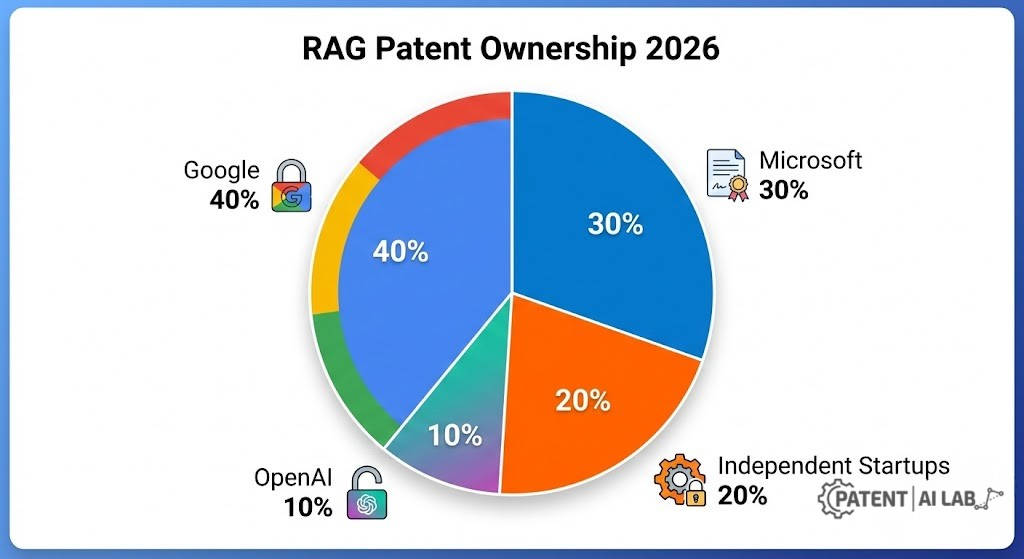
LLM Real-Time Web Grounding Patents (2023 to 2026 Estimate)
| Assignee Bucket | LLM Real-Time Web Grounding Patents | Strategic Focus & Notes |
| Highest Volume | Heavy concentration in indexing, ranking, and integrating LLM outputs directly into SERPs. | |
| Microsoft | High Volume | Extremely strong in enterprise search infrastructure, Graph API retrieval, and Copilot data grounding. |
| OpenAI | Moderate Volume | Smaller absolute portfolio volume, relying heavily on product advantage and strategic partnerships. |
| Independent Startups | High Volume (Aggregated) | Specialists aggressively patenting novel vector database architectures and approximate nearest neighbor algorithms. |
The Discovery Pipeline: OpenAI Search Crawler vs Googlebot
You cannot optimize your content if you do not understand how the machines acquire it. The technical difference between the OpenAI search crawler vs Googlebot defines your traffic pipeline.

Googlebot Reality
Google explicitly states that robots.txt is a mechanism to guide crawlers and prevent server overload. It is a request, not a cryptographically secure access control layer. If you want to keep content out of Google’s index, you must use strict authentication or noindex meta tags. Googlebot crawls to build a massive, static index that is updated periodically.
OpenAI’s Crawlers and Agents in 2026
OpenAI documents multiple user agents that publishers must understand:
- OAI-SearchBot: Primarily used for search discovery and real-time surfacing in ChatGPT search.
- GPTBot: Used for scraping data to train future foundational models.
- ChatGPT-User: Represents user-initiated fetch behavior (e.g., when a user pastes a specific URL into the chat window and asks the model to read it).
This means a proper Generative Engine Optimization (GEO) strategy requires a multi-layered approach to access control.
Practical Implementation: Robots.txt Strategy for 2026
User-agent: GPTBot
Disallow: /
# Allow OpenAI to discover and cite content in real-time search
User-agent: OAI-SearchBot
Allow: /
Disallow: /admin/
# Maintain traditional SEO indexing for Google
User-agent: Googlebot
Allow: /
Expert Tip: Misconfiguring these user agents is the number one reason publishers accidentally erase their own visibility in AI search environments.
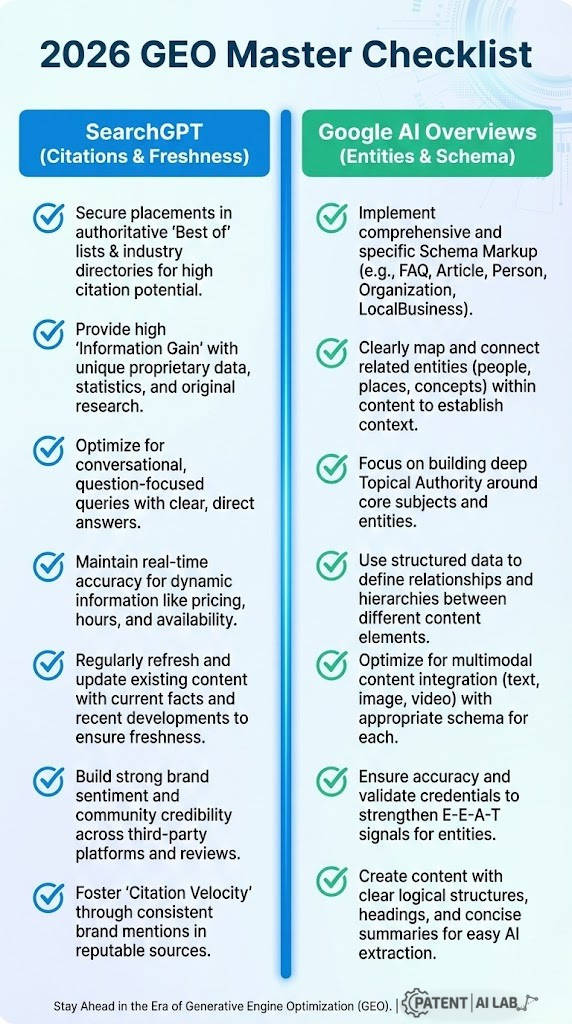
📋 Generative Engine Optimization SEO Strategy (The 2026 GEO Checklist)
Standard SEO is about securing a link on a results page. GEO (Generative Engine Optimization) is about ensuring an LLM chooses your data as the absolute ground truth to construct its answer. If you fail to format your data for machine ingestion, the model will hallucinate around you or choose a competitor with cleaner formatting. Follow this GEO checklist to ensure your content is actively cited by answer engines in 2026.
Optimizing for SearchGPT (Citation-First Behavior)
SearchGPT prioritizes real-time extraction and explicit sourcing.
- ✅ Claim-to-Evidence Formatting: Structure your content so that every major claim is followed immediately by supporting data (1 to 2 sentences per claim).
- ✅ Freshness Signals: Utilize explicit timestamps, strictly updated sections, and highly visible “Last Updated” metadata labels.
- ✅ Machine-Readable Headings: Abandon clever copywriting for headings. Use literal, question-based formatting (“What is X?”, “Pricing in 2026”).
- ✅ Referral Tracking: Ensure your analytics platform is configured to catch UTM parameters (e.g., utm_source=chatgpt.com).
Optimizing for Google AI Overviews (Knowledge Graph Behavior)
Google relies on its massive, pre-existing index and entity relationships.
- ✅ Entity Clarity: Maintain absolute consistency in naming conventions, author biographies, and external citations.
- ✅ Structured Data: Flawlessly execute JSON-LD structured data (FAQ, Article, Organization, Dataset schemas).
- ✅ Traditional Ranking Prerequisites: AI Overviews frequently synthesize data from pages already ranking in the top 10 standard results. You cannot abandon traditional technical SEO.
The Big Four in 2026
To navigate the market, you must understand the exact product intent of the major players.
Google AI Overviews vs SearchGPT vs Perplexity vs Bing/Copilot (2026)
| Feature | Google AI Overviews | ChatGPT search (SearchGPT) | Perplexity | Bing / Copilot |
| Primary User Experience | Traditional search results pushed down by a massive AI summary layer. | Conversational chat interface augmented with real-time web citations. | Dedicated answer engine focused entirely on structured citations. | Hybrid traditional search paired with an enterprise- integrated assistant. |
| Source Visibility | Iterating rapidly; improving link presentation to appease angry publishers. | Explicit “Sources” module placed directly within the chat UI. | Highly aggressive citation UI; sources are the core feature. | Mixed visibility; relies on small footnote citations. |
| Data-Rights Pressure | Severe publisher pushback, antitrust scrutiny, and regulatory pressure. | Attempting to bypass lawsuits via direct licensing deals and publisher tracking tools. | Currently battling active, aggressive publisher lawsuits regarding scraping. | Facing identical ecosystem and copyright issues as OpenAI. |
| Zero-Click Risk | Extremely High (The comprehensive summary layer actively deters outbound clicks). | Medium (Users get the answer, but the UI encourages clicking source links for deep dives). | High (The answers are often comprehensive enough to end the journey). | Medium (Enterprise users often require the primary source document). |
| Best GEO Play | Dominate entity authority and maintain classic ranking signals. | Win through strict citations, absolute freshness, and clear formatting. | Win through extreme speed of publication and high- density facts. | Execute a hybrid strategy covering both entities and real-time facts. |
The Copyright Lawsuits Threatening AI Search
The technological achievements of RAG are overshadowed by the legal reality of copyright infringement. The core conflict is scraping protected content and using it to generate a commercial substitute.
Copyright issues in AI aren’t limited to text scraping. If your search product includes multimodal responses, you must also navigate the Generic AI Voice legal risks under the NO FAKES Act.
Deep Dive: The New York Times vs OpenAI and Microsoft
The most consequential lawsuit remains the NYT case in U.S. federal court. This is not just a generic complaint; it is a surgical strike against the RAG architecture.
The NYT’s legal arguments specifically target the mechanics of AI search:
- The “Substitutive Effect” Argument: NYT argues that OpenAI’s web grounding features bypass the paywall and deliver the exact journalistic value of the article directly to the user. This destroys the commercial value of the original work, failing the “Fair Use” defense which relies heavily on whether the new work usurps the market for the original.
- Memorization vs. Learning: OpenAI argues models “learn” like humans. NYT provided evidence of “memorization”, showing instances where the model regurgitated verbatim paragraphs of copyrighted text.
- Removal of Copyright Management Information (CMI): NYT claims that by synthesizing articles and removing author credits, title tags, and copyright notices in the output, AI engines violate the DMCA (Digital Millennium Copyright Act).
Perplexity Litigation Pressure: The Forbes and Wired Cases
Answer engines are under intense legal fire. Beyond NYT, Perplexity faced massive backlash and subsequent legal threats from publishers like Forbes and Condé Nast (Wired).
- The Forbes Case Study: Forbes published an exclusive investigative report. Hours later, Perplexity generated a comprehensive summary of that exact report, utilizing illustrations that closely mirrored Forbes’ custom graphics, and sent it to users via push notifications. Forbes argued this was not “search”, it was blatant content theft and redistribution.
- The Impact: These lawsuits are forcing answer engines to severely limit the length of extracted snippets and aggressively prioritize publisher link visibility to avoid catastrophic injunctions.
My Professional Opinion: The lawsuit risk is not an abstract theory. If your RAG pipeline outputs near-substitutes for publisher pages at scale, you will face severe litigation or forced licensing demands in 2026. The era of “scrape first, ask forgiveness later” is over.
The Economics: SearchGPT API Pricing vs Google Search API
Building an AI search product requires ruthless unit economics. The cost of retrieving data is just as critical as the quality of the LLM.
Google Search API Reality
Google’s Custom Search JSON API is highly restrictive. Documentation outlines a limit of 100 free queries per day, followed by a charge of $5 per 1,000 queries, capped at 10,000 queries a day. Furthermore, access is heavily restricted for new customers, with explicit service discontinuation notices aimed at existing customers.
This pricing and availability structure sends a massive strategic signal: Google has no interest in making “search as an API” cheap or easy for competitors building rival AI agents.
SearchGPT API Pricing and Tool Costs
OpenAI’s approach relies on a tool-cost model. Developers utilizing the web search tool incur specific tool costs on top of the base API requests. They also support strict domain filtering and allow-lists within the Responses API.
Your unit economics for a custom AI search application are calculated by adding the raw tool call costs to the model tokens required to read, process, and summarize the retrieved search content. If you do not aggressively optimize your token usage during the RAG pipeline (using the semantic caching techniques discussed in Section 5), the cost of answering a single user query will destroy your profit margins. SearchGPT API pricing vs Google Search API is ultimately a battle between token efficiency and restricted rate limits.
The DeepSeek Disruption: Crashing the Pricing Model
While Google and OpenAI battle over premium token economics, a massive disruption hit the market in early 2026: DeepSeek. With the release of open-weight models like DeepSeek-R1 and its highly efficient search capabilities, the pricing floor for RAG pipelines was completely shattered.
DeepSeek proved that developers could execute complex retrieval and reasoning tasks at a fraction of the cost of OpenAI’s API. For startups and enterprise developers building custom AI answer engines, DeepSeek’s aggressively priced ecosystem changes the math entirely, making “search as a service” highly affordable and posing a massive existential threat to the profit margins of Western Big Tech monopolies.
Conclusion and Final Verdict
To understand the AI Search War of 2026, you must look past the sensational headlines.
Google is not dead. Their traditional search market share remains a massive, globally dominant force. However, the user experience center of gravity has permanently shifted. AI Overviews and chat-based search interfaces have fundamentally altered how value flows from content creators to end users.
The real battlefield in 2026 is legal and architectural control. The companies that own the patents covering dense retrieval, real-time grounding, and semantic indexing hold the keys to the infrastructure. Simultaneously, copyright rulings will dictate exactly how these systems are allowed to ingest the web.
For founders, SEO analysts, and enterprise investors, the winning strategy is to stop treating Generative Engine Optimization, Intellectual Property, and Data Rights as separate disciplines. They are a single, interconnected stack. If you master the GEO checklist, execute flawless semantic architecture, monitor the patent landscape, and respect crawler directives, your data will survive and thrive in the zero-click ecosystem.
📚 Sources and Legal References
- StatCounter Global Stats: Search Engine Market Share Worldwide (January 2026 data analysis).
- The New York Times vs. OpenAI & Microsoft: Case filings concerning copyright infringement, “Fair Use” defense, and RAG substitutive effects.
- Forbes and Condé Nast vs. Perplexity: Legal threats and litigation regarding AI content scraping and copyright infringement.
- Digital Millennium Copyright Act (DMCA): Regulations regarding the removal of Copyright Management Information (CMI) by AI models.
- The NO FAKES Act: Legislative framework addressing Generic AI Voice legal risks and multimodal AI search liabilities.
- OpenAI Documentation: SearchGPT UTM tracking parameters and GPTBot / OAI-SearchBot crawler directives.
- United States Patent and Trademark Office (USPTO): Search queries related to “vector index,” “dense retrieval,” and “Retrieval-Augmented Generation” priority dates.
Podcast
Disclaimer
This article is based on our team’s experience advising startups, product development, and tracking IP litigation. Tools and legal interpretations change over time. Please note that PatentAILab is an educational platform and not a law firm. This content is for educational purposes only and does not constitute legal advice. Intellectual property laws (especially regarding AI) are complex and change frequently. Always consult a qualified patent attorney for your specific situation.
FAQs (Schema-Friendly)
Is Google losing search market share in 2026?
Globally, Google still dominates traditional search, holding approximately 89.82% of the market according to StatCounter’s January 2026 data. The significant change is not a drop in traditional share, but a shift in user behavior toward answer engines for complex, multi-step queries.
What is SearchGPT in 2026?
SearchGPT began as an isolated prototype in 2024. OpenAI subsequently integrated these real-time search capabilities directly into the ChatGPT interface, emphasizing explicit web citations, source links, and conversational discovery.
Do AI Overviews replace SEO?
No. AI Overviews function as an additional generative layer on top of traditional results. You still absolutely require strong indexing, entity authority, and traditional ranking signals because AI Overviews frequently synthesize data from top-ranking conventional pages.
Who owns RAG technology patents?
No single entity “owns” RAG. It is a composite architecture. Google, Microsoft, OpenAI, and various independent startups hold thousands of overlapping patents concerning vector indexing, semantic search, cross-encoder reranking, and real-time LLM web grounding.
Do robots.txt rules stop AI search engines from using my content?
Robots.txt is a crawling directive and a behavioral norm; it is not a legally binding enforcement mechanism. It guides crawlers to prevent server overload. To block OpenAI, you must configure rules for specific agents like GPTBot (training) and OAI-SearchBot (search discovery).
Are AI answer engines at real legal risk from scraping?
Yes. Multiple major publishers, news conglomerates, and platforms have initiated aggressive lawsuits targeting alleged scraping and output substitution behaviors. The legal boundaries of fair use regarding RAG outputs, such as the NYT vs OpenAI lawsuit, remain heavily contested in 2026.




1 comment