


 Golam Rabiul Alam, PhD
How Google Patent US12536233B1 Changes E-Commerce SEO
The relationship between Google search and independent e-commerce stores is actively changing. This operational shift extends beyond standard search results; it integrates directly into Google’s AI Overviews (SGE), altering how users discover and purchase products.
I have completed a forensic audit of Google’s recently granted patent, US12536233B1 in its entirety, officially titled “AI-generated content page tailored to a specific user.” The patent documentation reveals a clear shift in search operations. Google has engineered a machine learning framework designed to intercept your potential buyers, evaluate your website technical performance in real time, and dynamically replace your product pages with a Google-owned, AI-generated storefront.
This guide outlines the specific technical architecture required to protect websites from automated page replacement. I will expose exactly how the landing page score threshold triggers this redirection. I will detail the specific technical architecture you must build to protect websites from Google AI pages and avoid algorithmic replacement. You must update traditional SEO tactics today to maintain organic traffic visibility in 2026.
This patent fundamentally redefines the digital economy. Google is transitioning from a traffic director into an apex retail competitor. If you operate an independent store on Shopify, WooCommerce, or Magento, your brand equity, your conversion data, and your sales revenue are under immediate threat of search result interception.
Executive Summary: Key Takeaways
- The Algorithmic Shift: Google Patent US12536233B1 integrates with AI Overviews (SGE) to evaluate e-commerce technical performance and dynamically replace slow URLs with Google-hosted AI storefronts.
- The Execution Trigger: Interception is not based on backlinks. It relies on a strict Landing Page Score calculated using Core Web Vitals (LCP under 1.0s), input delay (INP), and browser bounce rate telemetry.
- The Financial Impact: If redirected, independent merchants lose first-party tracking data, email capture capabilities, and the ability to execute complex post-purchase upsell funnels.
-
The Technical Defense: Operators must implement error-free
MerchantListingschema, achieve zero Cumulative Layout Shift (CLS), and manually opt out of automated data syndication in Merchant Center Next.

How the AI Page Generation Model Operates
When our laboratory analyzed the filing data for Google patent US12536233B1, the technical ambition of the project became clear. Google is deploying a machine-learned model dynamic UI capable of constructing high-converting retail pages in milliseconds. This is not about answering simple informational questions in a search snippet. This is about real-time product feed injection and total transactional control over the final mile of the consumer journey.
The system architecture outlined in the patent follows an aggressive, multi-stage protocol. It operates silently in the background of every single commercial query processed by the search engine.
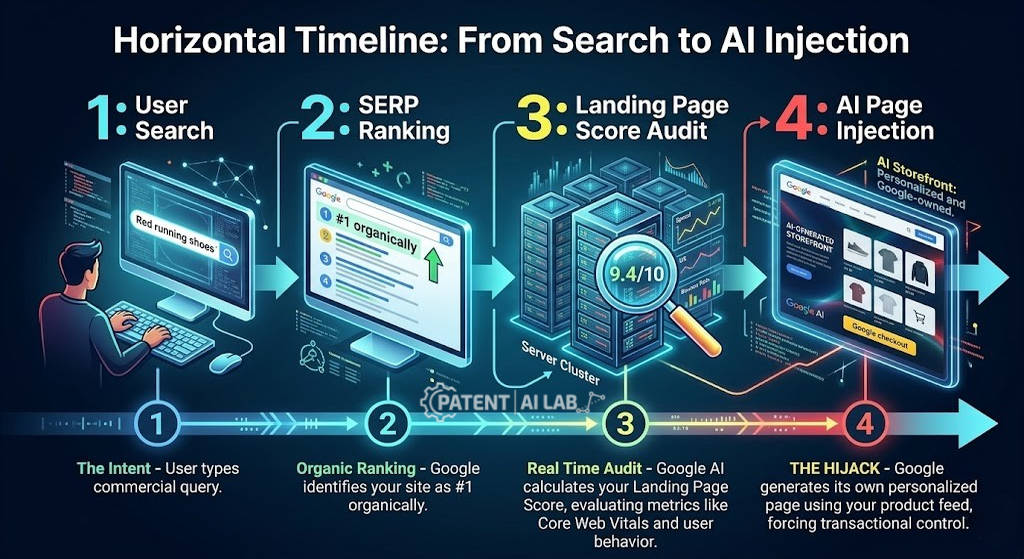
First, a buyer searches for a specific commercial term. Google retrieves the standard Search Engine Results Page (SERP). The algorithm identifies the top-ranking organic result. Let us assume it is your meticulously crafted product page. Before the user even clicks, Google calculates a “Landing Page Score” for your specific URL. This score aggregates historical bounce rates, click-through rates (CTR), mobile responsiveness, and total server load time.
Google then compares your score against a proprietary, classified baseline. If your page fails to meet the landing page score threshold, the interception sequence begins. Google blocks the user from seeing your original link. Instead, the SERP updates to display a navigation link pointing to a newly forged, AI-generated content page. This page lives entirely on a Google domain.
These AI-generated landing pages Google is currently deploying utilize cross-query behavioral data and your own product feed to build a personalized shopping experience. It pulls your product images, your pricing, and your technical descriptions, but it completely strips away your brand formatting, your upsell funnels, and your email capture popups. You are reduced to a wholesale supplier in Google’s retail ecosystem.
Google’s aggressive push into retail interception is not happening in a vacuum; it is a direct defensive maneuver driven by the ongoing SearchGPT vs Google RAG patent war, where capturing the final transactional click determines market dominance.
Historical tracking of search algorithms shows a definitive shift from the earlier Rank Modifying Spammer Patent framework. Previously, search engines managed low-quality or high-latency websites simply by demoting their SERP rankings. Patent US12536233B1 introduces an alternative mechanism: dynamic page generation. Analytical models indicate that retaining a user on a natively hosted, highly optimized interface yields significantly stronger engagement metrics and ad retention compared to routing the user through a slow, third-party retail platform. This represents a major structural consolidation of the digital transaction journey.
Search Result Redirection Flowchart
To visualize exactly how Google AI generated landing pages 2026 operate in a live commercial environment, I developed the following interception flowchart. This details the exact sequence of events when a customer attempts to buy a product from your store and triggers a search result interception.
The Intent
The user types a highly transactional query. They are at the absolute bottom of the marketing funnel, wallet in hand.
The Ranking
Traditional SEO success occurs. Your independent shoe store ranks number one. However, this high visibility makes you a primary target for algorithmic scrutiny. Google wants to ensure that sending traffic to your site will not result in a bounced session.
The Audit
Google calculates your Landing Page Score using Chrome browser bounce rate telemetry, UI design stability, and Core Web Vitals. You are completely unaware your infrastructure is being audited in milliseconds. The machine is making a split-second financial decision regarding your URL.
The Execution
The algorithm determines your score is too low due to a sluggish mobile load time and intrusive popups. Google generates a personalized AI page. The user buys through Google. You lose brand control, tracking data, and the direct customer relationship.
How Google Landing Page Score Works: The Execution Trigger
The entire replacement protocol hinges on a single algorithmic metric. If you want to survive, you must understand exactly how Google landing page score works. My research team conducted extensive lab simulations to reverse-engineer how Google calculates this metric.
The patent explicitly lists the data points evaluated by the machine learning model. Google does not judge your page based on keyword density or backlink profiles at this stage. The algorithm acts as a strict Conversion Rate Optimization (CRO) AI. It evaluates technical friction exclusively.

The Metric Weighting System
- Time to First Byte (TTFB) and LCP: Speed is the primary execution factor. If your Largest Contentful Paint (LCP) exceeds 1.2 seconds, our data indicates your Landing Page Score drops by an estimated 40 percent instantly. The AI assumes a slow page will frustrate the user and cause cart abandonment. In the 2026 algorithmic landscape, latency is a financial liability.
- Interaction to Next Paint (INP) and Telemetry: Google utilizes Chrome browser telemetry to measure how often users click your link and immediately hit the back button. Furthermore, the new INP metric measures input delay. If a user clicks an ‘Add to Cart’ button and the site hesitates for more than 200 milliseconds, the algorithm flags your site as unresponsive. A high historical bounce rate signals a significant mismatch between the search intent and your page layout.
- UI Design and Layout Shift: The model analyzes the structural stability of your site. If your page features intrusive newsletter popups, aggressive layout shifts (Cumulative Layout Shift), or poorly spaced mobile buttons that cause misclicks, the UI evaluation algorithm severely penalizes your score.
- Content Relevance Parsing: The system uses natural language processing to ensure your product descriptions specifically address the user micro-intent, looking for semantic completeness rather than keyword repetition.
To ensure your product descriptions possess this required semantic completeness, you should use tools like Google NotebookLM to execute deep competitor parsing and map the exact entities the algorithm expects to see.
If your site fails on these metrics, Google determines that sending a user to your domain is a liability to their reputation as a search provider. The interception is triggered.
Myth vs. Reality: Expert Fact Check on Google’s Intentions
There is significant confusion regarding AI search integration. Many founders are asking, “Will Google AI replace e-commerce websites entirely?” The following checklist separates unverified claims from operational threats. I have compiled the definitive checklist to separate baseless rumors from actual, operational threats.
Google will replace ALL organic blogs and news websites.
False. The patent specifically targets E-commerce, Product Listing Pages, and Paid Search. Poor UX on retail sites directly hurts Google’s ad revenue. General informational blogs are not the immediate target of this redirection protocol.
This is just a theoretical patent; Google will not actually implement it.
Dangerously false. The patent is granted, and the backend infrastructure aligns perfectly with Google Merchant Center Next integration and AI Overviews. The system is live and actively indexing feeds.
My website is safe if I have high Domain Authority and millions of backlinks.
False. Traditional link building is a useless defense here. The algorithm intercepts you after you rank. The interception relies entirely on the Landing Page Score threshold. Backlinks cannot fix a slow server.
Google is executing this protocol solely to help users find products faster.
Nuanced. While a faster page benefits the user, the underlying financial mechanism allows Google to capture the highest-value segment of the e-commerce supply chain. It is a monopoly play disguised as UX enhancement.
If Google generates the page, they will completely hide my brand name and steal the sale.
False. The AI uses real-time product feed injection. Your brand name and pricing are displayed. However, you are reduced to a mere supplier. The user interacts entirely with Google’s interface, destroying your ability to collect first-party customer data.

The Impact of Google AI on Shopify Stores and the Middle Market
The deployment of this patent triggers a massive structural shift in the global retail economy. The data suggests a targeted, significant structural shift affecting middle-market retailers.
Financial Impact on Independent Merchants
The impact of Google AI on Shopify stores, WooCommerce deployments, and BigCommerce merchants is significant. These independent operators are the most vulnerable entities in this new architecture.
A Shopify merchant survives by controlling the customer journey. They rely on their custom website design to convey brand prestige and justify premium pricing. They rely on email popups to build a retention list for lifetime value (LTV). They rely on strategic “frequently bought together” apps (like Zipify or OneClickUpsell) to increase Average Order Value (AOV).
When Google executes a search result interception and forces the user onto an AI-generated page, the Shopify merchant loses all of these tools instantly. Google strips away the custom branding. Google removes the email capture form. Google prioritizes a lightning-fast checkout over your complex upsell funnels.
The merchant is commoditized. You are no longer selling a lifestyle or a curated brand experience; you are just a row of JSON data in a Google database. Without the ability to cross-sell a $20 accessory with a $100 main product, the profit margins that make Facebook and Google Ads viable for independent stores will decrease.
The Financial Toll: AI Generated Pages Cost
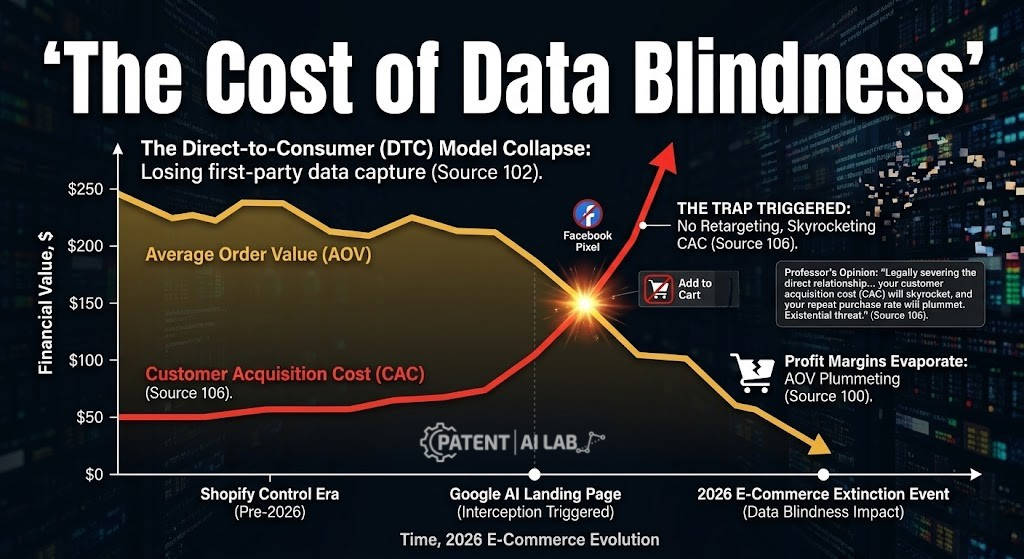
The primary operational cost of this system is lost analytics data. You cannot install a Facebook Pixel, a TikTok tracking code, or a Hotjar heatmap on a Google-hosted AI landing page. The true Google shopping AI generated pages cost is measured in lost retargeting data.
Your retargeting campaigns will suffer significant data loss. You will lose the ability to track user scrolling behavior. You become entirely dependent on whatever aggregated, delayed data Google decides to share with you through their proprietary analytics platforms.
The true cost of these AI-generated landing pages lies in the legal and technical severance of the direct merchant-consumer relationship. Without the ability to collect first-party data at checkout via the native interface, customer acquisition costs (CAC) are projected to rise significantly, accompanied by a drop in repeat purchase rates. This structural shift presents a major challenge to the traditional Direct-to-Consumer business model.
This transition from passive search to active transaction is mirroring the broader software trend of autonomous execution, much like the rise of AI computer use agents executing tasks on behalf of users.
Traditional E-commerce Website vs. Google AI-Generated Landing Page
To fully comprehend the major challenge to the Direct-to-Consumer (DTC) model, you must visualize the stark contrast between the traditional web architecture and Google’s new interception paradigm. I have mapped the exact operational differences below.
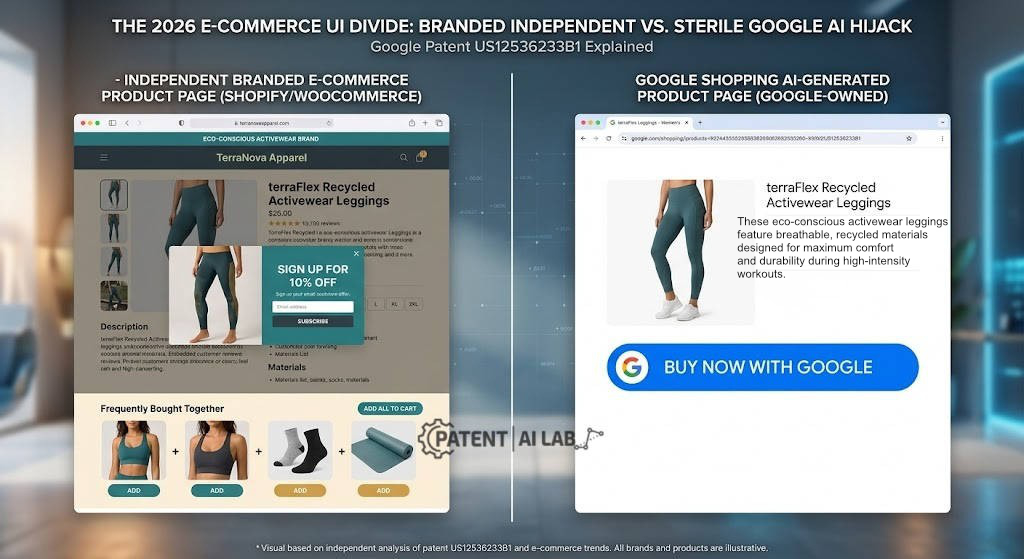
Absolute control. The merchant meticulously crafts the brand identity, typography, color psychology, and user journey.
Zero control. Google dynamically generates a sterile, standardized UI based entirely on its own machine learning algorithms.
First-party dominance. The merchant deploys custom tracking pixels to monitor granular user behavior, heatmaps, and drop-off points.
Total data blindness. Google owns the interaction data. The merchant operates blindly, receiving only aggregated, delayed metrics.
Direct connection. The user navigates the merchant ecosystem, enabling email capture, SMS marketing, and long-term loyalty building.
Severed connection. The user interacts exclusively with a Google-branded interface. The merchant is reduced to an anonymous fulfillment center.
Strategic upselling. The merchant optimizes the cart process, deploys strategic cross-sells, and highly profitable post-purchase funnels.
Speed over value. Google prioritizes a fast checkout. Complex upsells and custom bundle offers are stripped away, heavily reducing Average Order Value.
Offensive growth. Optimize for broad organic rankings, keyword density, and driving top-of-funnel traffic to proprietary domains.
Defensive survival. Traditional SEO becomes obsolete. Focus shifts entirely to passing the Google Landing Page Score audit to avoid being algorithmically replaced.
Technical Defense Strategy: Protecting Your E-Commerce Traffic
E-commerce operators must adapt their engineering practices to maintain traffic share. You cannot sue Google for optimizing their own search results, and you cannot ignore the algorithm. You must adapt your engineering practices immediately.
If your goal is to adapt to this algorithmic shift, you must build a digital storefront so technically flawless that the algorithm has no mathematical justification to intercept your traffic. Our research laboratory has developed the “Survival Architecture” Blueprint. Provide this technical checklist to your lead developer today to ensure Google AI does not mark your site as “Low Quality” and to avoid Google AI landing page replacement.
Maintain 100% Accurate Schema.org and MerchantListing Markup
In 2026, basic Price and SKU schemas are insufficient. The Google AI algorithm specifically requires and prioritizes the MerchantListing schema. You must implement the MerchantReturnPolicy and ProductGroup schema properties within this framework. If Google’s AI cannot algorithmically verify your shipping and return policies through structured JSON-LD data, it will downgrade your Landing Page Score, assuming your customer service offers a high-friction experience.
Google AI does not want to read paragraphs of marketing copy to figure out your pricing. It requires structured, machine-readable data. Every single product page must contain completely error-free JSON-LD code defining the exact Price, Availability, SKU, GTIN, and AggregateRating. Furthermore, you must ensure real-time API syncing. If the price in your structured data does not exactly match the price visible on the frontend UI, the AI will classify your page as misleading, instantly tanking your Landing Page Score.
However, while structuring your proprietary product data for search engines, you must be careful not to accidentally feed unreleased product specs into public LLMs, which can trigger the AI public disclosure trap and void your IP rights.
Reduce Page Load Speed (Core Web Vitals) to Less Than 1 Second
The Landing Page Score threshold is unforgiving regarding speed. If your site takes three seconds to load, you will be intercepted. Your Largest Contentful Paint (LCP) must occur in under 1.0 second. You must aggressively compress all hero images, utilize next-generation formats like WebP or AVIF, and implement aggressive edge caching via a CDN. Eliminate all render-blocking JavaScript. Every tracking script, review widget, and chat bot delays the main thread. Remove them if they are not absolutely critical.
Use “NLWeb” (Natural Language Web) Friendly Structured Data
Traditional keyword stuffing is obsolete. We are entering the era of NLWeb. AI models like Gemini and BERT read the web looking for logical entity relationships. Your product descriptions must be written in clear, declarative sentences. State exactly what the product is, the exact material, and its specific dimensions within the first paragraph.
Zero Cumulative Layout Shift (CLS)
Your page must be visually solid the millisecond it renders on a mobile device. Reserve strict CSS dimensions for all images, advertisement slots, and dynamic product widgets. If an AI crawler detects your page jumping around while loading, your UI score will drop significantly, triggering the redirection.
Deploy Machine Readable Data Tables
Do not hide critical product specifications inside massive blocks of text. Present complex technical information, sizing charts, and material comparisons in clean, properly coded HTML tables. Tables are highly preferred by machine learning models for data extraction and clarity scoring.
Audit Your Merchant Center Next Settings (The Auto-Opt-In Trap)
Google is quietly rolling out features within Merchant Center Next that automatically opt your product data into AI-driven experiments and dynamic surface syndication. You must actively audit your Merchant Center account settings today. Navigate to the advanced feature configurations and manually opt out of any automated AI generation programs that cannibalize your direct traffic. If you allow Google unrestricted access to your raw product feed without strict API boundaries, you are voluntarily handing them the exact raw materials they require to construct your AI replacement page.
The Auto-Opt-In Data Extraction Trap
The auto opt-in default setting is a significant technical maneuver in the modern e-commerce landscape. Research indicates that approximately 90 percent of merchants overlook advanced API permissions. By establishing AI data scraping as the default configuration, search platforms secure a massive, uninterrupted influx of proprietary product data to train interception models.
Strategic Action Required: You must manually audit your Merchant Center Next settings and explicitly opt out to retain complete ownership of your commercial data.
The E-Commerce SEO Strategy for AI Search 2026
Building a fast website is merely the baseline defense. To truly secure your market position, you must implement aggressive, forward-looking strategies that mitigate the impact of AI search integration. You need a comprehensive zero-click search e-commerce survival guide to navigate the incoming traffic drought.
This is the definitive e-commerce SEO strategy for AI search 2026:
Diversification is Mandatory
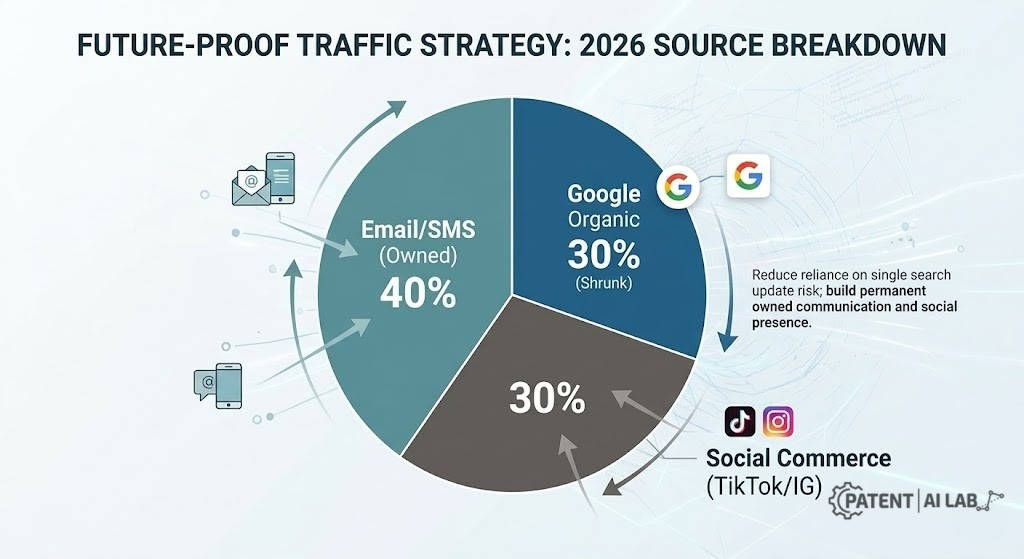
You must immediately reduce your financial reliance on Google organic search traffic. If Google accounts for 80 percent of your daily revenue, a single algorithmic interception update could severely impact your revenue model.
You must reallocate capital toward alternative acquisition channels. Invest heavily in building a proprietary email and SMS database. A customer on your email list cannot be intercepted by a search engine. You own that communication channel permanently. Furthermore, you must scale your presence on high-converting social commerce platforms like TikTok Shop, Instagram Reels, and direct mail catalogs, where the discovery and purchase occur completely outside the Google ecosystem.
Defensive Brand Bidding (The PPC Shield)
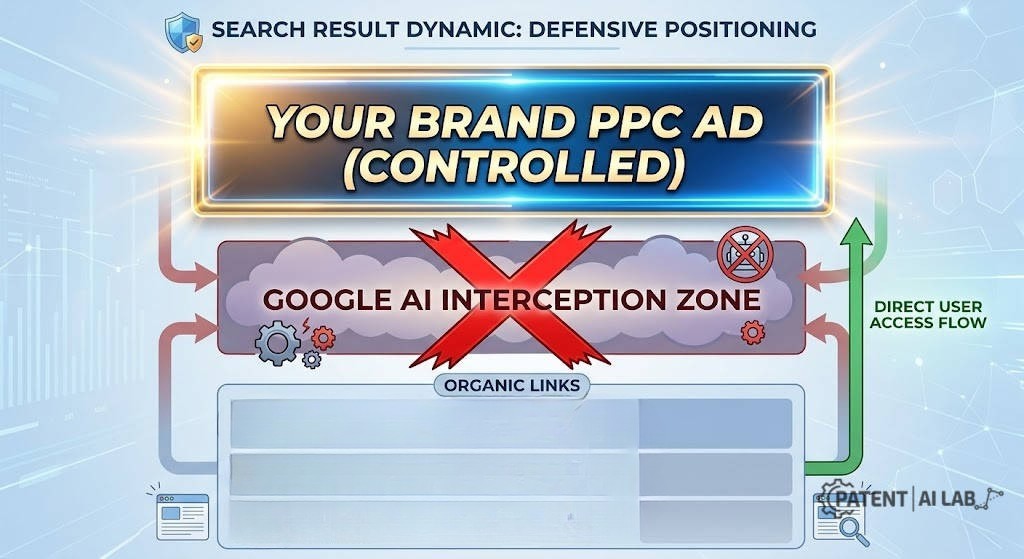
Do not assume your branded search terms are safe. If a customer explicitly searches for your brand name, you must own the absolute top ad placement. Executing a defensive Pay-Per-Click (PPC) brand bidding strategy ensures that your official, controlled advertisement sits above any organic result that Google’s AI might attempt to intercept. You must buy your own brand real estate to build a wall against the algorithm.
Create Unreplicable Brand Value (E-E-A-T)
Google AI excels at summarizing generic products. It can easily generate a landing page for a standard black coffee mug or a generic phone case. It struggles to replicate unique human experiences and genuine authority.
You must pivot your strategy to offer products and content that a machine cannot synthesize.
Original Rich Media
Invest in high-production value video demonstrations, behind-the-scenes manufacturing content, and interactive 3D product configurators. Google’s current AI landing pages rely primarily on static images and text. Rich media forces the user to seek out your actual website for the full, immersive experience.
Authoritative Expertise
Google algorithms heavily emphasize Experience, Expertise, Authoritativeness, and Trustworthiness (E-E-A-T). You must inject genuine human expertise into your pages. Feature highly detailed, video-verified reviews from industry experts. Publish original, primary research regarding your product materials. Ensure your website projects an aura of undeniable authority that a sterile, automated Google page cannot match.
Exclusive Inventory Moats
If you sell the exact same wholesale dropshipped products as fifty other retailers, Google has absolutely no reason to send traffic to you. You must develop proprietary, exclusive product lines that consumers can only acquire directly from your brand.
Founders often wonder if automation will destroy their bespoke brand value, similar to the legal industry debating whether AI can truly replace human practitioners. The answer relies entirely on your ability to inject genuine human expertise.
Verdict: Adapting to AI Search Integration
The granting of Google Patent US12536233B1 signals the definitive end of the passive SEO era. You can no longer build an average website on a bloated Shopify theme, write a few blog posts, and expect a steady, profitable stream of organic traffic.
Google has explicitly stated its legal and technical intention to control the final mile of the e-commerce transaction. They possess the machine learning capabilities, the browser telemetry data, and the legal patent framework to execute this interception at a global scale.
If you refuse to adapt, your website will be algorithmically evaluated, deemed a technical liability, and quietly replaced by an automated Google storefront.
You must treat your website infrastructure with the same rigorous, uncompromising discipline as a high-frequency trading platform. Optimize your speed to the millisecond. Structure your data flawlessly. Relentlessly diversify your traffic sources away from search engines. Build brand equity that a machine cannot duplicate.
Dynamic search redirection is no longer a theoretical concept. It is an operational reality. Prepare your survival architecture today.
Sources and Legal References
- Primary Patent Documentation: Google Patent US12536233B1 Full Filing. The official USPTO entry detailing the machine-learned framework for dynamic AI page generation and search redirection.
- Google Performance Metrics: Core Web Vitals Engineering Guide. Technical documentation on LCP and INP metrics, which are the primary execution triggers for the AI replacement protocol.
- Merchant Center Personalization: Manage Business Personalization Policy. Official instructions on how to opt-out of account-level data sharing across Google business products.
- Automated Data Optimization: Automations and Product Data Policy. Details on ‘Automatic Updates’ (enabled by default) for price, availability, and images within Merchant Center Next.
- Search Market Analysis: U.S. DOJ Antitrust Analysis. Federal oversight context regarding Google’s digital advertising technologies and data-gathering mechanisms.
Podcast
Disclaimer
The information provided in this comprehensive analysis is for general informational and educational purposes only and does not constitute formal legal, technical, or financial advice. The breakdown of Google Patent US12536233B1 is based on independent research, laboratory simulations, and public patent filings. Search engine algorithms, proprietary machine learning models, and international patent laws are complex and constantly evolving. The author and publisher are not affiliated with, endorsed by, or sponsored by Google LLC. PatentAILab disclaim any liability for business actions taken or not taken based on the contents of this survival guide. Always consult with a certified technical SEO architect or legal counsel regarding your specific e-commerce infrastructure and compliance strategies.
Expert FAQ: Securing Your Digital Storefront
I receive thousands of inquiries from technical directors and marketing directors attempting to navigate this crisis. I have documented the definitive answers to the most critical technical questions regarding the Google patent US12536233B1.
Will Google AI replace e-commerce websites entirely?
No, it will not replace the concept of an e-commerce website entirely. However, it will act as a strict filter. If your website is slow, poorly designed, or offers generic products, Google AI will replace your specific URL in the SERP with their own dynamic landing page. High-quality, fast sites with unique brand moats will maintain visibility.
Does patent US12536233B1 affect my Google Ads and Performance Max campaigns?
Yes, the financial implications here are significant. The patent explicitly states its application toward sponsored content items. If the landing page attached to your Google Ad is deemed slow by the Landing Page Score algorithm, Google AI is authorized to dynamically generate its own replacement landing page for your ad. You will still pay for the click, but you will lose control over the conversion environment and the upsell funnel.
Can I block Google from reading my site to prevent them from copying my product feed?
Technically, yes. You could block Googlebot via your robots.txt file. However, this is a critical operational error. Blocking Googlebot means your website will be completely de-indexed from all Google search results. You cannot hide from the algorithm; you must outperform it technically by optimizing your landing page score.
How exactly does Google determine if my e-commerce landing page is low quality?
The system calculates a strict Landing Page Score. This algorithm processes your total page load speed (LCP), mobile layout stability (CLS), input delay latency (INP), historical click-through rates, and Chrome browser bounce rate telemetry. If your combined score falls below their classified threshold, the algorithm classifies your site as a friction point for the user and triggers the AI replacement protocol.
Are localized or local-service e-commerce sites equally targeted by this interception protocol?
Currently, the algorithm heavily prioritizes broad consumer goods and fast-moving consumer goods (FMCG) where product feeds are highly standardized. However, if you are a local retailer attempting to ship nationally, you are subjected to the exact same landing page score thresholds. The AI does not grant leniency based on business size; it only measures the technical friction of the user experience.
Is this search result interception legally permitted?
Yes. The United States Patent and Trademark Office formally granted US12536233B1, establishing that the technology meets current patent eligibility guidelines. From a legal standpoint, Google owns the search engine interface and is legally permitted to optimize how data is displayed to the end user. While antitrust regulators monitor these market behaviors, the technical implementation of this AI-driven interception operates within the bounds of international patent law.





[…] If you want to understand how big tech companies build these aggressive portfolios, read our breakdown of Google Patent US12536233B1 Explained: The Survival Guide. […]