


 Golam Rabiul Alam, PhD
Editorial note: The content on this website is provided for informational and educational purposes only and does not constitute professional legal, financial, or technical advice. See disclaimer below.
As a computer scientist working in AI, I spend a lot of time analyzing how to copyright ai art and where an automated system’s output stops and human judgment begins. That question turns out to sit at the center of one of the more consequential legal debates facing anyone building on generative tools today. This piece is a technical and case-law analysis of that boundary: how the U.S. Copyright Office and federal courts have drawn the line between raw AI output and human authorship, and why the underlying architecture of tools like Midjourney, Sora, and Suno makes that line harder to locate than it first appears. It draws on the Copyright Office’s own published decisions, its Part 2 Copyrightability Report, and the federal court dockets tracking these disputes as they unfold. I want to be upfront about what this article is and is not: I am a computer science researcher and patent holder, not a licensed attorney, and nothing here is legal advice for a specific project or filing. Where a question genuinely turns on the facts of a particular case, that is exactly the kind of question a licensed copyright attorney should answer, and I say so explicitly throughout.
Why a Midjourney Subscription Does Not Buy Copyright
A paid Midjourney, Sora, or Suno subscription does not, by itself, create any federal intellectual property right in what that tool generates. This is not a theoretical curiosity. It is the single most common misunderstanding I encounter when looking at how creators and technologists structure AI-assisted workflows, and it has already been tested, repeatedly, in federal court and before the Copyright Office’s own Review Board.
What the Ruling Actually Decided
A common assumption among creators generating large volumes of AI assets is that paying for the subscription and crafting a detailed prompt is enough to establish ownership. The case law says otherwise. In Thaler v. Perlmutter, the D.C. Circuit affirmed on March 18, 2025 that the Copyright Act requires a work to be authored, in the first instance, by a human being. The Supreme Court denied the petition for certiorari (Case No. 25-449) on March 2, 2026, which leaves that ruling final and binding nationwide. It is worth being precise about what that specific case decided: Dr. Stephen Thaler sought registration for an image his AI system, DABUS, generated entirely on its own. Thaler told the Copyright Office he had neither prompted the system nor made any subsequent edits, and he named the AI itself as the sole author, claiming no human creative contribution whatsoever. The court’s holding addresses that narrow scenario directly. It does not, by itself, resolve every question about how much human editing is enough to qualify for protection — a point the Supreme Court’s own denial of review implicitly left open, and a question this analysis returns to in the sections that follow.
The practical consequence of that narrow holding is still significant. Where a competitor copies an unedited AI-generated image, a copyright-based claim generally will not succeed, because the U.S. Copyright Office treats raw output as falling outside the scope of protectable authorship in the first place. This applies identically whether the medium is a static image, a Sora-generated video, or a Suno-composed song. The output of a generative model, standing alone, does not qualify, regardless of how the underlying model was trained or how sophisticated its architecture is.
At a Glance: How AI Copyright Actually Works in 2026
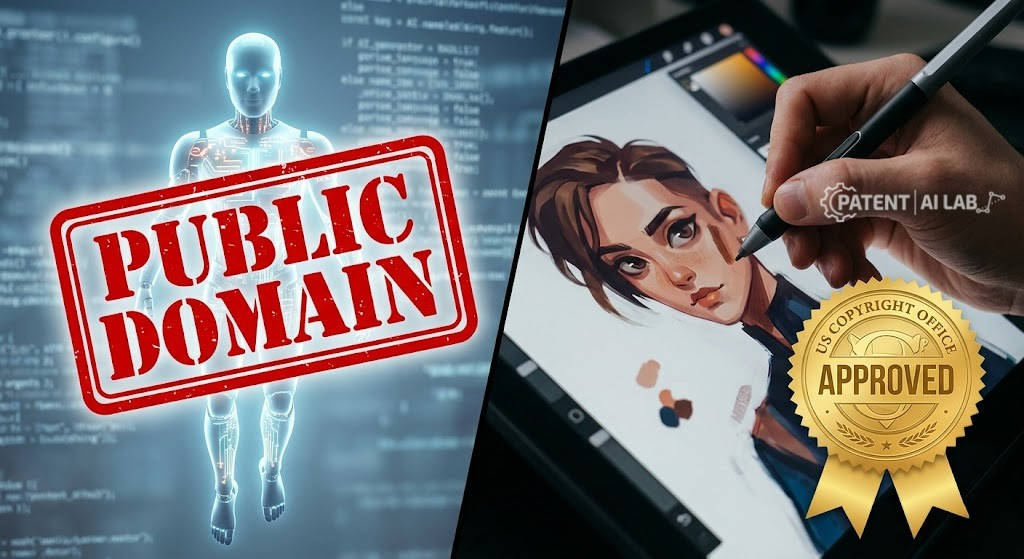
There is, however, a well-established and specific path forward. A creator cannot copyright the machine’s raw output, but they can copyright their own human contribution layered on top of it. Understanding exactly where that line sits, and why the technology behind these tools makes it sit there, is the single most useful piece of context for anyone building on AI-assisted creative work this year.
- The baseline rule: Raw, unedited AI output from tools like Midjourney, Sora, or Suno generally falls outside copyright protection. A text prompt alone does not establish authorship, even after hundreds of iterations.
- The protectable path: Federal copyright can cover the specific, manually executed human modifications, such as structural edits or overpainting, applied on top of an AI base layer.
- The disclosure requirement: Current guidance calls for identifying AI-generated elements on a federal registration application when a work contains more than a de minimis amount of such material.
- Contract versus federal right: A commercial-use license granted through a platform’s Terms of Service is a private contractual permission, not a substitute for federal copyright ownership.
- An open question in active litigation: Artist Jason Allen’s federal appeal challenging the Office’s refusal to register Théâtre D’Opéra Spatial remains before the District of Colorado as of this writing, discussed in detail below.
- An international contrast: The United Kingdom’s Copyright, Designs and Patents Act 1988 takes a different approach to computer-generated works entirely, discussed later in this piece.
What follows is an analysis of how that disclosure framework is structured and why it exists — not a walkthrough of how to complete a specific registration form. For the mechanics of an actual filing, the Copyright Office’s own instructions, or a licensed attorney, are the right resource.
The Human Authorship Standard and the Technical Reason It Exists
Understanding how AI-assisted work is treated starts with understanding how the federal government defines authorship in the first place. U.S. copyright law exists to protect “original works of authorship,” and the U.S. Copyright Office and federal courts have consistently interpreted authorship as requiring a human origin. A camera can capture an image, but the human photographer holds the copyright, because they arranged the lighting, composed the frame, and chose the precise moment of capture. The creative judgment, not the mechanical device, is what the law protects. That same logic runs through more than a century of U.S. copyright jurisprudence, from early debates over whether photography itself could be authored, to the Copyright Office’s current framework for evaluating generative AI.
There is a genuinely technical reason this analogy breaks down for most generative AI tools in a way it does not for a camera, and it is worth spelling out plainly. A camera is a deterministic instrument: the same settings, pointed at the same scene, produce the same image every time, and every pixel traces back to a choice the photographer made about light, framing, or timing. A diffusion or transformer-based generative model is not deterministic in that sense. It samples from a learned probability distribution over a vast latent space, and running the same prompt twice, or perturbing it slightly, can produce meaningfully different results. The user supplies an instruction; the system, not the user, resolves that instruction into the specific arrangement of pixels, words, or notes that appear in the final output. That gap between instruction and execution is the analytical thread connecting the Thaler decision, the Copyright Office’s guidance documents, and the individual registration decisions examined throughout this piece.
Why a Prompt Alone Does Not Establish Authorship
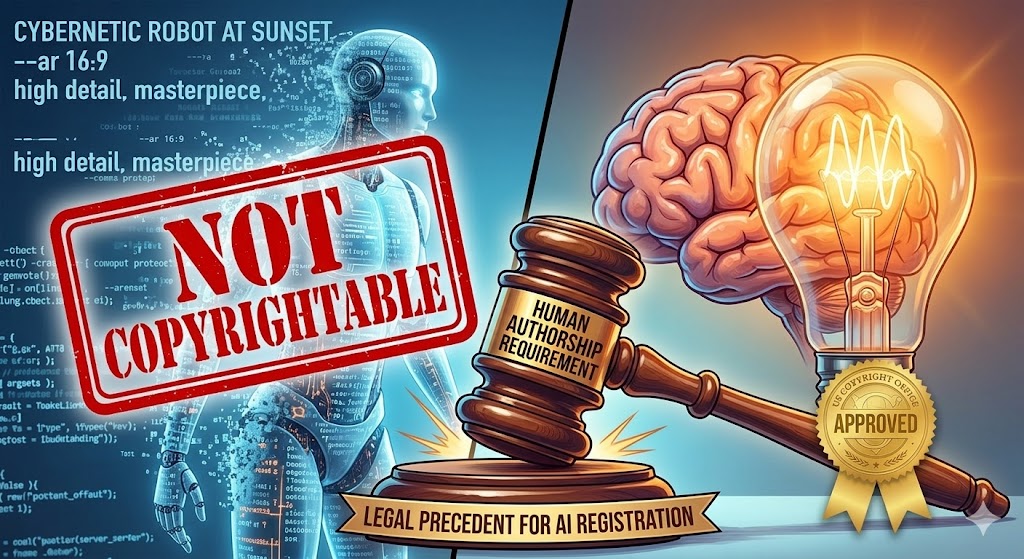
This is a difficult distinction for many creators to accept, but it is worth being direct about it: writing a prompt, however detailed or iteratively refined, is not itself treated as authorship under current U.S. Copyright Office guidance.
A genuinely complex, carefully engineered prompt can represent real skill and judgment about what to ask for. The Office’s position, though, is that a prompt functions more like detailed instructions given to another party than like the act of authorship itself. If a person tells a human illustrator, “draw me a futuristic city at sunset with flying cars, in a cyberpunk color palette, with dramatic lighting,” they have given a detailed creative brief. The illustrator, not the person who wrote the brief, holds the copyright in the resulting drawing, because the illustrator is the one who executed the actual expression.
The Copyright Office’s 2023 Registration Guidance addressed this directly, explaining that because current text-to-image systems do not treat prompts as instructions for a specific, predictable result but rather as a starting point the system then interprets unpredictably, the user does not exercise the kind of control over the final image that authorship requires. This is precisely the stochastic-sampling behavior described above, expressed in legal rather than technical terms: a person entering a prompt occupies roughly the position of the client giving instructions, not the artist executing them, and current guidance treats that distinction as decisive.
This same reasoning surfaced again in one of the Office’s most closely watched and most misreported decisions, involving digital artist Jason M. Allen. Allen used Midjourney to generate an image he titled Théâtre D’Opéra Spatial — French for “Space Opera Theater” — which won a digital art award at the 2022 Colorado State Fair and, once its AI origins became public, ignited a national debate about machine-assisted creativity. Allen entered at least 624 iterative text prompts, then further refined the resulting image using Adobe Photoshop for cosmetic cleanup and Gigapixel AI for resolution upscaling. On September 5, 2023, the Copyright Office’s Review Board issued its final decision letter, affirming a refusal to register the work as submitted. The Board did not dispute that Allen’s Photoshop edits could reflect genuine human authorship, and it accepted that those specific edits could, in principle, be registered on their own. What sank the application was that Allen refused to disclaim the Midjourney-generated and Gigapixel-generated portions from his claim, insisting on protection for the piece as a whole. Because the Board found the underlying AI-generated content was more than de minimis and Allen would not exclude it, the entire application was denied — not because no human contribution existed, but because the application did not isolate it correctly.
What the Office Actually Looks For
Registration decisions and Review Board rulings involving AI-assisted work have repeatedly focused on the same question: how much human creative expression is visible in the specific pixels, words, or notes of the final work, not how much effort or iteration went into producing the prompt that led there. A detailed prompt history, submitted alongside an application, does not on its own establish the human authorship the Office is evaluating for. The genuinely useful distinction the Office has drawn — one this analysis returns to repeatedly — is between disclaiming AI content while registering the surrounding human work, which routinely succeeds, and refusing to disclaim it at all, which is what sank the Allen application.
Allen’s Federal Appeal Is Still Pending
Allen did not stop at the Review Board. On September 26, 2024, he filed a federal lawsuit against the Copyright Office and its Register, Shira Perlmutter, in the U.S. District Court for the District of Colorado (Allen v. Perlmutter, Case No. 1:24-cv-02665), seeking a declaratory judgment that the work is eligible for registration and asking the court to order the Office to register it.
Where the case stands as of this writing: Both sides filed cross-motions for summary judgment, fully briefed by early 2026, and the case remains before the District of Colorado without a ruling on the merits. This matters directly for anyone relying on the Allen Review Board decision as settled precedent: it is currently under active judicial review, and a district court ruling could meaningfully clarify — in either direction — exactly how much documented human editing is enough to save a substantially AI-generated work.
A Practical Note
Because this case is unresolved, this analysis treats the Allen Review Board decision as instructive current agency practice rather than as final, binding case law. Anyone tracking this fact pattern for their own situation should check the case’s current docket status directly on CourtListener’s public docket, since a ruling may have issued after this piece’s publication date.
Commercial Licenses Are Not the Same as Copyright
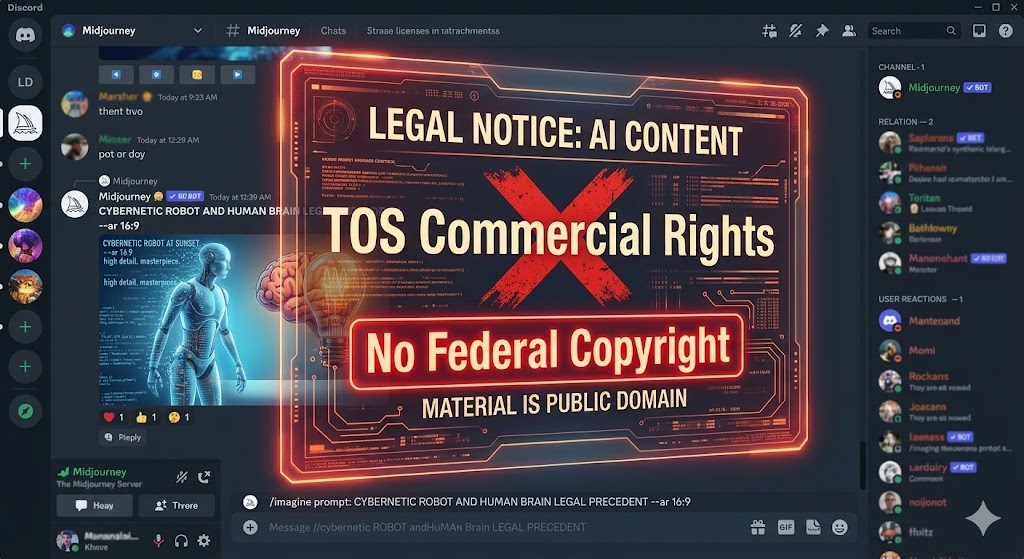
A specific misconception worth addressing directly involves how commercial-use terms from paid AI subscriptions, such as Midjourney, DALL-E, or a Stable Diffusion API plan, actually function legally.
Many subscribers read their platform’s Terms of Service and see language granting paid users broad rights to use, sell, and distribute what they generate, and reasonably conclude this must mean they hold federal copyright in the output. That conclusion does not follow, and understanding why matters for anyone building on generated content at any scale.
A platform’s Terms of Service is a private contract between the platform and its user. In substance, it typically says the platform will not assert a claim against the user for selling what the tool generated, and grants a commercial license to monetize that output without paying royalties back to the platform. What it cannot do is create federal copyright where none otherwise exists. Because a raw, unedited AI image generally lacks the human authorship the Copyright Act requires, no amount of contractual language from the platform changes that underlying legal status. The license and the copyright are two entirely separate legal instruments — one contractual, one statutory — and the gap between them is structural, not a matter of which platform’s fine print a person reads.
Why This Distinction Matters
This gap between a commercial license and actual copyright ownership is not a technicality; it shapes what a creator can and cannot do if a competitor copies the same output. A creator can legally use an unedited Midjourney character on a book cover and sell it commercially, under the platform’s license. But because the underlying image itself is not protected by copyright, a competitor who copies that exact image onto their own cover is operating in a different legal position than someone copying a photograph or a hand-drawn illustration.
The Underlying Legal Gap
Without an independent copyright in the specific image, there is no infringement claim to bring for reproducing that raw output, because copyright law requires an underlying protectable work to infringe upon in the first place. A trademark claim over a logo or brand mark is a separate legal question entirely, and does not substitute for copyright protection in the underlying artwork.
Closing the Gap
Closing this gap requires moving beyond the raw output and adding genuine, documented human creative expression on top of it, which is the subject of the sections that follow.
What the Zarya of the Dawn Decision Actually Established
The clearest illustration of how the Copyright Office treats hybrid human-AI works comes from a specific, well-documented case that remains the reference point for this area of law, and one worth distinguishing carefully from the Allen decision discussed above, since the two are frequently conflated in casual coverage despite reaching the same underlying conclusion through different facts.
In September 2022, artist Kris Kashtanova registered a graphic novel titled Zarya of the Dawn. The initial application did not flag the Midjourney involvement in the images, and after the Office learned of the AI use through Kashtanova’s own public statements, it reopened the registration for review. On February 21, 2023, the Office issued its final decision letter, limiting the original certificate to the work’s human-authored elements rather than canceling it outright.
The Office’s reasoning was specific and remains instructive. It held that the individual Midjourney-generated images themselves were not copyrightable, even accounting for the hundreds of prompt iterations Kashtanova had used to refine them, because the artist did not exercise the kind of direct, predictable creative control over the final image that authorship requires — the same stochastic-system distinction discussed above. The letter also noted that even where an author edits an AI-generated image afterward, the Office cannot always conclude those editing alterations are sufficiently creative to qualify for protection on their own, meaning editing alone is not automatically enough; the depth and documentation of that editing is what the analysis turns on, a point this piece returns to in the next section. At the same time, the Office confirmed that Kashtanova did hold valid copyright in two specific elements:
- The original, human-written text and narrative dialogue throughout the graphic novel.
- The human-authored selection, coordination, and arrangement of the images and text as they appear on each specific page.
This decision directly informed the Office’s broader March 2023 Copyright Registration Guidance, and the same underlying framework was applied again just months later in the Allen decision covered above. It has since been reinforced by the Office’s more detailed Part 2 Copyrightability Report, published in January 2025, which remains the most current and authoritative statement of the Office’s analytical framework as of this writing. Reading Zarya and Allen together is genuinely useful: Zarya shows a creator who registered successfully by clearly disclaiming the AI-generated images and claiming only the compilation and text. Allen shows what happens when a creator with an arguably stronger, more heavily edited fact pattern refuses to make that same disclaimer. The lesson is less about how much editing occurred and more about how the application itself is structured.
So, can a comic book made with AI art be copyrighted? Yes, but what gets protected is the human-authored compilation, the story, and the layout, not the individual AI-generated panels standing alone. A pirate reproducing an entire page, including the original layout and story sequence, faces a real infringement claim. Someone who crops out a single unedited AI-generated background element and reuses it in isolation generally does not.
De Minimis AI Use
The Zarya decision and subsequent Office guidance also help define the boundaries of what counts as de minimis AI involvement, meaning AI use minor enough that it does not require disclosure or threaten the registration.
If AI is used for a genuinely minor part of an otherwise entirely human-authored work, such as using Photoshop’s generative fill to remove a small unwanted object from a photograph a person physically took, that use is generally treated as de minimis. It does not undermine the underlying human authorship of the photograph, and disclosure is not required for that kind of limited, mechanical assistance.
Where the Exception Ends
Once AI generates a core, focal expressive element rather than assisting with a minor mechanical edit, the de minimis exception no longer applies — this was precisely the finding the Review Board made against Allen, whose Midjourney-generated composition, not his later Photoshop cleanup, was found to be the dominant expressive element — and the work needs to be analyzed as a derivative work built on top of uncopyrightable material.
A Pattern Across Published Decisions: Human-Modified AI Content
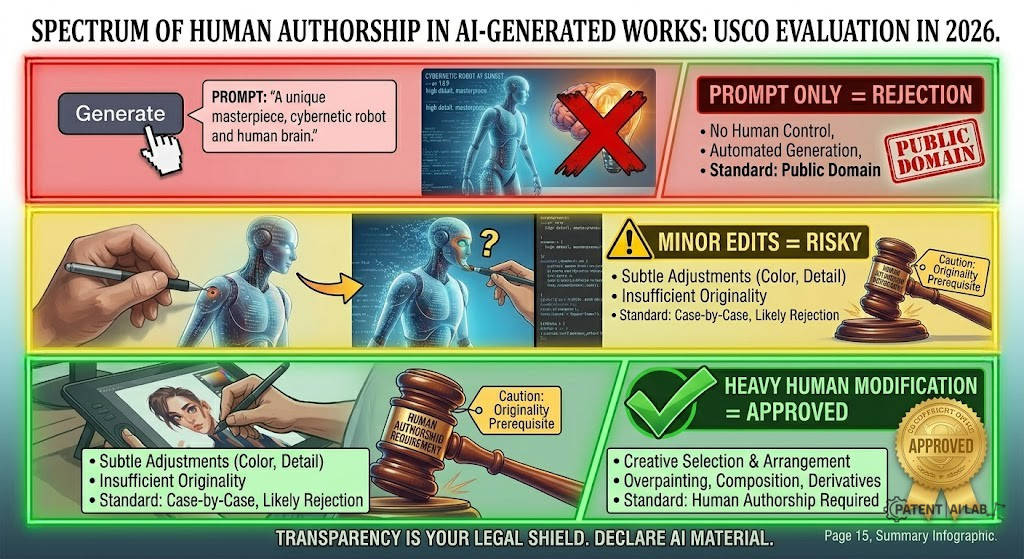
Reading across the Copyright Office’s published decisions, the Part 2 Copyrightability Report, and the currently pending Allen litigation, a consistent pattern emerges in how the depth of human modification maps to registration outcomes. The Office treats raw AI output as unprotected raw material, comparable to a block of digital clay or licensed stock footage, and looks for genuine human creative work built on top of it. What an examiner is trying to identify is a specific human contribution that is creative and transformational, not mechanical or trivial — and, separately from the depth of editing, whether the application itself properly discloses what the AI generated, which is the lesson the Allen case adds to the Zarya framework.
A Pattern of Registration Outcomes
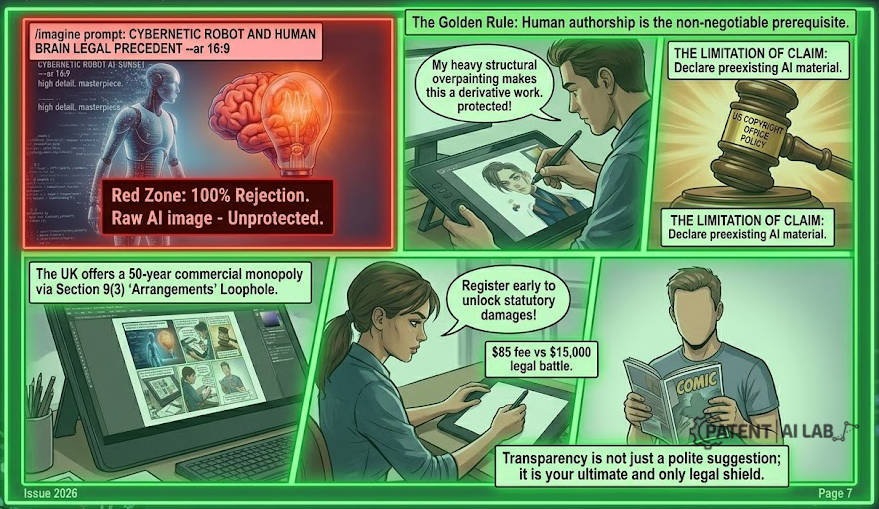
Based on published Review Board decisions, the Office’s Part 2 Copyrightability Report, and the currently pending Allen litigation, three general patterns emerge in the published record.
Pattern: Prompt entered, image generated, uploaded directly with no meaningful human editing.
Pattern: AI output followed by minor mechanical edits, such as basic color correction, cropping, or resolution upscaling.
Pattern: AI output used as a base layer for extensive structural editing, hand overpainting, compositing with original elements, and a custom final composition — properly disclaimed on the application itself.
Reaching the stronger end of that spectrum means meaningfully changing the aesthetic or structural expression of the AI base output, rather than making surface-level adjustments. Across the published decisions, the human contribution that succeeds at registration functions as the dominant creative force in the final result, not as a finishing touch applied to an otherwise unedited machine output. The difference between a five-minute color correction and a multi-hour compositing session is not just a matter of effort; it is the fact pattern an examiner, or later a court, actually looks at — and, as the Allen case illustrates, it sits alongside a separate question of whether the application accurately separates the disclaimed AI material from the claimed human material in the first place.
A Step-by-Step Guide on How to Copyright AI Art
Once a workflow involves genuinely substantial human modification, the Office’s registration framework asks applicants to do something specific: separate the preexisting, uncopyrightable AI-generated material from the new, human-authored material, and describe each category in its own terms. Current guidance requires disclosing AI-generated elements and identifying the human contribution; omitting a material fact about AI involvement can put the resulting registration at risk. That structural requirement, not the specific mechanics of any one federal form, is what is worth understanding here — completing an actual application, and deciding how to characterize a specific work’s contributions, is exactly the kind of task that calls for the Office’s own instructions or a licensed attorney rather than a general analysis like this one.
Conceptually, the framework divides a hybrid work into two categories. Preexisting, AI-generated material is excluded from the claim; it is treated the way a copyright application would treat any other uncopyrightable base material the applicant did not create, such as public-domain source text or licensed stock elements. The new, human-authored material — the specific structural edits, overpainting, compositing, or original arrangement a person actually executed — is what the applicant claims and what the examiner evaluates for the kind of creative, non-mechanical contribution described in the previous section. This is precisely the distinction Jason Allen declined to draw for the AI-generated portions of his work, which the Review Board identified as the specific reason his application could not proceed as submitted.
Separately, it is worth noting that the Copyright Office periodically adjusts its fee schedule to reflect its operating costs, most recently through a proposed rulemaking process working its way through the required period of congressional review as of this writing. That process is a matter of Office administration and is unrelated to the disclosure standard itself; anyone with a live filing decision should confirm current fees directly on the Copyright Office’s official fee schedule rather than relying on a figure quoted in an article like this one.
What the Published Record Shows About Undisclosed AI Use
Some creators consider simply declining to disclose AI involvement, on the theory that an examiner is unlikely to notice. The published decisions discussed throughout this piece suggest that theory is weaker than it looks, and the statutory structure surrounding registration is worth understanding on its own terms, independent of any specific case.
Two Consequences Visible in the Published Pattern
Registration Limitation or Cancellation
If an omission is discovered, whether by the examiner during initial review or through information that surfaces later, the registration can be limited to only the work’s human-authored elements or, in more serious cases, canceled — broadly consistent with the pattern the Office followed in both the Zarya of the Dawn and Allen reviews described above.
A Separate Statutory Timing Requirement
Independent of any disclosure question, the Copyright Act’s structure ties certain remedies, including statutory damages under 17 U.S.C. §504 and attorney’s fees, to registering before infringement began or within three months of first publication, under 17 U.S.C. §412. What any of this means for a specific work, or a specific infringement dispute, is a fact-specific legal question for a licensed attorney, not something a general analysis can resolve in the abstract.
The Pattern, Stated Plainly
Across the published decisions this piece discusses, accurate disclosure at the time of filing is consistently what preserved a registration’s strongest footing if the work was later challenged or infringed.
Where This Analysis Ends and Legal Counsel Begins
For a solo hobbyist thinking through a few personal projects, the analysis above generally covers the conceptual landscape. For a funded startup, agency, or studio building commercial value on AI-assisted workflows, the stakes and complexity increase considerably, and specific scenarios call for a qualified intellectual property attorney directly rather than a general-audience piece like this one. I want to be direct about the boundary of what a computer scientist and patent holder, writing about copyright rather than practicing it, can responsibly cover here: explaining published registration decisions and public court dockets is one thing, but the moment an actual dispute or a high-value transaction is on the table, the analysis becomes genuinely fact-specific in a way that only a licensed copyright attorney reviewing the real documents can properly navigate. This article was not reviewed by an attorney before publication, and every specific legal proposition above is tied to a primary source rather than to a legal opinion of my own.
- Commercializing AI-heavy code: If a startup’s core product relies heavily on AI-generated code from tools like GitHub Copilot or Claude, an attorney conducting an IP audit can help separate the uncopyrightable AI-generated portions from proprietary human logic and structure the resulting “Literary Work” registrations appropriately.
- Pursuing an infringement claim: If a properly registered, substantially human-modified work is copied by a larger entity, pursuing statutory damages under 17 U.S.C. §504 through federal litigation requires the kind of case preparation an experienced litigator provides.
- Enterprise licensing agreements: A creator selling exclusive rights to AI-assisted character designs or other assets to a larger commercial partner benefits from an attorney-drafted licensing agreement that clearly establishes chain of title and avoids future ownership disputes.
- Filing during an unsettled area of law: Given that the Allen litigation described above remains pending and could shift how the Office evaluates similar fact patterns, a studio with significant portfolio value tied to heavily AI-assisted work benefits from counsel who is actively monitoring that docket, rather than relying on a snapshot of the law as it stood at any single point in time.
How UK Law Treats Computer-Generated Works Differently
The strict U.S. human-authorship standard is not universal, and comparing it to another major jurisdiction’s approach is a useful way to see how much of the U.S. position reflects a deliberate policy choice rather than an inevitability of the technology. This divergence is not a minor technicality; it is one of the more consequential structural differences in global IP law for anyone building a content operation across borders, and it was directly raised — and rejected as a controlling argument — during Thaler’s unsuccessful Supreme Court petition, where he specifically pointed to the UK and Chinese approaches as evidence the U.S. rule was out of step internationally.
The UK’s Approach Under Section 9(3)
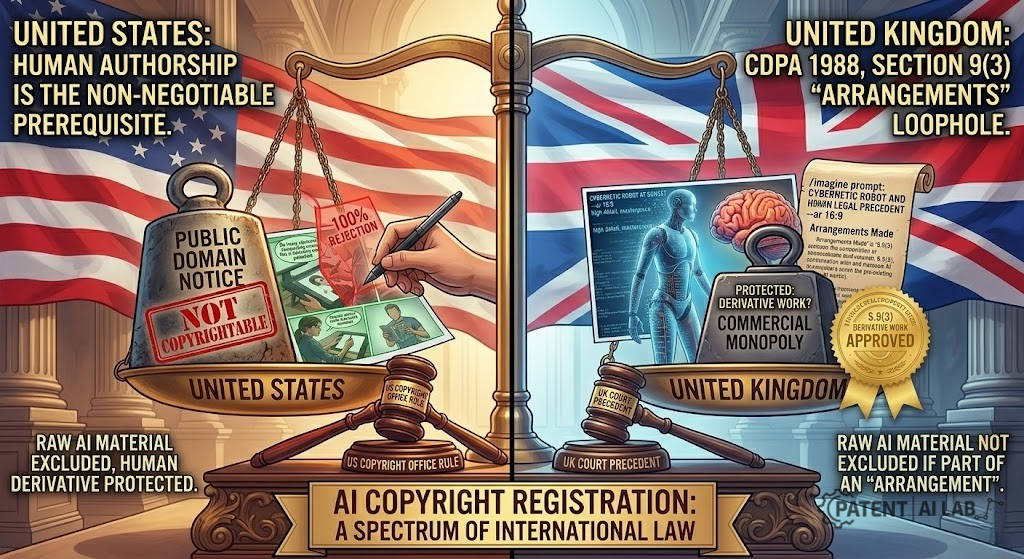
Where U.S. law requires a human to directly execute the expressive elements of a work, the United Kingdom’s Copyright, Designs and Patents Act 1988 contains a specific provision addressing works with no identifiable human author.
Under Section 9(3) of the CDPA, where a work is computer-generated and there is no human author, the statute treats the author as “the person by whom the arrangements necessary for the creation of the work are undertaken.”
What this means structurally: under this provision, the person who initiates and arranges the generation process may be treated as the legal author, even where their direct manual creative input into the final result is minimal — a meaningfully different standard than the U.S. approach, and one that maps far more comfortably onto how a stochastic generative system actually behaves.
US vs. UK: A Direct Comparison
- Core requirement: Direct human authorship of the specific expressive elements.
- Raw AI output: Generally falls outside copyright protection.
- Term: Life of the human author plus 70 years, applying to the protectable human-authored portions.
- Disclosure: Required for more than de minimis AI-generated material.
- Core requirement: A human made the “arrangements necessary” for the work’s creation.
- Raw AI output: Potentially protectable under the computer-generated works provision.
- Term: 50 years from the end of the calendar year the work was made.
- Disclosure: Not explicitly required by statute.
A Structural Observation, Not a Strategy Recommendation
For a business generating substantial volumes of AI content with minimal per-asset human editing, the underlying statutory standard under UK law is meaningfully more permissive for this specific category of work. Whether establishing a genuine commercial presence under a different jurisdiction’s law makes sense for a particular business is a strategic and legal question best worked through with counsel qualified in that jurisdiction — this section is describing how the two frameworks differ, not recommending a course of action.
Technical Safeguards Beyond Copyright Registration
Given how narrowly U.S. copyright currently protects raw AI output, creators and technologists working at meaningful scale are increasingly layering technical provenance and tracking measures on top of legal registration, rather than relying on federal registration alone. This is where the analysis moves from case law back onto more familiar ground for a computer scientist: legal protection and technical protection are complementary tools, not substitutes for one another, and the strongest asset-protection strategies I have seen in patent and IP work generally combine both rather than leaning entirely on one.
Where the underlying copyright claim to a raw image may itself be legally uncertain, making the file technically harder to strip of provenance information, or to reuse undetected, offers a genuinely independent layer of protection that does not depend on how a court eventually resolves the Allen case or any similar dispute.
Technical Safeguards Worth Understanding
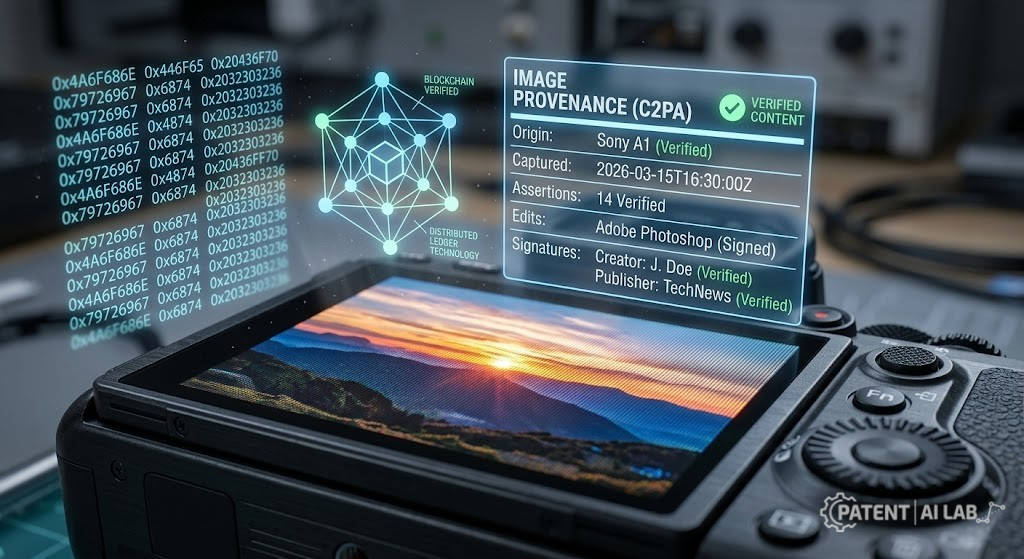
- 1️⃣ C2PA Content Credentials: Embedding C2PA provenance metadata into an exported file creates a verifiable record of the file’s editing history. Stripping that metadata to disguise a file’s origin can itself implicate the DMCA’s integrity-of-copyright-management-information provisions under 17 U.S.C. §1202, creating a separate legal claim independent of whether the underlying image copyright is contested.
- 2️⃣ Invisible Digital Watermarking: Embedding a tracking signal directly into image pixel data, rather than relying on a visible signature alone, provides a way to identify unauthorized copies even after resizing or basic filtering.
- 3️⃣ Cryptographic Timestamping: Hashing a finished file and recording that hash on a public blockchain creates an independently verifiable record that a specific, human-edited version of the file existed at a specific date and time, which can support a later authorship or priority argument.
- 4️⃣ Documented Editing Logs: Retaining layered project files, editing-history exports, and dated iteration records serves a dual purpose: it strengthens a later registration’s supporting record, and it is the exact category of evidence a dispute can surface, so treating documentation as a standing practice rather than an afterthought protects the creator on both fronts.
The Analytical Bottom Line
Across every decision examined in this piece, obscuring AI involvement when filing a federal copyright application has consistently been treated as a misrepresentation with real downstream consequences, not a harmless omission.
Examiners have become increasingly attentive to signs of AI generation, including characteristic visual artifacts and structural inconsistencies, and the D.C. Circuit’s now-final ruling in Thaler v. Perlmutter has only reinforced how seriously the human-authorship standard is being applied across the Office’s decisions. The pending Allen litigation, meanwhile, is the clearest sign that the precise boundary of that standard — not whether it exists, but exactly how much documented human work is enough to cross it — remains an open, actively contested question rather than a settled one.
This regulatory picture, though strict, is also genuinely predictable once the underlying technology is understood. Generative AI can be used to brainstorm concepts quickly and produce raw visual, textual, or audio material at scale, because that is what a stochastic, sampling-based system is built to do. The legally protectable value lives in the documented human creative work built on top of that raw material — which is really just the human-authorship requirement expressed in the vocabulary of how these systems actually function. For anyone building a content or technology business on generative AI at real scale, understanding that boundary, and where the open questions in the case law still sit, is worth treating as a standing part of the picture rather than a one-time read.
Podcast
Note: This audio is a condensed intelligence brief outlining the USCO rules for copyrighting human-modified AI art.
FAQs
Does the Thaler v. Perlmutter ruling mean AI-assisted work can never be copyrighted?
No. Thaler v. Perlmutter involved a work claimed to be entirely AI-generated with no human authorship asserted at all — Dr. Thaler told the Copyright Office directly that he neither prompted the system nor edited the result — which is a narrower fact pattern than most creators actually work with. The ruling, now final after the Supreme Court’s March 2026 denial of certiorari, confirms that fully autonomous AI output cannot be copyrighted, but it does not disturb the separate, well-established path for registering the human-authored portions of a hybrid work, which this analysis covers in detail above.
If I train a custom AI model only on my own original artwork, do I own the copyright to whatever it generates?
Not automatically. Even where the training data is entirely your own original work, the specific new image the model generates is still produced through a stochastic, automated process rather than direct human execution. The output itself is not copyrightable until you apply substantial, documented human modification to that specific new asset.
Can I register AI-assisted work under my LLC or a pseudonym instead of my real name?
Registering under a pseudonym, or as a work made for hire owned by an LLC, is a recognized path under the Copyright Act, but the natural person who actually performed the human modifications still needs to be identified as the author, not the AI system. Where an independent freelancer performs the substantial edits, ownership of that freelancer’s contribution is governed by separate work-made-for-hire and assignment principles under federal law — exactly the kind of agreement-drafting question a licensed attorney should structure before any filing happens, rather than something to resolve from a general article.
Do I need to disclose AI use if I only used it for spell-checking or code formatting?
No. AI used purely as a mechanical assistance tool, such as a grammar checker or a code formatter, falls under de minimis use and does not require disclosure, because it is not generating any of the work’s core expressive content.
How is the human authorship standard for copyright different from the standard USPTO uses for AI-assisted inventions?
They are related but not identical, and the difference is one I think about often given my own work on the patent side. Copyright looks at whether a human directly executed the specific expressive elements of a work. Patent law asks a different question, focused on whether a natural person made a significant contribution to the conception of the claimed invention; the USPTO issued revised guidance in November 2025 confirming that an AI system cannot be named as an inventor, though human inventors may use AI tools throughout the inventive process. This mirrors the earlier Federal Circuit ruling in Thaler v. Vidal, which held that AI systems, not being natural persons, cannot be listed as inventors on patents. Anyone working across both copyright and patent protection for the same AI-assisted project should treat these as two separate legal tests, not one shared rule.
Is the Jason Allen case the same as the Zarya of the Dawn decision?
No, though they are often confused because both reached the same underlying conclusion. Zarya of the Dawn involved artist Kris Kashtanova’s graphic novel, where the Office limited the registration to the human-written text and page arrangement while excluding the individual Midjourney images. The Allen case involves a single image, Théâtre D’Opéra Spatial, where the Copyright Review Board refused registration outright because Allen would not disclaim the AI-generated portions from his claim. Allen has since taken the matter to federal court in the District of Colorado, and that case remains pending as of this writing, making it a genuinely different procedural posture from the closed Zarya matter.
Sources and Legal References
This analysis is based on the following primary copyright-law sources, verified current as of publication:
-
1. U.S. Copyright Office Decision Letter: Zarya of the Dawn
The official February 21, 2023 decision letter limiting the registration for the graphic novel to its human-authored text and compilation, excluding the individual AI-generated images.
Review the Official Zarya of the Dawn Decision Letter -
2. U.S. Copyright Office Review Board Decision Letter: Théâtre D’Opéra Spatial
The official September 5, 2023 final Review Board letter affirming refusal to register Jason Allen’s work as submitted, on the grounds that Allen would not disclaim the more-than-de-minimis AI-generated content from his claim.
Review the Official Théâtre D’Opéra Spatial Decision Letter -
3. Allen v. Perlmutter, No. 1:24-cv-02665 (D. Colo., filed Sept. 26, 2024)
Jason Allen’s pending federal appeal of the Review Board’s refusal, with cross-motions for summary judgment fully briefed as of early 2026. Public docket tracked via CourtListener.
Track the Allen v. Perlmutter Public Docket -
4. Copyright Registration Guidance: Works Containing Material Generated by AI
The U.S. Copyright Office’s March 2023 Federal Register guidance setting the disclosure standard for AI-generated content discussed throughout this piece.
Review the Official 2023 Registration Guidance -
5. Copyright and Artificial Intelligence, Part 2: Copyrightability
The U.S. Copyright Office’s January 2025 report, its most current and detailed statement on how human contributions to AI-assisted works are analyzed for copyrightability.
Review the Official Part 2 Copyrightability Report -
6. Thaler v. Perlmutter, No. 25-449 (Supreme Court Docket); D.C. Cir. Opinion (2025)
The D.C. Circuit’s March 18, 2025 opinion affirming that the Copyright Act requires human authorship, with the Supreme Court denying certiorari on March 2, 2026 under Docket No. 25-449, making the ruling final.
Review the Official Thaler v. Perlmutter Opinion -
7. UK Copyright, Designs and Patents Act 1988, Section 9(3)
The official UK statutory text governing authorship of computer-generated works, the basis for this piece’s comparison between U.S. and UK legal treatment of AI-assisted content.
Review Section 9(3) of the CDPA 1988 -
8. 17 U.S.C. §412, §504, and §1202
The statutory provisions governing the registration timing prerequisite for statutory damages, the statutory damages amounts themselves, and the integrity of copyright management information, all directly referenced in this piece’s discussion of disclosure consequences and provenance metadata.
Review 17 U.S.C. §504 (Statutory Damages)
Disclaimer & Legal Notice
This article’s author, Dr. Golam Robiul Alam, is a computer science professor, AI researcher, and registered patent holder with direct experience navigating federal intellectual property filings on the patent side. He is not a licensed attorney, and this piece was not reviewed by one prior to publication. PatentAILab is an educational publication covering patent law, AI, and technology, not a law firm, and nothing on this site creates an attorney-client relationship. This article is a technical and case-law analysis, drawing on our team’s review of official U.S. Copyright Office decisions, its published guidance and reports, and the public federal court dockets referenced throughout — it explains what these primary sources say and why the underlying technology behaves the way it does, and it does not offer legal advice about how any specific work, filing, or dispute should be handled. Copyright law is complex, fact-specific, and outcomes vary by the particular circumstances of each work — a reality this piece’s ongoing coverage of the pending Allen v. Perlmutter litigation illustrates directly, since a single pending court ruling could shift the practical picture described above. Always consult a qualified, licensed attorney before making decisions about registration strategy, disclosure, or licensing for a specific project.



Add comment