


 Golam Rabiul Alam, PhD
The Cost of Drafting Inefficiency
At a Glance: 2026 USPTO Patent Claim Optimization
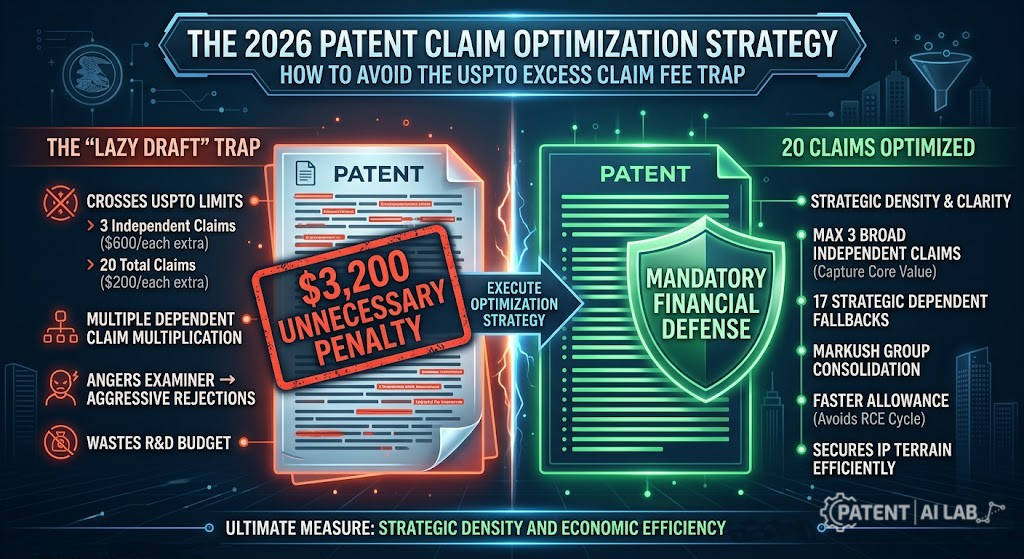
- The 20/3 Penalty Limit: Exceeding 20 total claims or 3 independent claims triggers severe USPTO financial penalties, costing large entities an immediate $3,200 upon filing.
- The Markush Solution: Consolidate interchangeable product variations into single claims using Markush groups to legally bypass excess fee limits.
- The Multiple Dependent Trap: Unlike European practice, the USPTO heavily penalizes multiple dependent claims with a strict $925 surcharge and geometric multipliers.
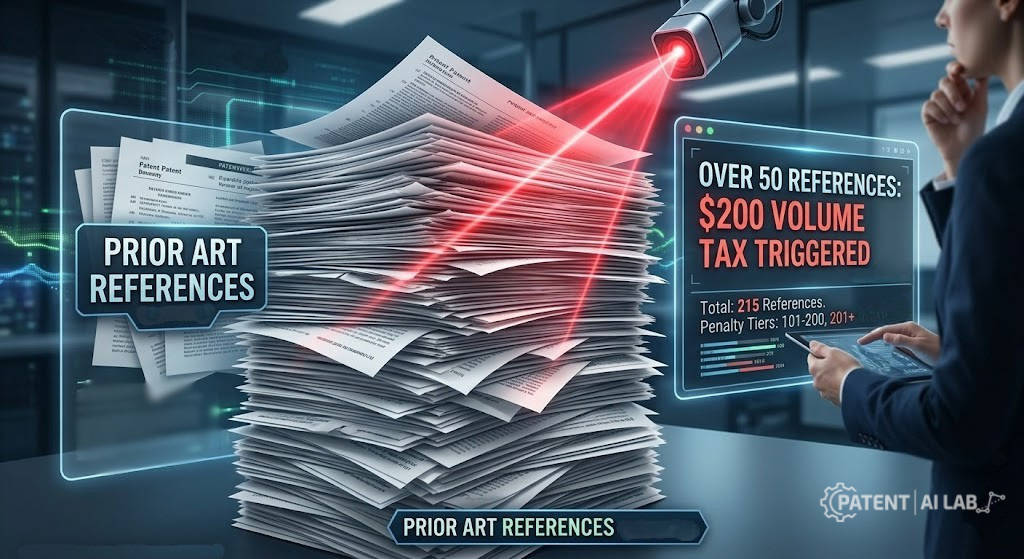
- 2026 Prosecution Taxes: Filing late continuations or submitting an Information Disclosure Statement (IDS) containing over 50 references now incurs massive new volume fees.
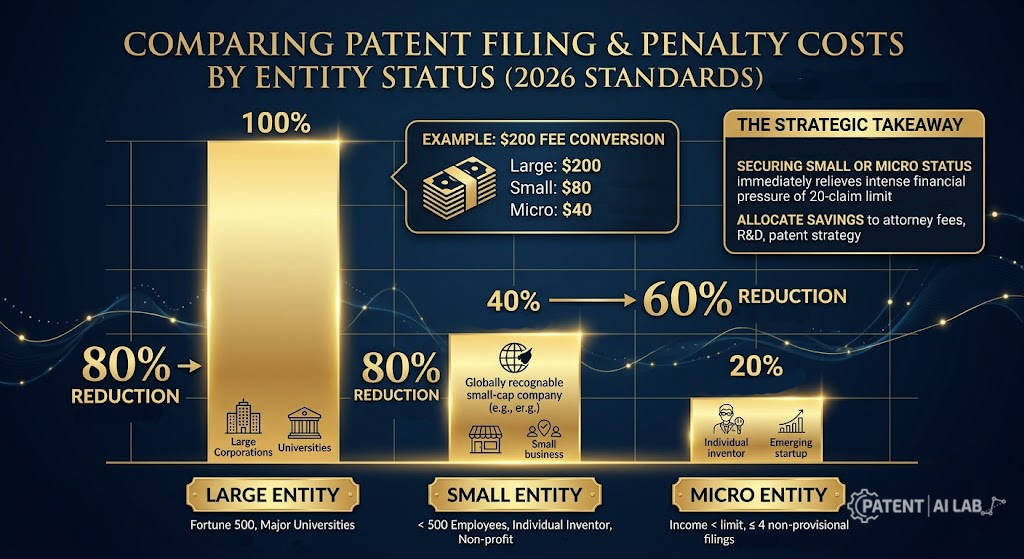
- Entity Status Arbitrage: Properly securing Micro Entity status reduces a standard $200 excess claim penalty down to just $40.
The Economic Reality of the USPTO Fee Structure
The patent ecosystem operates on a fundamental conflict of interest. Inventors want to claim every possible variation of their technology. The USPTO wants to process applications as quickly as possible to manage an overwhelming national backlog. To resolve this conflict, the USPTO relies on financial friction.
The cost to add extra patent claims 2026 has reached levels designed to deter behavior rather than simply cover administrative costs. The USPTO uses a tiered pricing model. The base filing fee covers a specific, limited amount of examiner labor. The moment you demand more labor by adding extra claims, you trigger severe penalty multipliers.
Decoding 37 CFR 1.16(h) and (i): The Penalty Statutes
The exact legal mechanisms for these penalties reside in Title 37 of the Code of Federal Regulations. Understanding the text of these statutes is necessary to formulate a defense.
The 3 Independent Claims Limit
An independent claim stands entirely on its own. It is the broadest structural or functional definition of your technology. Because these claims are broad, the patent examiner must conduct entirely separate, exhaustive prior art searches for each one. The USPTO restricts these heavily.
Your baseline filing fee covers exactly three independent claims. The text triggers a $600 surcharge for each independent claim beyond three for a large entity. Submitting an application with six independent claims instantly generates an $1,800 penalty.
The 20 Total Claims Threshold
Dependent claims reference a previous claim and add a specific, narrowing limitation. While dependent claims are narrower and technically easier for an examiner to process, the USPTO caps the total volume of text they are willing to read for the base fee.
Your baseline filing fee covers a maximum of 20 total claims. This total includes your independent claims. If you submit exactly 21 claims, you trigger the excess fee. The penalty for crossing this threshold is a punishing $200 per extra claim for large entities.
The Lazy Drafting Penalty Calculator
To comprehend the severity of these changes, we must look at the raw financial data. Brilliant engineers routinely hand over sprawling invention disclosure documents to their attorneys. These documents often feature dozens of minor structural variations. If an attorney lacks strategic discipline or is attempting to inflate their billable hours, they will write a separate claim for every single variation.
Below is a direct, data-driven comparison between a poorly optimized application and a tightly engineered application for a Large Entity applicant.
Comparison: Financial Impact of Optimization
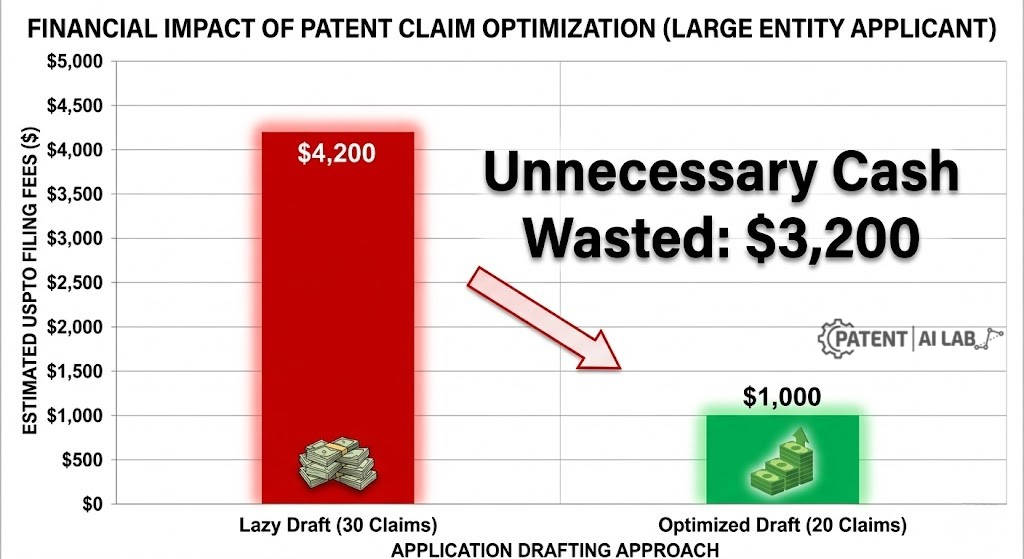
| Fee Category | The “Lazy Draft” (30 Claims, 5 Independent) | The “Optimized Draft” (20 Claims, 3 Independent) | Financial Impact and Difference |
| Basic Filing, Search, and Exam Fees | ~$1,000 | ~$1,000 | Baseline procedural cost remains identical. |
| Excess Independent Claims Penalty | $1,200 (2 extra claims × $600) | $0 (Stays perfectly within the 3 limit) | $1,200 pure penalty applied. |
| Excess Total Claims Penalty | $2,000 (10 extra claims × $200) | $0 (Stays perfectly within the 20 limit) | $2,000 pure penalty applied. |
| Total Estimated USPTO Filing Fees | $4,200 | $1,000 | Unnecessary Cash Wasted: $3,200 |
The data in this table is unequivocal. Failing to execute patent prosecution cost reduction techniques results in an extra $3,200 in government bills on the very first day of filing. That capital should be allocated to prototype development, market research, or filing a separate provisional application for a different asset. Paying excess claim fees is a voluntary tax on inefficiency.
The Examiner Production System and the Surcharge
We must analyze the internal incentive structures of the USPTO to understand how to avoid patent claim fees. You are not writing a patent for a judge. You are writing a patent for a federal examiner working under a strict quota system.
The USPTO evaluates patent examiners using a system called “Counts.” An examiner receives a specific number of counts for issuing a first office action and eventually disposing of an application. Depending on the specific technology art unit, an examiner is granted roughly 15 to 25 hours total to read your entire specification, map your claims, execute a global prior art search, and write a legal rejection or allowance.
A 20-claim application fits within their expected production schedule. A 60-claim application destroys their timeline. When an applicant submits 60 claims, the examiner is legally obligated to map every single limitation in every single claim against prior art references. The USPTO administration uses the patent examiner fee surcharge as a financial weapon to protect their workforce. The agency forces applicants to do the difficult analytical work of narrowing their inventions before the examiner ever receives the file.
If you submit a bloated application, you anger the examiner. An frustrated examiner operating behind schedule will issue broader, more aggressive rejections simply to force you to amend and narrow the claims. You lose money on the filing fees, and you lose months of prosecution time fighting avoidable rejections.
The USPTO 20 Claims Limit Strategy
For early stage technology companies, preserving cash flow dictates survival. Patent cost optimization for startups relies entirely on mastering the 20-claim wall. Startup founders face a difficult tension. Venture capital investors demand bulletproof intellectual property protection to justify their valuations. However, the company runway cannot support the cost of bloated legal filings. IP counsel must approach claim drafting with surgical precision.
Broad vs Narrow Claim Scoping
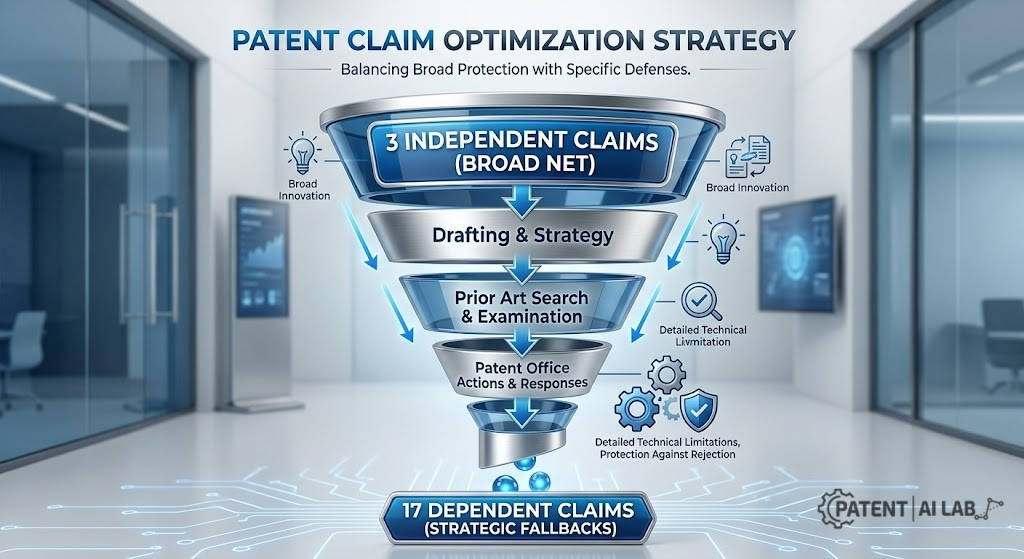
The most reliable architectural framework for drafting is the “funnel” approach. You deploy your maximum allotted 3 independent claims to capture the absolute broadest, most commercially valuable interpretations of your product. You design these independent claims to catch direct competitors attempting to copy your core functionality. You must strip out all unnecessary adjectives, optional components, and secondary features.
You then deploy your remaining 17 dependent claims to create a series of strategic fallback positions. If a patent examiner uncovers an obscure piece of prior art that invalidates your broad independent claim, your narrower dependent claims might still survive the examination. These dependent claims must contain highly specific technical details that explicitly separate your modern invention from the older prior art.
A common failure point for startups is wasting their 17 dependent claims on trivial, non-commercial details. Claiming the specific material of a generic plastic casing is a catastrophic waste of a $200 slot. Every single dependent claim must add a concrete, technically distinct feature that a competitor would actually need to use to build a viable competing product. If a dependent claim does not directly block a competitor from executing a profitable workaround, you must eliminate it from the draft immediately.
The Claim Consolidation Blueprint: Utilizing Markush Groups
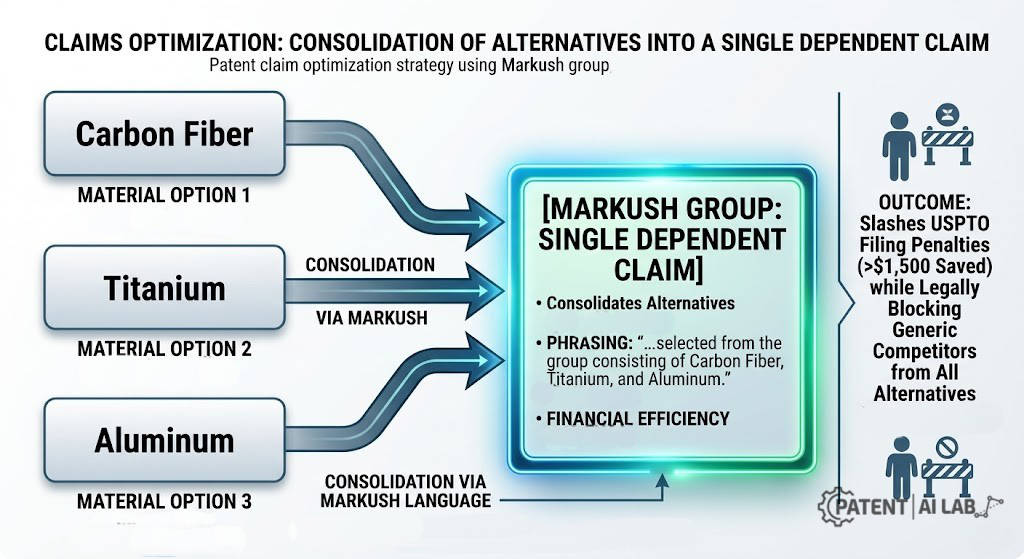
The single most effective tactic for consolidating patent claims to save money is mastering the use of the Markush group.
Originally established in 1924 by inventor Eugene Markush for complex chemical patents, a Markush group allows an applicant to list a series of alternative elements within a single claim structure. Instead of writing three separate dependent claims to cover three different materials, you write one single claim stating the material is “selected from the group consisting of A, B, and C.”
Because this methodology is the absolute baseline for financial efficiency, we will examine three highly practical Markush group claim drafting examples applied across different technological sectors.
The Multiple Dependent Claim Warning: USPTO vs. EPO Rules
There is a specific structural trap that routinely devastates international applicants and inexperienced domestic drafters. It involves exactly how a dependent claim points back to previous claims within the document.
A standard dependent claim points to one single claim. For example: “The system of claim 1…” A multiple dependent claim points to several previous claims in the alternative. For example: “The system of claim 1 or claim 2…” In theory, multiple dependent claims appear to be a fantastic, logical method to consolidate ideas and save space on the page. The USPTO disagrees and punishes this practice ruthlessly.
The EPO vs. USPTO Claim Culture Clash
The Multiplication Trap
Furthermore, the USPTO calculates your total claim count by mathematically multiplying the dependencies.
If Claim 5 states, “The device of any one of claims 1, 2, 3, or 4,” the USPTO does not count Claim 5 as one single claim. The USPTO counts Claim 5 as four separate claims when calculating your excess claim fees. This geometric progression will instantly force you past the 20 total claims threshold and trigger thousands of dollars in excess fees.
The 2026 Multiple Dependent Claim USPTO Breakdown
If you submit a multiple dependent claim in 2026, you will instantly trigger a premium government surcharge. This fee is strictly stacked on top of whatever excess claim fees the mathematical multiplication effect triggers.
The Dangers of Extreme Consolidation
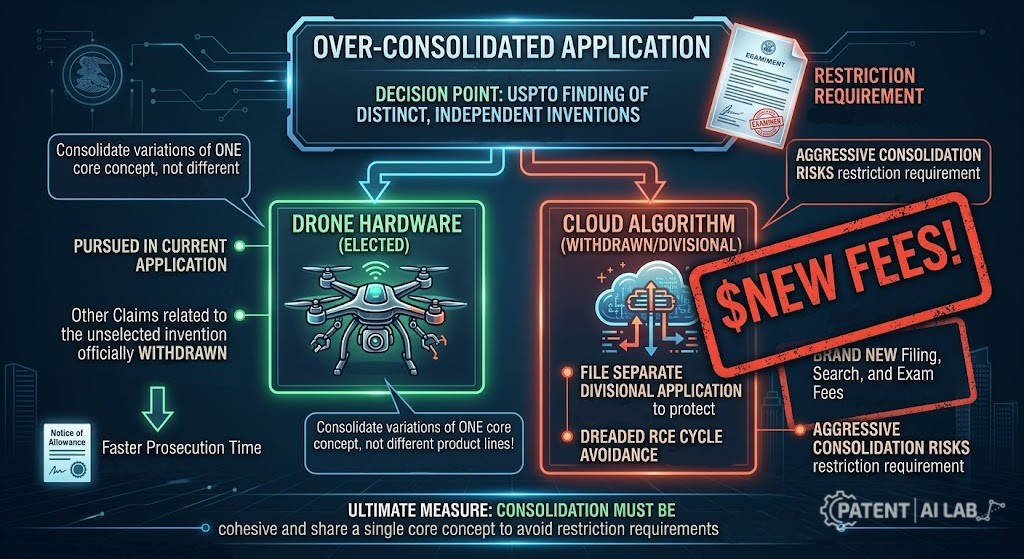
Executing these techniques is mandatory, but aggressive claim consolidation carries distinct risks. You cannot simply cram five totally different inventions into a single 20-claim application and expect the federal examiner to approve it.
Avoiding the Dreaded RCE Cycle
If your initial 20 claims are poorly drafted, you will inevitably sink into endless written arguments with the examiner. Claims that are excessively broad are easily rejected by prior art. Claims that are confusingly consolidated will receive Section 112 rejections for lacking clarity and definiteness.
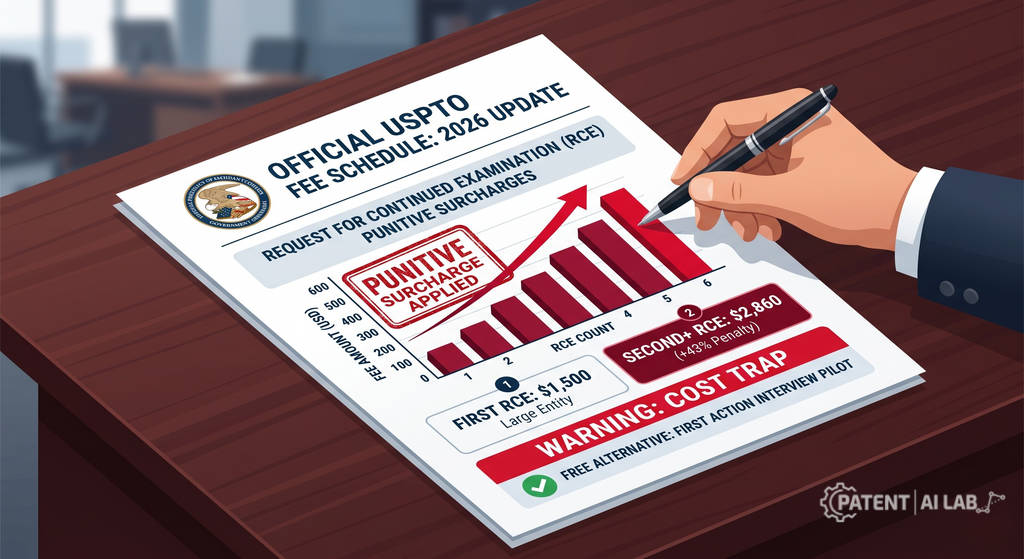
When you exhaust your allotted response periods during prosecution (typically after receiving a Final Rejection), you are forced to file a Request for Continued Examination (RCE) to keep the application alive and continue arguing. RCEs are where patent budgets go to die.
Furthermore, possessing excess claims means the examiner has more targets to reject. If you file 40 claims, the examiner will likely find prior art to reject at least 30 of them. Your attorney must then spend highly billable hours arguing against 30 separate rejections. Optimizing your 20 claims upfront guarantees they are clear, distinct, and deeply supported by the specification. A clean, tightly optimized claim set leads to faster allowances, directly avoiding the dreaded, expensive RCE cycle.
The “First Action Interview” Hack to Bypass RCEs
Beyond upfront claim consolidation, the absolute most effective legal maneuver to avoid a $1,500 RCE fee is proactively requesting an Examiner Interview.
Instead of engaging in a blind, expensive, and protracted written debate with the USPTO, you should instruct your attorney to request a free video call with the patent examiner (often utilizing the USPTO’s First Action Interview Pilot Program). By speaking directly with the examiner after they review your optimized 20 claims, you can quickly identify exactly what minor verbiage adjustments will satisfy their prior art rejections. Resolving these technical ambiguities over a 30-minute collaborative call frequently leads to an immediate Notice of Allowance, entirely bypassing the need to ever file an RCE.
Navigating the Prosecution Phase: The Claim Canceling Hack
What happens if you file an optimized application with exactly 20 claims, but during prosecution, you realize you need to add 3 new claims to properly capture a competitor’s newly released product feature?
If you simply add 3 claims via an amendment, your total count hits 23. You will immediately receive a notice from the USPTO requiring you to pay $600 in excess claim fees.
The strategic maneuver here is claim canceling. Before you add the 3 new claims, you instruct your attorney to officially cancel 3 of your weakest, least commercially viable dependent claims.
By canceling 3 old claims and adding 3 new claims simultaneously, your net total remains at 20. You successfully shift your legal protection toward the new competitor threat without triggering the 37 CFR 1.16(h) and (i) excess claim penalties.
The New Prosecution Traps: Continuation Penalties and IDS Volume Fees
Beyond the USPTO 20 claims limit strategy, the new fee schedule introduces two massive financial landmines during the prosecution phase that every CTO must be aware of: late continuation filings and prior art data dumps.
To curate these references and avoid the volume tax, you need efficient analytics. Discover how to execute this curation by reading our Google NotebookLM review for free patent analysis versus expensive $10,000 legacy tools.
Entity Status Arbitrage: Micro, Small, and Large Entity Fees 2026
Before you begin drafting the actual text of your patent claims, you must verify your organizational entity status. The USPTO actively subsidizes the American innovation ecosystem by offering massive financial discounts to smaller players. Failing to properly establish and claim your entity status is a completely unforced error that will double or quintuple your costs instantly.
Micro, Small, and Large Entity Discounts
The USPTO recognizes three distinct tiers of applicants.
Large Entity
This category includes Fortune 500 companies, major research universities, or any entity that does not specifically fit the smaller categories.
Small Entity
Generally defined as a business with fewer than 500 employees, an independent individual inventor, or a registered non-profit organization.
Micro Entity
To qualify, you must meet small entity requirements, have a gross household income below a specific threshold set by the USPTO, and have not filed more than four prior non-provisional patent applications.
If you are a startup, securing Small or Micro entity status immediately relieves the intense financial pressure of the 20-claim limit.
While you should still actively practice patent claim optimization strategy to save on attorney fees, an extra 5 claims will only cost a micro entity $200 total, rather than the $1,000 a large entity would be forced to pay.
The Private Sector Multiplier
The True Cost of Legal Bloat
Drafting a high-quality, technically sound, and legally enforceable patent claim takes significant time. The attorney must review the technical specification, analyze competitor prior art, and carefully select every single word to avoid infringement loopholes and Section 112 clarity rejections.
If you demand a 40-claim application from your legal team, the attorney has to spend hours drafting those extra 20 claims. During the prosecution phase, the patent examiner will likely reject many of those extra claims. Your attorney then has to spend highly billable hours reading the rejections, formulating complex legal arguments, and writing formal responses for all 40 claims.
A 40-claim patent does not just cost you an extra $4,000 in USPTO penalties. It easily costs you an extra:
$5,000 to $12,000
in attorney billing hours over the entire multi-year lifespan of the prosecution.
Enforcing a strict 20 total claims threshold and 3 independent claims limit as corporate policy forces your legal team to focus their billed hours on the core commercial value of your product.
You stop wasting your expensive legal retainer on formatting redundant, useless dependent claims that add zero value to your startup valuation.
Tactical Alternatives
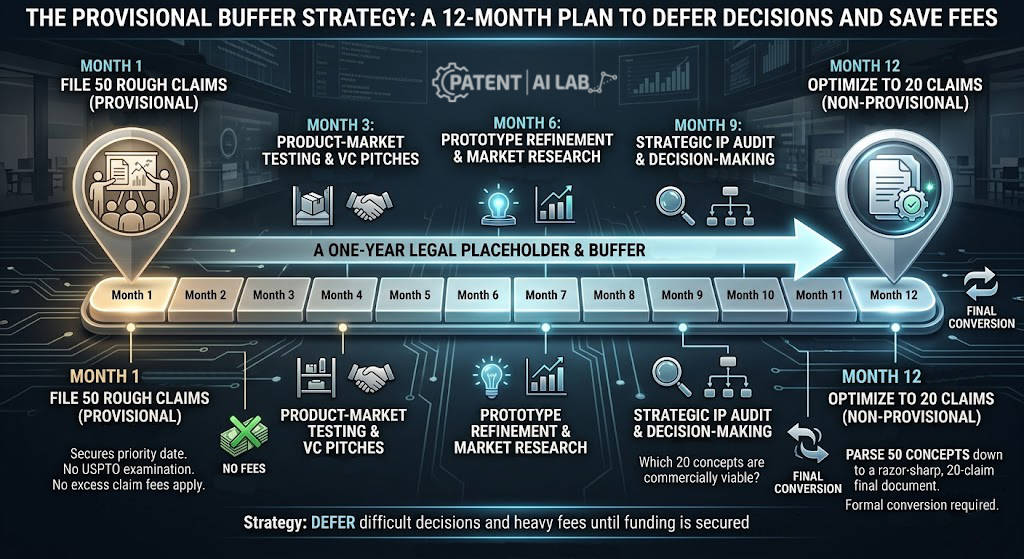
If you are a startup still actively finalizing your product design and you do not want to commit to a rigid, finalized 20-claim structure just yet, there is a powerful strategic alternative.
The Electronic Filing Mandate
You must ensure your legal team files exclusively through the USPTO digital Patent Center. Filing a physical paper application in the modern era triggers an immediate, punitive non-electronic filing surcharge of $400 for large entities.
“In 2026, there is zero strategic reason to file physical paper. It is purely a financial tax on outdated law firms that refuse to modernize their administrative workflows. If your attorney hands you a paper filing receipt with a $400 surcharge attached, find a new attorney immediately.”
Final Verdict
The USPTO has drawn a very clear line in the sand regarding their examination resources. The days of filing sprawling, unoptimized, kitchen-sink patent applications are officially over. The aggressive new fee structure dictates that intellectual property protection must be treated as an exercise in extreme efficiency and corporate discipline.
By strictly adhering to the 20 total and 3 independent claim thresholds, aggressively utilizing Markush groups for claim consolidation across all industries, completely avoiding the multiple dependent claim trap, and maximizing your federal entity status discounts, you can secure world-class patent protection without falling victim to the excess claim fee trap.
In the modern 2026 innovation economy, a great patent is no longer measured by the sheer volume or length of its claims. It is measured exclusively by the strategic density, absolute clarity, and economic efficiency of the protection it provides to the inventor.
Sources and Legal References
- USPTO Official Fee Schedule: 2026 Current Fee Rates. The primary federal source for all large, small, and micro entity pricing, including excess claim surcharges and RCE penalties.
- USPTO Patent Examining Procedure: MPEP § 2173.05(h). Official examination guidelines governing the inclusion of alternative elements (Markush Groups) within a single patent claim structure.
- Multiple Dependent Claims Mandate: MPEP § 608.01(n). Federal structural requirements detailing how the USPTO multiplies and penalizes complex claim dependencies.
- Micro Entity Qualification Law: USPTO Micro Entity Guidelines. Legal definitions, thresholds, and requirements to legally claim subsidized entity status without committing patent fraud.
- Title 37 Code of Federal Regulations: 37 CFR § 1.16. The specific federal statute dictating the baseline 20 total and 3 independent claim thresholds and their corresponding excess fees.
Podcast
Disclaimer
Expert FAQ: Navigating the 2026 Standards
To provide maximum operational value, we have compiled the definitive answers to the most critical questions asked by founders, CTOs, and independent inventors regarding the 2026 fee changes.
What are the exact USPTO excess claim fees for 2026?
For a standard large entity, the USPTO charges a strict penalty of $200 for every single claim submitted over the 20 total claims limit. Additionally, they charge $600 for every independent claim submitted over the base limit of three. Small entities receive a 60 percent discount on these penalty fees. Qualifying micro entities receive an 80 percent discount.
How does a Markush group help avoid patent claim fees?
A Markush group allows an applicant to combine multiple alternative features or chemical compounds into a single legal claim using specific phrasing like “selected from the group consisting of A, B, and C.” By grouping these alternatives, you successfully cover multiple variations of your invention using only one claim against your 20-claim budget, rather than paying your attorney to write a separate dependent claim for every single variation.
Why should I absolutely avoid multiple dependent claims at the USPTO?
Unlike the European Patent Office (EPO) where multiple dependent claims are expected and cheap, the USPTO actively punishes them. The USPTO applies a flat surcharge of $925 for large entities just for including a single multiple dependent claim in the document (Small entities pay $370, and micro entities pay $185). Furthermore, the USPTO calculates your total claim count by mathematically multiplying the dependencies, which instantly pushes your application over the 20 total claims threshold and triggers massive additional excess fees.
Will reducing my claim count to exactly 20 make my patent legally weaker?
Not if an expert drafts it correctly. A bloated patent containing 40 repetitive, poorly thought-out claims is often significantly weaker than a highly optimized 20-claim patent. The ultimate goal is to capture broad commercial protection in your independent claims and use your dependent claims to cover distinct, commercially valuable fallback positions. Quality always supersedes quantity in patent litigation.
Do these specific excess claim fees apply to provisional patent applications?
No. Provisional patent applications serve strictly as placeholders and are not formally examined by a patent examiner. The USPTO does not apply independent or excess claim fee limits to them. You only face the strict 20-claim and 3-independent limits when you file your formal non-provisional utility application.
What happens if I file exactly 20 claims initially, but need to add more claims during prosecution to overcome an examiner rejection?
If you add new claims via an amendment that pushes your total count over 20, the USPTO will immediately pause the examination and issue a notice requiring you to pay the excess claim fees for the new additions. To avoid this, you practice “claim canceling” by officially withdrawing older, weaker dependent claims at the exact same time you add the new ones, keeping your net total strictly at 20.
Can I use a Markush group to combine completely unrelated parts of my invention to save money?
No. Doing so will likely trigger a Restriction Requirement from the examiner. The items listed in a Markush group must share a common structural or functional denominator. If you try to group a software routing algorithm and a titanium drone propeller in the same Markush group just to save a claim slot, the examiner will reject the claim as an improper Markush group.
If I file an international PCT application, do the USPTO claim limits apply?
Not directly during the international phase. However, when your PCT application enters the US National Stage, the USPTO rules immediately take effect. If your international PCT application contains 40 claims and multiple dependent claims (which is common in Europe), you must actively file a “Preliminary Amendment” concurrent with your US National Stage entry. By utilizing this preliminary amendment to formally cancel, consolidate, and reduce your claim count down to a strict 20 before the USPTO calculates your initial national stage fees, you completely avoid getting hit with thousands of dollars in surprise USPTO surcharges.
Are there any fee increases for filing a Request for Continued Examination (RCE) in 2026?
Yes. The USPTO aggressively increased RCE fees to discourage protracted arguments. For a large entity, the first RCE costs $1,500. If you cannot reach an agreement and are forced to file a second or subsequent RCE, the fee now jumps to an incredible $2,860. This makes getting your optimized claims right the first time more critical than ever.
If I file 5 independent claims, but only 15 total claims, do I still pay a penalty?
Yes. The USPTO fee structure evaluates independent claims and total claims as two entirely separate thresholds. Even if your total claim count is under 20, having 5 independent claims means you are 2 claims over the 3 independent claims limit. A large entity would owe a $1,200 penalty for the extra independent claims.
If I am a software startup, how do I know if my dependent claims are actually valuable?
Ask yourself one decisive question. Would a competitor still be able to sell a viable product if they omitted the feature described in this claim? If the answer is yes, the claim is commercially weak. Your dependent claims must cover features that are essential for commercial success, regulatory compliance, or core user experience. Do not waste claims on trivial UI choices or generic database structures.




[…] of complex filings. To ensure your strategy remains cost-effective, you should also consider The 2026 Patent Claim Optimization Strategy to avoid falling into the USPTO excess claim fee […]
[…] As a patent holder myself, I know that patent drafting is not “creative writing.” It is “technical legislation.” A single missing antecedent in a claim can trigger a 35 U.S.C. § 112 rejection, costing the client thousands in prosecution fees. Beyond drafting errors, inefficient claim structures can lead to massive cost overruns. Learn how to protect your R&D budget in our guide to Avoiding the USPTO Excess Claim Fee Trap. […]