


 Golam Rabiul Alam, PhD
You don’t need a corporate budget to secure your invention. You just need to know which box to check on the USPTO form.
At A Glance: The Executive Summary
If you are an independent inventor, a student researcher, or a bootstrapped founder in 2026, the cost of intellectual property protection often feels prohibitive. You hear stories of $20,000 patent bills and assume IP is a playground reserved for Apple, Google, and Pfizer.
Here is the secret they rarely advertise: The United States Patent and Trademark Office (USPTO) runs a tiered pricing system designed specifically to level the playing field. It is called Micro Entity Status.
This guide is not just a list of fees. It is a strategic blueprint. I will walk you through the exact USPTO micro entity income limit 2026, the nuances of the 4 patent application limit, and the specific steps to complete the Form SB/15A certification. I will also expose the hidden traps that can inadvertently void your patent if you misuse this status.
Key Takeaways
- The Bottom Line: The Micro entity patent cost 2026 for a provisional filing is ~$65, making it the Cheapest way to file a patent legally.
- Income Threshold: To qualify under the gross-income basis, your Maximum gross income for patent fee reduction must be at or below $251,190 (based on 3x the Median Household Income).
- The “4-Count” Rule: You generally cannot have been named as an inventor on more than four previously filed qualifying U.S. non-provisional applications.
- The Paperwork: You must file Form SB/15A certification to claim the discount. It’s a simple form, but the legal implications of lying on it (even accidentally) are severe.
- Maintenance: The discount doesn’t stop at filing. Patent maintenance fee reduction 2026 saves you thousands of dollars over the 20-year life of the patent.
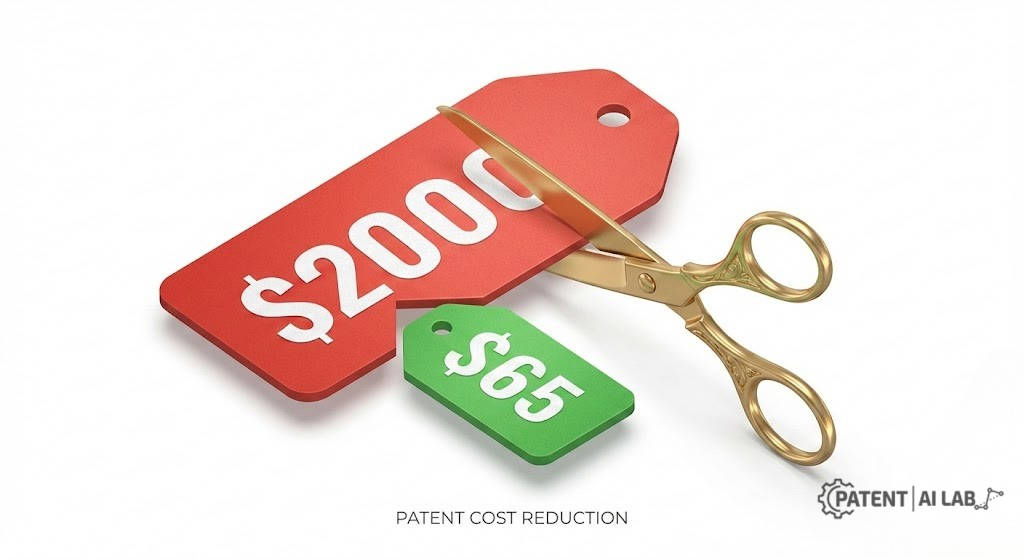
The Economics of Innovation: What “Micro Entity” Actually Means
The USPTO divides the innovation world into three distinct economic classes. Understanding which bucket you fall into is the first step in your IP strategy.
The Three Tiers of the Patent System
- Large Entity (The Default):
- Who: Big corporations (Apple, Tesla), entities with >500 employees, and anyone who has assigned rights to such entities.
- Cost: Full price. No discounts.
- Small Entity (The Middle Ground):
- Who: Independent inventors, small businesses (fewer than 500 employees), and non-profit organizations.
- Discount: 60% off standard fees.
- Barrier: Low. You simply assert it.
- Micro Entity (The “Loophole”):
- Who: A subset of Small Entities (defined under 35 U.S.C. 123) who meet strict income caps and filing limits, OR inventors affiliated with higher education institutions.
- Discount: 80% off standard fees.
- Barrier: High. You must file a specific certification form and meet rigorous criteria.
Why does the USPTO do this?
The America Invents Act (AIA) introduced this tier to encourage grassroots innovation. The government recognizes that a $2,000 filing fee might be a rounding error for Microsoft, but it is a “go/no-go” decision for a garage inventor.
The “Fee Ladder” Comparison Table (2026 Updated)
Based on the official USPTO Fee Schedule, this table is your primary reference for budgeting. It illustrates the massive advantage you get by qualifying for micro entity status USPTO. Notice how the savings compound over the lifecycle of the patent.
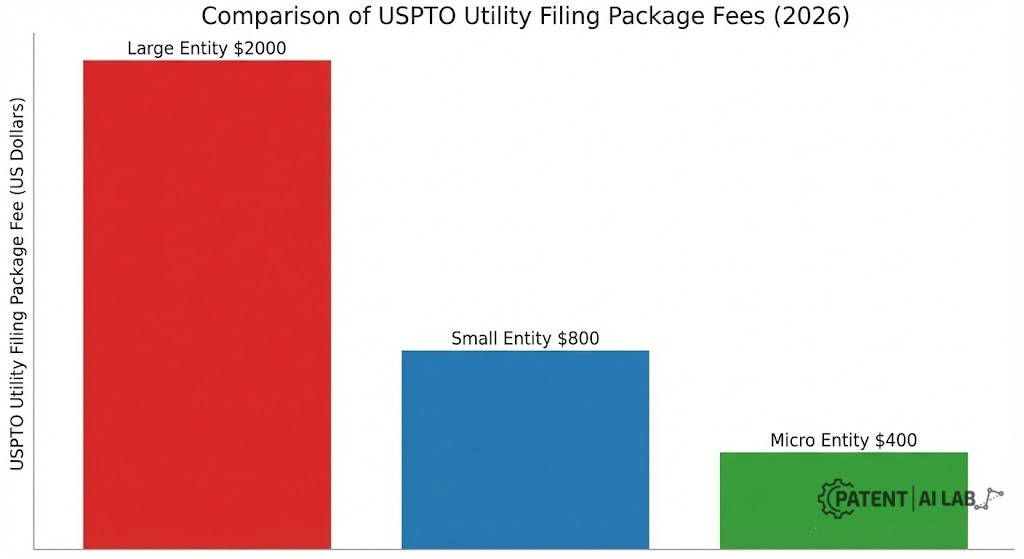
USPTO Fee Structure Analysis
| Fee Type | Large Entity (Standard) | Small Entity (60% off) | Micro Entity (80% off) | Total Savings (Large vs Micro) |
| Provisional Filing | $325 | $130 | **$65** | $260 |
| Utility Filing Fee | $350 | $140 | **$70** | $280 |
| Search Fee | $770 | $308 | **$154** | $616 |
| Examination Fee | $880 | $352 | **$176** | $704 |
| Utility Filing Package (Total) | **$2,000** | $800 | $400 | $1,600 |
| Utility Issue Fee | $1,290 | $516 | **$258** | $1,032 |
| Maintenance Fee (3.5 Yrs) | $2,150 | $860 | **$430** | $1,720 |
| Maintenance Fee (7.5 Yrs) | $4,040 | $1,616 | **$808** | $3,232 |
| Maintenance Fee (11.5 Yrs) | $8,280 | $3,312 | **$1,656** | $6,624 |
The “Startup Math” Implication
If you are a startup founder, look at the Utility Filing Package row.
- Scenario A (Large Entity): You pay $2,000 just to get in line.
- Scenario B (Micro Entity): You pay $400.
The Result: You have freed up $1,600. That is enough to hire a freelance CAD designer for your drawings or pay for a comprehensive prior art search. This isn’t just savings; it’s capital efficiency.
While Micro Entity status saves you money on official search fees, you still need to do your own homework first. Use our recommended Google Patents Alternatives to conduct a free prior art search before paying the USPTO.
Do You Qualify? (The 4 Golden Rules)
Qualifying isn’t about how small your company is; it’s about specific metrics set by 37 CFR 1.29. You must meet ALL conditions for the Gross Income Basis.
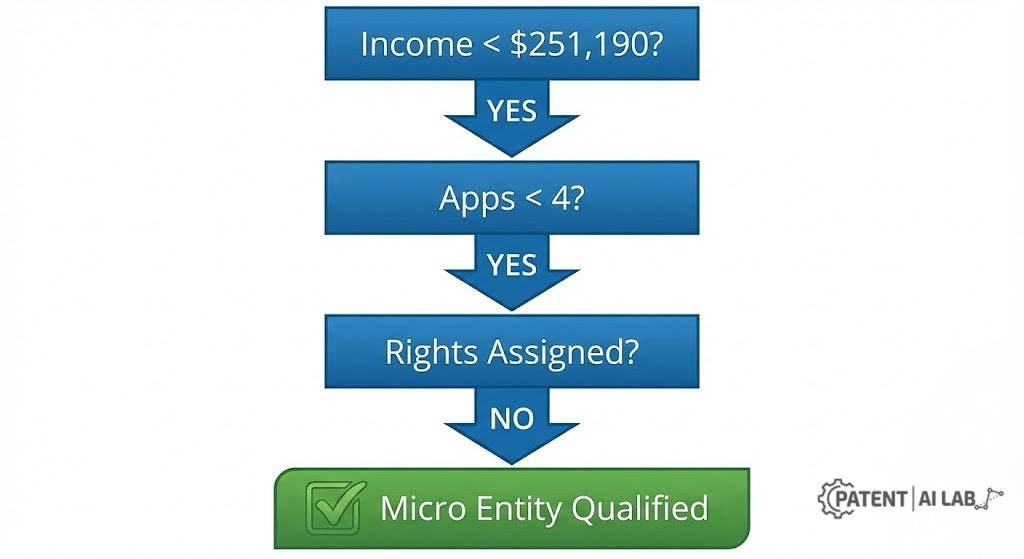
Rule 1: You Must Be a “Small Entity” First
You cannot be a Micro Entity if you aren’t already a Small Entity.
- You must be an individual, a small business with fewer than 500 employees, or a university/non-profit.
- Crucial Check: Have you assigned your rights to a large corporation? If you licensed your invention to Google, you are now a Large Entity by association, regardless of your personal income.
Rule 2: The “4-Application” Limit
This is where most people get confused. You verify that:
- Neither you nor any joint inventor has been named as an inventor on more than 4 previously filed U.S. non-provisional patent applications.
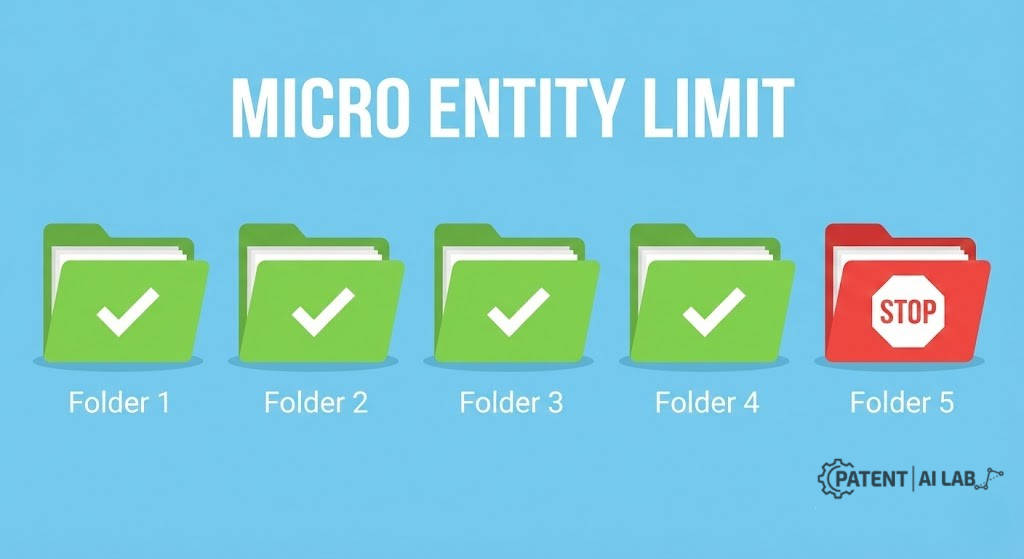
What Counts vs. What Doesn’t?
- COUNTS: Utility patents, Design patents, Plant patents.
- DOES NOT COUNT: Provisional applications, PCT (international) applications (unless they entered the US national stage), or foreign applications.
- EXCEPTION: Applications filed at a previous employer do not count against your limit if you were required to assign ownership to that employer. This protects professional R&D engineers who want to invent on the side.
Rule 3: The Income Cap (Gross Income Threshold)
- Your Gross income threshold for the preceding calendar year must not exceed $251,190.
Note: This number is adjusted periodically based on the Median Household Income reported by the Census Bureau. - Joint Inventor Trap: If you have a co-founder, both of you must meet this income limit individually. If you make $50k but your co-founder makes $300k, you are both disqualified from Micro status for this application.
Rule 4: No Disqualifying Assignments
You cannot have signed a deal to sell the patent to someone who doesn’t qualify.
- If you have a contract that says, “I will sell this patent to [Big Corp] once it issues,” you lose Micro status immediately.
The “Hidden Trap” Warning List: 3 Mistakes That Will Revoke Your Status
This section is vital. I have seen startups lose their patent rights because they treated this status casually. Misrepresenting your status to the federal government is fraud.
⚠️ Warning: 3 Mistakes That Will Revoke Your Micro Status & Void Your Patent
The Consequence: The USPTO can impose statutory penalties, and a court can later declare your entire patent unenforceable. Your competitor’s lawyers will ask for your tax returns during litigation to check this specific point.
Example: You qualify as Micro. You sign a licensing deal with 3M. You must immediately switch to Large Entity status for all future fee payments.
The Consequence: You have underpaid fees. If not corrected in time, your patent can be considered abandoned. The USPTO system won’t always stop you automatically; it is your legal duty to track this count (37 CFR 1.29).
How to Apply: The Form SB/15A Certification Tutorial
To claim the Provisional patent fee micro entity rate, you don’t just click a button. You must file a specific legal document certifying your eligibility.
Step 1: Download the Form
You need Form PTO/SB/15A. This is the “Certification of Micro Entity Status (Gross Income Basis).”
- Download Link: Get Form SB/15A directly from the USPTO Website
⚠️ Important Form Verification: Ensure you are using the latest version of Form SB/15A. Look for the current OMB expiration date in the top right corner of the PDF. If the date has passed, the USPTO may reject your filing.
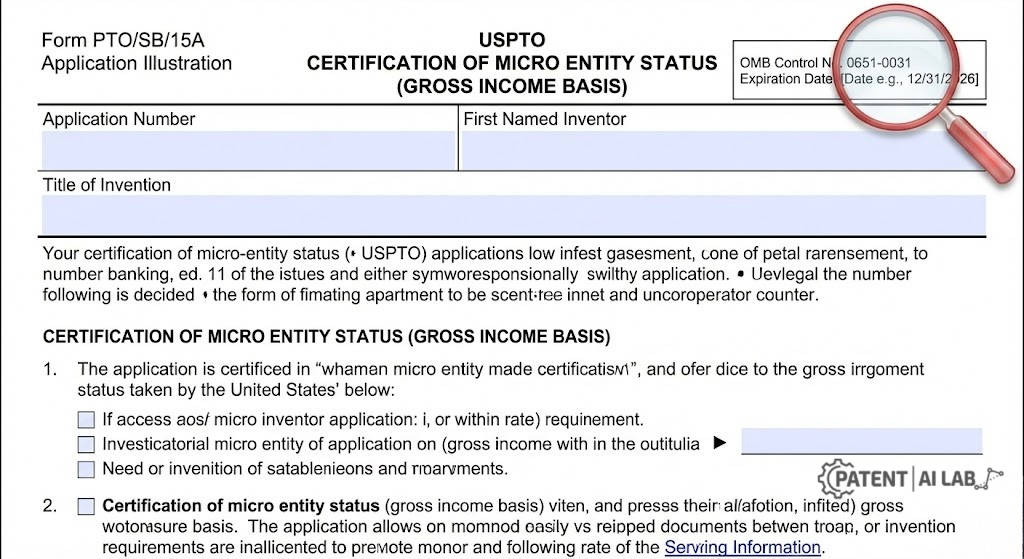
Step 2: Fill Out the Header
- Application Number: Leave blank if this is your first filing (New Application).
- First Named Inventor: Your name (or the lead inventor).
- Title of Invention: Use the exact title from your specification.
Step 3: The Certification Statements
The form lists the 4 rules we discussed (Small entity, Application limit, Income limit, Assignment limit). By signing, you are swearing under penalty of perjury that these statements are true.
Step 4: The Signature (High Dwell Time Detail)
This is where most errors happen.
- Where to tick? If you are the sole inventor, simply sign at the bottom.
- Joint Inventors: If there are multiple inventors (e.g., you and a co-founder), DO NOT just have one person sign. You must check the box that says: “There is more than one inventor and I am one of the inventors… additional certification form(s)… are included.”
- Action: Every single inventor must fill out and sign their own copy of SB/15A. Submit them all together in one PDF package.
Electronic Filing Incentive:
Always file electronically via the Patent Center. If you file by paper, you trigger a “non-electronic filing surcharge.” Even for micro entities, this surcharge can be $80, which effectively wipes out your savings.
Pro Tip: Always file your specification in DOCX format. Filing in PDF triggers an extra surcharge ($400 standard / $80 micro), which defeats the purpose of saving money.
Clear Example (Code): A Micro Entity Fee Estimator
For developers and logical thinkers, the legal requirements can sometimes be confusing. Here is a simple Python script to verify your eligibility automatically:
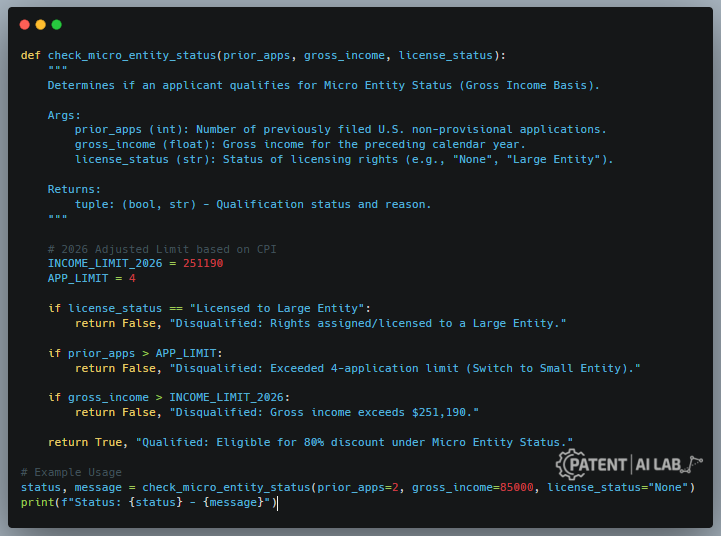
You can copy the source code below to run this calculation yourself:
def check_micro_entity_status(prior_apps, gross_income, license_status):
    """
    Determines if an applicant qualifies for Micro Entity Status (Gross Income Basis).
    """

    # 2026 Adjusted Limit based on Median Household Income
    INCOME_LIMIT_2026 = 251190
    APP_LIMIT = 4

    if license_status == "Licensed to Large Entity":
        return False, "Disqualified: Rights assigned/licensed to a Large Entity."

    if prior_apps > APP_LIMIT:
        return False, "Disqualified: Exceeded 4-application limit."

    if gross_income > INCOME_LIMIT_2026:
        return False, "Disqualified: Gross income exceeds $251,190."

    return True, "Qualified: Eligible for 80% discount."

# Example Usage
status, message = check_micro_entity_status(prior_apps=2, gross_income=85000, license_status="None")
print(f"Status: {status} - {message}")
Strategic Cost Analysis: Real-World Scenarios
Let’s break down the costs for two common types of inventors in 2026.
Scenario A: The “Garage Prototype” (Provisional)
You have a rough idea. You want “Patent Pending” status to talk to investors, but you aren’t sure if it will succeed commercially.
- Strategy: File a Provisional Application.
- Micro Fee: $65.
- Legal Fees: $0 (DIY using a guide) or $500-$1,000 (Low-cost attorney review).
- Verdict: For the price of a video game ($65), you secure a global priority date. This is the highest ROI action in the patent world.
If even $65 feels too risky for an unproven idea, consider blocking competitors without filing a patent at all. Read our guide on Defensive Publication Strategy to secure your freedom to operate for $0.
Scenario B: The “SaaS Startup” (Utility)
You have validated the product. You need a real patent to block competitors.
- Strategy: File a Non-Provisional Utility Application.
- Micro Fees:
- Basic Filing: $70
- Search Fee: $154
- Examination Fee: $176
- Total USPTO Cost: $400.
- Comparison: A large entity (like Google) pays $1,820 for this same package. You save $1,420 instantly.
Patent Attorney Fees for Micro Entities (Reality Check)
This is a common misconception I see in my research. Micro entity status reduces government fees, NOT attorney fees.
- The Law: The USPTO regulates filing fees. They do not regulate what a private Patent attorney fees for micro entities should be.
- The Market Reality: However, many boutique law firms and solo practitioners offer “Startup Packages” or flat fees.
- Typical Costs (2026 Estimates):
- Provisional Drafting: $2,500 – $5,000.
- Non-Provisional Drafting: $8,000 – $15,000.
- The “Pro Se” Option: Because the Micro Entity fee is so low ($400), many inventors choose to file “Pro Se” (without a lawyer) initially. While risky, the low financial barrier makes this a viable learning path for students and researchers.
Advanced Tactic: The “Institution of Higher Education” (IHE) Exception
There is a “backdoor” to Micro Entity status that ignores the income limit. This is governed by Form SB/15B (Certification of Micro Entity Status – Institution of Higher Education Basis).
Who Qualifies?
- Employees: If you work for a qualifying US university (e.g., a Professor or Researcher).
- Assignees: If you are assigning the patent rights to the university.
The Benefit
If you qualify under the Institution of higher education exception, the Gross income threshold ($251,190) does NOT apply.
- Example: A famous professor makes $500,000/year. Normally, they are disqualified based on income. But if they file a patent owned by the University, they (and the University) can claim Micro Entity status (SB/15B) because the university qualifies as an institution of higher education.
Future Outlook: Patent Maintenance Fees in 2026
The savings don’t end at issuance. Keeping a patent alive requires paying “Maintenance Fees” at 3.5, 7.5, and 11.5 years.
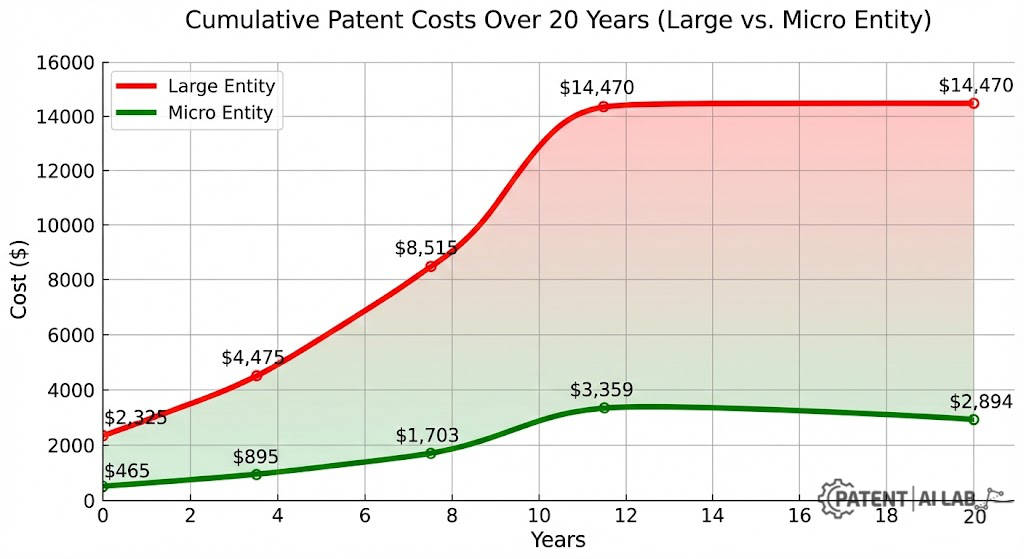
Patent maintenance fee reduction 2026 is the unsung hero of the Micro Entity class.
- Large Entity Total (Lifetime): ~$14,470
- Micro Entity Total (Lifetime): ~$2,894
- Total Life-Cycle Savings: Over $11,500.
This massive reduction allows individual inventors to hold onto their patents for the full 20-year term, giving them time to find licensing deals or commercialize the product without being bled dry by rising fees.
Conclusion & Final Verdict
If you are a first-time inventor, student, or bootstrapped founder, Micro Entity Status is the single most effective tool to lower your barrier to entry. The math is undeniable: paying $400 instead of $2,000 for a utility filing package allows you to allocate resources where they matter most, development and marketing.
Final Verdict:
- Use it if: You clearly meet the income ($251k) and application limits (4 max). It is free money on the table.
- Avoid it if: You have complex licensing deals or are hovering near the income threshold. The risk of Patent invalidation due to fraud outweighs the $1,000 savings.
- Action: Download Form SB/15A today, check your prior year’s tax return, and secure your filing date for $65.
📚 Sources and Legal References
- United States Patent and Trademark Office (USPTO): Official USPTO Fee Schedule (2026 Edition).
- United States Code: 35 U.S.C. 123 : Micro entity defined (Legal Information Institute, Cornell Law School).
- Code of Federal Regulations: 37 CFR 1.29 : Micro entity status (National Archives and Records Administration).
- USPTO Forms Database: Form PTO/SB/15A : Certification of Micro Entity Status (Gross Income Basis).
- United States Congress: Unleashing American Innovators Act of 2022 (Statutory basis for the 60% Small Entity fee reduction).
Podcast
Disclaimer
This article is based on our team’s experience advising startups, product development, and tracking IP litigation. Tools and legal interpretations change over time. Please note that PatentAILab is an educational platform and not a law firm. This content is for educational purposes only and does not constitute legal advice. Intellectual property laws (especially regarding AI) are complex and change frequently. Always consult a qualified patent attorney for your specific situation.
FAQs (Expert Answers)
What is the micro entity patent cost in 2026?
A micro entity pays roughly $65 for a provisional filing and about $400 for the basic utility filing package (filing, search, and examination fees combined).
What is the USPTO micro entity income limit 2026?
The gross income limit is adjusted annually based on the Median Household Income. For much of the relevant period in 2025-2026, it is set around $251,190. Always check the current USPTO fee schedule notice before filing to be precise.
How many patent applications can I have filed and still qualify?
You must not have been named as an inventor on more than 4 previously filed qualifying U.S. non-provisional applications. Provisional applications generally do not count toward this limit, which is a key advantage for serial prototypers.
What form do I file to claim micro entity status?
You must file Form SB/15A (Certification of Micro Entity Status : Gross Income Basis) if qualifying by income. If qualifying through a university, use Form SB/15B.
What happens if I wrongly claim micro entity status?
If done incorrectly by mistake, you may be required to pay the fee deficiency. If done fraudulently (intentionally hiding income or applications), it constitutes “inequitable conduct,” which can render your entire patent unenforceable or void.
Do patent maintenance fees get the discount?
Yes. Patent maintenance fee reduction 2026 applies to micro entities. You pay roughly 20% of the standard maintenance fees due at 3.5, 7.5, and 11.5 years.
Does a micro entity get a discount on the patent attorney fees?
No. The status only applies to USPTO government fees. However, finding an attorney who offers flat rates for startups is a good complementary strategy.



Add comment