


 Golam Rabiul Alam, PhD
Editorial note: The content on this website is provided for informational and educational purposes only and does not constitute professional legal, financial, or technical advice. See disclaimer below.
Keyword searches match words; AI matches meaning. If you are trying to protect SaaS source code in 2026, relying on outdated boolean strings to hide a million-dollar invention simply leaves hidden prior art for your competitors to find and use against you.
At A Glance
Most SaaS founders believe their code is protected the moment it is written. That belief is wrong more often than it is right. Today, AI-assisted development, API-driven products, and fast-moving competitors make traditional software protection weaker than ever. Copyright does not protect logic. Patents are harder to obtain. Trade secrets collapse the moment code leaks. This guide breaks down what actually protects SaaS code using real examples and current US patent standards, drawing on technical and academic analysis of the underlying frameworks. This content is written for educational purposes from a technical and academic perspective and does not constitute legal advice from a licensed attorney. Always consult a registered patent attorney before making IP filings or investment decisions.
The Illusion of Code Ownership
SaaS founders often assume their code is protected simply because they wrote it. That assumption carries real legal risk.
Today, SaaS code faces three compounding threats that did not exist at this scale even five years ago:
- Fast AI-assisted cloning that can reproduce functional behavior without copying a single line
- Reverse engineering via public APIs and browser-exposed logic
- Aggressive IP litigation driven by enterprise deal scrutiny and investor due diligence
The real question is not whether your code is valuable. It is how it is legally protected, and whether that protection survives competitors, investors, and courts.
This guide breaks down copyright, patent, and trade secret protection in plain language, using real SaaS and AI-generated code examples. No legal fluff. No myths.
The short answer on the best way to protect your application: Use a layered strategy. Copyright protects code expression, patents protect functional inventions that clear USPTO eligibility, and trade secrets protect confidential algorithms and data. No single method is sufficient on its own.
Why Securing Your Software Is Harder Now
Modern SaaS products are API-first, AI-augmented, continuously deployed, and built partly with AI-generated code. That combination creates a structural legal problem.
Courts do not protect ideas. They protect specific expressions, implementations, or inventions. AI makes copying faster without copying line-for-line, which means a competitor can reproduce your product’s core behavior using an entirely different codebase and potentially face zero liability under copyright law.
That is precisely why founders must understand the difference between copyright, patent, and trade secret protection for software, and where each one actually holds up under legal pressure.
Copyright Limits for Cloud Applications
What Copyright Protects
Under the U.S. Copyright Office Compendium, Chapter 700, copyright automatically protects the original expression of source code text, file structure and organization, and comments and documentation. It does not protect algorithms, business logic, functional behavior, or outputs.
That distinction matters far more than most founders realize.
Code Example: What Copyright Covers and What It Misses
Consider this AI-generated Python function on your platform:
# Version A — your original implementation (server-side, protected as trade secret)
def rank_users(score, activity):
    return (score * 0.7) + (activity * 0.3)

# Version B — competitor rewrite using AI (different syntax, identical logic)
def compute_user_rank(engagement_score, activity_index):
    weight_score = engagement_score * 0.70
    weight_activity = activity_index * 0.30
    return weight_score + weight_activity
Copyright protects Version A’s exact text and formatting. It does not protect the underlying ranking idea, the mathematical weighting logic, or Version B — which a competitor’s AI can generate in seconds. Both functions produce identical results; only one is yours by expression, and neither is yours by function.
This is why keeping Version A server-side matters. If this logic never appears in client-facing JavaScript or an API response body, it can qualify as a trade secret under the DTSA — adding a second layer of protection that copyright alone cannot provide.
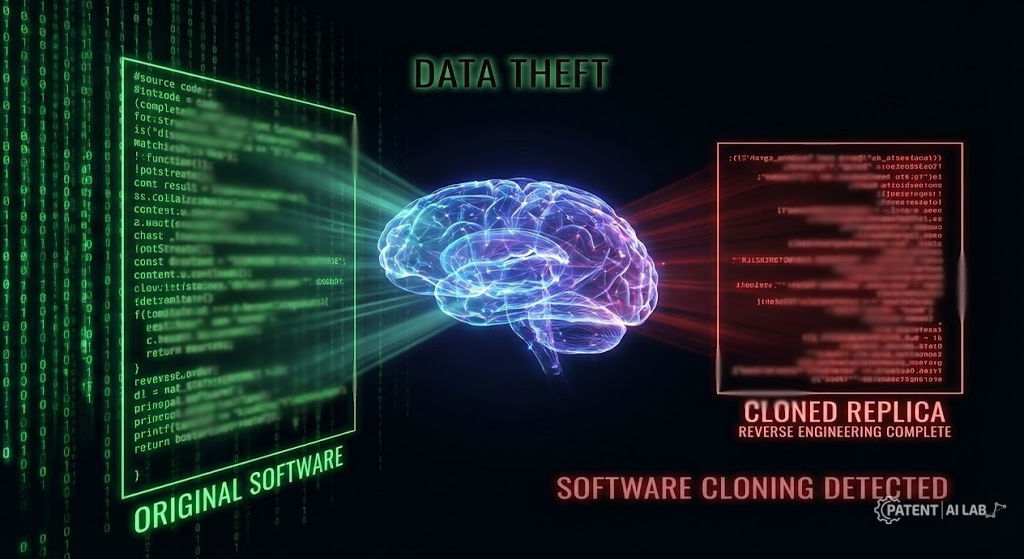
The AI Rewrite Problem
AI can rewrite code instantly without copying structure. That makes copyright enforcement largely ineffective against well-resourced competitors unless the copying is direct and obvious. For founders, this means copyright alone is structurally insufficient as a primary defense to protect SaaS source code.
There is an additional complication worth flagging: the U.S. Copyright Office’s January 2025 AI Copyrightability Report confirmed that works generated entirely by AI without meaningful human creative input do not qualify for copyright protection. If your developers rely heavily on AI coding tools with minimal human shaping of the output, portions of your codebase may fall into an unprotected gap.
Where Copyright-Only Strategies Fall Short
Founders who rely solely on copyright face three structural gaps: patents can be challenged and invalidated through USPTO inter partes review, trade secrets evaporate the moment a disgruntled employee or misconfigured API exposes them, and copyright enforcement is limited to literal copying that courts can identify. None of those gaps are theoretical. All three occur regularly in commercial software disputes.
When Copyright Works Best
Copyright remains the right tool for preventing direct code theft by contractors, enforcing against former employees who copy verbatim output, pursuing platform takedowns on app stores and GitHub, and establishing baseline SaaS code protection at minimal cost. For those use cases, it is fast, inexpensive, and effective. The mistake is assuming it covers more than expression.
Software Patents: What Actually Qualifies
USPTO Patent Eligibility: The Current Reality
Under the USPTO’s July 2024 AI Subject Matter Eligibility Guidance (reaffirmed by USPTO memoranda in August and December 2025), software must do more than automate an abstract idea to qualify for patent protection. To be patentable, it must demonstrate a technical improvement to a computer or process, a specific solution to an identifiable technical problem, and a non-generic implementation that goes beyond conventional steps.
Simply labeling a product “AI-powered” carries no weight. The Federal Circuit made this explicit in Recentive Analytics, Inc. v. Fox Corp. (April 2025), ruling that claims which apply established machine learning methods to a new data environment, without improving the underlying technology itself, are patent-ineligible under the Alice framework. The court’s reasoning was direct: applying a known technique to a new domain is not an invention.
The August 2025 USPTO memorandum, while not issuing new rules, strongly implied that examiners had been applying the Alice/Mayo framework too harshly, signaling a gradual shift toward higher grant rates for AI-based applications drafted with technical specificity.
Patent-Eligible vs. Non-Eligible: Practical Examples
Patent-friendly innovations include: a novel caching architecture that demonstrably reduces database query latency, a new data pipeline that measurably improves model training efficiency, and a cryptographic workflow that improves the security of API authentication. Each of these solves a technical problem with a technical solution.
Not patent-friendly: user matching logic, pricing optimization algorithms, generic dashboards, and standard business rules. These are abstract ideas that happen to run on computers, and the USPTO treats them accordingly.
Illustrative Scenario (for conceptual framing only): Consider an AI startup that builds a fraud detection model claiming a 40% reduction in false positives through a novel feature selection method. From a technical standpoint, if that improvement is driven by the feature selection method itself, and the application describes precisely how that method differs from conventional approaches, the claims are more likely to engage productively with the Alice framework during examination. If the claims instead describe “using AI to detect fraud,” they are far more likely to face early rejection. How any specific application would actually be received by an examiner depends on the full claim language, prosecution history, and prior art landscape — questions that require review by a registered patent attorney rather than a general technical illustration like this one.
AI-Generated Code and Patent Inventorship
AI can help write code. However, patent claims must reflect human conception of the invention. If your team uses AI to implement a solution that a human engineer defined and directed, inventorship remains with that human and the patent application is valid. The critical distinction is who conceived the technical solution, not who typed the code. Courts and the USPTO consistently require a human inventor who understood and directed the creative process, so documentation of that decision-making trail matters more than it once did.
The biggest hurdle for modern software remains the Alice standard. We explain how to structure claims to overcome this in our article: How to Fix Software Patents That Fail Under Alice.
Trade Secrets for Core Algorithms
What Trade Secrets Actually Cover
The Defend Trade Secrets Act (DTSA, 18 U.S.C. § 1836) provides federal civil causes of action for misappropriation of trade secrets, covering algorithms, model weights, feature engineering pipelines, internal scoring logic, and proprietary training data. Protection applies only if the information is genuinely secret and the owner takes reasonable, documented steps to maintain that secrecy.
Courts have consistently held that reasonable measures include non-disclosure agreements with all personnel who access the information, access-controlled servers, documented internal IP policies, and auditable logging. According to 2024 court guidance, confidentiality agreements remain the single most important factor courts weigh when assessing whether trade secret status is established.
Example
A fraud detection platform keeps its risk scoring algorithm entirely server-side, never exposing it through API responses or client-side JavaScript. That logic qualifies as a trade secret precisely because the secrecy is structural, not just contractual.
Trade secret litigation under the DTSA has grown substantially since the law’s enactment. Federal DTSA filings grew from 173 cases in 2016 to 749 cases in 2023, and the first half of 2025 showed a further 15% increase over the first half of 2024, with AI-related trade secret cases up approximately 80% in the same period, according to Benesch’s 2025 Trade Secret Year in Review.
The Core Weakness of Trade Secret Protection
Once disclosed, protection is permanently gone. There is no registration, no exclusivity period, and no way to recapture the secret after it leaves your control. Trade secret protection fails when code is shipped client-side where it can be reverse-engineered from the browser, when logic is inferrable from observable API behavior, or when internal processes allow employees to extract proprietary methods without detection. Unlike a patent, a leaked trade secret offers no legal fallback position.
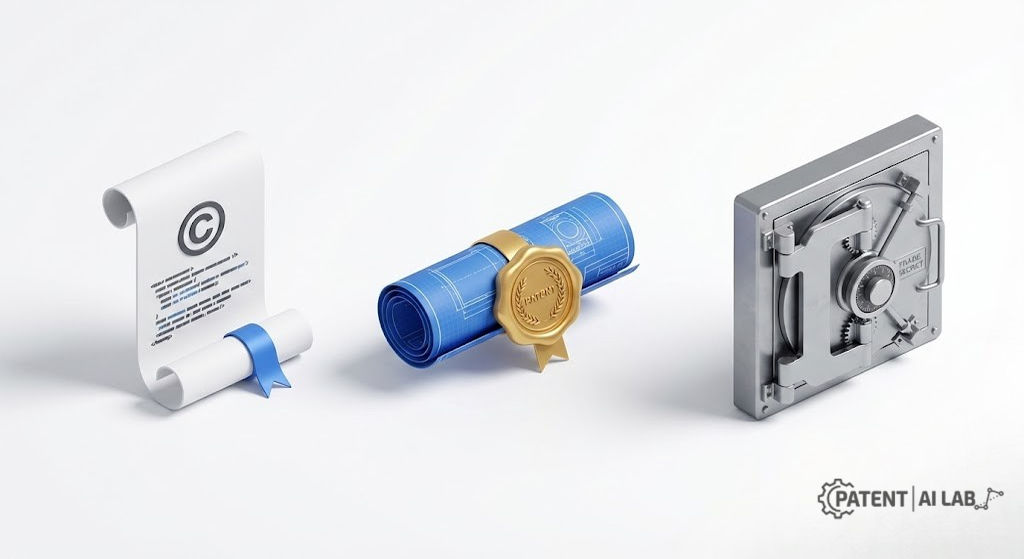
Copyright vs Patent vs Trade Secret
Cost Breakdown: What Founders Actually Pay
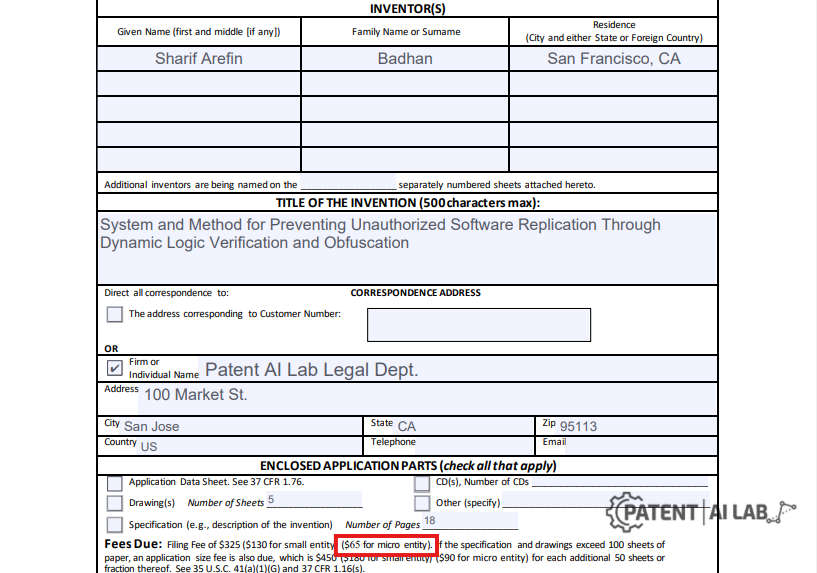
For early-stage teams working within a tight MVP budget, AI-assisted patent drafting tools have become a common cost-reduction approach before engaging full attorney services. Our detailed breakdown of one such tool — The Honest PowerPatent Review — covers where it performs well and where attorney involvement remains essential.
Reality check: Most early tech startups should not skip provisional patents if they plan to raise venture capital. Investors performing due diligence will scrutinize your IP position, and an empty patent portfolio is a negotiating liability.
Best Way to Protect Software Intellectual Property
Standard Industry Approach: Layered Protection
No single protection method covers every attack surface. The approach that consistently holds up in commercial and litigation contexts combines all three layers in a deliberate sequence:
- Copyright everything from day one, at minimal cost
- Keep core logic server-side and structurally inaccessible to clients
- Use trade secrets with documented confidentiality measures for all proprietary algorithms
- File provisional patents early to establish priority dates before product launch or investor announcements
- Convert only the most technically specific inventions to full utility patents
This sequence balances cost, speed, and enforcement power at each stage of company growth.
Software Litigation in the US: What Actually Triggers Lawsuits
IP disputes in the SaaS space rarely emerge from a competitor noticing clever code. They emerge from commercial events. Enterprise sales create discovery risk. Platform dominance attracts patent assertion entities. API compatibility disputes arise when a product gains enough market share to become infrastructure. Investor due diligence at Series A and beyond routinely surfaces IP gaps that kill or re-price deals.
Courts rarely care how sophisticated your code is. They care whether it fits a legally recognized category and whether you took the steps required to protect it in that category.
AI-Generated Code: Who Owns It?
Ownership of AI-generated code depends on your contracts, the tools you use, and how much human creative direction shaped the output. You own it if your agreement with the AI vendor assigns output rights to you, which most enterprise agreements do. However, risk persists if the training data underlying the AI is unclear or if your output closely resembles copyrighted material in the training set.
Three mitigation steps that reduce this exposure: use AI vendors with clear enterprise IP indemnification terms, document the prompts and human decisions that shaped significant outputs, and avoid ingesting public repository code blindly without license review.
⚠️ Developer Risk: The AI Copilot Privacy Trap
If your developers use AI coding assistants (like Copilot or Cursor) with default or consumer-tier settings, your proprietary SaaS logic may be fed back into the AI’s training data. Once your code enters an LLM’s public knowledge base, your Trade Secret protection is permanently destroyed under the DTSA’s reasonable-measures requirement. Enterprise-level privacy toggles must be explicitly enabled and audited on all internal development tools.
Future Outlook: Where SaaS IP Protection Is Heading
SaaS IP Protection After 2026
Trends to watch:
Narrower software patents focused on demonstrable technical improvements, stronger federal trade secret enforcement driven by DTSA case growth, more API-based infringement claims as products become infrastructure, and increased judicial scrutiny of AI inventorship declarations.
Strategic Alignment:
Expect function-focused, technically specific patents to survive, while broad platform claims continue to fail under Alice. The USPTO’s December 2025 memoranda signal a practitioner-friendly shift, but only for applications drafted with precise technical framing.
Podcast
Note: This audio is a condensed summary. Please refer to the written text for precise legal and compliance definitions.
Frequently Asked Questions
Is SaaS source code automatically protected?
Yes, by copyright — but only the expression, not the function. Under U.S. copyright law, the moment you write original source code, that specific text is protected automatically. However, the underlying logic, algorithms, and functional behavior are not. A competitor who rewrites the same functionality in different syntax faces no copyright liability, which is why copyright alone is insufficient protection for most SaaS products.
Is a patent better than copyright for software?
For protecting core technical innovations, patents are significantly stronger than copyright. A patent can cover the functional method itself, not just how the code is written. However, software patents require clearing the USPTO’s Alice eligibility test, which is demanding and expensive. For general codebase protection, copyright is faster and costs far less. Most mature SaaS companies use both.
Are trade secrets safer than patents?
Trade secrets can be more durable than patents in some situations — they have no expiration date and require no public disclosure. However, they are far more fragile. Protection is permanently lost the moment the information becomes publicly accessible, whether through an employee leak, a misconfigured API, or client-side code exposure. Patents, once granted, provide enforceable exclusivity regardless of whether competitors independently discover the same method.
What is the best protection for AI SaaS?
A layered combination of copyright, patents, and trade secrets, applied strategically. Copyright covers code expression automatically. Trade secrets protect server-side algorithms provided confidentiality measures are documented and enforced. Patents cover novel technical implementations that clear USPTO eligibility requirements. No single method addresses all exposure vectors, which is why most well-advised AI SaaS companies use all three in parallel.
Sources and Legal References
The legal frameworks, statutory structures, and software examination indices analyzed across this report are verified through official registries:
-
1. U.S. Copyright Office — Copyright and Artificial Intelligence, Part 2: Copyrightability (January 29, 2025)
Confirms that works generated entirely by AI without human authorship are not eligible for copyright protection, establishing the current standard for AI-assisted SaaS codebases.
Access U.S. Copyright Office AI Copyrightability Report -
2. USPTO — 2024 Guidance Update on Patent Subject Matter Eligibility Including on Artificial Intelligence (Federal Register, July 17, 2024)
The operative examination framework establishing the two-pronged Alice/Mayo eligibility test for AI and software patent claims, reaffirmed by USPTO memoranda in August and December 2025.
Review USPTO 2024 AI Patent Eligibility Guidance -
3. Defend Trade Secrets Act of 2016 (DTSA — 18 U.S.C. § 1836)
The federal statute establishing civil causes of action for trade secret misappropriation, mandating explicit and documented confidentiality measures to maintain legal protection over proprietary back-end code and model weights.
Verify Federal DTSA Statutory Provisions -
4. Benesch — 2025 Trade Secret and Restrictive Covenant Year in Review (December 2025)
Documents the 15% increase in federal DTSA filings in H1 2025 versus H1 2024, and the approximately 80% rise in AI-related trade secret cases, supporting enforcement growth claims in this guide.
Access Benesch 2025 Trade Secret Year in Review
Disclaimer & Legal Notice
PatentAILab is an independent educational research platform. The case studies, patent analysis, and strategic insights provided across this platform are written from a technical and academic perspective and are intended strictly for informational and educational purposes. They do not constitute formal legal, corporate, or financial advisory services and should not be relied upon as a substitute for advice from a registered patent attorney. Intellectual property outcomes depend on dynamic jurisdictional laws and specific technical drafting. Always consult a certified patent attorney before making IP filings or investment decisions.




3 comments