


 Golam Rabiul Alam, PhD
The Startup Extinction Event Nobody is Talking About
The legal risks of building RAG apps require immediate attention. If you are a startup founder, Chief Technology Officer (CTO), or lead backend engineer who believes you can seamlessly scrape the open internet, dump that raw text into a scalable vector database, and launch a billion-dollar Retrieval-Augmented Generation (RAG) application overnight, you are sitting on a massive, ticking legal time bomb.
In the early days of the generative AI boom, the entire legal community and tech media were fixated strictly on “training data.” The famous New York Times vs. OpenAI battle was primarily about what went into the foundational models during their initial, multi-billion-parameter pre-training phase. But the legal battlefield has shifted violently. Today, the immediate, existential threat to your business is not how the LLM was trained. It is exactly how your application retrieves, processes, and displays third-party information in real-time to your end-users.
If you have been tracking the Perplexity lawsuit 2026 developments, you know exactly what I mean. Global media conglomerates like The New York Times, News Corp (Dow Jones/NY Post), Forbes, and even cloud infrastructure titans like Amazon have dragged Perplexity into federal court. They are not just suing a single rogue startup; they are putting the entire Retrieval-Augmented Generation architecture on trial.
This article is your uncompromising, battle-tested survival guide. We will break down the precise mechanics of the AI web scraping lawsuit wave, answer the burning question: Is RAG copyright infringement? We will hand you a bulletproof compliance strategy so your startup survives the incoming regulatory winter.
At a Glance
The 2026 Legal Reality
Building a RAG (Retrieval-Augmented Generation) app is not inherently illegal, but the data ingestion method is under severe federal scrutiny. The Perplexity AI lawsuits explicitly demonstrate that ignoring robots.txt files, bypassing security paywalls, and generating verbatim summaries without driving meaningful traffic back to the source will void any Fair Use defense. Startups must shift immediately from rogue web scraping to licensed API data pipelines to survive.
Based on architectural code audits and reviewing active federal court dockets, the legal baseline is definitive. If you build an application that stores copyrighted content in unlicensed vector databases and generates outputs that serve as a direct market substitute for the original publisher, it is a guaranteed path to catastrophic copyright infringement.
The Perplexity scraping lawsuit rulings prove that the traditional Generative AI fair use defense completely falls apart when your AI summaries actively discourage users from visiting the original content. If you steal their traffic, you steal their revenue, and the courts will hold you strictly liable.
Key Takeaways for Founders and Developers
Before we dive into the heavy legal text and technical code analysis, you must internalize these core realities about AI web scraping copyright law 2026:
- The 3-Stage RAG Trap: Copyright liability in RAG applications does not just trigger at the final output text on the user’s screen. It triggers at the input (scraping), the indexing (vector storage), and the output (regurgitation) stages.
- The DMCA vs. Robots.txt Legal Reality: Ignoring a website’s
robots.txtfile is a civil breach (Trespass to Chattels), but bypassing a login page or paywall is a criminal DMCA (Digital Millennium Copyright Act) violation. Both destroy your Fair Use defense, but one puts you in federal crosshairs. - The Copyright Indemnification Trap: The “Copyright Shields” offered by OpenAI and Google only cover their base models. The second you inject scraped third-party data into your RAG pipeline, that enterprise indemnification is instantly voided.
- The Threat of Market Substitution: If your RAG app provides enough comprehensive information that a user never needs to click the source link, you are creating an illegal market substitute. You are stealing their traffic, and publishers will sue you for economic damages.
- Human Inventorship Rules: According to the latest USPTO 2026 guidelines, you cannot patent AI-generated code or RAG workflows unless a human “significantly contributed” to the inventive concept.
Why Copyright Infringement in AI Search Engines is Different
To truly grasp the legal risks of building RAG apps, we have to examine the foundational economic model of the open internet. We must look at the history of how the web was monetized.
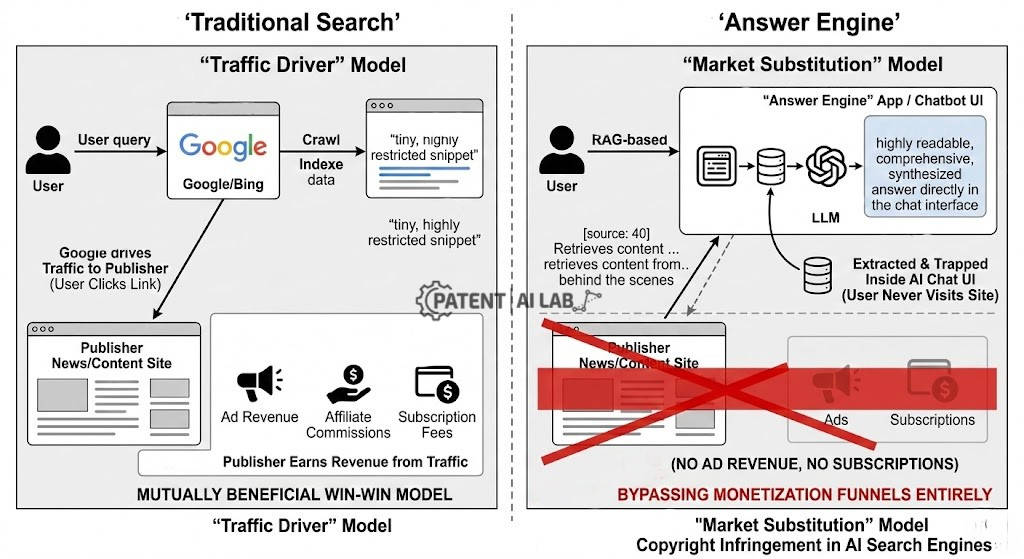
For over two decades, traditional search engines like Google and Bing operated on a mutually beneficial “traffic driver” model. Google crawls a news site, indexes the data, and shows a tiny, highly restricted snippet on the search engine results page (SERP). The user reads the headline, clicks the blue link, and the publisher earns ad revenue, affiliate commissions, or subscription fees. The value proposition was a delicate win-win: the search engine gets user queries and behavioral data, and the publisher gets monetizable web traffic. RAG applications completely obliterate this script.
Instead of routing users to the source material, an “answer engine” retrieves the content behind the scenes, augments it using a Large Language Model (LLM), and generates a highly readable, comprehensive, synthesized answer directly in the chat interface.
The user gets exactly what they need immediately. They never leave your application. They never visit the publisher’s site. They never view the publisher’s advertisements or encounter their subscription prompts.
Publishers legally define this as “Market Substitution.” You are taking their expensive, hard-won investigative reporting, bypassing their monetization funnels entirely, and replacing their market presence with your chatbot. This fundamental economic disruption is the precise reason why copyright infringement in AI search engines is currently the most aggressively litigated topic in global intellectual property law.
“Startup founders frequently argue in boardrooms, saying, ‘But Dr. Alam, we provide a tiny citation link to the source at the bottom of the prompt!’ If your AI agent just gave the user a perfectly formatted 500-word summary of a paywalled Bloomberg financial analysis, the user is absolutely not clicking that citation link.”
A citation is not a magic legal shield against copyright infringement if the economic damage to the publisher has already been executed.
The Perplexity Lawsuit 2026: Q2 Scorecard
Core Claim: Scraping behind active paywalls. Hallucinating quotes and falsely attributing them to NYT journalists. Stealing traffic and diverting subscription revenue.
Core Claim: Unauthorized commercial use of premium content. Labeling RAG technology as an explicit and deliberate “copyright trap” designed to siphon publisher value.
Core Claim: Verbatim copying of exclusive investigative reporting without proper attribution or financial compensation.
Core Claim: “Comet” AI agent bypassing AWS security. CFAA violations. Spoofing headers to impersonate human browser behavior on AWS-hosted sites.
As you can clearly see from the data table, these plaintiffs are not independent bloggers complaining about attribution. They are mega-corporations possessing unlimited legal budgets, looking to set federal precedents that will dictate how the internet functions for the next century. The Forbes settlement is particularly telling: publishers will drop the copyright hammer until you agree to pay for API access.
The Technical Anatomy of RAG Infringement
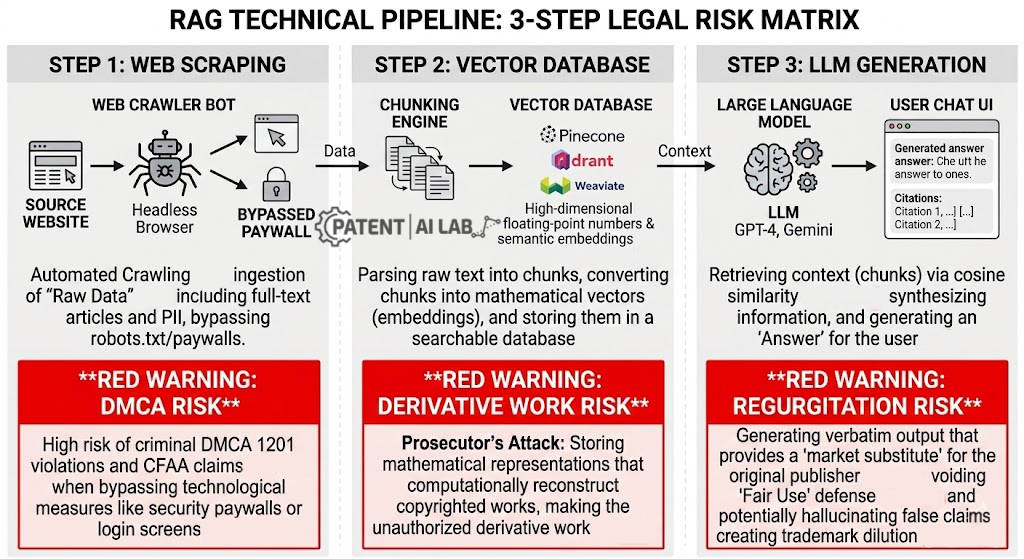
As an IP strategist looking at how RAG is fundamentally built, I do not see a single software feature. I see a highly vulnerable, interconnected three-stage pipeline. Unfortunately, each stage presents a unique, fatal legal trap for your engineering team.
The Input Trap and the Scraping Liability
The very first step of RAG is gathering the raw data. Most developers write automated web crawlers or use headless browser tools like Puppeteer or Playwright to scrape the web. The legal issue here isn’t just the act of reading a public webpage. It is how your bot accesses that page. If you are scraping blindly, you are stepping directly into civil liability territory.
The Indexing Trap and Enterprise Privacy
Once you scrape the text, your system parses it, breaks it into computational chunks, and stores it in a Vector Database (like Pinecone, Milvus, Qdrant, or Weaviate). This is where the legal and technical worlds violently collide.
The Engineer’s Defense: A vector embedding is just a list of high-dimensional floating-point numbers representing semantic meaning. It is purely math. It is definitely not a literal “copy” of the text, so copyright law doesn’t apply to a string of decimals.
The Prosecutor’s Attack: Copyright law protects the expression of ideas. If those floating-point numbers can be computationally queried via an LLM to reconstruct the original copyrighted work (even partially), the vector database itself functions as an unauthorized derivative work.
Furthermore, enterprise RAG architecture data privacy becomes an absolute nightmare here. If you ingest confidential corporate data, Personally Identifiable Information (PII), or copyrighted articles into a shared, multi-tenant vector database, you run the massive risk of that data bleeding into outputs for unauthorized users. This triggers severe GDPR, HIPAA, and CCPA violations alongside copyright claims.
The Output Trap and Output Citation Mechanisms
The final stage is where the LLM reads the retrieved chunks, synthesizes the information, and generates the text for the user. Even if you implement strict output citation mechanisms (like a hyperlink or a UI tooltip), you are not legally safe.
If your AI “regurgitates” too much of the original content verbatim, it is a direct, undeniable copyright violation. Courts apply the Substantial similarity test here. If your generated output is substantially similar to the source article in structure, tone, and specific wording, and it serves as a complete economic substitute for reading that article, you are in the “Red Zone” of liability.
Furthermore, if you are blindly feeding proprietary data into external LLMs without ironclad enterprise agreements, you are likely triggering the “Public Disclosure” Trap: Does Drafting Patents with AI (ChatGPT/Claude) Kill Your Global Rights? and voiding your global IP.
The DMCA vs. Robots.txt Nuance: Correcting a Massive Industry Misconception
The tech community consistently misinterprets the legal weight of robots.txt versus actual paywalls. We need an immediate technical fact-check on bypassing robots.txt legal liability.
To Summarize
Ignoring robots.txt ruins your Fair Use defense and invites civil lawsuits.
Bypassing a paywall invites federal prosecutors and the DMCA.
The Enterprise Copyright Indemnification Trap (Missing Context)
Here is a massive legal gap that CTOs and enterprise architects are currently falling into blindly.
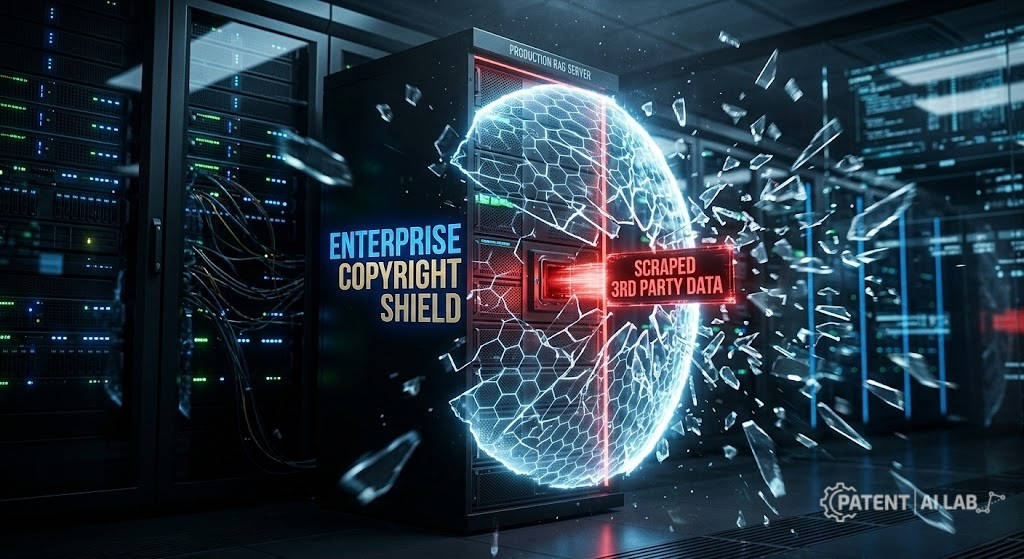
Currently, many enterprise clients eagerly sign lucrative contracts to use OpenAI’s API (GPT-4) or Google’s API (Gemini) because these mega-corporations boldly advertise a “Copyright Shield.” They promise to pay your legal fees if you get sued for copyright infringement while using their models.
OpenAI’s indemnification clause explicitly states they will not cover infringement caused by “Customer Materials” (the data you feed the model). Therefore, if your RAG app pulls a paywalled New York Times article from your vector database, feeds it to GPT-4, and GPT-4 summarizes it for your user, you are entirely on your own. OpenAI will not pay your legal bills. You assumed 100% of the liability the moment you injected the scraped text.
Do not assume that shifting away from proprietary APIs to local models automatically saves you. Read our analysis on The “Fake Open Source” AI Trap: Why Using “Open Weights” (LLaMA/Mistral) Might Void Your IP Rights to understand the hidden licensing risks of self-hosted RAG.
Generative AI Fair Use Defense 2026: Transformative Use vs Verbatim Copying
If you want to see exactly how verbatim copying is being weaponized in federal court, you must read our deep dive on the NYT vs. OpenAI Lawsuit Update: Did “Regurgitation” Kill the Fair Use Defense? to understand the 20 million log order.
Trademark Dilution & The “Hallucination” Liability Factor
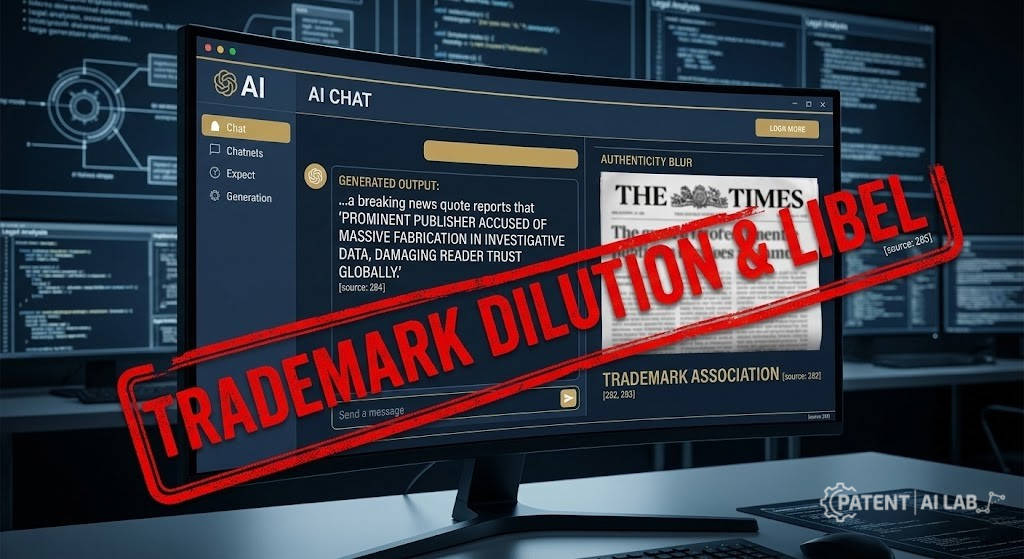
A massive, deeply underreported aspect of the New York Times lawsuit is the issue of AI hallucinations. Perplexity and other answer engines frequently make mistakes. A major complaint of the NYT is that Perplexity often gives incorrect information, commonly known as a Hallucination and specifically uses the NYT name as a reference citation to back up that false claim.
This isn’t just a copyright problem; it is a Trademark Violation and a potential case of Libel.
When an AI confidently says, “According to The New York Times, the CEO of Company X committed financial fraud,” and that is a hallucination, you have just damaged a global brand’s reputation. This is legally known as Trademark Dilution.
In the 2026 legal landscape, courts are increasingly holding AI companies responsible for the “reputational harm” caused by these errors. For startups, this means you are strictly liable not just for the data your AI steals, but for the devastating lies your AI makes up while wearing someone else’s corporate logo.
Liability extends far beyond just text hallucinations. If your RAG application outputs audio summaries, you must immediately audit your system against the “Soundalike” Trap: Why Using “Generic” AI Narrators Might Be Illegal in 2026 (NO FAKES Act Analysis).
The Hallucination Liability Audit
Mandatory compliance check for RAG-based enterprise applications.
Does your system employ a secondary LLM pass to aggressively verify facts against the retrieved source before the final generation?
Are you displaying brand logos or names in a way that falsely implies their endorsement of your AI-generated output?
A tiny footer is insufficient in 2026. If marketed as an “answer engine,” your disclaimer must be prominent to survive the market-effect test.
The RAG Legal Risk Matrix: A Founder’s Audit
To help your engineering and product teams navigate this minefield without constantly calling outside counsel at exorbitant hourly rates, we have developed the RAG Legal Risk Matrix. Use this flowchart logic to audit your current application stack immediately to see whether your app is legally secure.
The RAG Legal Risk Matrix: Audit Logic
Decision Point
Strictly respect robots.txt?Decision Point
Pay for API Licensing?Scraping vs. Displaying Comparison
Understanding the exact legal difference between backend data ingestion and frontend user display is critical for evaluating your risk profile.
| Feature | Scraping (Input Phase) | Displaying (Output Phase) |
| Legal Basis | Fair Use (Transformative Indexing) | Direct Infringement (Market Substitution) |
| Key Legal Defense | “We are just indexing facts to understand the web.” | “We are providing a transformative summary.” |
| Main Legal Risk | Bypassing technical barriers, CFAA, DMCA violations. | Verbatim regurgitation, Trademark Dilution, Substantial Similarity. |
| 2026 Verdict | Generally legal only if robots.txt is strictly followed. | Highly risky if it economically replaces the source entirely. |
The Global Perspective: RAG and the EU AI Act Intersection
While the Perplexity lawsuits are centered entirely in the United States, tech startups must build for a global market. The European Union AI Act reached full implementation in 2026, and it fundamentally changes enterprise RAG architecture data privacy and copyright compliance worldwide.
As of the May 2026 compliance deadline, the European AI Office possesses the explicit authority to demand your complete training data logs. Non-compliance results in immediate operational suspension across all EU member states.
Because of the “Brussels Effect,” smart US-based startups are simply adopting EU standards globally to ensure they do not have to maintain two drastically different codebases. This includes implementing comprehensive opt-out detection algorithms and ensuring that all retrieved data is handled with strict provenance tracking.
USPTO Patent Eligibility: Can You Patent AI-Generated Code in 2026?
Before determining if your RAG architecture qualifies for IP protection, you must first understand the strict USPTO inventorship rules outlined in A Software Patent Attorney’s Reality Check on ChatGPT Code and Patentability.
Let’s look at the flip side of intellectual property. If your engineering team builds a revolutionary new RAG application architecture, can you patent the underlying algorithms to protect yourself from competitors?
If your RAG app uses a novel way to generate code or algorithms, the USPTO 2026 Guidance has brought much-needed clarity to this issue, but it has also raised the bar for what qualifies as a “human invention”.
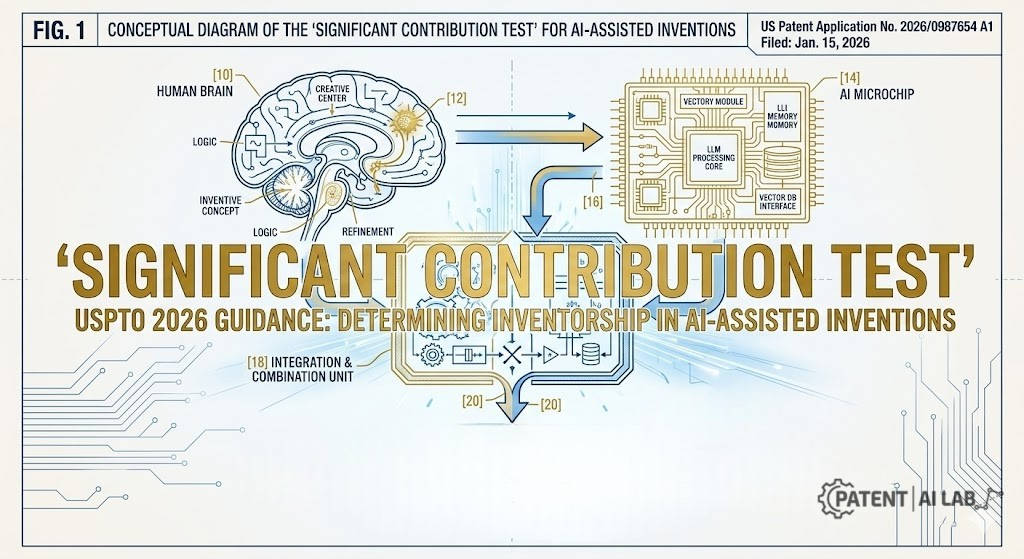
The 2026 Revised Guidance has streamlined the process, eliminating the heightened ‘significant contribution’ test via Pannu factors for single inventors, and returning to the traditional ‘Human Conception’ standard where AI is treated strictly as a tool, like software or a lab instrument.
The Future of API Licensing vs Web Scraping
As we look toward the end of 2026 and into 2027, the “Wild West” era of reckless AI web scraping is rapidly being replaced by a much more structured Licensing Economy. Companies like OpenAI, Apple, and even Perplexity itself are increasingly capitulating and signing multi-million dollar deals with massive publishers like News Corp, Axel Springer, and the Associated Press.
Investor Due Diligence: What VCs are Checking in RAG Startups
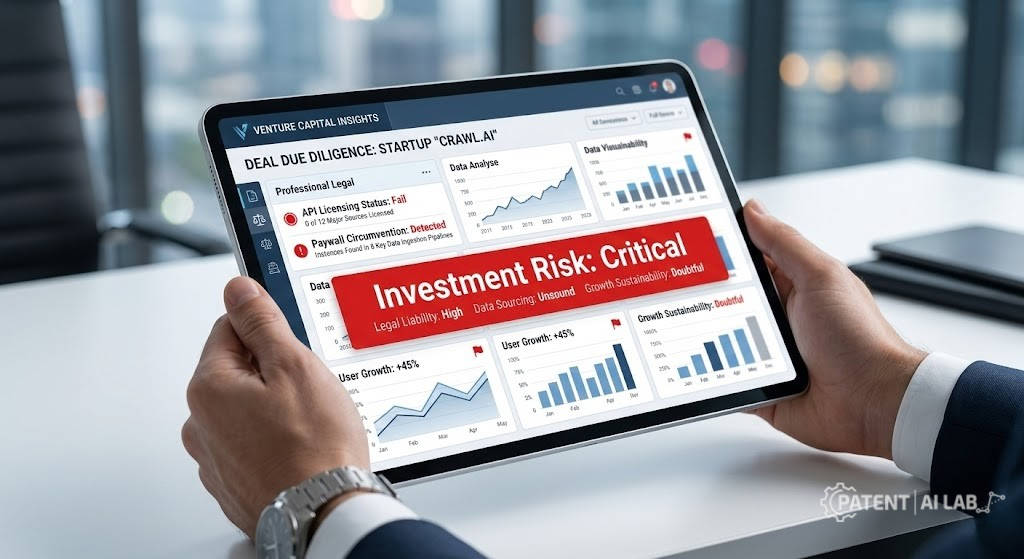
If you are a startup raising a Series A round in 2026, venture capitalists are no longer just looking at your user growth metrics. The legal risks of building RAG apps have fundamentally altered tech due diligence. Investors know that an AI web scraping lawsuit can bankrupt a company before it ever reaches an IPO.
When you sit down with a VC, their legal team will aggressively audit your data pipeline. They will ask to see your API licensing agreements. They will run automated tests to see if your system bypasses paywalls or circumvents robots.txt. They will examine your indemnification clauses, asking whether you are mistakenly relying on OpenAI’s voided copyright shield. They will demand to see your enterprise RAG architecture data privacy protocols to ensure you aren’t leaking proprietary data into a public vector database.
If you cannot provide a transparent, legally sound answer to how your application ingests and regurgitates data, the funding deal will collapse on the spot. Building a legally compliant architecture is no longer just about avoiding lawsuits; it is about making your company investable.
Verdict for Startups: The Parasite vs. The Partner
The Perplexity lawsuit 2026 is not just a passing tech headline about a single company fighting the media; it is a fundamental stress test for the entire generative AI ecosystem.
In 2026, the “move fast and break things” era of indiscriminate AI data collection is officially dead. The federal courts, the major publishers, and enterprise clients are all aggressively demanding a “Legal-by-Design” approach to software engineering.
Sources and Legal References
Podcast
Disclaimers & Legal Notices
Important Legal Notice for Founders: This guide is intended strictly as a high-level strategic resource, not as a substitute for dedicated legal counsel. Federal AI copyright law is actively being rewritten in the courts almost weekly. Never launch a commercial RAG product without having a registered IP attorney review your specific web crawlers, API licensing agreements, and LLM output mechanisms. Relying on generalized internet advice for software compliance is a risk your startup cannot afford.
Disclaimer: This article is based on our team’s experience advising startups, product development, and tracking IP litigation. Tools and legal interpretations change over time. Please note that PatentAILab is an educational platform and not a law firm. This content is for educational purposes only and does not constitute legal advice. Intellectual property laws (especially regarding AI) are complex and change frequently. Always consult a qualified patent attorney for your specific situation.
FAQ: AI Web Scraping Copyright Law 2026
Does ignoring robots.txt mean I have violated the DMCA?
No. This is a common misconception. robots.txt is a behavioral directive. Ignoring it is generally a civil issue like Trespass to Chattels or Breach of Contract, but it ruins your Fair Use “Good Faith” argument. However, bypassing a technical barrier like a password-protected paywall is a criminal DMCA (Digital Millennium Copyright Act) violation under Section 1201.
Will OpenAI’s or Google’s “Copyright Shield” protect my RAG application?
Absolutely not. This is the Enterprise Copyright Indemnification Trap. Their indemnification only covers the native outputs generated by their base model. If you use RAG to inject scraped, third-party copyrighted data into their LLM prompt, you instantly void the protection and assume 100% of the legal liability.
Is a vector database considered a copyright violation?
Not inherently. A vector database simply stores mathematical embeddings. However, if your specific algorithmic implementation of the database allows users to reconstruct and output large, verbatim portions of copyrighted works, federal courts may view the database as facilitating unauthorized derivative works.
Do output citation mechanisms protect my RAG app from copyright claims?
No. A citation is not a legal license. Providing a link to The New York Times does not give you permission to copy their article. If your AI summary is so comprehensive that the user no longer needs to visit the original site (Market Substitution), the citation will not save your Fair Use defense.
Can I face legal trouble for scraping if I use the data just for internal enterprise RAG?
Yes. While internal use might lower the risk of a highly public lawsuit from a media publisher, enterprise RAG architecture data privacy laws still strictly apply. If you scrape proprietary data or bypass technical security (like a login screen) to get that internal data, you are risking CFAA violations regardless of whether the output is public.
What is the exact difference between transformative use and verbatim copying in RAG?
Verbatim copying is when the LLM outputs paragraphs identical to the scraped source. Transformative use occurs when the LLM takes raw facts from multiple scraped sources and synthesizes a completely new expression, insight, or format (like turning five news articles into a comparative data table) without harming the original publishers’ market.
Can my startup patent the code we generated using an LLM like Claude or ChatGPT?
Only if a human engineer made a “significant contribution” to the final code. If the AI did all the architectural thinking and coding based on a generic prompt, it is ineligible for USPTO patent protection. You must thoroughly document human ingenuity in the loop.
Will paying for APIs completely eliminate my legal risk?
Utilizing API licensing vs web scraping drastically reduces your copyright risk to near zero, assuming you strictly abide by the API’s Terms of Service. It is the safest, most sustainable route for building enterprise-grade RAG applications in 2026.




Add comment