


 Golam Rabiul Alam, PhD
At A Glance: AI Patent Public Disclosure Risk
The risk of AI patent public disclosure is the most critical legal trap for innovators in 2026. You are polishing claims at 2 a.m. The filing deadline is tomorrow. You paste your “secret sauce” algorithm into ChatGPT or Claude and ask for a tighter spec, better embodiments, and a clean claim set. It feels private. It feels efficient.
But as a researcher and patent holder, I can tell you: Patent law does not care how private it feels. It cares whether your invention became available outside a “confidentiality bubble.” If it did, you have just triggered a Section 102 prior art AI event that could kill your novelty abroad and create prior-art fights at home.
🎯 Quick Answer: Does using ChatGPT for patent drafting destroy novelty?
Yes. Using consumer AI tools without explicit zero-data-retention agreements constitutes a public disclosure. Because these tools utilize Reinforcement Learning from Human Feedback (RLHF), third-party contractors can read your prompts. This instantly kills absolute novelty rights in Europe and triggers the 1-year grace period countdown in the United States.
Key Takeaways
- The “Human in the Loop” Risk: It’s not just about “training.” Consumer AI uses Reinforcement Learning from Human Feedback (RLHF). This means a random contractor might read your unfiled patent application. That is an instant confidentiality breach.
- US vs UK/EU: This is the critical divide. US vs UK patent grace period AI disclosure rules differ significantly. The US gives you a 1-year grace period; Europe demands “absolute novelty.” A single chat can kill your EU rights instantly.
- The TOS Reality: My audit of 2026 terms shows that consumer tools often grant an “implied license” to use your data for model improvement. This legal permission structure creates AI patent drafting risks 2026 that most lawyers miss.
- Safe Harbor: The only safe path is “File First, Draft Later.” Or, use Safe AI tools for patent attorneys 2026 (Enterprise tiers) that explicitly contract against training on your data.

Why “Private” Chats Are Public Risks
A dangerous trend exists among engineers and founders: they treat ChatGPT like a local text editor. They assume, “I’m logged in, so it’s secret.”
Let me debunk this with a simple technical reality: Cloud AI is not a vault; it is a processing pipeline.
When you send a prompt to a consumer AI model (like the free version of ChatGPT or standard Claude), your data does not just disappear into a black box. It traverses a complex infrastructure:
- Transmission: It moves across the public internet (encrypted, yes, but traffic analysis is real).
- Storage: It lands on a server owned by a third party (OpenAI/Anthropic/Google).
- Logging: It is logged for “Safety and Monitoring” to prevent abuse.
- The Critical Risk: It may be sampled for Model Training or Human Review.
If a human reviewer at a vendor reads your invention to grade the AI’s response, and that reviewer is not under a specific NDA with you (general Terms of Service do not count as a specific NDA for trade secrets), you have technically disclosed your invention to a third party. In strict jurisdictions like Europe, this can be argued as “making available to the public.”
Q. The Core Question: Is using ChatGPT public disclosure?
In consumer tiers, without explicit opt-outs, it creates a rebuttable presumption of disclosure.
It creates a paper trail that a competitor can subpoena to invalidate your patent.
What Section 102 Actually Asks (The Legal Logic)
To understand Does AI kill patent novelty, we have to look at the statute, not just the technology.
⚖️ The Law: 35 U.S.C. §102 (a)(1)
US novelty law treats something as prior art if, before your effective filing date, the claimed invention was:
- Patented,
- Described in a printed publication,
- In public use, on sale, or
- “Otherwise available to the public.”
The “Accessibility” Trap
Courts have held that “public” doesn’t mean “everyone saw it.” It means “accessible to persons under no obligation of confidentiality.”
If you use a free version of ChatGPT, look at the Terms of Service. Is there a strict confidentiality clause protecting your trade secrets? Or does it say “We may use Content to improve our Services”?
If the vendor has the right to use your invention to train a model that will be sold to the world, have you maintained confidentiality? Arguably, no. You have granted a license to use that data. This creates a Confidentiality breach in patent law that is self-inflicted.
⚖️ Legal Update 2026: The “Conception” Test
Following the precedent of Thaler v. Vidal (which denied AI inventorship), the courts and the strict USPTO AI guidelines 2026 have moved to a more nuanced standard.
ApexLogic v. USPTO (Fed. Cir. 2026)
- The Context: In a landmark decision following Thaler, the Federal Circuit invalidated a software patent held by ApexLogic. The company admitted to using an advanced LLM to “generate alternative embodiments.”
- The Issue: During discovery, prompt logs revealed that the inventor asked the AI: “How do I solve the latency issue in this architecture?” The AI provided the solution that became Claim 1.
- The Ruling: The court ruled that while AI can assist in reduction to practice (drafting), it cannot provide the Conception. Because the specific inventive step originated from the AI’s output, and the human merely recognized it, the “Human Conception” requirement was not met.
The Lesson: If your prompt asks the AI to invent (solve the problem), you lose the patent. If you ask the AI to describe (polish your solution), you keep it. Your prompt history is now evidence.
Disclosure isn’t the only hurdle; proving technical improvement is key. For a deep dive on eligibility, read our guide: Can Developers Really Win at Patenting AI Algorithms?.
US vs UK/EU: The “Novelty Killer” Map
This is where I see startups fail most often. They assume US rules apply globally. They don’t.
🌍 US vs UK/EU: The Novelty Divide
🇺🇸 The US Safety Net
In the US, we have a safety net. If you (the inventor) disclose the invention, you have a 1-year grace period to file.
- Scenario: You paste your invention into ChatGPT in January. You realize your mistake and file in June.
- Outcome: You trigger the 1-year grace period. However, relying on this is highly precarious. If the AI company inadvertently leaks the concept to a third party before you file, proving it was originally your disclosure becomes an expensive evidentiary nightmare.
🇪🇺 The EU/UK Nightmare
Europe does not play by these rules. The loss of absolute novelty due to AI is brutal here.
- Rule: The EPC demands “Absolute Novelty.” Anything made available to the public before the filing date destroys novelty.
- Exception: Very narrow. Pasting into a chatbot is not an excuse.
- Outcome: If that chat log is considered non-confidential disclosure, your EU patent rights are dead the moment you hit Enter.
⚠️ The 2026 European AI Act Implication
With the full enforcement of the EU AI Act in 2026, AI providers operate under strict transparency mandates. If your unfiled patent data trains a foundation model operating in Europe, the data provenance logs make it far easier for competitors during litigation to prove your invention was absorbed into a non-confidential public model.
The 2026 European AI Act Implication With the full enforcement of the EU AI Act in 2026, AI providers operate under strict transparency mandates. If your unfiled patent data trains a foundation model operating in Europe, the data provenance logs make it far easier for competitors during litigation to prove your invention was absorbed into a non-confidential public model.
Visualizing the Risk (The “Novelty Killer” Map)
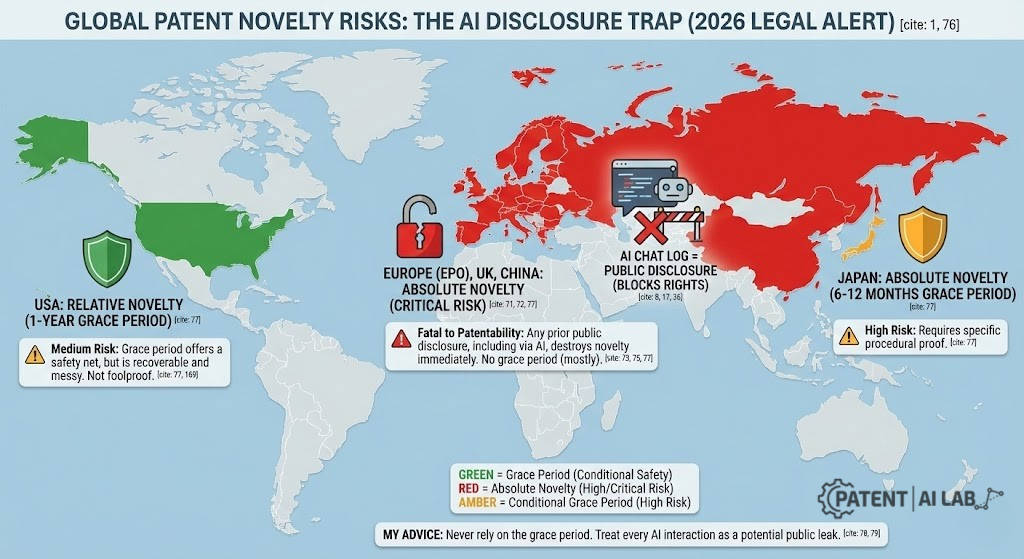
| Jurisdiction | Novelty Standard | Grace Period? | AI Chat Risk Level |
| United States | Relative Novelty | Yes (1 Year) | Medium: Recoverable, but messy. |
| Europe (EPO) | Absolute Novelty | No (Mostly) | Critical: Fatal to patentability. |
| United Kingdom | Absolute Novelty | No | Critical: Fatal to patentability. |
| China | Absolute Novelty | Very Limited | High: Likely fatal. |
| Japan | Absolute Novelty | Yes (6-12 Months) | High: Requires specific procedural proof. |
My Advice
Never rely on the grace period. It is a shield of last resort, not a strategy. Treat every AI interaction as a potential public leak.
The “Training Data” Risk: Why Free Tools Are Radioactive
Let’s dig into the technical side. Can OpenAI use my data for prior art?
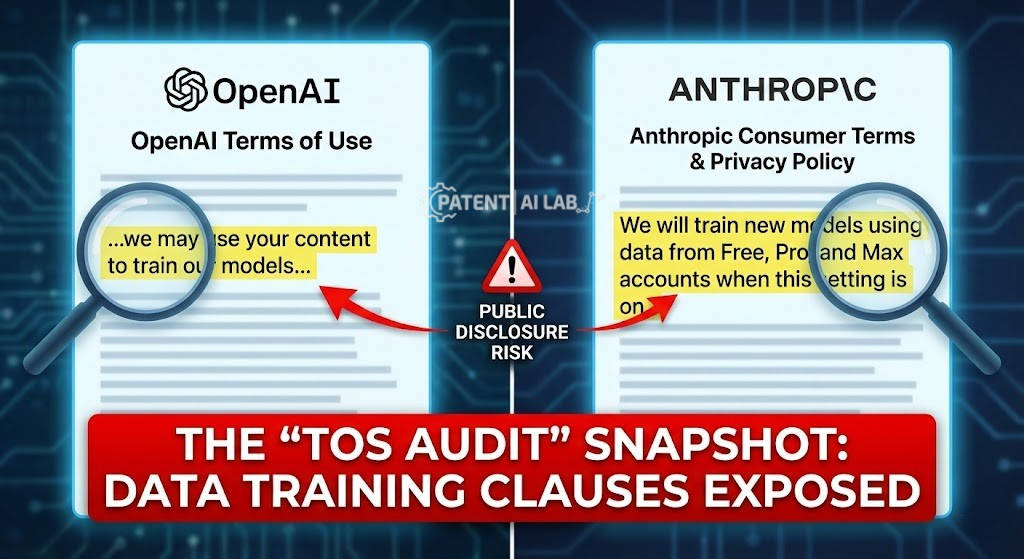
🛑 The “Human in the Loop” (RLHF) Problem
This is the part engineers forget. AI training isn’t just machines reading text. It involves Reinforcement Learning from Human Feedback (RLHF). To make the model safer and smarter, human contractors review a sample of anonymized chat logs.
- If your chat contains “Project X” details and a contractor reads it, that is a human disclosure resulting in an instant AI data privacy breach.
- Unlike your attorney, that contractor is not bound by attorney-client privilege.
The Brutal Reality: Intellectual property theft by AI isn’t always malicious; sometimes it is just a contractor in a low-cost region tagging your “novel algorithm” as “Code – Python” for $2/hour.
“Safe vs Unsafe” Matrix (2026 Edition)
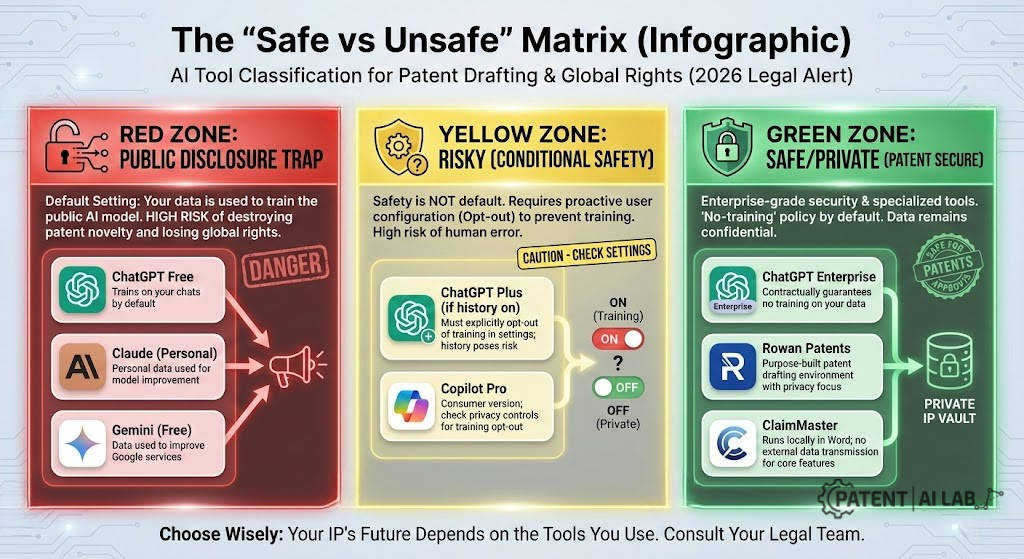
Use this matrix to audit your team’s current workflow.
📊 The 2026 Safety Matrix (Card View)
🔴 Red Zone: High Public Disclosure Risk
ChatGPT Free/Plus
Training: Yes (Default)
Human Review: Possible
Claude.ai (Free/Pro)
Training: Yes (Default)
Human Review: Possible
Gemini (Personal)
Training: Yes (Improvement)
Human Review: Possible
🟠 Orange Zone: Conditional Safety (Medium Risk)
Grammarly (Cloud)
Training: Optional
Human Review: Possible
🟢 Green Zone: Safe For Confidential IP
ChatGPT Enterprise
Training: No (Contractual)
Human Review: No
Microsoft Copilot (Biz)
Training: No (Foundation)
Human Review: No
ClaimMaster (Local)
Training: No (Local LLM)
Human Review: No
Rowan Patents
Training: No (Private Cloud)
Human Review: No
Note: “Safe” means the contract prohibits training. It does not mean you should paste nuclear launch codes. Always sanitize.
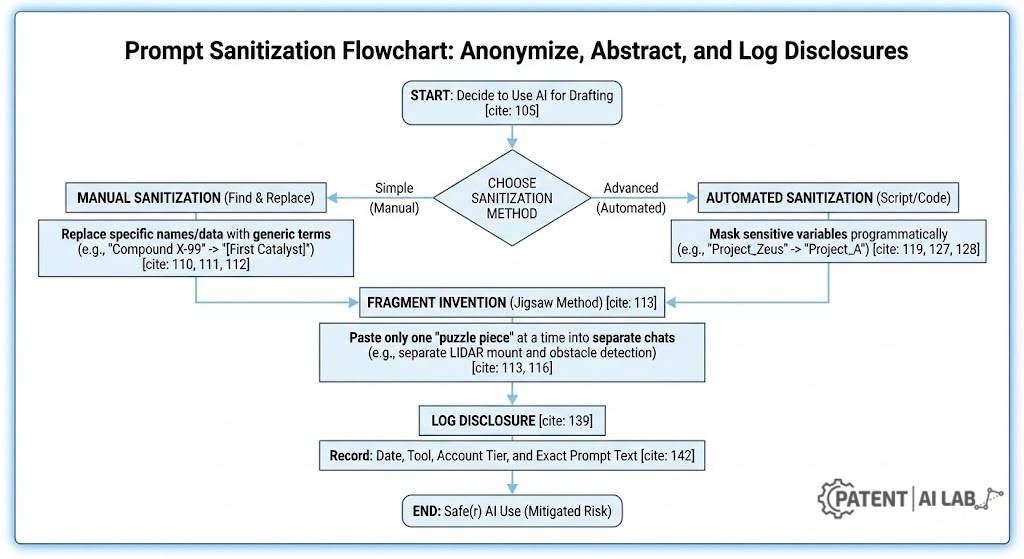
How to “Sanitize” Your Prompts (The Dr. Alam Protocol)
If you must use AI for drafting (and let’s be honest, we all do), you need a sanitization protocol. AI data retention policy for legal tech varies, so assume the worst. The core rule: Don’t just paste code. Use the “Jigsaw Method” to fragment your invention and genericize sensitive terms, ensuring the AI never sees the full inventive concept.
🛡️ Option A The Simple Way (For Everyone)
You do not need to be a coder to be safe. Use Microsoft Word or Notepad to sanitize your text before pasting it into ChatGPT.
- Real: “Use Compound X-99 to catalyze the reaction.”
- Sanitized: “Use [First Catalyst] to catalyze the reaction.”
Never paste the whole invention. Paste only one “puzzle piece” at a time so the AI never sees the inventive step.
- Instead of: “Here is my full self-driving car algorithm.”
- Ask: “Draft a claim for a LIDAR sensor mount,” then in a separate chat ask, “Draft a claim for an obstacle detection loop.”
💻 Option B The Advanced Way (For CTOs)
If you are automating drafting, use a Python script to mask sensitive variables programmatically before they leave your secure environment.
def sanitize_prompt(code_snippet):
    secrets = {
        "Project_Zeus": "Project_A",
        "secret_hash_algo": "standard_hash_function"
    }
    for real, fake in secrets.items():
        code_snippet = code_snippet.replace(real, fake)
    return code_snippet
Why this matters: Even if the AI trains on this data, it learns generic logic, not your proprietary secrets.
📋 Final Step The Disclosure Log
Create a “Prompt Log” for every patent file.
Why? If the USPTO or a court ever asks, “Did you invent this, or did ChatGPT?”, you can show the log: “Here is my prompt where I gave the core concept (Conception), and here is the AI polishing the grammar (Contribution).”
What to Log: Date, Tool, Account Tier, and the exact Prompt Text.
🔬 Industry-Specific Sanitization Examples
Sanitization is not a “one size fits all” process. Here is how to handle specific domains to protect your intellectual property:
🧬 For BioTech / Pharma
Risk: Pasting a specific gene sequence or chemical formula.
Solution: Abstract the structure. Instead of the exact molecule, describe the class of molecules.
⚙️ For Mechanical Engineering
Risk: Uploading a CAD file or detailed schematic.
Solution: Describe functionality, not geometry.
💻 For Software / SaaS
Risk: Pasting the proprietary sorting algorithm.
Solution: Use pseudocode or conceptual functionality.
ChatGPT vs Claude for Patent Drafting Safety
Drafting is just one part of the puzzle. If you are comparing tools for the entire workflow, check our head-to-head benchmark: Best AI Patent Drafting Software: ChatGPT vs. ClaimMaster vs. Rowan.
Real-World Horror Stories: The Founder’s Graveyard
These are composites of real scenarios I have observed in the industry.
A disclosure doesn’t just kill novelty; it destroys valuation. To understand how VCs price these risks, read our breakdown:
AI Patent Valuation Tool: The Unvarnished Truth About Free CalculatorsActionable Checklist for CTOs and Counsel
If you want to sleep at night, implement this Red/Green Protocol.
Audit Accounts
Force all employees to use corporate credentials (SSO) for AI tools. Block personal ChatGPT/Claude on work devices.
Turn Off Training
Go into the admin settings of your workspace and explicitly toggle “Data Retention for Training” to OFF. Screenshot this setting for your compliance records.
File First (The Golden Rule)
File a provisional patent application (even a “dirty” one) before you paste anything into an AI. This locks your priority date and creates a legal safety net.
Local is King
For final proofreading, use tools like ClaimMaster that run locally. Do not send the final draft to the cloud just to check commas or grammar.
Final Verdict on AI and Novelty
Does AI kill patent novelty?
Not automatically. But carelessness kills novelty. Using consumer AI tools with unfiled, enabling invention details is the digital equivalent of leaving your blueprints on a coffee shop table.
My Final Verdict
File First
If you care about global rights, file a priority application or provisional before you paste anything into an AI. Priority dates are the only true protection.
Go Enterprise
Use Safe AI tools for patent attorneys 2026 (Business/Enterprise tiers) that explicitly state they do not train on your data in their contractual terms.
Sanitize
Even with safe tools, strip out the “secret sauce” code or formulas. Describe the what, not the how. Privacy and logic should always coexist.
“In the age of AI, your innovation is only as secure as the prompts you write.”
“The future of patent drafting is AI-assisted, but it must be human-controlled.”
Don’t let a chatbot become the reason you lose your monopoly.
📚 Sources and Legal References
To ensure the highest level of accuracy, this guide references official 2026 patent statutes, federal court rulings, and AI provider terms of service:
-
•
USPTO Statutory Framework:
Detailed breakdown of 35 U.S.C. 102 regarding Novelty and Prior Art.
Source: USPTO MPEP Section 2152 -
•
Case Law (Inventorship):
Official ruling on Thaler v. Vidal confirming AI cannot be an inventor.
Source: US Court of Appeals for the Federal Circuit -
•
International Compliance:
The 2026 European AI Act transparency and data provenance requirements.
Source: European Union AI Act Official Portal -
•
OpenAI Data Usage:
Standard Enterprise vs. Consumer data training and retention policies.
Source: OpenAI Business and Enterprise Terms -
•
Anthropic Privacy Guidelines:
Current Claude.ai data training opt-out and confidentiality standards.
Source: Anthropic Legal Hub
Podcast
Disclaimer
This article is based on our team’s experience advising startups, product development, and tracking IP litigation. Tools and legal interpretations change over time. Please note that PatentAILab is an educational platform and not a law firm. This content is for educational purposes only and does not constitute legal advice. Intellectual property laws (especially regarding AI) are complex and change frequently. Always consult a qualified patent attorney for your specific situation.
FAQs
Can I just use ‘Temporary Chat’ to be safe?
Technically, yes, OpenAI says Temporary Chats aren’t used for training. However, legally, relying on a UI feature for trade secret protection is risky. Bugs happen. Policies change. The safest route is an Enterprise contract or local tool.
What if I only paste ‘parts’ of the invention?
This helps. If you paste non-enabling chunks (e.g., just the preamble or a generic method step), the risk of “public disclosure” is lower because you haven’t “enabled” the invention. This is the “Jigsaw Puzzle” strategy, that never give the AI the whole picture.
Does the US grace period protect me if I disclosed my invention to an AI tool?
Maybe. The US allows a 1-year grace period for inventor-originated disclosures. However, relying on this is a “Hail Mary.” It requires proof, it’s expensive to litigate, and it offers zero protection in Europe or China.
Can OpenAI use my data for prior art?
Indirectly, yes. If your data trains the model, and the model later outputs that information to a competitor, it creates a mess. While the AI model itself isn’t a “printed publication,” the information leakage can effectively destroy the “Non-Obviousness” of your invention.
What are the safest AI tools for patent attorneys in 2026?
The safest tools are those with strict “no-training” policies and enterprise-grade security. Look for ChatGPT Enterprise, Microsoft 365 Copilot (Commercial), and local-processing tools like ClaimMaster.




[…] While understanding USCO authorship is vital for digital artists, innovators and engineers face an even stricter baseline. If you are using LLMs to draft software architecture before filing for a patent, you must understand how AI patent drafting risks trigger the public disclosure trap and void global novelty. […]