


 Golam Rabiul Alam, PhD
Is generic AI voice illegal in 2026? As federal laws like the NO FAKES Act actively target unauthorized “soundalikes,” using a stock narrator without checking its provenance has become a direct liability trap for creators and brands.
At A Glance: The Executive Summary
If you create content in 2026, you are likely relying on AI voices. You believe you are safe because you aren’t cloning Taylor Swift or Morgan Freeman. You are simply using “Generic Male Narrator #4” from a popular SaaS tool to narrate your corporate training video or YouTube explainer.
Here is the cold truth: That “generic” voice might be the most expensive asset you ever use. In 2026, the legal landscape has shifted tectonically. The NO FAKES Act 2026 summary highlights a new reality: it isn’t just about deepfakes anymore; it creates a federal property right in a human voice. If your “generic” narrator is actually a scraped recording of a working voice actor who didn’t sign a specific AI waiver, you are trafficking in an unauthorized Digital Replica.
Key Takeaways
- The “Generic” Lie: “Generic” does not mean “Safe.” If a voice sounds like a specific person to a reasonable listener, you face AI voice soundalike legal risk, even if you never named them.
- The ELVIS Act Standard: Before the federal NO FAKES Act, Tennessee’s ELVIS Act set the gold standard, making unauthorized voice cloning a criminal offense in some cases. Ignoring state laws while waiting for federal ones is a fatal mistake.
- The NO FAKES Hammer: This legislation moves voice protection from a messy state-by-state patchwork to a Federal anti-deepfake legislation compliance issue. It introduces statutory damages ($5,000 per violation) that stack up fast.
- The Platform Trap: Commercial use of AI voice on YouTube 2026 requires strict labeling. YouTube now allows privacy takedowns for synthetic voices, bypassing copyright strikes entirely.
- The “As-Is” Scam: My analysis of popular AI voice generators shows their Terms of Service (TOS) actively push liability onto you. They sell you the tool, but you hold the legal bag for Intellectual property indemnification clause failures.
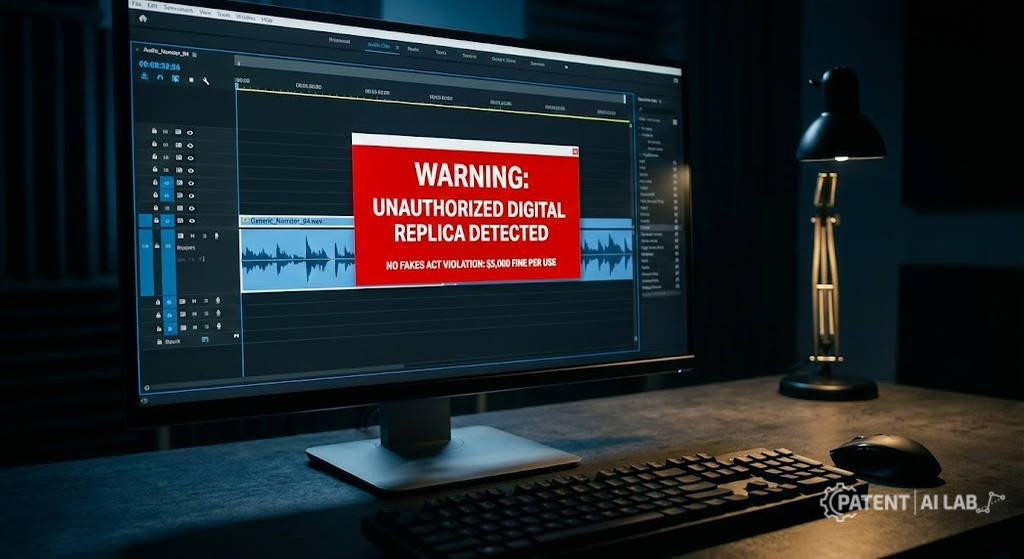
The “Generic Voice” That Wasn’t Generic
Everyone understands why cloning a celebrity is dangerous. That’s low-hanging fruit. The real danger in 2026 is the “Unintentional soundalike liability.”
The Trap Scenario
You are a marketing director or a YouTuber. You need a voiceover for a 30-second ad. You go to a popular “Text-to-Speech” platform. You pick a voice labeled “Warm, Professional, Corporate.” It costs $29/month. You publish the ad.
Three weeks later, you get a cease-and-desist letter. Not from a studio, but from a mid-tier voice actor named “Paul.” It turns out, “Warm, Professional, Corporate” is actually a fine-tuned clone of Paul’s demo reel, scraped from a freelance website five years ago.
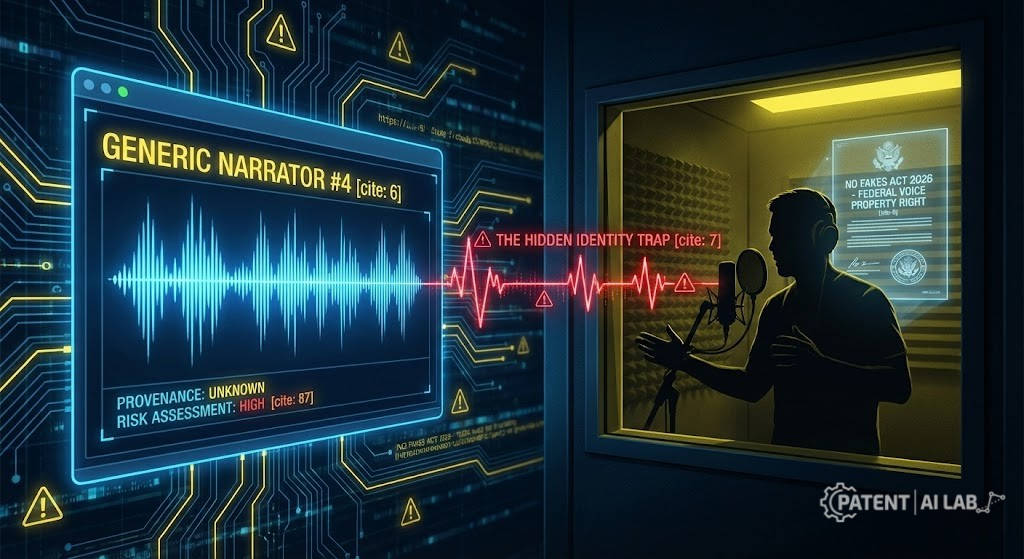
The Legal Reality
You didn’t know it was Paul. The AI company didn’t tell you it was Paul. It does not matter.
Under the NO FAKES Act, strict liability can apply to the distribution of unauthorized digital replicas. You used his identity (voice) for commerce without consent. You are now a defendant in a Voice misappropriation lawsuit settlement.
My Professional Opinion:
The term “Generic Voice” is a marketing fabrication. Every voice comes from a human larynx originally. If the provenance isn’t documented, assume it’s stolen property. The “black box” nature of AI training data is no longer a valid defense in court; it is a liability.
The Legal Landscape: From ELVIS to NO FAKES
For decades, Right of Publicity AI laws were a mess. New York had one rule, California another. But the game changed in 2024.
The ELVIS Act: America’s Strongest Shield
Before discussing federal law, we must acknowledge the Tennessee ELVIS Act (Ensuring Likeness Voice and Image Security Act). Passed in 2024, it was the first law to explicitly add “Voice” as a protected property right against AI cloning.
- Why it matters: It made voice cloning not just a civil tort, but potentially a criminal offense (Class A misdemeanor) in Tennessee, the home of the music industry.
While the ELVIS Act focuses on voice, the music industry is fighting a similar battle on a different front regarding generative audio rights; for a deeper dive into how major labels are reacting, read our analysis on the Suno AI Lawsuit Update: Will the RIAA Shut It Down? - The Reach: It targets not just the cloner, but anyone who “makes available” the unauthorized voice. If your SaaS tool hosts a clone of a Tennessee artist, you are in the crosshairs.
The NO FAKES Act: The Federal Baseline
Building on the ELVIS Act, the NO FAKES Act (Nurture Originals, Foster Art, and Keep Entertainment Safe Act) aims to create a uniform federal standard.
- It’s Not Copyright: Copyright protects the recording (the audio file). The NO FAKES Act protects the voice itself (the identity). You can own the copyright to an AI-generated file and still be sued for violating the NO FAKES Act because the sound steals an identity.
- The “Digital Replica” Definition: The act targets any computer-generated electronic representation of the image or voice of a person that is “readily identifiable” to the public. This Digital Replica definition 2026 is broad enough to catch not just perfect clones, but “soundalikes” that evoke the persona of a specific individual.
- The Liability Chain: It targets those who create the replica, those who publish it (that’s you), and the platforms that host it (if they ignore notices).
Are AI narrators copyright infringement?
Usually, no. They are Right of Publicity infringements. This distinction is vital because your “Copyright clearance” team might miss it entirely. Copyright lawyers look for sampled audio; Right of Publicity attorneys look for stolen identity.
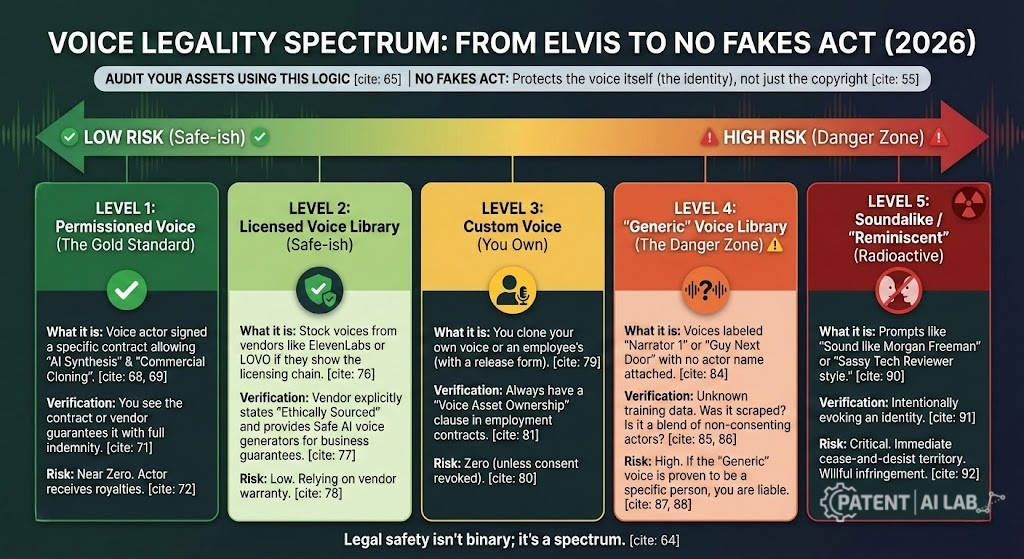
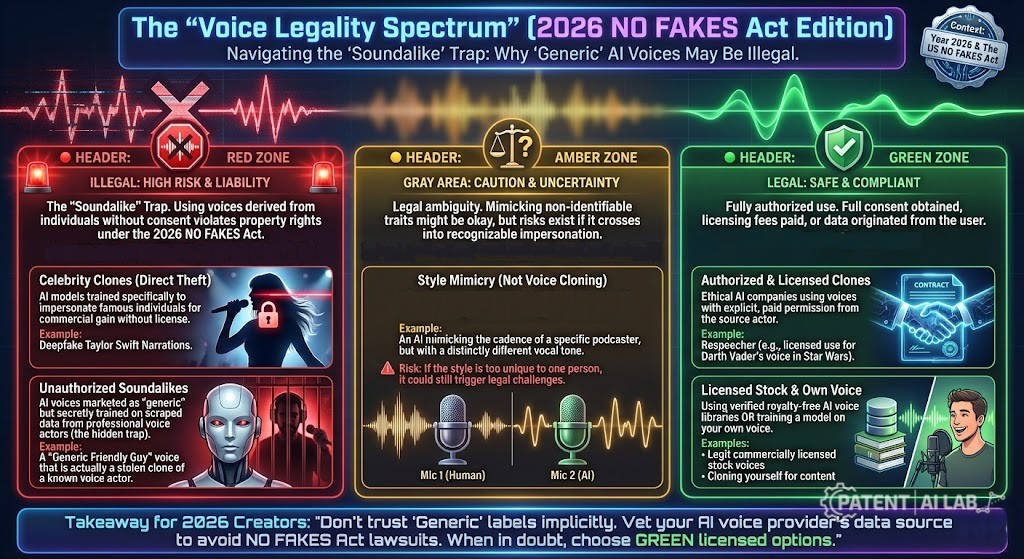
The “Voice Legality Spectrum” (Infographic Analysis)
I have audited dozens of voice models. Legal safety isn’t binary; it’s a spectrum. Use this infographic logic to audit your current assets.
📊 The “Voice Legality Spectrum” Audit
What it is: Voices with explicit contracts or ethically sourced vendor guarantees.
Risk: Near Zero. You are relying on solid warranties.
What it is: You clone your own voice or an employee’s with a release form.
Risk: Zero, assuming proper employment contracts are in place.
What it is: Voices labeled “Narrator 1” with no actor provenance.
Risk: High. If the “Generic” voice is proven to be a scraped real person, you are liable.
What it is: Prompts like “Sound like Morgan Freeman.”
Risk: Critical. Immediate cease-and-desist territory. This is willful infringement.
The “TOS Trap” Snapshot: Reading the Fine Print
I reviewed the Terms of Service (TOS) for three major AI voice platforms in 2026. What I found should terrify any business owner. Most users blindly click “I Agree,” signing away their legal protection.
The “As-Is” Clause
Most platforms include a line like this (paraphrased):
“The Services are provided ‘AS IS’. We make no warranty regarding non-infringement.”
My Translation: They are selling you a tool, but they are not promising the output is legal. If you get sued for using a voice, they can point to this clause and say, “We told you so.” They are essentially saying, “We provide the gun, you pull the trigger, you go to jail.”
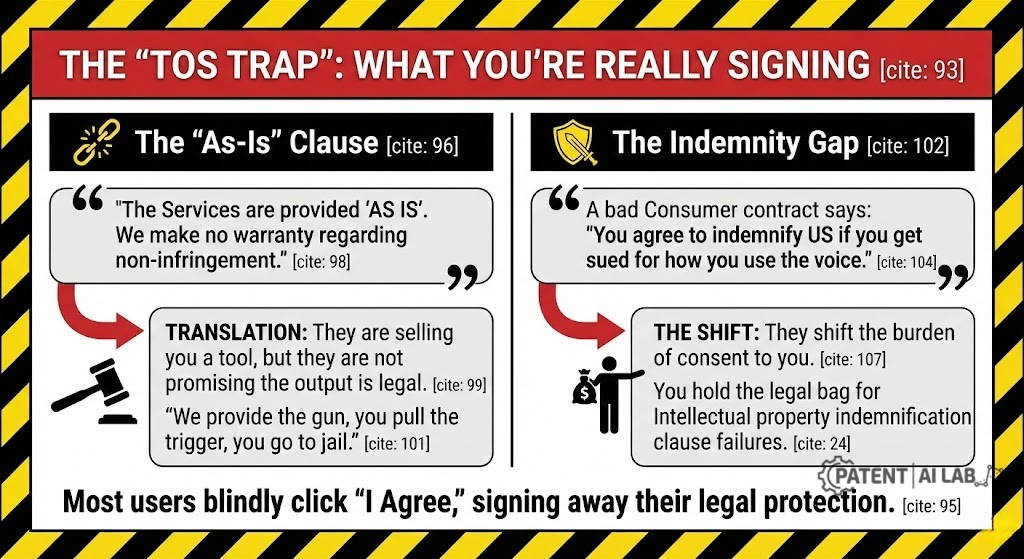
⚖️ The Indemnity Gap: Contract Reality Check
Look for the Intellectual property indemnification clause. The difference between a consumer subscription and an enterprise deal is massive.
Why this matters: They shift the burden of consent to you. Even for their stock library, if they get sued, they might argue you used it in a way that created the liability. If you are using a “Pro” plan for $20/month, you almost certainly do not have indemnification protection.
Beyond voice assets, protecting your core software intellectual property requires a similar layer of legal shielding. Learn more about securing your proprietary tech in Is Your SaaS Code Safe? Copyright vs. Patent Strategies.
Case Study: Lehrman v. LOVO (The Precedent)
The Paul Lehrman v Lovo lawsuit update is the case study every founder needs to study. It is the Napster moment for AI voice.
The Facts:
Voice actors Paul Lehrman and Linnea Sage sued LOVO, alleging their voices were used to train AI models without permission. They claimed their voices were sold as “generic” options to paying customers. Lehrman discovered his voice being used in podcast intros and tech videos he never recorded.
The Legal Update (2025-2026 Context):
While the court dismissed some broad trademark claims (ruling a voice isn’t always a trademark), it allowed the Right of Publicity (under NY state law) and Breach of Contract claims to proceed. This is critical. It establishes that scraping voices to build a commercial product is a viable cause of action.
The Implications for YOU (The User):
While LOVO is the primary defendant, the customers who used those voices in ads are theoretically liable for distributing unauthorized digital replicas.
- If you used the “Generic” voice in a national TV spot, you could be named in a “John Doe” suit.
- Discovery Risk: Courts can order platforms to hand over user logs to identify who generated the infringing audio. Your account history is evidence.
Lesson: “The platform gave it to me” is a defense that gets you to settlement, not a defense that gets the case dismissed immediately.
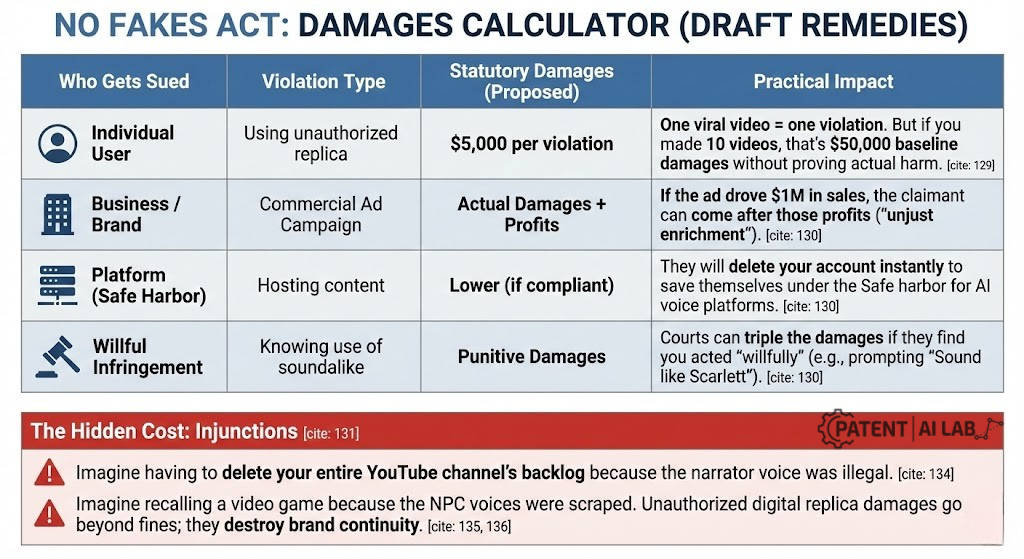
The “Damages Calculator” Table (NO FAKES Act Draft)
What does it cost if you get this wrong? The NO FAKES Act introduces a federal remedy structure that makes “ignoring the risk” financially unviable.
| Who Gets Sued | Violation Type | Statutory Damages (Proposed) | Practical Impact |
| Individual User | Using un- authorized replica | $5,000 per violation | One viral video = one violation. But if you made 10 videos, that’s $50,000 baseline damages without proving actual harm. |
| Business / Brand | Commercial Ad Campaign | Actual Damages + Profits | If the ad drove $1M in sales, the claimant can come after those profits (“unjust enrichment”). |
| Platform (Safe Harbor) | Hosting content | Lower (if compliant) | They will delete your account instantly to save themselves under the Safe harbor for AI voice platforms. |
| Willful Infringement | Knowing use of soundalike | Punitive Damages | Courts can triple the damages if they find you acted “willfully” (e.g., prompting “Sound like Scarlett”). |
The Hidden Cost: Injunctions
Money is one thing. An injunction is another. A court can order you to pull the content immediately.
- Imagine having to delete your entire YouTube channel’s backlog because the narrator voice was illegal.
- Imagine recalling a video game because the NPC voices were scraped.
- Unauthorized digital replica damages go beyond fines; they destroy brand continuity.
Safe Harbor: How to Stay Out of the Blast Radius
You want a workflow you can actually run. Here is the Safe AI voice generators for business playbook I recommend to my clients.
1) The “Provenance” Check
Before you subscribe to a tool, look for their “Ethics” page. Do they have a “Voice Actor Program”? Do they pay royalties?
- Good Signal: “We pay our voice actors a revenue share.” (e.g., ElevenLabs’ Voice Library marketplace).
- Bad Signal: “Thousands of voices generated from public data.” If they can’t tell you who the voice is, don’t use it.
2) The Enterprise Shield
If you are a business, never use the “Free” or “Pro” plan for core assets. Call Sales. Ask for an Enterprise Agreement.
- Ask for: “Uncapped IP Indemnification for the use of Stock Voices.”
- Why: If they won’t give it to you, it means they don’t trust their own data legalities. Why should you?
3) Build a “Voice Provenance File”
For every voice in production, keep a digital paper trail. This is your “shield” in court.
- Record: Vendor Name, Plan Level, Date of Creation.
- Asset: The specific Voice ID (e.g., “Adam_V2”).
- Rights: Screenshot the license grant active on that day.
4) Label Synthetic Content (YouTube & TikTok)
Commercial use of AI voice on YouTube 2026 is regulated.
- YouTube: You must check the “Altered content” box in YouTube Studio.
- Why: If you label it as AI, you weaken the argument that you were trying to “deceive” the public into thinking it was a real person. It is a defense against “False Endorsement” claims under the Lanham Act.
Is “Generic” AI Voice Illegal? (The Nuance)
Is generic AI voice illegal?
The strict answer is “No.” But the practical answer is “It’s complicated.”
If a voice is truly synthetic, a blend of 1,000 people where no single identity remains, it is likely safe. This is De Minimis use.
However, most “good” AI voices aren’t blends. They are “Fine-Tunes.” They take a base model and train it on one specific person to get that rich, emotional texture.
The Litmus Test:
Play the voice for 5 people. Ask: “Who does this sound like?”
- If they say, “It sounds like a robot,” you are safe.
- If they say, “It sounds like the guy from the movie trailer,” you are in the danger zone.
- If they say, “That’s definitely Scarlett Johansson,” do not publish.
The “Training Data” Risk (Technical Deep Dive)
Let’s be engineers for a moment. How do these models actually work?
- Data Scraping: Many 2024-era models were trained on audiobooks, podcasts, and YouTube videos without consent.
This scraping issue isn’t limited to voice actors, text models face the exact same scrutiny over ‘regurgitation’ of protected works, a critical factor we explored in the NYT vs OpenAI Lawsuit Update: How “Regurgitation” Evidence is Reshaping AI Copyright. - Latent Space: The AI maps the “timbre,” “cadence,” and “pitch” of a voice into a vector space.
- The Trap: Even if you don’t name the person, if the model overfits to a specific vector (e.g., David Attenborough), any output in that vector space is legally a “Digital Replica.”
The “Safe Harbor” for AI Voice Platforms:
The NO FAKES Act provides a Safe harbor for AI voice platforms that take down infringing content upon notice. This means YouTube, Spotify, and Apple Podcasts are incentivized to shoot first and ask questions later. If a voice actor files a complaint against your podcast, Spotify will de-list you immediately to protect themselves.
📋 Actionable Checklist for CMOs and Producers
If you are shipping content in 2026, implement this Red/Green Protocol.
- 🔍 Audit Your Library: Go through your past videos. Identify which AI voice was used. If the vendor is gone or the voice is deprecated, consider re-rendering or deleting.
- 📄 Contractual Requirement: Add a clause to your vendor contracts: “Vendor represents that all AI voices are trained on data with explicit consent from the data subject.”
- 🚫 No “Lookalikes”: Ban the use of celebrity names in prompts (e.g., “Make it sound like Elon Musk”). This is evidence of Willful Infringement.
- 🎙️ Buy a Real Microphone: Sometimes, the safest AI voice is your own. Clone your own voice. You own the rights to your own larynx.
Future Outlook: 2027 and Beyond
Where is this going?
- Watermarking: We will see mandatory “C2PA” watermarking for audio.
- Biometric Rights: States will pass laws treating voice prints like fingerprints.
- The “Authorized” Marketplace: We will move to a Spotify-like model for voices, where you pay a micro-royalty to the actor for every minute of audio generated. This will legitimize the industry but raise costs.
As AI agents begin to autonomously select and generate content, determining liability becomes even more complex, a topic we unravel in Agentic AI & IP Laws: Who Owns the Code Your Agent Writes?
Conclusion: The End of the “Wild West”
The era of “grab any voice from the internet” is over. 2026 is the year of Accountability.
The NO FAKES Act doesn’t ban AI. It bans theft. If you treat voice data like music rights, something you need to clear and pay for; you will be fine. If you treat it like free clip art, you are building your brand on a legal fault line.
My Final Verdict:
If you cannot prove permission, and the voice is plausibly identifiable, the soundalike trap is real. The cheapest narrator voice ($29/month) can become the most expensive asset you ever used ($50,000 in legal fees). Pay for provenance.
📚 Sources and Legal References
The legal framework and precedents discussed in this analysis are based on the following verified 2026 standards:
- The NO FAKES Act (Federal Legislation): Official framework establishing federal property rights protecting individuals from unauthorized computer-generated digital replicas (voice and likeness).
- Tennessee ELVIS Act (2024): Groundbreaking state legislation explicitly adding “voice” to Right of Publicity protections and establishing criminal penalties for unauthorized commercial cloning.
- Paul Lehrman v. LOVO, Inc.: Key judicial precedent regarding the scraping of voice actors’ demo reels for commercial AI “generic” libraries under Right of Publicity and Breach of Contract claims.
- U.S. Copyright Office Guidance: Federal policy distinguishing between copyright protections for sound recordings versus identity protections for the human voice itself.
- Lanham Act (15 U.S.C. § 1125): Statutory basis for “False Endorsement” claims relevant to the deceptive use of soundalikes in commercial advertising.
- YouTube “Altered Content” Policy (2026): Platform requirements for the mandatory disclosure of realistic synthetic media and privacy dispute procedures for simulated individuals.
Podcast
Disclaimer
This article is based on our team’s experience advising startups, product development, and tracking IP litigation. Tools and legal interpretations change over time. Please note that PatentAILab is an educational platform and not a law firm. This content is for educational purposes only and does not constitute legal advice. Intellectual property laws (especially regarding AI) are complex and change frequently. Always consult a qualified patent attorney for your specific situation.
FAQs (Expert Answers)
Is generic AI voice illegal in 2026 under the NO FAKES Act?
Not automatically. The risk arises if the “generic” voice is essentially a Digital replica of a real person without their consent. If the voice is “readily identifiable,” it violates the act, regardless of whether you labeled it “Generic.”
What is the ‘digital replica’ definition under the NO FAKES Act?
The Digital Replica definition 2026 targets any computer-generated, highly realistic electronic representation of an individual’s voice or likeness that allows the public to identify the individual. It focuses on identity, not just recording copyright.
Are AI narrators copyright infringement?
Usually, no. Copyright protects the recording. AI voice issues fall under Right of Publicity (protecting the persona). However, if the training data was pirated, there could be separate copyright claims against the model builder.
What happened in the Paul Lehrman v. LOVO lawsuit update?
Reports indicate courts are taking these claims seriously. Lehrman alleged his voice was used to build a “generic” model sold to customers. This case highlights that “marketing” a voice as generic is not a defense if the source was specific.
Can I use AI voice commercially on YouTube in 2026?
Yes, but you must disclose it. YouTube’s “Altered Content” policy requires creators to label realistic synthetic voices. Failure to do so can lead to demonetization or removal. Furthermore, YouTube has a privacy complaint process specifically for “Simulated” people.
What is a safe harbor for AI voice platforms?
Under the 2026 NO FAKES Act implementation, platforms (like YouTube or Spotify) have a safe harbor if they remove infringing replicas upon notice. This means they will shoot first and ask questions later; removing your content immediately to protect themselves.
What are Safe AI voice generators for business?
Look for platforms that explicitly market “Ethical AI,” “Artist Compensation,” or “Licensed Libraries.” Examples often cited (subject to current verification) include ElevenLabs’ licensed library, Resemble AI, or working directly with voice talent who sign AI releases.


Add comment