


 Golam Rabiul Alam, PhD
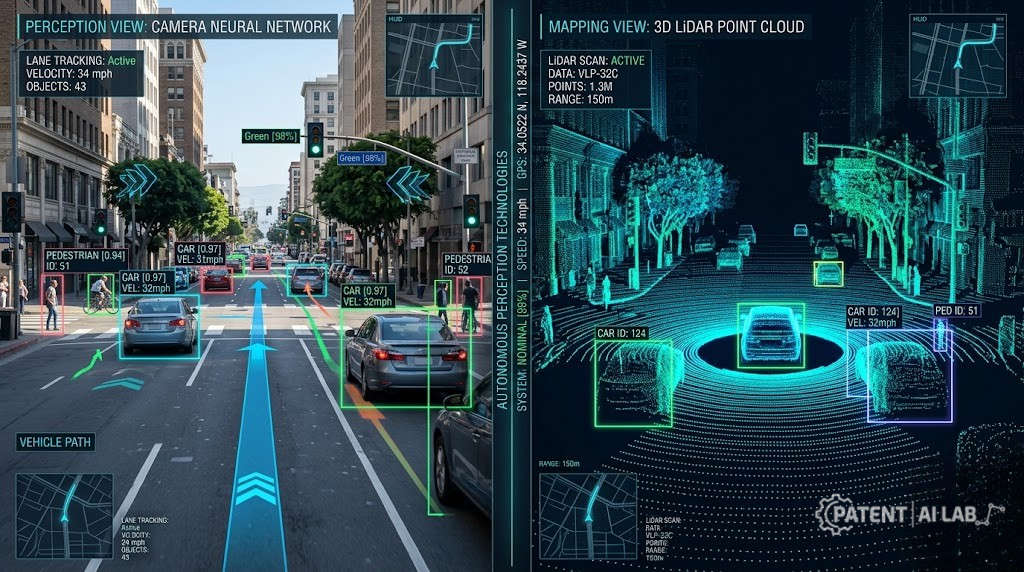
The intense self-driving patent litigation battle for autonomous vehicle supremacy is quietly being fought inside the examination rooms of the USPTO. In 2026, comparing Tesla’s aggressive camera-driven neural network deployment against Waymo’s heavily patented LiDAR-based geofencing model exposes a fundamental divide: is it safer to rely on software iteration speed or to lock down the physical and mapping architecture under defensive legal boundaries? Here is the brutal reality of who actually owns the IP infrastructure of self-driving tech.
At A Glance
Tesla and Waymo are fighting two very different patent battles over autonomous driving. Tesla bets on vision-only AI and rapid neural network iteration, while Waymo relies on LiDAR-heavy systems protected by deep hardware and mapping patents. Under current USPTO eligibility rules — shaped most recently by the July 2024 AI Subject Matter Eligibility guidance and the August 2025 examiner memorandum — Waymo holds stronger enforceable patents, but Tesla moves faster in deployment. The winner may depend less on technology superiority and more on how courts interpret AI training data and system-level claims as patent eligibility doctrine continues evolving.
Why This Patent War Actually Matters
The Tesla vs Waymo patent dispute is not just a corporate feud. It is a test case for how the US patent system treats AI-driven inventions, training data, and autonomous vehicle safety logic — and the outcome will shape what can be protected, what can be copied, and what falls into the public domain.
Tesla wants full autonomy through software and cameras. Waymo wants autonomy through redundancy, sensors, and mapping. Both approaches collide at the USPTO, in federal courts, and increasingly in accident liability proceedings. This divergence in IP strategy, in our analysis at Patent AI Lab, is not merely technical. It reflects fundamentally different theories of value creation and legal defense.
If you are an AI researcher, investor, startup founder, or patent attorney, this battle shapes which innovations receive durable legal protection and which remain exposed to competitors, copyists, and plaintiff discovery requests.
Tesla FSD vs Waymo: Technology and Patent Strategy at a Glance
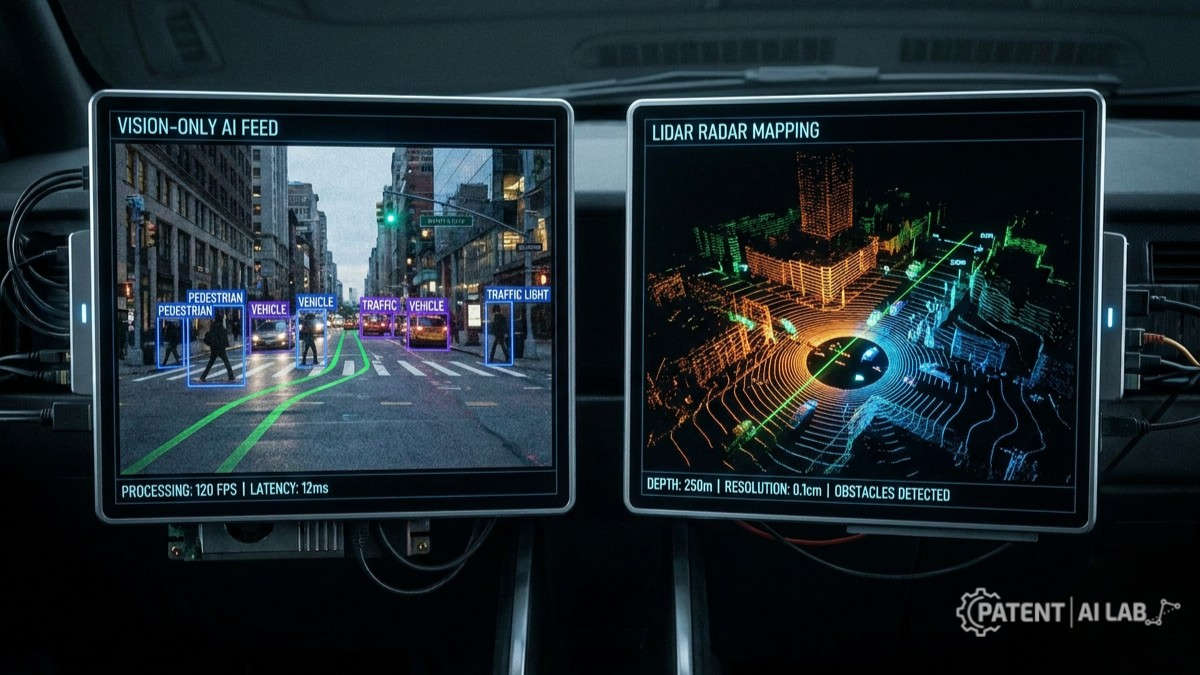
Before getting into claim language and case law, it helps to see exactly where the two systems diverge at the engineering level, since every legal distinction discussed later in this article traces back to one of these architectural choices. The table below lines up the core technical decisions side by side, from sensor selection down to how each company structures its patent filings around that hardware.
This technical gap drives the patent war — and shapes the legal exposure each company carries into the courtroom.
Understanding the Legal Battlefield (Without Legal Jargon)
What Can Be Patented After Alice and the 2024–2025 USPTO Guidance?
The legal terrain shifted meaningfully in July 2024, when the USPTO issued its formal AI Subject Matter Eligibility guidance update (effective July 17, 2024), followed by a clarifying examiner memorandum in August 2025. Taken together, these documents established a consistent framework: AI inventions must demonstrate a concrete improvement to a technology or technical field, not simply apply a known machine learning method to new data.
The Federal Circuit reinforced this directly in Recentive Analytics, Inc. v. Fox Corp. (April 2025). The court held that patents doing no more than applying generic machine learning to new data environments, without disclosing improvements to the underlying models, are ineligible under 35 U.S.C. § 101.
Under that framework, what survives examination looks like this:
Patentable:
- A specific technical solution implemented by software that concretely improves a computer or technical system
- AI models tightly bound to vehicle control execution — not abstract decision logic, but structured actuation output
- Sensor fusion methods that measurably reduce latency thresholds or reduce specific calculation anomalies
Not patentable:
- Abstract driving logic lacking structural implementation detail
- Generic machine learning layers claimed at a high functional level
- Neural network training algorithms — the August 2025 USPTO memo confirmed that training steps using named algorithms like backpropagation or gradient descent are now treated as mathematical calculations and face 101 rejection without additional concrete claim elements
This matters because Tesla files broad, software-heavy patent applications while Waymo files narrower but structurally deeper system claims. For a deeper dive on why software patents remain legally fragile, our guide on Surviving the ‘Alice’ Nightmare walks through the current examination framework in detail.
Waymo LiDAR Patents vs Tesla Vision Strategy
Why Waymo’s LiDAR Patents Are Stronger Legally
According to data from GreyB’s patent intelligence platform (updated March 2025), Waymo has filed 1,237 patent applications at the USPTO (excluding design and PCT applications), with 929 granted, a grant rate of 97.07%. That figure stands in stark contrast to the broader AI patent landscape, where abstract and software-heavy claims face dramatically higher rejection rates under the post-Alice framework.
Waymo’s portfolio is anchored in hardware-grounded claims covering:
- LiDAR hardware configurations and emitter matrix designs — including dual-device synchronization systems that adjust pointing directions in real time
- Optical calibration tracking systems that manage exposure consistency across variable-angle imaging
- Spatial positioning pipelines using multi-sensor fusion, including active sensor power configurations selected on the basis of vehicle operating context
- High-definition point-cloud map telemetry tracking that generates three-dimensional environmental representations
These patents survive eligibility challenges because they explicitly incorporate structural hardware architecture, demonstrate specific operational output enhancements, and cannot be dismissed as abstract mathematical systems by examiners or reviewing courts.
The global LiDAR patent landscape is intensely competitive. As of October 2025, KnowMade’s landscape analysis documents more than 62,900 individual patents across 36,200 patent families, with filing activity growing at an estimated 27% CAGR between 2020 and 2025. Waymo remains one of the central US players in that landscape, alongside Aurora and Ouster.
This structural strength is precisely why Waymo successfully sued Uber in 2018, forcing a settlement valued at roughly $245 million in equity after Uber employees were found to have misappropriated Waymo trade secrets related to LiDAR technology. That case turned on trade secret allegations and patent infringement together — a combination that remains Waymo’s core enforcement model.
Tesla’s Vision-Only Risk
Tesla’s vision-only approach is bold, but it carries compounding legal risk under the current framework. Independent patent-tracking analysis published by Electrek in December 2025 reports that the company’s portfolio has undergone a visible structural shift.
- By Electrek’s estimate, roughly 40% of Tesla’s recent filings are classified as AI-related
- The largest categories cover neural network training via the Dojo supercomputing platform, vision-only distance estimation replacing LiDAR-based ranging, and data labeling and simulation pipelines
- That same analysis reports the share of Tesla’s portfolio classified as purely “automotive” has fallen into the single digits, though the underlying classification methodology is not independently audited
- The 2023-2024 filing data cited carries an acknowledged publication lag of roughly 12 months, so the precise percentage should be treated as an estimate rather than an official figure
Directionally, this still marks a clear departure from legacy OEMs like Toyota or Volkswagen, whose portfolios remain dominated by mechanical engineering claims.
The legal problem is structural. Neural network architectures described at highly abstracted functional levels struggle to survive USPTO examination under the post-July 2024 framework. Examiners now treat training steps using named algorithms as mathematical calculations, and functional language claiming what a system does, rather than concretely specifying how it achieves a technical improvement, is increasingly cited as grounds for 101 rejection. Tesla compensates for this legal fragility by moving fast operationally, not by locking competitors out through defensive patent walls.
Hypothetical Practitioner Scenario: Suppose Tesla files a patent application claiming a method for “generating a vehicle trajectory using an end-to-end neural network trained on camera frames.” Under current USPTO guidance, an examiner would likely treat the neural network training elements as mathematical calculations, per the 2024 AI SME Update, Example 47.
The examiner would then require Tesla to identify concrete structural elements, such as specific hardware scheduling constraints or actuation control outputs, that transform the claim into a practical application. Without those structural anchors, the application faces a 101 rejection regardless of the novelty of the underlying data pipeline.
Waymo’s strength lies in its claims architecture. Our guide on How to Read a Software Patent in 5 Minutes walks through how to spot the structural elements that make hardware-grounded claims like Waymo’s more defensible.
AI-Generated Code and Patent Ownership: A Hidden Flashpoint
Example: Neural Network Inference Pipeline
The eligibility distinction described above is easiest to see at the claim-drafting level. A patent application does not fail or succeed based on how sophisticated the underlying model is; it fails or succeeds based on how the claim language describes what the system does. A genuinely advanced neural network can still be claimed in language abstract enough to fail Section 101, while a comparatively simple hardware modification can pass examination cleanly because the claim ties directly to a physical, measurable mechanism. The following stripped-down example illustrates that gap.
Consider this simplified pseudo-code, representative of the kind of high-level functional description that commonly appears in early-stage AI patent drafts:
def predict_trajectory(camera_frames):

    features = vision_encoder(camera_frames)

    path = end_to_end_model(features)

    return smooth(path)
That code is not patentable as written, regardless of how sophisticated the underlying vision_encoder or end_to_end_model implementations actually are. It recites an abstract computational flow, naming functional steps without specifying how the model achieves a concrete technical improvement over existing trajectory estimation systems. An examiner applying the 2024 USPTO framework would treat this as exactly the kind of “apply it on a computer” claim that Example 47 was written to reject.
The following implementations, by contrast, may survive examination. Each example below replaces a generic functional description with a concrete, measurable technical element, which is precisely the kind of substitution the post-2024 USPTO framework rewards:
- A specific instruction set optimizing camera data stream prioritization to reduce sensor-to-actuator latency below a defined threshold, with implementation detail at the chip scheduling level
- An optical frame alignment methodology structurally bound to hardware scheduling intervals, where the specification demonstrates an explicit improvement in system throughput
- A sparse structural weight matrix layer that directly modulates actuation current metrics, with claims tied to specific circuit parameters rather than high-level functional language
What separates the rejected example from these three is not technical sophistication. All four describe AI systems making driving decisions from camera input. The difference is that the rejected version describes the system in terms of what it accomplishes, while the surviving versions describe how a specific, physically grounded mechanism accomplishes it.
This is the practical translation of the Federal Circuit’s reasoning in Recentive Analytics: a claim must do more than apply a known computational technique to a new problem. It must specify the technical means by which an improvement is achieved, in language an examiner can verify against the rest of the specification.
Waymo patents system behavior and hardware output. Tesla historically patents the learning process itself. Courts and the USPTO, as confirmed by the Federal Circuit’s April 2025 ruling in Recentive Analytics, favor the former. That preference is not stylistic; it reflects the foundational distinction between claims directed to abstract ideas and claims directed to concrete technological improvements.
For drafters working on AI-related autonomous vehicle applications today, the practical takeaway is to anchor every functional claim element to a measurable hardware or system-level effect, rather than describing the model’s behavior in isolation.
Intellectual Property Theft and Trade Secret Allegations
Is This Really an Elon Musk vs Alphabet Legal Battle?
Publicly, Tesla and Waymo rarely sue each other directly. The real competitive legal warfare runs through former employee disputes, supplier IP conflicts, and PTAB patent challenges — not headline infringement suits between the two companies themselves.
Waymo aggressively protects trade secrets alongside its patent portfolio, as the Uber litigation demonstrated. Anthony Levandowski’s departure from Google and subsequent criminal conviction for trade secret theft — he left taking files that Waymo claimed detailed its LiDAR architecture — established a precedent for how aggressively Alphabet will protect its autonomous vehicle IP stack. Tesla operates with a notably more open posture, publishing research and releasing patents, which functions as a deliberate competitive strategy: raising the bar for competitors through transparent advancement rather than through legal moats.
This creates asymmetric competitive risk. Waymo’s closed posture blocks competitors from freely building on its innovations. Tesla’s openness invites competitive imitation — but also makes Tesla’s own market position dependent on execution speed rather than legal exclusivity.
Self-Driving Patent Litigation and Growing Liability Pressure
Accident Liability Is Becoming an IP Weapon
The litigation landscape around autonomous vehicles has shifted from abstract IP disputes toward product liability claims with massive damages. Several 2025 verdicts illustrate how large these numbers have become:
- A Florida jury awarded $243 million against Tesla in an Autopilot-related wrongful death case, finding the company had misled consumers about the system’s safety capabilities
- A separate jury verdict in a Tesla Autopilot case delivered a $329 million award
- GM’s Cruise division settled for a reported $8 to $12 million after a pedestrian dragging incident in San Francisco
These verdicts are establishing the damages floor for algorithmic negligence claims.
As these cases develop, patent claims are becoming embedded in the liability calculus in a specific and consequential way. Discovery in product liability suits targeting software decision logic can expose proprietary AI models, training datasets, and safety validation records that companies would otherwise protect as trade secrets.
Patents function as a double-edged shield here. Strong, specific claims signal to courts that a manufacturer understood the technical limitations of its system and engineered defined safeguards. Weak or abstract patents, by contrast, may be read as evidence that the company never concretely constrained its system’s behavior, which strengthens plaintiff arguments about foreseeable risk.
The two companies carry distinctly different liability profiles as a result:
- Waymo carries a structural liability advantage. Its vehicles operate under Level 4 full automation within defined geofenced zones, placing responsibility squarely on the manufacturer rather than the user. Its LiDAR-redundant safety architecture gives it credible technical evidence of layered safeguards that can be pointed to in court
- Tesla, operating at Level 2 with driver-monitoring requirements for FSD, faces a more complex liability picture. Consumer misuse, ambiguous driver responsibility claims, and ongoing NHTSA regulatory scrutiny compound each other in ways that hardware-grounded competitors largely avoid
California’s Assembly Bill 1777, enacted in 2026, made this dynamic explicit. It establishes clear manufacturer liability standards when autonomous vehicles fail to meet safety or operational protocols, and it requires immediate collision data disclosure to first responders, preserving crash records as evidence in civil claims.
Who Has Better Autonomous Driving Technology?
The short answer is that “better” depends entirely on the metric being applied — and those metrics point in opposite directions for Tesla and Waymo.
Tesla Wins On:
- Scale: a global consumer vehicle fleet generating more real-world driving data than any robotaxi competitor
- Data volume: fleet learning across millions of vehicles provides training signal density that geofenced robotaxi operations cannot match
- Neural network iteration speed: Tesla’s Dojo supercomputing infrastructure enables rapid model retraining and deployment cycles
- Cost efficiency: camera-only systems eliminate the hardware cost premium associated with LiDAR sensor arrays
Waymo Wins On:
- Reliability: structured sensor redundancy and defined geofencing reduce edge-case failure modes
- Regulatory trust: Level 4 certification in multiple US jurisdictions, including California and Arizona, with ongoing commercial expansion into Atlanta (via Uber partnership), Denver, and other cities
- Patent defensibility: a 97.07% USPTO grant rate on hardware-grounded claims that survive Alice-framework scrutiny
- Commercial robotaxi readiness: operating as a revenue-generating transportation service, not a consumer driver-assistance feature
From a pure IP standpoint, Waymo is ahead. From a deployment and data-accumulation standpoint, Tesla dominates. These are not temporary gaps — they reflect genuinely different product architectures with different legal risk profiles.
Alphabet vs Tesla: IP Strategy Compared
Stepping back from individual claims and lawsuits, the two companies’ overall IP postures read almost like mirror images of each other. Tesla treats patents as one input among many in a strategy built around speed, scale, and consumer-facing iteration. Waymo treats patents as a primary defensive and offensive instrument, backed by a trade secret program it has shown a willingness to litigate aggressively. The table below summarizes how that divergence plays out across the dimensions that matter most to attorneys, investors, and competitors evaluating either company’s exposure.
This strategic divergence shapes who “owns” the future legally, not just technologically. A company can hold fewer patents and still dominate licensing revenue if the claims it does hold are structurally defensible and hardware-grounded, because defensibility, not volume, determines what survives a validity challenge or a freedom-to-operate dispute. Tesla’s higher filing volume gives it negotiating leverage in cross-licensing discussions and a deterrent effect against smaller competitors who cannot afford prolonged litigation, but that leverage thins out considerably against a well-funded challenger willing to take a weak claim all the way to the PTAB.
Waymo’s smaller, denser portfolio functions differently. Because each granted claim tends to survive scrutiny, Waymo can rely on individual patents to carry disproportionate legal weight, the same dynamic that allowed it to extract a nine-figure settlement from Uber on the strength of a relatively contained set of allegations. For founders and engineers mapping out their own IP strategy, this contrast is itself a useful data point: filing volume signals market presence, but claim density and hardware specificity are what actually determine enforceability.
Robotaxi Regulations in the US and UK: The Wildcard
Regulatory frameworks don’t just govern behavior. They indirectly pick IP winners by determining which technical architectures qualify for commercial deployment approval in the first place. A patent claim that perfectly satisfies USPTO eligibility doctrine is still commercially worthless if the underlying system cannot clear the safety and liability standards that regulators require before a vehicle is allowed on public roads. This is the layer where Waymo’s hardware-centric design philosophy and Tesla’s software-centric one diverge most sharply in practical consequence, because the two companies are effectively being evaluated against different evidentiary expectations.
- US jurisdictions are tilting toward systematic safety validation requirements, with NHTSA advancing AV-specific regulations that will increase evidentiary burdens for manufacturers seeking market authorization
- UK corporate liability frameworks, updated from April 2026, isolate fleet operating responsibilities in ways that align more closely with Waymo’s geofenced commercial model than with Tesla’s consumer vehicle distribution approach
- California’s AB 1777 (2026) creates specific manufacturer liability exposure for software and sensor failures, directly targeting the architecture that underpins Tesla’s consumer FSD deployment at scale
Waymo’s patent claims align more closely with regulatory safety checklists. Multi-sensor redundancy, defined operational domains, and hardware-grounded safety validation are all artifacts that regulatory agencies can audit directly, since each one corresponds to a physical, inspectable component rather than an internal model weight. That alignment strengthens Waymo’s enforcement leverage and its ability to operate commercially in new jurisdictions, because a regulator evaluating a deployment application can point to the same structural elements that a patent examiner already found concrete enough to grant.
Tesla’s regulatory exposure runs in the opposite direction. Because its safety case rests heavily on statistical claims about fleet-wide neural network performance rather than auditable hardware redundancy, regulators and plaintiffs’ counsel alike are pushing for disclosure of training methodology and validation data, areas where Tesla has historically been less transparent than its public research posture might suggest. The result is a widening gap between the two companies’ regulatory risk profiles, one that mirrors the underlying gap in their patent portfolios.
⚠️ Market Update: The Robotaxi Liability Shift
As of mid-2026, the battleground has officially shifted from patent filings to accident liability and insurance underwriting. With Tesla heavily pushing its end-to-end neural network models in urban areas and Waymo expanding its geofenced LiDAR fleets, including commercial launches in Atlanta, Denver, and additional California markets, courts are beginning to use patent claims as a baseline to determine corporate negligence. A weak software patent doesn’t just lose royalties today. It exposes the manufacturer to massive liability lawsuits, as the 2025 Florida verdict against Tesla ($243M) and the 2025 Autopilot verdict ($329M) have already demonstrated.
Intellectual Property Litigation Trends to Watch
Several converging forces are reshaping the AV patent landscape through 2026 and beyond:
- Increased PTAB challenges targeting AI patents, especially those filed before the 2024 USPTO guidance clarified what constitutes a practical application — older applications describing training steps at a high functional level are particularly vulnerable
- Narrower claim interpretations from examiners, following the December 2025 MPEP update instructing examiners not to dismiss meaningful technical limitations without adequate explanation
- Higher emphasis on system-level inventions, consistent with the Federal Circuit’s Recentive Analytics ruling, which confirmed that applying conventional ML techniques to new data environments is insufficient for eligibility
- Expanded discovery around training data rights, as plaintiffs in product liability cases seek access to model training logs, dataset provenance records, and internal safety testing documentation
Training data ownership is the next major battleground. Who contributed the data that trained a system making a fatal decision? Can that contribution be patented, licensed, or used to establish negligence? These questions have no clean answers yet — but they are being litigated.
Future Outlook: Where Software AV Claims Stand
The self-driving patent litigation trend suggests that hardware-anchored claims will continue to win in court over abstract software methods.
Projections Based on Current Trends:
These are projections based on current verified trends, not guarantees, but the directional picture through the next 24 months looks reasonably consistent. The LiDAR patent landscape — 41,939 active patents globally as of March 2026, with 6,502 new filings in 2024 alone (PatSnap, April 2026) — will continue intensifying as solid-state LiDAR costs fall toward mass-market viability. If unit costs remain above $1,000 by 2028, LiDAR adoption stalls in consumer vehicles, reinforcing Tesla’s camera-only architecture as the cost-efficient path. If costs drop below that threshold, the hardware patent moat Waymo has built becomes exponentially more valuable as new entrants are forced to design around it.
Shifting Legal Realities:
For patent practitioners, the immediate priority is ensuring that AI-related autonomous driving claims filed before July 2024 are audited against the current eligibility framework. Applications relying on functional language to describe neural network training methods — without concrete hardware integration or improvement specificity — may be vulnerable to post-grant PTAB challenges. Proactive claim narrowing or reissue proceedings may be worth evaluating before adverse parties identify the weakness first.
My honest review of PowerPatent covers how AI-assisted drafting tools perform in this evolving prosecution environment.
Who Really Owns the Future of Self-Driving?
From a patent attorney’s perspective, the answer is clear on paper: Waymo owns stronger, more enforceable IP — hardware-grounded claims with a near-perfect grant rate and a demonstrated willingness to enforce aggressively. Tesla owns momentum, fleet data, and market mindshare, but its legal armor is thinner under current doctrine.
From a business perspective, Tesla may win consumer adoption; Waymo may collect licensing revenue and regulatory approval as its footprint expands into new cities. From a legal perspective, courts are currently favoring Waymo’s approach — though the November 2025 USPTO policy shift (rescinding portions of Biden-era AI inventorship guidance) and the ongoing evolution of Federal Circuit case law mean the landscape can shift materially by 2027.
There is no absolute winner yet. But the direction of travel — toward hardware-anchored, system-level claims and away from abstract AI training methods — strongly favors Waymo’s architecture over Tesla’s in the courts.
Practical Implications Across the Innovation Ecosystem
The observations in this section are drawn from the patent and litigation trends described above. They are general educational analysis, not individualized legal or financial advice. Anyone making a specific filing, investment, or product decision based on these dynamics should consult a licensed patent attorney or financial advisor first.
Implications for Startups Entering This Space
- Avoid LiDAR mapping and sensor hardware claims that overlap with Waymo’s portfolio — freedom-to-operate analysis is essential before committing to a sensor architecture
- Focus on niche autonomy applications where neither Tesla nor Waymo has saturated the claim space: specific industrial settings, defined-lane agricultural automation, last-mile logistics in controlled environments
- Patent concrete technical improvements — the post-2024 USPTO guidance makes clear that practical application with measurable technical improvement is the only reliable path to eligible claims in this space
Investment Landscape: Patent Risk Considerations
The following observations describe patent and litigation risk only. They are not investment recommendations, and readers evaluating either company as a holding should consult a licensed financial advisor for guidance suited to their own circumstances.
- Waymo’s hardware-grounded patent portfolio reduces downside IP risk — its claims are structurally harder to invalidate, and its geofenced operating model creates a more contained liability profile
- Tesla’s fleet-data advantage is real, but the legal exposure from product liability verdicts (now reaching into the hundreds of millions of dollars per case) represents a documented and growing category of litigation risk tied to its software-heavy patent strategy
Implications for Developers Building in This Field
- Open-source vision models operating outside Waymo’s hardware-specific claim territory carry lower patent infringement risk — though training data provenance is emerging as a separate exposure vector
- System-level claims — anything touching sensor fusion, point cloud generation, or multi-device synchronization architectures — are dangerous territory requiring clearance analysis before product development proceeds
Bottom Line
As we have explored, the current self-driving patent litigation landscape is forcing a pivot in how companies approach AI.
The Tesla-Waymo IP contest is a proxy for a broader question the patent system has not yet fully answered: what makes an AI-driven technical system patentable when the core innovation is a learned model rather than a physical mechanism? Waymo has built its strategy around the answer the current legal framework gives: hardware structure, sensor architecture, and concrete system behavior are the anchors that survive examination and litigation. Tesla has built its strategy around a bet that deployment speed, fleet data volume, and neural network iteration will render patent barriers secondary.
Both bets are rational given each company’s competitive position. But as product liability verdicts grow larger and as courts increasingly use patent claims as a proxy for engineering due diligence, the company with structurally defensible IP carries a meaningful long-term advantage — in licensing negotiations, in regulatory proceedings, and in the courtroom.
For a condensed walkthrough of these same points, the audio briefing below covers the core findings in roughly ten minutes.
Podcast
This automated audio brief outlines the primary data, analysis, and strategic insights covered in this guide.
Sources and Legal References
The corporate legal metrics, hardware patents, and statutory guidelines evaluated across this analysis are cross-referenced with official entries from major patent enforcement repositories and publicly verified intelligence datasets:
-
1. USPTO 2024 Guidance Update on Patent Subject Matter Eligibility, Including on Artificial Intelligence (35 U.S.C. § 101) — Federal Register Vol. 89, No. 137 (July 17, 2024)
The formal administrative framework (effective July 17, 2024) defining updated subject matter eligibility standards for AI inventions, including the introduction of Examples 47–49 illustrating how neural network claims are analyzed under the Alice/Mayo framework. Directly applicable to how Tesla’s training-method patents are evaluated by USPTO examiners.
Access USPTO 2024 AI Eligibility Guidance (Federal Register) -
2. USPTO August 2025 Section 101 Subject Matter Eligibility Memorandum to Patent Examiners
The August 4, 2025 examiner memo clarifying how AI-related claims should be evaluated in Technology Centers 2100, 2600, and 3600 — including the confirmation that explicit technological improvement descriptions are not always required in the specification if the improvement would be apparent to a skilled artisan.
Access USPTO Subject Matter Eligibility Resources -
3. Recentive Analytics, Inc. v. Fox Corp., 134 F.4th 1205 (Fed. Cir. April 18, 2025)
Federal Circuit decision holding that patents applying generic machine learning to new data environments without disclosing improvements to the underlying ML models are ineligible under 35 U.S.C. § 101 — the controlling precedent for evaluating software-heavy autonomous driving AI claims.
Review Analysis of the § 101 Reset and Recentive Analytics Decision -
4. GreyB Insights: Waymo Patent Portfolio Analysis (Updated March 2025)
Proprietary patent intelligence analysis documenting Waymo’s 1,237 USPTO applications and 97.07% grant rate, providing the quantitative baseline for comparing Waymo’s prosecution success against Tesla’s broader, software-heavy filing strategy.
Access GreyB Waymo Patent Intelligence -
5. KnowMade: LiDAR for Automotive — Patent Landscape Analysis 2025 (Published December 2025)
Comprehensive patent landscape report documenting 62,900 individual LiDAR patents across 36,200 patent families as of October 2025, with a verified 27% CAGR in filing activity from 2020 to 2025 — establishing the competitive context for Waymo’s hardware patent position relative to global LiDAR IP leaders.
Access KnowMade LiDAR Patent Landscape Report
Disclaimer & Legal Notice
This article reflects the author’s perspective as a computer science professor and registered patent holder evaluating patent strategy from an inventor’s point of view. It is intended strictly for informational and educational purposes and does not constitute formal legal, corporate, or financial advisory services. It is not a substitute for the advice of a qualified, licensed patent attorney. Intellectual property outcomes depend on dynamic jurisdictional laws, specific technical claim drafting, and individual facts and circumstances. Always consult a certified patent attorney before making IP filings, responding to assertion letters, negotiating licensing arrangements, or making investment decisions based on patent analysis.





2 comments