

 Golam Rabiul Alam, PhD
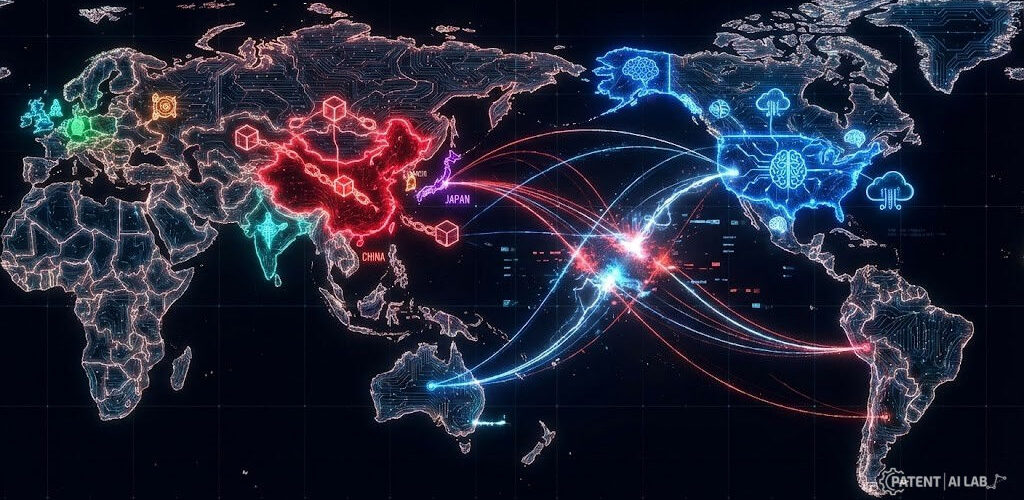
When tracking the countries with most ai patents, two nations rule the global tech race — but not in the same way. China and the United States both lead global AI and blockchain patent activity, yet the nature of that leadership diverges sharply. China dominates on raw filing volume, while the US holds the decisive edge in high-value, cross-border enforceability.
At A Glance
In 2026, China and the United States dominate global AI and blockchain patent trends. However, market leadership looks different depending on your target metrics. China wins on raw filing volume focused on computer vision and surveillance infrastructure. The United States dominates high-value approvals tied to generative models and crypto custody systems.

Why AI & Blockchain Patents Matter More in 2026
AI and blockchain have crossed from experimental territory into core commercial infrastructure, and that transition fundamentally changes what a patent is worth. Companies are no longer filing defensively to build a portfolio — they are filing aggressively to lock down market access, create licensing revenue streams, and build litigation-ready moats against competitors. Three macro forces are accelerating this shift: the rapid commercialization of generative AI models, large-scale enterprise blockchain adoption in financial services and supply chains, and government-led innovation mandates in China, the EU, and the United States. In this environment, a patent is no longer a passive asset. It determines who can build, who must license, and who faces legal exposure.
How Patent Leadership Is Measured
Filing volume alone is a misleading indicator of market power. A country with 300,000 annual filings may exercise less commercial influence than one filing 70,000 patents with broader claim scope and higher international enforceability. This analysis ranks countries across four signals: total approvals and local grant rates, global enforcement reach and cross-border validity, active litigation data reflecting real commercial stakes, and licensing relevance to multinational technology buyers. Using volume as a proxy for leadership — which much reporting does — produces a distorted picture that advantages quantity over strategic impact.
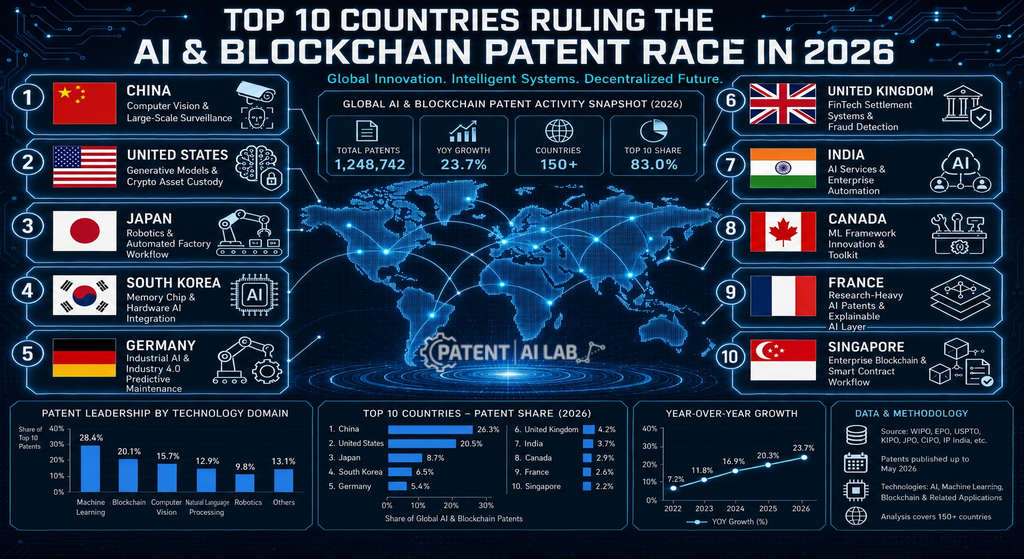
Top 10 Countries With Most AI Patents in Global Rankings
Snapshot Table: Global AI & Blockchain Innovation Rankings
Global Tech Patent Rankings
Timeline Horizon: 2026 Active Index#1
China
Volume scale, computer vision, defensive filings
#2
United States
High-value enterprise AI, crypto custody platforms
#3
Japan
Robotics systems, automated factory workflows
#4
South Korea
Semiconductor AI, hardware memory optimization
#5
Germany
Industrial algorithms, predictive maintenance twins
#6
United Kingdom
Fintech settlement systems, fraud detection models
#7
France
Ethical AI systems, university research spinouts
#8
India
AI service automation, cost-efficient scaling
#9
Canada
Deep learning frameworks, core ML toolkits
#10
Singapore
Regional blockchain hub, trade finance security
1. China: The Undisputed Volume Leader
No country files more AI and blockchain patents than China. According to the WIPO 2024 Generative AI Patent Landscape Report, Chinese entities produced over 38,000 GenAI patent inventions between 2014 and 2023 — approximately six times the US output over the same period. More broadly, separate data compiled by the Rapacke Law Group estimates that China filed approximately 300,000 AI patent applications in 2024 alone, accounting for roughly 70% of global AI patent accumulation. This scale is driven by strong state incentives administered through CNIPA, with strategic concentration in computer vision, surveillance AI, and blockchain infrastructure systems. The limitation is cross-border reach: many Chinese filings carry narrow claim scope and face eligibility rejection under USPTO Section 101 rules, constraining their commercial enforceability outside China’s domestic market.
2. United States: Fewer Patents, More Power
The United States files far fewer patents than China — approximately 67,800 AI applications in 2024 versus China’s estimated 300,000 — but achieves substantially greater commercial leverage per granted patent. Strict USPTO Section 101 eligibility standards, which require AI inventions to produce a concrete technical improvement rather than merely automate an abstract process, filter out weak applications early and produce a portfolio of grants with broader claim scope and higher citation impact. US patents dominate in generative model architectures, enterprise AI software platforms, and crypto asset custody systems — areas with the highest global licensing demand. The result is a portfolio that produces a higher grant-to-enforcement ratio than any comparable jurisdiction.
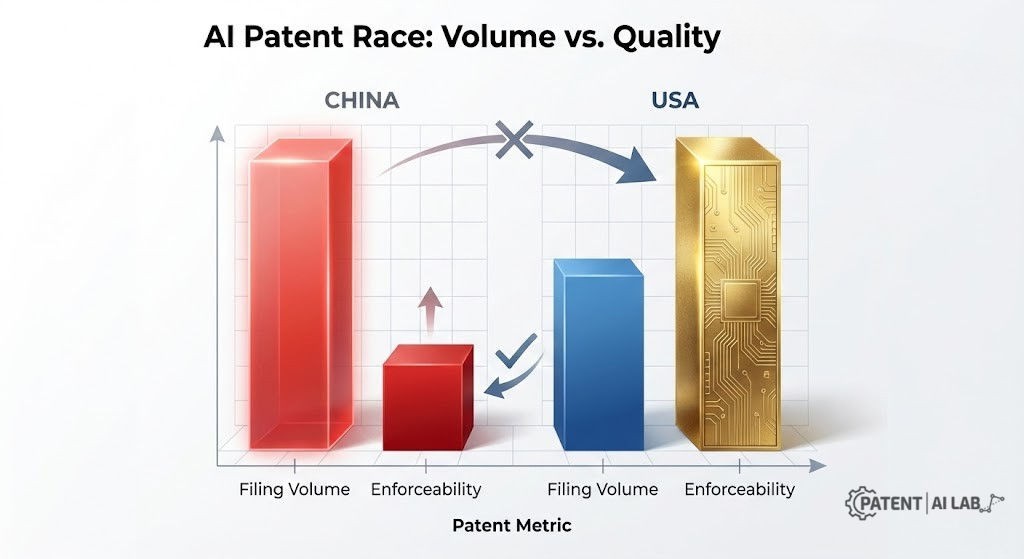
The table below captures the structural divergence between the two systems across the four metrics that determine real market control.
The table below captures the structural divergence between the two primary systems, mapping out why they lead the core metrics among all countries with most ai patents across the technology sector.
Market Control Metrics: China vs United States
Comparative Analysis — AI & Blockchain PatentsFiling Volume Scale
Approval Grant Quality
Global Enforceability
Venture Startup Relevance
3. Japan: Robotics and AI Integration Leader
Japan’s competitive advantage lies at the intersection of machine learning and physical hardware, and the volume data reflects this precision focus. According to data published by the Japan Patent Office (JPO), approximately 26,400 AI patent applications were filed by Japanese entities in 2024, with a consistent concentration in robotics and industrial automation. Domestic filings reached approximately 10,300 in 2022 with a focus on factory automation and deep learning hardware integration. Leading applicants include Fujitsu, NTT, Canon, and Hitachi — all of whom anchor their claims to specific hardware behaviors rather than software abstractions, which allows them to navigate examiner scrutiny at both the JPO and the USPTO. Japanese applicants deliberately tie software methods to measurable physical outcomes in machine control loops, building an enforceable IP moat around high-precision automated manufacturing systems that competitors cannot easily design around.
4. South Korea: Semiconductor AI Powerhouse
South Korea’s patent strategy is built on vertical hardware integration, and the numbers support its position as the fourth-largest AI filer globally. Korean entities filed approximately 23,700 AI-related patent applications in 2024, with Samsung Electronics alone accounting for over 6,000 filings globally — a concentration that reflects the company’s dominant role in the sector. Samsung’s patent activity focuses specifically on on-device neural processing architectures, including memory bandwidth optimization systems for next-generation high-bandwidth memory (HBM) chips that directly reduce inference latency in AI accelerators. This hardware anchoring is deliberate: by binding claimed methods to measurable silicon-level performance outcomes, Samsung and peers like LG circumvent abstract software rejections at the USPTO and secure enforceable utility claims in both the US and European markets.
5. Germany: Industrial AI and Industry 4.0
Germany leads Europe in AI patent filings through a strategy rooted in industrial application rather than software-first abstraction. According to the EPO Patent Index 2024, German applicants filed 25,033 patent applications at the EPO in 2024 — retaining Europe’s second-place position globally behind the US — and AI-related computer technology filings grew by 12.7% year over year. Three German companies rank among the EPO’s global top ten applicants: Siemens (6th, 1,830 applications), BASF (7th, 1,599 applications), and Robert Bosch (10th, 1,249 applications). Germany’s AI filings achieve an average citation rate of 6.12 per patent — more than triple China’s 1.90 — reflecting depth of technical content rather than defensive volume. Under EPO Article 52 and Section G-II, 3.3.1, German applicants link AI predictive outputs to quantified hardware performance gains such as measurable energy savings or reduced machine downtime, satisfying the EPO’s technical character requirement and producing patents with deep cross-border commercial value.
6. United Kingdom: Fintech and Blockchain Strategy
The United Kingdom has carved a focused niche in financial automation and distributed ledger architecture, positioning itself as the primary European hub for blockchain IP in regulated industries. UK-based teams file applications designed to clear the strict Section 1(2) exclusions of the UK Patents Act 1977, which — similar to EPO Article 52 — bars pure business methods and software as such from protection. Practitioners navigate this by linking digital ledger algorithms directly to measurable physical server processing improvements, such as documented reductions in transaction settlement time or verified gains in fraud detection accuracy. nChain, headquartered in London, consistently ranks among the highest-volume blockchain patent filers globally, with a portfolio spanning smart contract architecture, tokenization protocols, and data integrity verification systems. This drafting discipline ensures that fintech and blockchain patents granted by the UK Intellectual Property Office (UKIPO) hold validity in both European and US jurisdictions.
7. France: Research-Driven AI Patents
France’s position in the global patent race reflects the strength of its public research infrastructure more than its commercial technology sector. The majority of French AI patent filings originate from university laboratories, CNRS-affiliated research institutes, and academic spinouts — a pattern that produces foundational mathematical frameworks and explainable AI systems rather than market-driven product patents. French applicants filed approximately 10,800 applications at the EPO in 2024, placing France among the top three European filers. Their applications are drafted to satisfy EPO technical character requirements by protecting specific data processing sequences rather than pure abstract logic — a drafting approach that survives eligibility challenges by documenting the computational mechanism rather than the conceptual result. Key filing areas include explainable AI model layers, federated learning architectures, and decentralized ethical verification protocols with regulatory compliance applications.
8. India: AI Services and Rapid Growth
India has emerged as one of the fastest-growing AI patent jurisdictions in the world, with total patent applications across all fields reaching 110,375 in FY 2024–25 — a 19.75% increase year over year, according to the CGPDTM IP India Annual Report 2024–25. In the AI-specific domain, a TCS-CII industry report recorded 83,059 AI patents filed in India between 2019 and 2024, compared with just 3,931 between 2010 and 2018 — a structural acceleration driven by enterprise NLP, code generation, and customer service automation. Grant rates for AI applications rose from 0.7% in 2019 to 32% in 2024, indicating rapid maturation of examiner capacity. Indian applicants navigate Section 3(k) of the Patents Act 1970 — which excludes software as such — by binding claimed methods to concrete technical contributions, documenting the hardware system on which the software operates and the measurable performance improvement it produces. Jio Platforms led Indian international patent filings with 1,037 PCT applications in FY 2024–25, reflecting the growing outward IP ambition of Indian technology companies.
9. Canada: Deep Learning Framework Innovation
Canada’s influence on the global AI patent landscape exceeds what its filing volumes might suggest, because its contributions sit at the foundational layer of the technology stack. University spinouts and research labs linked to institutions in Toronto, Montreal, and Edmonton — the three cities forming Canada’s AI corridor — have produced core neural network training architectures and deep learning optimization methods that underpin much of the industry’s current tooling. Filings at the Canadian Intellectual Property Office (CIPO) protect distinct algorithmic logic layers through documented technical problem solutions — an approach that generates high citation rates internationally, because foundational methods are referenced by downstream commercial applications globally. Canadian university spinouts continue to lead in core transformer architecture optimizations and reinforcement learning framework patents.
10. Singapore: Regional Blockchain and Fintech Hub
Singapore has established itself as Southeast Asia’s primary blockchain IP gateway, combining a favorable regulatory environment with an accelerated patent pathway for fintech innovations. The Intellectual Property Office of Singapore (IPOS) operates the FinTech Fast Track initiative, which prioritizes examination of patent applications covering financial services technology — including distributed ledger systems, smart contract logic, and cross-border settlement protocols. Local filings protect trade finance automation layers and regulatory compliance workflows aligned with the Monetary Authority of Singapore’s digital asset frameworks. Singapore’s strategic value extends beyond domestic protection: it serves as a regional filing hub for companies seeking patent coverage across ASEAN markets simultaneously, making it a critical node for any enterprise blockchain strategy targeting the Asia-Pacific corridor.
Generative AI Patent Infringement Risks in 2026
A widely misunderstood risk confronts software developers building on generative AI outputs: the copyright-patent distinction. Code produced by an AI model may carry no copyright exposure, because copyright law does not protect functional methods and processes. However, the underlying software workflow — the specific sequence of computational steps the code implements — can directly infringe an active utility patent, regardless of whether a human or an AI tool produced the code. This means developers who copy automated system architectures from public repositories or AI-generated outputs without verification are exposed to patent claims they may not have anticipated. The correct protection measure is a freedom-to-operate (FTO) search conducted by qualified patent counsel before commercial deployment of any AI-generated workflow — particularly in enterprise automation, financial processing, and natural language generation, where dense patent thickets exist across all major filing jurisdictions.
Future Outlook: Where the Patent Race Is Headed
Strategic Horizon
Global Shifts: 2026–2028Patent trends map out clear macro trajectories across the tech ecosystem. Regulatory updates completely reshape model monetization strategies.
Where Growth Will Accelerate:
- Licensing Revenue: US entities will dominate global software monetizations.
- Convergence Systems: Artificial intelligence and decentralized networks merge seamlessly.
Where Restrictions Will Enforce:
- Junk Application Purge: Major registries will block narrow algorithmic claims.
- Model Logic Shifts: Traditional trade secrets decline under modern transparency laws.
The EU AI Act (Regulation EU 2024/1689, in force August 2024) is reshaping the commercial AI IP landscape in a specific and consequential way. The law imposes mandatory transparency obligations on providers of high-risk AI systems — including requirements to maintain technical documentation covering model architecture, training data characteristics, and accuracy benchmarks, and to make that documentation accessible to national competent authorities upon request. The practical implication is that technical implementations which companies previously shielded under trade secret law must now be disclosed to regulators. Once disclosed, trade secret protection lapses for those details, leaving patent protection as the only mechanism for retaining exclusive commercial rights over a documented method. This regulatory pressure has triggered a clear behavioral shift: AI teams are accelerating patent filing timelines to establish priority dates before regulatory disclosure obligations force technical details into the public record.
Podcast
This automated audio brief outlines the primary data, analysis, and strategic insights covered in this guide.
FAQs
Which country files the most AI patents in 2026?
China files the most AI patents by volume, but the United States leads in high-value, enforceable AI patents.
Are AI-generated inventions patentable in the US?
Yes, if a human meaningfully contributes and the invention solves a technical problem under USPTO Section 101 guidelines.
Which country leads blockchain patents?
The US leads in crypto asset protection and enterprise blockchain, while China leads in infrastructure-level filings.
Is patent quantity or quality more important?
Quality matters more for enforcement, licensing, and investor confidence.
Sources and Legal References
The global ranking indexes, market control data, and regional software compliance eligibility frameworks analyzed across this report are verified through official registries:
-
1. WIPO Patent Landscape Report: Generative Artificial Intelligence (2024)
The primary authority dataset used to verify cross-border generative AI filing volumes, country-level output comparisons, and the dominance of Chinese entities in GenAI patent families between 2014 and 2023.
Access WIPO GenAI Patent Landscape Report (PDF) -
2. USPTO Patent Eligibility Directives (35 U.S.C. 101)
The official regulatory examination parameters governing abstract software claims, neural network models, and technical functional steps in the United States.
Review USPTO Eligibility Guidelines -
3. EPO Guidelines for Examination — Section G-II, 3.3.1: Artificial Intelligence and Machine Learning (2025 Edition)
The specific European regional framework governing the technical character requirements for AI and machine learning patent claims, including sufficiency of disclosure obligations for training datasets and algorithm-derived technical effects.
Verify EPO AI Examination Guidelines G-II 3.3.1 -
4. CNIPA Official Gazette of Patent Statistics
Direct regulatory output data documenting volume growth trajectories, image recognition utilities, and blockchain network layout applications in China.
Access Official CNIPA Portal -
5. Official Journal of the European Union — Regulation (EU) 2024/1689 (EU AI Act)
The codified legislative transparency requirements mandating technical documentation disclosure for high-risk AI systems, forcing commercial algorithmic frameworks into patent filing timelines over traditional trade secret strategies.
Access Official EU AI Act Directive
Disclaimer & Legal Notice
PatentAILab is an independent educational research platform. The case studies, patent analysis, and strategic insights provided across this platform are intended strictly for informational and educational purposes. They do not constitute formal legal, corporate, or financial advisory services. Intellectual property outcomes depend on dynamic jurisdictional laws and specific technical drafting. Always consult a certified patent attorney before making IP filings or investment decisions.





[…] to see how this dynamic plays out across other emerging sectors, check out our deep dive into the top countries ruling the AI and blockchain patent race, which further highlights this ongoing battle between volume and actual […]