


 Golam Rabiul Alam, PhD
Editorial note: The content on this website is provided for informational and educational purposes only and does not constitute professional legal, financial, or technical advice. See disclaimer below.
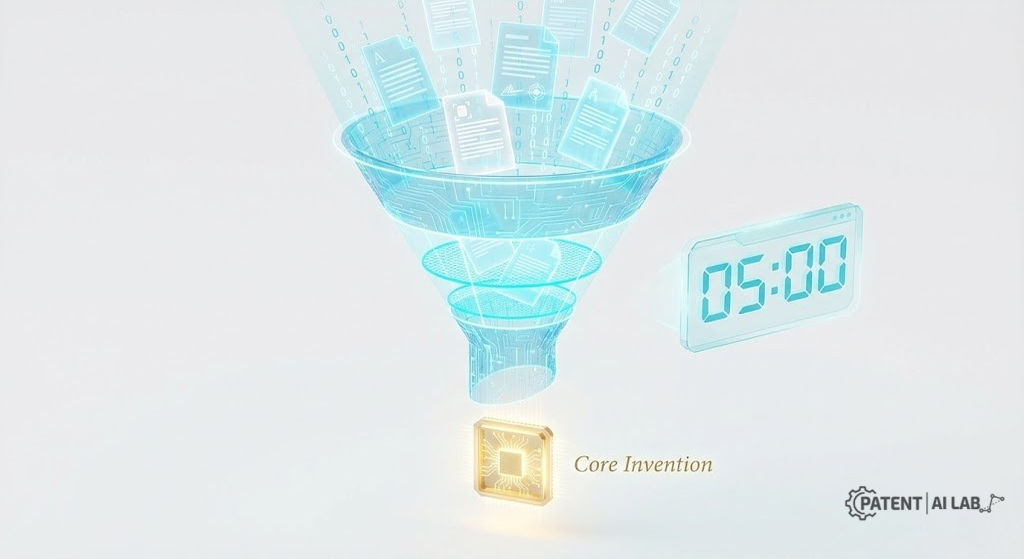
Most founders stare at a 40-page software patent and see a wall of legal gibberish. That is exactly what patent attorneys want you to see. If you want to protect your startup in 2026, knowing how to read software patent claims is not just a legal skill. It is a survival requirement for competitive strategy and VC due diligence.. This guide shows you the exact method patent professionals use to analyze any patent document in under five minutes.
At A Glance
Patent professionals analyze any software or AI patent by focusing on three sections: claims, specification, and drawings. Start with independent claims to understand legal scope, then scan dependent claims for technical detail, and finally use the specification to interpret ambiguous terms and real-world embodiments. This mirrors precisely how attorneys analyze infringement risk and validity.
Why Patent Literacy Matters for AI and SaaS Founders
If you work with AI, software, or startups, patents are not optional reading anymore. They determine what you can legally build, where innovation is blocked, and how investors assess risk. Yet most people read patents the wrong way — they start at page one, drown in legal language, and give up before reaching the only section that actually matters legally.
Patent attorneys do the opposite. They scan, prioritize, and deliberately skip most of the document. The difference between a mechanical patent and a software or AI patent is that the “invention” in the latter is invisible logic — you cannot look at a drawing and understand the scope. That is why traditional patent-reading guides fall short for developers and founders: they do not address functional claiming, Alice eligibility traps, or how to spot a patent that looks broad but is actually legally hollow.
This guide teaches the claim-first method used by practicing patent attorneys, adapted specifically for AI and SaaS contexts so you can quickly master how to read software patent claims.
Structure of a US Patent Document: What Matters vs. What Doesn’t
Before decoding anything, you need to understand the anatomy of a US patent. Each section serves a different purpose, and knowing which ones actually define legal rights will save you hours of wasted reading.
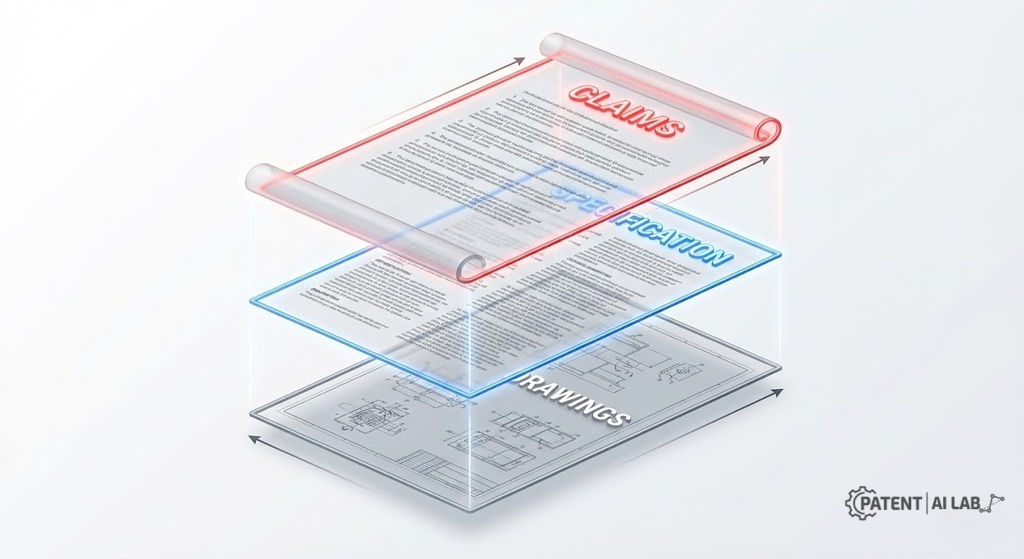
US Patent Section Reference Guide
The foundational attorney rule: Claims define rights. Everything else explains them. A beautiful, detailed specification cannot expand what a narrow claim actually protects.
The 5-Minute Patent Reading Framework (Attorney Method)
Here is the exact sequence patent professionals use when they first encounter a new patent — whether for infringement analysis, competitive research, or validity assessment. The order is not arbitrary; each step informs the next.
Step 1: Read the Title and Abstract
Ask one question only: What problem does this patent claim to solve?
Consider this real example from the AI space: “Systems and methods for generating source code using a trained neural network model.” The title tells you the domain (code generation) and the technical mechanism (neural network). If the abstract is vague or uses purely outcome-based language without describing how anything works technically, treat that as an early warning sign. Vague abstracts often indicate thin eligibility or intentionally overbroad claims that may not survive examination.
Step 2: Read the Independent Claims — and Only Those First
This is the most important step in the entire process. Independent claims define the broadest legal scope of the invention. They stand alone, reference no other claims, and are the first thing courts analyze in any infringement proceeding. Dependent claims should be ignored on your first pass — they add narrowing detail but do not change the outer boundary of protection.
Step 3: Scan the Specification Strategically
Do not read the specification front to back. Use it as a reference tool. Search for defined terms, technical embodiments (real implementation examples), and flowcharts that correspond to claim language. If a claim uses the phrase “hierarchical attention mechanism,” find where the specification defines or illustrates it — that definition will govern how a court interprets that term. Under USPTO claim construction practice (MPEP § 2111), examiners must apply the “Broadest Reasonable Interpretation” to pending claims, which means a vague or thin specification can silently widen — or fatally weaken — the legal scope the applicant ultimately receives.
How to Read Software Patent Claims: The Language of Legal Boundaries
A patent claim is a single, unbroken legal sentence — sometimes spanning an entire paragraph — that precisely describes the invention in terms of who or what performs the steps, what actions occur, in what order, and using what technical components. Every word is chosen deliberately. Attorneys and courts treat claim language the way software treats syntax: one missing element changes the entire output.
Worked Example: Dissecting a Real AI Software Claim
Consider this simplified independent claim from a hypothetical AI coding assistant patent:
A computer-implemented method comprising: receiving a natural language prompt from a user device; generating source code by applying a trained transformer-based language model to a tokenized representation of the prompt; and transmitting the generated executable code to the user device via an API endpoint.
Breaking this apart the way an attorney would:
- Platform: “Computer-implemented” — this grounds it in hardware execution and helps with Alice eligibility.
- Input: “Natural language prompt from a user device” — specific input source, not just any text.
- Technical mechanism: “Trained transformer-based language model applied to a tokenized representation” — this is where the novelty lives. It names a specific architecture (transformer) and a specific preprocessing step (tokenization). Vague claims say “AI model”; strong claims say which kind and how it processes input.
- Output channel: “Via an API endpoint” — limits the claim to a specific delivery method.
If you can summarize each of those four elements, you understand the patent’s legal scope. If a competitor’s product omits even one element — say, it does not tokenize before processing — a literal infringement argument becomes significantly harder to make.
Independent vs. Dependent Claims: How the Hierarchy Works
Patent claims operate in a hierarchy. Independent claims set the widest boundary. Dependent claims then incorporate all the limitations of the claim they reference and add additional narrowing detail. This structure is not cosmetic — it has direct legal consequences for both infringement analysis and validity challenges.
Independent Claim: Setting the Outer Boundary
Claim 1: “A method for generating software code using an artificial intelligence model, comprising: receiving a natural language input; processing the input through a neural network; and outputting compiled executable code.”
This claim is fairly broad. Anyone performing all three steps — receiving natural language, processing through a neural network, outputting compiled code — is potentially within its scope. The breadth is what makes it valuable, but also what makes it vulnerable to an Alice challenge (discussed below).
Dependent Claim: Narrowing for Fallback Protection
Claim 2: “The method of claim 1, wherein the neural network is a transformer-based architecture fine-tuned on domain-specific training data comprising open-source repository commits.”
Claim 2 inherits every element of Claim 1 and adds two more: the specific architecture type (transformer) and the specific training data source (open-source repository commits). This dependent claim is narrower, which makes it harder to infringe — but also harder to invalidate using prior art, since you must find prior art that teaches all of those combined elements.
The attorney’s key insight: If Claim 1 is invalidated or found patent-ineligible, Claim 2 usually falls with it, because it incorporates Claim 1 by reference. That is why a patent’s overall strength depends heavily on whether the independent claim can survive scrutiny on its own.
Independent vs. Dependent Claims at a Glance
How to Analyze the Specification Without Reading Every Word
The specification is the longest section of any patent, but you should almost never read it sequentially. Its legal role is to support and explain the claims — and courts interpret ambiguous claim terms using the specification as a dictionary. Under 35 U.S.C. § 112, the specification must describe the invention in full, clear, concise, and exact terms that enable any person skilled in the relevant field to make and use it. If the specification fails that standard, the claims can be invalidated for lack of written description — entirely separate from an Alice challenge.
What to Focus On and What to Skip
When scanning the specification for a software or AI patent, prioritize these elements in order:
- Explicit definitions — Look for the phrase “as used herein” or “the term X means.” These override ordinary dictionary meanings and directly shape claim scope.
- Preferred embodiments — These are real implementation examples. They show what the inventors actually built and give you the clearest picture of the technical architecture.
- Flowcharts and algorithm steps — In AI and SaaS patents, flowcharts often reveal the precise sequence of operations that the claim language abstracts. If a claim says “processing the input,” a flowchart may show it means tokenizing → embedding → attending → decoding in a specific order.
- Training data and model architecture details — These are critical for Alice eligibility. The more technically specific these details are, the stronger the eligibility argument.
What to skip: marketing language, background motivation paragraphs, and overly general “the invention may also be used for…” statements. Those passages have no binding legal effect and will waste your time.
USPTO Patent Eligibility: The Alice Test Explained for AI Patents
Section 101 eligibility is the single most important legal question for any AI or software patent. The USPTO applies a two-step framework derived from the Supreme Court’s 2014 Alice Corp. v. CLS Bank International decision, commonly called the Alice/Mayo test. Understanding it is not just for attorneys — it is the practical tool that determines whether a patent is worth the paper it is printed on.
Developer shortcut: Read a claim and ask yourself, “Could I implement this in a weekend using standard open-source libraries?” If the answer is yes, the claim is almost certainly vulnerable to an Alice rejection. A strong, eligible AI patent must describe an architecture that a skilled developer could not simply guess from knowing the problem statement alone.
Alice Step 1: Is the Claim Directed to an Abstract Idea?
The examiner’s first question is whether the claim, read as a whole, is directed to a judicial exception — most commonly an abstract idea (a mathematical concept, mental process, or certain methods of organizing human activity). Red flags that trigger Step 1 rejection include:
- Pure data processing described only in terms of inputs and outputs
- Generic AI usage without naming an architecture or training methodology
- Claims that describe results (“organizing data more efficiently”) without technical means
- Steps that a person could theoretically perform mentally, without a computer
A USPTO Deputy Commissioner memorandum issued on August 4, 2025, directed to Technology Centers 2100, 2600, and 3600, gave examiners an important clarification: they must distinguish claims that merely “involve” a judicial exception (such as referencing an algorithm incidentally) from claims that actually “recite” an abstract idea as the core of the invention. Critically, the same memo cautioned examiners against stretching the “mental process” category to cover steps that require machine-based operations — including AI model training and hardware-executed functions — since those cannot, by definition, be performed in a person’s head. This memo matters for founders because it provides the clearest recent signal of how examiners are supposed to apply Step 1 to AI-specific claims.
Alice Step 2: Is There an Inventive Concept That Amounts to “Significantly More”?
If a claim is found to recite an abstract idea at Step 1, the examiner then asks whether the claim elements — individually or in combination — add an “inventive concept” that amounts to significantly more than the abstract idea itself. Boilerplate elements like “using a computer” or “storing data in a database” do not satisfy this step. What survives are elements that demonstrate a genuine technical improvement, such as:
- A specific neural network architecture that improves computational efficiency
- A novel training methodology that reduces memory usage or convergence time
- A preprocessing technique that improves model accuracy in a measurable, non-obvious way
- Hardware-software integration that achieves a technical result not achievable by either alone
Side-by-Side: Weak vs. Strong AI Claim Language Under Alice
Consider two claims from the same hypothetical AI data organization patent:
Claim A (weak): “A method for organizing customer data using a machine learning model.”
This is a textbook Step 1 failure. It names an outcome (organizing data) without describing how the system technically achieves it. “Machine learning model” is treated as generic by the USPTO — no different from writing “using a computer.” An examiner following the 2025 memo guidance would find this claim directed to an abstract idea of organizing information, with no inventive concept in the claimed elements.
Claim B (strong): “A method for organizing customer data wherein a transformer encoder with a learned positional embedding reduces query latency from O(n²) to O(n log n) by applying a hierarchical multi-head attention mechanism over segmented data partitions.”
Claim B survives Step 2 because it ties the AI usage to a specific architecture (transformer encoder with learned positional embeddings), a specific optimization strategy (hierarchical multi-head attention over segmented partitions), and a measurable, specific technical improvement (sub-quadratic query latency). This is the precise distinction the USPTO’s 2025 examiner guidance asks reviewers to make. A claim gets allowed when it describes a specific improvement to computer functioning; it gets bounced on a first Office Action when it merely recites an abstract result.
Section 101 Rejection Rates: What the Data Shows
The stakes of Alice eligibility are not theoretical. According to a 2024 analysis of the USPTO’s Patent Examination Research Dataset, Art Unit 2120 — the working group that reviews AI and simulation modeling applications — issued a Section 101 rejection in approximately 77% of its Office Actions that year. That rate was nearly 20 percentage points higher than before the USPTO’s 2019 Patent Eligibility Guidance took effect, reflecting a sustained period of heightened scrutiny for software and AI claims.
The environment has since shifted. Following the August 2025 memorandum and a Patent Trial and Appeal Board (PTAB) precedential Appeals Review Panel decision issued on September 26, 2025 — which vacated a Section 101 rejection against AI-related claims, citing Enfish, LLC v. Microsoft Corp. for the principle that claims directed to an improvement in computer functioning are patent eligible — the PTAB’s reversal rate of examiner Section 101 rejections reportedly doubled, moving from roughly 10% to roughly 20% in the months that followed. Founders should treat this as a meaningful but still-developing trend. Examiner-level behavior at the Office Action stage has not necessarily caught up to the appellate-level shift, so a more lenient appeals posture does not yet mean fewer first-action rejections.
For a deeper analysis of why specific claim patterns fail eligibility, read our guide on Why Software Patents Fail Under Alice.
How Attorneys Evaluate Potential Infringement: The Element-by-Element Method
When a patent attorney assesses whether a product infringes a patent, they do not make holistic judgments or compare overall impressions. They apply a rigorous element-by-element analysis to each independent claim. The legal rule is that literal infringement requires every single element of a claim to be present in the accused product or process. If even one element is absent, there is no literal infringement of that claim.
Understanding this method is valuable for founders and developers for two reasons: first, it helps you assess whether a competitor’s patent actually threatens your product; second, it helps you design your own product to intentionally avoid specific claims in patents that are relevant to your space.
The following is an illustration of the element-by-element mapping process using the hypothetical AI coding assistant claim from earlier. This is an educational illustration — it does not constitute legal advice. Formal infringement analysis requires a qualified patent attorney.
Claim Element Mapping: Illustrative Example
In this illustration, the absence of API endpoint delivery means the product does not literally infringe that claim as written. The “disputed” tokenization element would require deeper specification analysis and potentially expert testimony to resolve. This is exactly why attorneys spend time mapping each element individually — a single absent element can completely change the analysis.
Note: There is also a legal doctrine called the “doctrine of equivalents” which allows courts to find infringement even when an element is technically absent, if a substantially equivalent element performs substantially the same function in substantially the same way to achieve substantially the same result. This doctrine significantly complicates DIY analysis and is one of the primary reasons formal legal counsel is essential for actual infringement determinations.
Patent Reading for Startup Founders: The VC Due Diligence Rapid Scan
Investors perform patent due diligence differently from litigation attorneys. They are not trying to determine infringement — they are assessing portfolio quality, risk exposure, and defensive moat. When reading your own patent portfolio (or a competitor’s) through that lens, focus immediately on three data points that experienced investors and deal counsel check within the first five minutes of reviewing an IP schedule.
The Three Due Diligence Checkpoints
1. Priority Date: The priority date is the earliest filing date the patent can claim. A patent with a priority date before 2023 — before examiners had detailed AI-specific guidance and before the AI investment boom — can carry outsized strategic value or outsized risk, depending on its claims. Broadly worded patents filed in that period were examined under a different eligibility climate than what exists today. Earlier priority dates are generally favorable for the patent holder; be more cautious if you are assessing competitive risk from a broad, pre-2023 AI patent.
2. Assignee: Who owns the patent matters as much as what it covers. A patent assigned to a non-practicing entity (commonly called a patent troll) poses a different risk profile than one held by an operating company like Google or Microsoft. Operating companies typically assert patents only in retaliation or as leverage in cross-licensing negotiations. Non-practicing entities have no products to protect and monetize entirely through assertion — which means they have more incentive to sue broadly and settle quickly.
3. Independent Claim Length: This is a counterintuitive but reliable heuristic. Shorter independent claims are almost always broader in scope. A claim written in three lines covers more ground than one written in twelve lines, because every word added is a limitation that a potential infringer could potentially design around. Very long, highly specific independent claims are easier to get approved by the USPTO (they are narrower and less likely to have prior art), but they offer weaker market protection. Investors looking for a strong IP moat want to see short, technically grounded independent claims paired with a robust family of dependent claims for depth.
Real-World Example: Reading a Live US Patent Claim Line by Line
Abstract explanation only goes so far. Here is a walkthrough using US Patent No. 11,556,773 — a granted patent in the AI/ML space relating to neural network model optimization — to show how the element-by-element reading framework applies to an actual public document.
Independent Claim 1 (paraphrased from the granted patent): A computer-implemented method comprising: receiving a computational graph representing a machine learning model; identifying a first set of operations in the graph having a first data type; converting the first set of operations to a second, reduced-precision data type while preserving a second set of operations in the original data type; and executing the resulting mixed-precision graph on a hardware accelerator.
Reading this claim through the attorney framework:
- Platform: Computer-implemented, executed on a hardware accelerator — this satisfies Alice Step 1 by grounding the invention in specific hardware execution rather than abstract computation.
- Core novelty: The selective mixed-precision conversion — preserving some operations at full precision while reducing others — is the technical heart of the claim. This is not generic “use AI” language; it describes a specific optimization technique (mixed-precision inference) with a specific mechanism (graph-level operation classification).
- Alice Step 2 analysis: The claim ties to a measurable technical improvement: reduced memory bandwidth and inference latency on hardware accelerators, without full precision loss. This is the kind of specific, architectural improvement that survives Step 2 under the 2025 examiner guidance.
- Design-around opportunity: A developer who always converts the entire graph uniformly — rather than selectively by operation type — likely falls outside this claim’s literal scope, because the “preserving a second set of operations” element would be absent.
This is how patent reading translates into actionable engineering and legal strategy. The claim tells you not just what is protected, but where the gaps are.
Common Mistakes Founders and Developers Make When Reading Patents
After working through the framework above, the most common beginner errors should be obvious in hindsight — but they are worth naming explicitly, because they are surprisingly persistent even among technically sophisticated founders.
Reading from page one: The background section, summary, and much of the specification are not legally binding. Starting there builds a mental model of the patent based on the inventor’s aspirations rather than the actual legal grant. Go to the claims first, always.
Treating broad language as strong protection: A claim that reads “using AI to improve efficiency” sounds sweeping but is almost certainly Alice-vulnerable. The opposite of broad is not weak — specificity often indicates a patent that has already survived examination and is therefore more likely to survive litigation.
Confusing embodiments with claim scope: The specification may describe five different implementation examples. None of those embodiments define what is protected. Only the claims do. A specification can describe a specific transformer architecture in rich detail, but if that detail did not make it into the claims, the patent does not protect it.
Ignoring the prosecution history: The patent file wrapper — the record of exchanges between the applicant and the USPTO during examination — can significantly narrow how courts interpret claim terms. If an applicant argued during prosecution that a claim means X and not Y in order to overcome a rejection, courts may hold them to that narrower interpretation even if the claim language is facially broader. This is called prosecution history estoppel, and it is why a granted patent tells only part of the story.
Real-World Implications by Role: Researchers, Founders, and Developers
Patent literacy looks different depending on what you are building and what decision you are trying to make. Here is how the same framework applies across three common roles in the AI ecosystem.
For AI Researchers
Patent reading is a form of landscape analysis. Before publishing or building on a training pipeline, review whether the core architectural choices have been claimed by others. The goal is not to avoid all patented territory — most fundamental techniques are unpatentable or already in the public domain — but to identify whether a specific combination of steps you plan to use is covered by a claim narrow enough to actually reach your implementation. Patent databases like Google Patents and the USPTO’s PAIR system let you search by technical keyword, CPC classification, and assignee, making prior art searches tractable for anyone with a technical background.
For Startup Founders
Freedom-to-operate analysis — determining whether your product infringes any valid patent claims — should happen before product launch, not after. The cost of a clearance opinion from a qualified patent attorney is a fraction of the cost of a demand letter, litigation, or a forced product redesign after launch. Patent reading skills do not replace that professional step, but they help you arrive at the conversation better informed, better able to scope the search, and better able to evaluate the attorney’s conclusions.
For Software Developers
Claim-based thinking is directly useful in architecture decisions. When a competitor’s patent covers a specific method for performing a function, understanding the precise elements of that claim tells you which alternative implementations fall outside its scope. Designing around a patent is a legitimate and widely practiced engineering strategy — it requires understanding claim language at the element level, which is exactly what the framework in this guide enables.
Future Outlook: AI Patent Trends to Watch in 2025–2026
Structural Trends Already Underway:
- Narrower independent claims: Applicants who have learned from high Alice rejection rates are drafting claims with more technical specificity from the outset, sacrificing breadth for eligibility certainty.
- Hardware-linked AI patents: Claims that tie AI methods explicitly to specific hardware accelerator types, memory architectures, or chip-level operations are becoming the standard strategy for avoiding abstract idea rejections.
- Prosecution history as a competitive intelligence source: The exchanges between patent applicants and examiners — publicly available through the USPTO’s Patent Center — are increasingly cited in both litigation and licensing negotiations as courts look to prosecution history to narrow claim scope.
Strategic Outlook:
The August 2025 USPTO memorandum and the PTAB’s increased reversal rate signal a cautious move toward more lenient eligibility treatment for technically specific AI claims. However, this is an administrative and appellate-level shift, not yet a consistent examiner-level one. Founders and patent applicants should draft for technical specificity regardless of the policy environment — it is the only approach that survives both permissive and restrictive eligibility climates. AI patents will reward architectural precision, not broad ambition.
Once you understand how to read and structure a patent, AI tools can accelerate the drafting process. See our honest PowerPatent Review for a look at current AI drafting assistance options and their limitations.
Patent vs. Research Paper: A Quick Comparison
AI founders often confuse the protections conferred by a published research paper with those of a patent — and vice versa. They serve entirely different purposes under different legal frameworks.
This distinction also has a practical implication for founders: publishing a research paper describing your invention before filing a patent application can, under certain circumstances, start a one-year clock in the US (under 35 U.S.C. § 102(b)(1)(A)) or immediately bar patenting in many international jurisdictions. If you plan to seek patent protection, consult a qualified patent attorney before any public disclosure.
Final Takeaway
Patent literacy in the AI era is not about reading more — it is about reading the right things, in the right order, with the right questions in mind. Learning how to read software patent claims using the attorney approach is a skill any technically sophisticated founder or developer can master. The core skill is understanding that a patent’s legal scope is defined entirely by the words in its independent claims, nothing more and nothing less.
Once you internalize that framework, you can evaluate competitive risk before it becomes a crisis, spot legally hollow patents that appear stronger than they are, and design products with intentional technical differentiation from existing claims. That skill compounds over time — and in an environment where AI-related patent filings are accelerating faster than examiner guidance can adapt, founders who develop it early have a measurable strategic advantage.
Podcast
Note: This audio is a condensed summary. Please refer to the written text for precise legal and compliance definitions.
Frequently Asked Questions
What is the most important section to read when analyzing a software or AI patent?
The claims section — specifically the independent claims — is the only section that defines the legal scope of the patent. Everything else, including the abstract, specification, and drawings, exists to explain or support those claims but carries no independent legal weight. Start with independent claims, and only consult the specification when you encounter ambiguous terms that need definition.
Do I need a patent attorney to understand whether a patent affects my product?
You do not need an attorney to develop a basic understanding of what a patent covers — the framework in this guide is designed precisely for technically sophisticated non-attorneys. However, any formal infringement determination, freedom-to-operate opinion, or licensing negotiation requires qualified legal counsel. The stakes in those scenarios — potential injunctions, damages, and litigation costs — are too high for self-assessment alone. Use this guide to prepare for those conversations, not to replace them.
Are patents on AI-generated code actually enforceable in 2026?
Some are, and some are not. Enforceability depends on whether the underlying claims survive Section 101 eligibility (the Alice test), Section 102 novelty analysis, and Section 103 obviousness analysis. A patent that claims ‘generating code using AI’ without any specific technical improvement is almost certainly Alice-vulnerable and would face a serious validity challenge. A patent claiming a specific neural architecture, training methodology, or tokenization technique that produces a measurable technical improvement has a much stronger chance of surviving challenge and being enforced. The 2025 USPTO guidance and recent PTAB decisions have moved cautiously toward allowing more technically specific AI claims, but this remains an evolving area.
What is the difference between an independent claim and a dependent claim, and why does it matter?
An independent claim stands alone and defines the broadest legal scope of the patent. A dependent claim explicitly incorporates all the limitations of a referenced claim and adds further narrowing detail. This distinction matters practically because: (1) literal infringement of a dependent claim requires satisfying every element of both the dependent claim AND the independent claim it references; (2) if the independent claim is invalidated, dependent claims typically fall with it; and (3) shorter, broader independent claims offer stronger market coverage while longer, narrower ones are easier to prosecute but easier to design around.
Where can I find software and AI patents to practice reading?
Google Patents (patents.google.com) and the USPTO’s Patent Center (patentcenter.uspto.gov) provide free access to the full text of all published US patents and applications. For AI-specific patents, searching by Cooperative Patent Classification (CPC) codes G06N (computing models and neural networks) and G06F40 (natural language processing) will surface the most relevant documents. The USPTO’s Patent Examination Research Dataset also provides metadata for analyzing examination trends across technology areas.
Sources and Legal References
The legal framework, document architecture, and claim analysis methodology described in this guide are anchored in official United States Patent and Trademark Office (USPTO) procedures and verified recent developments in AI patent eligibility examination:
-
1. USPTO Claim Interpretation Standards (MPEP § 2111)
The official legal directive governing how patent examiners must apply the “Broadest Reasonable Interpretation” (BRI) to claims during examination, establishing why the claims section is the definitive and absolute boundary of the invention.
Verify Claim Interpretation Rules -
2. Patent Specification Requirements (35 U.S.C. § 112)
The federal statute mandating that the specification must contain a written description of the invention in full, clear, concise, and exact terms sufficient to enable any person skilled in the relevant field to make and use the invention.
Review Specification Requirements -
3. Structure of Independent vs. Dependent Claims (MPEP § 608.01(n))
The manual guidelines defining the hierarchical relationship of patent claims, confirming that a dependent claim incorporates by reference all limitations of the claim to which it refers and must further limit its scope.
Access Claim Structure Guidelines -
4. USPTO Memorandum: Evaluating Subject Matter Eligibility Under 35 U.S.C. § 101 (August 4, 2025)
The official Deputy Commissioner for Patents memorandum directed to Technology Centers 2100, 2600, and 3600, providing updated examiner guidance on the “recites vs. involves” distinction and the mental-process limitation as applied to AI-specific claims.
Read the Official August 2025 Memo
Disclaimer & Legal Notice
PatentAILab is an independent educational research platform. All case studies, patent analysis, claim mapping illustrations, and strategic insights provided across this platform are intended strictly for informational and educational purposes. They do not constitute formal legal, corporate, or financial advisory services, and they are not a substitute for the advice of a qualified patent attorney. Intellectual property outcomes depend on dynamic jurisdictional laws, specific technical claim drafting, and individual facts and circumstances. Always consult a certified patent attorney before making IP filings, responding to assertion letters, or making investment decisions based on patent analysis.


[…] The burden of clarity is on you, not the AI. You must be able to review the AI’s output line-by-line. Master this skill with our 5-Minute Framework for Reading Patent Claims. […]