


 Golam Rabiul Alam, PhD
Editorial note: The content on this website is provided for informational and educational purposes only and does not constitute professional legal, financial, or technical advice. See disclaimer below.
Most technical founders assume the best AI patent drafting software eliminates the need for expensive legal counsel. Our 2026 testing shows a practical limitation. While automated tools excel at generating mechanical text, they actively introduce structural prosecution risks if deployed without strategic human oversight. The choice is not between human or machine, but how to sequence them effectively.
At A Glance
While the best AI patent drafting software (like PatentPal or Specifio) automates up to 70% of mechanical writing, including figure descriptions and boilerplate text, it cannot replace a patent attorney for strategic claim construction.
Core 2026 Evaluation Directives
- Prosecution Vulnerability: Automated tools frequently generate narrow claims that pass initial examination but remain simple for competitors to bypass.
- The Hybrid Approach: The most capital-efficient strategy deploys AI to minimize first-draft costs while retaining legal counsel to finalize the defensive strategy.
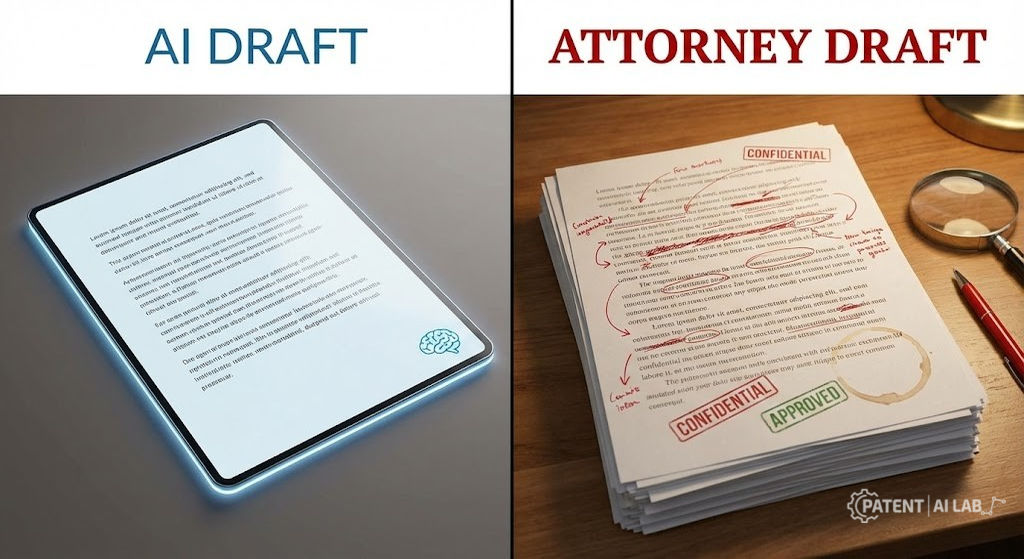
Operational Limitations Exposing Vendor Claims
Our technical team recently pressure-tested the assumption that the best AI patent drafting software replaces early-stage legal work entirely.
A solo inventor we advised submitted a provisional filing generated by a widely used AI platform, resulting in formal rejections from a patent examiner six months later. We audited the application to identify the exact failure points.
We integrate AI models daily to accelerate workflows. The objective of this audit was to map the precise functional boundaries where automated drafting structurally fails.
The analysis highlighted specific, recurring architectural errors executed with high confidence by the models.
Strategic Sequencing: Counsel vs. Automation
Deployment depends on the operational context. Blanket recommendations to entirely replace or completely avoid counsel demonstrate a lack of technical understanding.
Current data indicates that the best AI patent drafting software accurately produces a first-pass structure. These platforms effectively format claim layouts, process boilerplate sections, and construct background framing. (Patentext)
The Primary Point of Failure is Strategic Foresight
Self-Incrimination RiskThey lack the contextual awareness to exclude specific embodiments that could generate self-incriminating prior art.
Prosecution BlindspotsThey do not anticipate prosecution risk (how an examiner might interpret ambiguous terminology against the applicant).
Licensing LimitationsThey lack the capacity to forecast how a claim drafted today restricts future licensing negotiations.
Deployment Parameters
Use AI If:
You are testing novelty, documenting internal technical records, or require an immediate filing date for a product likely to undergo technical pivots within months.
Hire Counsel If:
The invention has commercial intent, cross-border exposure, or future licensing value. Outright elimination of legal counsel in these scenarios introduces severe liability.
The Evidence: Structural Testing
We ran a controlled test to evaluate the best AI patent drafting software for a mechanical-software hybrid invention: an IoT device with a novel calibration method. We fed identical disclosures into three widely used AI drafting platforms.
Platform names are omitted to focus on structural patterns rather than vendor rankings. The primary evaluation metric was strategic depth, not grammatical accuracy.
The Strategic Depth Checklist
Here is the internal checklist we used. I suggest you recreate this table if you are evaluating software for your own team:
Inventive Step ID
Why it mattersIdentifying true novelty versus restating surface-level features.
AI Performance Weak. Often confuses dashboard UI with invention logic.Claim Narrowing
Why it mattersCreating dependent claims that provide actual defensive value.
AI Performance Mixed. Often adds zero defensive value.Fallback Positions
Why it mattersDeveloping ‘Plan B’ options for legal prosecution.
AI Performance Poor. Optimized for standard path only.Speculative Embodiments
Why it mattersEnsuring technical alternatives are physically valid.
AI Performance Dangerous. Hallucinated cloud architecture requirements.The Result: While these tools produce syntactically clean documents, they frequently lack technical “enablement.” Many claims appear impressive but would collapse under examiner scrutiny due to vague language, ultimately failing to prevent competitors from designing around the invention.
The Structural Liability of Narrow Patent Approval
The most significant risk when deploying the best AI patent drafting software is not immediate rejection, but receiving structurally weak patent approval.
AI-drafted applications frequently satisfy examination requirements because the claims are often narrow and highly restrictive. This creates an institutional false sense of security, allowing competitors to easily engineer alternative designs around your intellectual property.
There is a fundamental divergence in objectives:
- Automated Models: Optimize for immediate administrative acceptance from the USPTO.
- Patent Attorneys: Optimize for market exclusivity to prevent competitor replication.
A further systemic vulnerability involves phrasing overlap. AI platforms frequently recycle syntax from their training data, mirroring existing prior art language. While this does not constitute academic plagiarism, replicating terminology from historical patents legally concedes that the method is not novel. Opposing counsel during litigation will systematically exploit this oversight to invalidate the protection scope.
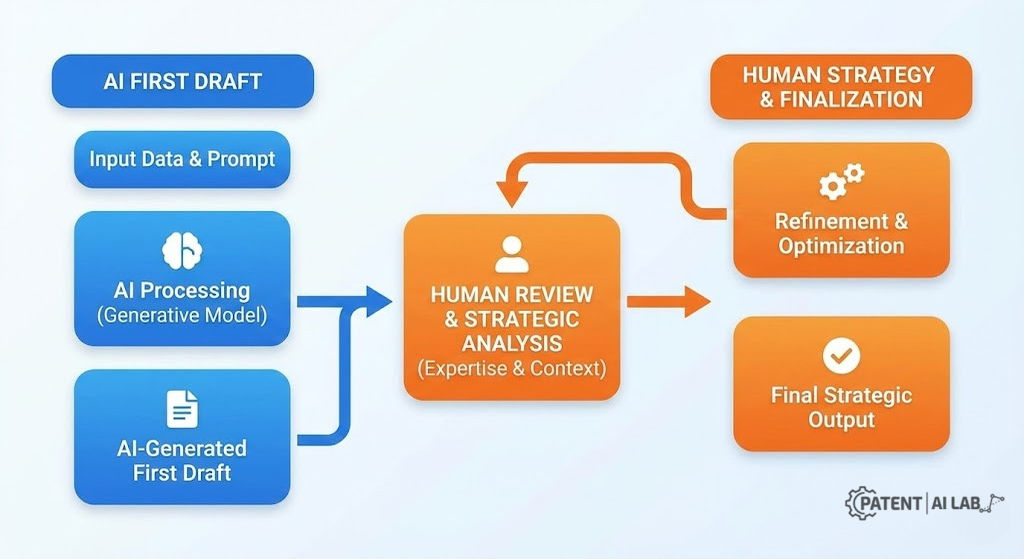
Final Recommendation: The Hybrid Model
Generative models perform sub-optimally when assigned sole responsibility for strategic legal execution. Patents are not merely documentation; they are commercial assets shaped by risk tolerance, business objectives, and legal foresight.
1. Automation Phase
Deploy AI to accelerate disclosure capture, generate figure descriptions, and construct the initial technical scaffolding required for the draft.
2. Strategic Phase
Retain legal counsel to define the claims, stress-test the strategic narrative, and future-proof the application against competitor replication.
This systematic transition from automated drafting to human-led strategy is the defining factor in securing commercially viable intellectual property.
Review Technical Audit: AI Claim WritingPodcast
Note: This audio is a condensed summary. Please refer to the written text for precise legal and compliance definitions.
FAQ: AI in Patent Law
Can ChatGPT draft a patent application?
Technically, yes, it can generate structural text. However, generic LLMs like ChatGPT often hallucinate technical details or case law. Specialized AI patent drafting software (like PatentPal, Specifio, or PowerPatent) is safer because it is constrained to patent-specific data, but it still requires strict human review.
How much does a patent attorney cost vs. AI?
A typical non-provisional patent application drafted by an attorney costs between $10,000 and $16,000. AI tools typically cost $100 to $300 per month. The price difference is substantial, directly correlating with the liability risk.
Will the USPTO reject a patent written by AI?
The USPTO does not reject patents based on who wrote them. They reject patents based on clarity, novelty, and enablement. If AI writes a vague or non-enabled description, it will be rejected under 35 U.S.C. § 112.
Under established USPTO guidance for practitioners, using AI is permitted, but the person signing the application bears full responsibility for Rule 11 compliance. If the AI hallucinates prior art, fails the duty of disclosure, or misrepresents technical facts, the USPTO will hold the human practitioner entirely accountable, potentially invalidating the patent.
Sources and Legal References
The legal frameworks, prosecution standards, and compliance mandates referenced in this analysis are based on established intellectual property regulations and official federal guidance regarding artificial intelligence integration:
-
1. USPTO Guidance on Artificial Intelligence
Official federal directive outlining practitioner responsibilities, Rule 11 compliance obligations, and the duty of disclosure when utilizing generative AI tools in patent drafting and prosecution.
Review USPTO AI Policy Framework -
2. 35 U.S.C. § 112 (Specification and Enablement)
Statutory requirements governing the necessity for clear, concise, and exact technical descriptions, which frequently serve as the primary failure point for AI-generated patent claims.
Analyze Section 112 Enablement Standards -
3. 37 CFR § 11.18 – Signature and Representations to the Office
The official federal code governing signature certification and accountability. It enforces strict penalties on practitioners for presenting AI-hallucinated facts or fraudulent descriptions to the USPTO.
Access CFR 11.18 Signature Regulations
Disclaimer & Legal Notice
PatentAILab is an independent educational research platform and is not a licensed law firm or financial advisory service. The data, patent analysis, and strategic insights provided in this article are for informational and educational purposes only and do not constitute legal, investment, or business advice. Intellectual property outcomes depend on specific technical facts, jurisdictional laws, and drafting execution. Always consult a certified patent attorney and a qualified financial advisor before making IP filing or venture capital investment decisions.


1 comment