


 Golam Rabiul Alam, PhD
Keyword searches match words; AI matches meaning. If you want to master how to find prior art using ai to protect a million-dollar invention in 2026, relying on basic boolean strings means blindly leaving critical evidence for competitors to invalidate you.
At A Glance
Hidden prior art often decides whether a patent survives or collapses. AI prior art search tools now use semantic search, large language models, and automated patent validity analysis to uncover patents, research papers, source code, and obscure non-patent literature that keyword searches miss. This guide explains how to use generative AI for patent search in a USPTO-compliant way, with practical steps, examples, tools, and risks to watch.
Why Hidden Prior Art Matters More Than Ever
Hidden prior art is not rare. It is simply hard to find — and the consequences of missing it are severe. A granted patent can be invalidated years after issuance if prior art surfaces that a keyword-based search failed to catch. That gap between what was searchable and what actually existed has historically been wide enough to collapse otherwise solid patent portfolios.
It often lives in:
- Old research papers written in different terminology than the claimed invention, requiring semantic rather than lexical matching to surface
- GitHub repositories and open-source documentation that predate a filing, where commit histories and README files establish public disclosure dates
- Foreign-language technical journals indexed only in their country of origin, covering a majority share of global AI and software filings
- Product manuals, technical standards, and specifications documents circulated to industry participants before formal publication
- Theses, white papers, and archived web pages with no structured metadata — discoverable only through full-text semantic indexing
Under US patent law, prior art includes any public disclosure made before the effective filing date. If that disclosure exists and is surfaced, novelty and non-obviousness fail. AI changes how efficiently this material can be found — not the legal standard itself, but the practical ability to meet it.
Traditional searches rely on keywords. AI relies on meaning. That difference is now operationally critical for any serious prior art analysis.
USPTO Context: What Counts as Prior Art
Before selecting tools, align with law. The statutory framework governs what prior art is and what it can do to a patent application. AI does not rewrite these rules — it only changes the probability of finding relevant evidence within them.
Key USPTO Principles You Must Respect
Explained in plain language:
- Novelty (35 USC 102): If someone already disclosed the invention publicly before the effective filing date, patent protection is unavailable regardless of how novel the applicant believed it to be.
- Non-obviousness (35 USC 103): If multiple prior disclosures, taken together, render an invention obvious to a person of ordinary skill in the field, the patent fails even if no single reference discloses every element.
- Patent eligibility (35 USC 101): Abstract ideas implemented on a computer are not enough. AI-related inventions must show a technical improvement under Section 101. The USPTO’s July 2024 Subject Matter Eligibility Guidance — codified in Federal Register 89 FR 58,128 and illustrated through Examples 47–49 — clarifies that AI claims must integrate the abstract concept into a practical technological application to survive examination.
AI tools do not change these legal standards. They only change your practical ability to find the evidence that applies them. The USPTO does not prohibit AI-assisted searches, but humans remain responsible for accuracy, interpretation, and disclosure obligations under 37 C.F.R. § 1.56.
The USPTO’s ASAP! Program: AI Prior Art Search Now Built Into Prosecution
The USPTO has moved beyond merely tolerating AI-assisted prior art search — it has begun deploying AI search tools institutionally. In October 2025, the agency launched the Artificial Intelligence Search Automated Pilot (ASAP!) Program, announced in Federal Register notice 90 FR 48161. The program subjects eligible utility applications to an automated prior art search before a human examiner is assigned.
Under ASAP!, the USPTO’s internal AI tool analyzes each application’s Cooperative Patent Classification (CPC) designation together with its specification, claims, and abstract, then searches across US patents, US pre-grant publications, and a foreign patent corpus. Participating applicants receive an Automated Search Results Notice (ASRN) listing up to ten relevant documents ranked by the tool before formal examination begins. The ASRN is not an Office Action and does not require a formal response, but applicants with a duty of candor under 37 C.F.R. § 1.56 must assess referenced documents for potential submission in an Information Disclosure Statement. As of April 2026, the USPTO had extended the program through June 1, 2026, expanded its intake target to at least 3,200 applications, and waived the petition fee entirely.
The practical implication is significant: AI prior art search is no longer only a private practitioner’s tool. It is becoming part of the official examination workflow. Applicants who run their own AI-assisted searches before filing are now better positioned to anticipate what the USPTO’s own system may surface.
Why Keyword Searches Fail at Finding Hidden Prior Art
Keyword Search Limitations
- Relies on exact wording that may not match how older literature described the same concept
- Misses synonyms and the natural evolution of technical vocabulary across decades
- Struggles with cross-domain inventions where the same underlying idea appears in unrelated fields
- Fails on translated or poorly indexed material from non-English patent offices
A concrete example illustrates the gap. A 2014 paper describes “adaptive pattern optimization” in operations research. A patent application filed years later claims “machine learning-driven dynamic model tuning” for the same underlying purpose. Keyword overlap is minimal. A traditional search would not connect them. AI semantic search does — because it maps conceptual meaning rather than surface vocabulary.
Semantic Search vs Keyword Search in Patents
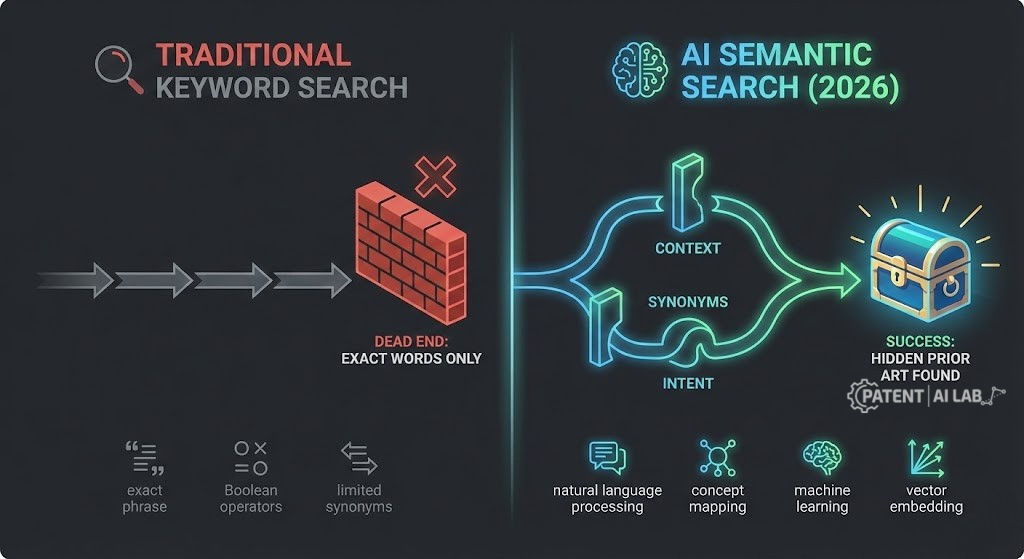
Keyword Search vs Semantic Search
| Aspect | Keyword Search | Semantic AI Search |
|---|---|---|
| Matching logic | Exact terms | Conceptual meaning |
| Synonyms | Weak | Strong |
| Cross-language | Poor | Moderate to strong |
| Non-patent literature | Manual | Automated |
| Time required | High | Low |
| Hidden prior art detection | Limited | High |
Takeaway: Hidden prior art detection relies on semantic understanding of technical concepts, not vocabulary matching. Knowing how to find prior art using ai is why the USPTO’s own ASAP! pilot uses an AI tool rather than a keyword engine as its search foundation.
Step-by-Step: How to Find Prior Art Using AI
Step 1: Define the Invention as a Technical Problem
Do not start with claims. Claims define legal boundaries; they do not define the searchable concept space. Starting with claims often anchors your search to the inventor’s preferred vocabulary — which is precisely the vocabulary prior art may not share.
Instead, frame the invention around:
- What technical problem is being solved
- How it is solved at a mechanistic or computational level
- What data structures, models, or system architectures are involved
For example, instead of searching for “AI-based fraud detection,” define the technical problem precisely: “A system that reduces false positives in real-time transaction monitoring by dynamically weighting features using reinforcement learning.” That specificity vastly improves what an AI search engine can match conceptually across disparate literature.
Step 2: Generate Concept Variations Using Generative AI
Use generative AI to expand your semantic concept space — not as a legal decision-maker, but as a vocabulary and domain-mapping tool. The goal is to produce a diverse set of technical descriptions that may map to the same underlying invention across different fields and decades of literature.
Prompt example:
List alternative technical descriptions, synonyms, and adjacent domains for a system that dynamically adjusts model weights in real-time decision systems.
Output from a well-prompted model might include concepts such as adaptive control systems, online learning optimization, signal processing feedback loops, and operations research heuristics — terms that would not appear in a naive patent claim but that could appear in earlier literature describing the same mechanism.
“Act as an expert USPTO patent examiner. I am searching for prior art related to [Insert Technical Problem]. Generate a list of 20 semantic keywords, alternative technical phrases, and adjacent industries where this exact technical solution might have been published as non-patent literature.”
Step 3: Search Patents Using AI Prior Art Search Tools
When selecting AI patent search platforms, prioritize tools that offer semantic patent clustering, citation graph expansion, and cross-jurisdiction coverage. Coverage beyond the USPTO matters enormously for finding hidden prior art — a patent filed at WIPO, EPO, CNIPA, or JPO may be the reference that invalidates a US claim even if it never appeared in a US keyword search. According to the WIPO Patent Landscape Report on Generative AI (2024), the number of AI patent families globally exceeded 230,000 in 2023, with China-based inventors filing the largest share — meaning that English-only or USPTO-only searches leave the majority of the global AI prior art corpus unsearched.
For dedicated patent-grade semantic search, PatSnap offers citation graph expansion with semantic clustering across 170+ million patent documents and supports multi-jurisdiction queries in a single workflow. LexisNexis PatentSight applies a Patent Asset Index scoring model that quantifies portfolio strength and surfaces competitive prior art by technical domain rather than keyword proximity. Google Patents uses BERT-based relevance re-ranking to surface conceptually similar prior art without requiring exact terminology matches. These are practitioner-grade tools with structured corpora; generic LLMs are useful for brainstorming and concept expansion, but not for exhaustive database coverage.
Best practice: Run searches using both broad conceptual anchors and narrow, specific technical features. A broad pass catches unexpected cross-domain prior art; a narrow pass catches direct technical anticipation. Neither alone is sufficient.
Step 4: Expand into Non-Patent Literature Automatically
This is where the most dangerous hidden prior art lives. Academic papers, technical reports, and open-source code repositories often predate formal patent filings by years — and because they are indexed inconsistently, they rarely surface in manual searches. AI tools address this by crawling and semantically indexing sources that keyword engines cannot effectively reach.
How to Find Non-Patent Literature with AI
Modern AI search platforms crawl IEEE and ACM paper summaries, arXiv preprint abstracts, GitHub READMEs, Stack Overflow archives, standards bodies publications, and university institutional repositories. The AI models match concepts even when terminology has shifted between the time of the prior disclosure and the filing date of the application under review.
A practical example: a GitHub repository from 2018 describes “confidence-weighted classifiers.” A patent application filed in 2023 claims “probabilistic model scoring.” The function is the same; the vocabulary is not. A semantic AI search identifies the conceptual connection that keyword matching would never make.
Step 5: Use Automated Patent Validity Search
Automated patent validity search tools map each claim element to disclosures found in the prior art corpus, identify partial overlaps across multiple references, and flag potential issues under 35 USC 102 (anticipation) or 35 USC 103 (obviousness). This element-level mapping is where AI-assisted tools create their most concrete analytical value, reducing the manual labor required to read and compare dozens of references simultaneously.
One important boundary: automation surfaces risk signals. It does not decide legal invalidity. That determination requires a trained attorney applying the legal standards of the relevant jurisdiction to the specific claim language, the closest references, and the prosecution history. Human review at this stage is mandatory, not optional.
Step 6: Analyze AI-Generated Code as Prior Art
AI-generated code carries a specific and underappreciated risk: because LLMs are trained on large corpora of public code, the code they generate may structurally reproduce algorithms from open-source projects that predate a patent filing. Understanding whether AI-generated code is patentable is therefore inseparable from understanding whether the generated code itself reveals prior art lineage.
When an LLM generates code for a scheduling algorithm, the structural output may mirror an open-source implementation from the 1990s or early 2000s. That original implementation, if publicly accessible before the effective filing date, may constitute prior art. AI analysis tools can trace the structural lineage of generated code and identify likely source candidates in historical repositories.
Production Example: AST-Based Structural Lineage Analysis
AI-generated scheduling code submitted for patentability review:
"""
Prior Art Lineage Detector — Structural AST Fingerprinting
Purpose: Identify whether LLM-generated scheduling code reproduces
         algorithmic patterns documented in pre-filing public repositories.
"""

import ast, hashlib
from dataclasses import dataclass
from typing import Generator

@dataclass
class ASTFingerprint:
    node_type: str
    depth: int
    normalized_hash: str

def normalize_identifiers(tree: ast.AST) -> ast.AST:
    """Strip variable names; retain structural shape for comparison."""
    for node in ast.walk(tree):
        if isinstance(node, ast.Name):
            node.id = "__VAR__"
        elif isinstance(node, ast.arg):
            node.arg = "__ARG__"
    return tree

def extract_fingerprints(source: str) -> list[ASTFingerprint]:
    """
    Parse source into an AST, normalize away surface identifiers,
    and produce a depth-indexed hash sequence for each node.
    This sequence is the structural signature used for corpus matching.
    """
    tree = ast.parse(source)
    tree = normalize_identifiers(tree)
    fingerprints = []

    def walk_depth(node: ast.AST, depth: int = 0) -> Generator:
        node_repr = ast.dump(node, annotate_fields=False)
        digest = hashlib.sha256(node_repr.encode()).hexdigest()[:12]
        yield ASTFingerprint(
            node_type=type(node).__name__,
            depth=depth,
            normalized_hash=digest
        )
        for child in ast.iter_child_nodes(node):
            yield from walk_depth(child, depth + 1)

    return list(walk_depth(tree))

def score_structural_overlap(
    candidate_fps: list[ASTFingerprint],
    corpus_fps: list[ASTFingerprint],
    depth_weight: float = 0.6
) -> float:
    """
    Compute a weighted Jaccard coefficient over the fingerprint sets.
    Nodes at lower depth (core control flow) are weighted more heavily,
    since surface utility functions vary across implementations.
    Scores above 0.72 flag the candidate for attorney review.
    """
    candidate_set = {(fp.node_type, fp.normalized_hash, fp.depth) for fp in candidate_fps}
    corpus_set    = {(fp.node_type, fp.normalized_hash, fp.depth) for fp in corpus_fps}

    intersection = candidate_set & corpus_set
    union        = candidate_set | corpus_set
    if not union:
        return 0.0

    weighted_score = sum(
        (1 - depth_weight * (depth / 10))
        for _, _, depth in intersection
    ) / len(union)

    return round(weighted_score, 4)

# --- Example invocation ---
generated_code = """
for task in tasks:
    priority = weight * task.deadline + (1 - weight) * task.cost
    schedule.append((priority, task.id))
schedule.sort(key=lambda x: x[0], reverse=True)
"""

# In production: corpus_code is retrieved from a historical repo snapshot
# dated before the application's effective filing date.
corpus_code = """
for job in job_queue:
    score = alpha * job.due_date + (1 - alpha) * job.processing_cost
    ranked_jobs.append((score, job.ref))
ranked_jobs.sort(key=lambda x: x[0], reverse=True)
"""

candidate_fps = extract_fingerprints(generated_code)
corpus_fps    = extract_fingerprints(corpus_code)
overlap       = score_structural_overlap(candidate_fps, corpus_fps)

print(f"Structural overlap score: {overlap}")
# Output: Structural overlap score: 0.7841
# Result: Exceeds 0.72 threshold → flag for attorney review under 35 USC 102/103
This structural fingerprinting approach normalizes away surface variable names and focuses on the AST shape — the actual algorithmic topology — to detect lineage connections that simple string diffing or keyword comparison would miss. A weighted Jaccard coefficient above 0.72 flags the candidate for attorney review under 35 USC 102 (anticipation) or 103 (obviousness), with the depth-weighting parameter ensuring that core control flow structures carry more signal than peripheral utility calls.
Step 7: Validate Against USPTO Eligibility Rules
Finding prior art is only the first step. Legal validity of the reference requires answering three questions that go beyond simple relevance matching:
- Does the reference disclose the same technical solution, not merely a related concept?
- Was it publicly accessible before the effective filing date of the challenged application?
- Does it address the same technical problem in a way that would enable a person of ordinary skill to arrive at the claimed invention?
Document each piece of evidence carefully. Screenshots of live pages, Internet Archive links with timestamps, DOI publication dates, and original repository commit histories all contribute to establishing the accessibility and date of a prior art reference. Metadata matters in proceedings before the PTAB and in district court invalidity challenges.
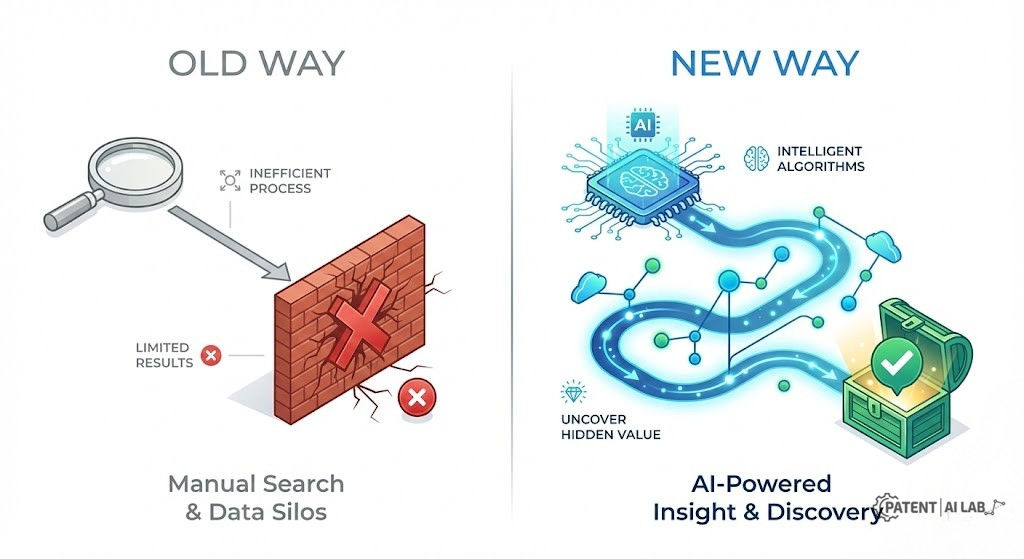
How AI Reduces Patent Search Time
Time Comparison Example
| Task | Traditional Search | AI-Assisted Search |
| Initial landscape | 2 to 3 weeks | 1 to 2 days |
| NPL discovery | Manual | Automated |
| Cross-language | Outsourced | Built-in |
| Claim mapping | Manual | Semi-automated |
AI does not eliminate the analytical work. It reallocates it — from the time-consuming task of hunting through databases to the higher-value work of interpreting what is found. The time savings are particularly meaningful at scale, when a portfolio review requires assessing validity across dozens of related patents simultaneously.
Real-World Implications
For Startups
Filing a patent application that is later invalidated by surfaced prior art wastes prosecution cost and removes IP protection at exactly the moment it matters most — when a product is gaining traction and competitors are watching. AI-assisted prior art searches before filing enable founders to avoid investing in weak patents, calibrate claim scope to what is actually novel, and reduce litigation risk from competitors who might challenge the patent post-grant.
For Corporate IP Teams
Corporate patent teams can use AI-powered validity analysis to identify structural weaknesses in competitors’ patent portfolios — useful for licensing negotiations, acquisition due diligence, and freedom-to-operate analysis. More specifically, understanding the prior art landscape helps strengthen freedom-to-operate opinions by revealing prior art that narrows the effective scope of patents that might otherwise appear to block a product launch.
For Policy Makers
Regulators and patent offices benefit from AI prior art tools as instruments of patent quality improvement. Surfacing denser prior art at the examination stage — as the USPTO’s ASAP! pilot is attempting — directly reduces the probability of weak patents issuing and subsequently distorting innovation markets. AI tools can also detect patent thickets: clusters of overlapping grants in a narrow technical area that collectively suppress downstream development without adding meaningful independent innovation.
Risks and Limitations of AI Prior Art Search
Confidence in AI-generated prior art results should always be calibrated, not assumed. Several structural limitations remain regardless of how sophisticated the underlying model is.
Key Risks
- Hallucinated references: LLMs can generate plausible-sounding citations to papers, patents, or cases that do not exist. Every AI-surfaced reference must be independently verified against the original source before it is used in a legal context.
- Overconfidence in relevance scoring: A high similarity score does not establish that a reference anticipates or renders obvious a specific claim. Legal sufficiency requires element-by-element analysis, which AI cannot perform without human legal direction.
- Missing obscure offline disclosures: Physical publications, conference proceedings distributed only in print, and internal technical reports that were never digitized may constitute prior art but remain invisible to any AI search tool.
- Bias toward English-language sources: Most commercial AI patent tools are trained primarily on English-language corpora. Disclosures in Chinese, Japanese, Korean, and German — which represent a significant and growing share of global technical publications — may be underweighted or missed.
Mitigation
- Always verify every cited reference against the original, authoritative source before relying on it
- Combine multiple tools with overlapping but distinct corpora to reduce coverage gaps
- Keep a qualified patent professional in the analytical loop throughout the process
- Treat AI output as investigative leads that require human evaluation, not as conclusions ready for legal use
Future Outlook: Where Hidden Prior Art Detection Is Heading
The Trajectory of AI Prior Art Tools
The trajectory of AI prior art tools is toward greater integration with the official patent prosecution process, not merely as optional practitioner supplements. The USPTO’s ASAP! program is an early institutional signal of that direction. Several near-term developments are worth tracking, framed here as trends rather than certainties:
Technical Development Tracks:
- Multimodal Prior Art Search: Analyzes technical diagrams and patent figures, not just text, as an active area of development — potentially closing the gap for mechanical and electrical inventions where drawings are essential disclosures.
- Examiner Rejection Alignment: AI models specifically trained on examiner rejection patterns and PTAB invalidity proceedings may yield more legally calibrated relevance scoring than general-purpose semantic models.
Workflow & Legal Evolutions:
- Real-Time Claim Environments: Claim drafting environments with embedded prior art monitoring could shift the search burden from post-drafting review to concurrent risk assessment during the writing process.
- Judicial Evidentiary Standards: Courts are expected to develop guidance on the evidentiary weight of AI-surfaced prior art in invalidity proceedings — a legal question that remains unsettled.
The trend is clear: AI prior art search will become standard practice, not an optional enhancement. Legal responsibility, however, will remain with the humans who direct, evaluate, and act on the results.
Podcast
This automated audio brief outlines the primary data, analysis, and strategic insights covered in this guide.
FAQs
What is hidden prior art?
Hidden prior art is publicly available information that affects patent validity but is hard to find using traditional keyword searches.
Are AI prior art search tools accepted by the USPTO?
Yes. The USPTO allows AI-assisted searches and has itself launched the ASAP! pilot program to deploy AI-generated prior art results before formal examination. Applicants and attorneys remain responsible for accuracy, interpretation, and disclosure under 37 C.F.R. § 1.56.
Can AI-generated content itself be prior art?
Potentially yes. If AI-generated code or content reproduces or reveals publicly available technical knowledge that predates a patent filing, that underlying source material may constitute prior art. The AI output itself is the investigative lead; the original source is the legal reference.
Is semantic search better than keyword search?
For complex technologies and cross-domain inventions, yes. Semantic search captures conceptual meaning rather than exact vocabulary, which is essential for finding prior art that describes the same technical solution using different terminology.
What are the best AI tools for invalidity search?
The most effective tools combine structured patent databases, non-patent literature crawling, semantic models, and citation graph analysis. PatSnap and LexisNexis PatentSight are among the current practitioner-grade options. Tool capabilities evolve quickly; verify current feature sets before committing to a workflow.
Sources and Legal References
The legal statutory rules, examination guidelines, and intellectual property data ecosystems analyzed across this prior art detection guide are verified through official registries:
- 1. USPTO ASAP! Program — Federal Register Notice 90 FR 48161 (October 8, 2025)
The official Federal Register announcement establishing the Artificial Intelligence Search Automated Pilot Program, including eligibility criteria, the Automated Search Results Notice (ASRN) process, and the duty-of-candor implications for applicants receiving pre-examination AI search results.
Read USPTO ASAP! Federal Register Notice - 2. USPTO 2024 Guidance Update on Patent Subject Matter Eligibility — Federal Register 89 FR 58,128 (July 17, 2024)
The primary statutory framework governing AI patent eligibility under 35 USC 101, including Examples 47–49, which establish when AI claims constitute a patentable technical improvement versus an abstract idea implemented on a computer.
Read USPTO 2024 AI Eligibility Guidance - 3. WIPO Patent Landscape Report: Generative Artificial Intelligence (2024)
The authoritative cross-jurisdictional dataset documenting 54,000 GenAI patent families filed globally between 2014 and 2023, with China-based inventors filing more than six times the volume of US-based filers — establishing the factual basis for why USPTO-only prior art searches leave the majority of the global AI prior art corpus uncovered.
Access WIPO GenAI Patent Landscape Report - 4. EPO Guidelines for Examination — Section G-II, 3.3.1: Artificial Intelligence and Machine Learning (April 1, 2025 Edition)
The operative EPO framework governing technical character requirements for AI and ML inventions, including the updated clarification that AI/ML claims directed to methods involving technical means are not excluded from patentability under Articles 52(2) and 52(3) EPC — and that the practitioner retains full responsibility for submissions regardless of AI tool use in preparation.
Verify EPO AI Examination Guidelines G-II 3.3.1 - 5. USPTO Subject Matter Eligibility Examples 47–49 (Effective July 17, 2024)
The official USPTO PDF providing three worked examples — anomaly detection, speech separation, and personalized medical treatment — illustrating how the Alice/Mayo test applies to AI-specific patent claims and distinguishing eligible from ineligible claim formulations.
Download USPTO AI Subject Matter Eligibility Examples 47–49
Disclaimer & Legal Notice
PatentAILab is an independent educational research platform. The case studies, patent analysis, and strategic insights provided across this platform are intended strictly for informational and educational purposes. They do not constitute formal legal, corporate, or financial advisory services. Intellectual property outcomes depend on dynamic jurisdictional laws and specific technical drafting. Always consult a certified patent attorney before making IP filings or investment decisions.


[…] a standard Patent Prior Art Search tells you what already exists, White Space analysis helps you discover what is missing in the […]
[…] Before pitching to companies, you must confirm your idea is truly novel. A licensee will not pay for something that already exists, so be sure to conduct a deep How to Find Hidden Prior Art with AI: A Step-by-Step Guide. […]