


 Golam Rabiul Alam, PhD
Last year, I sat in on a rushed internal experiment at a mid-sized hardware startup. We were preparing our first major international filing, and the pressure was on.
The CTO was convinced that AI for patent claim writing had matured enough to shave weeks off the process. The brief was simple: generate a full independent claim for a machine-learning-based fraud detection method, then compare it against what our external patent attorney would normally draft.
Article at a Glance
✓ The Scope Risk: AI writes syntactically perfect but legally brittle claims. It frequently over-broadens (triggering prior art rejections) or over-narrows (giving competitors an easy design-around).
✓ The “Clarity” Trap: AI optimizes for readability, not litigation strength. In patent law, strategic ambiguity is often necessary to protect future variations—a nuance AI completely misses.
✓ The Hybrid Rule: Never let AI write your independent claims. Use it strictly as a “pre-drafting accelerator” to organize ideas and generate alternative embodiments, leaving the core legal execution to a human expert.
On paper, it sounded efficient. In practice, it was messy, revealing, and frankly, uncomfortable.
It wasn’t that the AI failed completely. It was that it succeeded in ways that made the team dangerously overconfident. That is the part nobody advertises.
If you are a founder, product lead, or in-house IP manager trying to decide if you can cut costs with automation, here is the unvarnished truth about what happens when you let a machine draft your legal rights.
The Real Test: Can AI Draft Enforceable Claims?
Short answer: Yes, but only in narrow, risky conditions.
Relying on a patent claim generation tool blindly is exactly how you end up with a patent that looks strong on a screen but collapses under scrutiny in a courtroom.
Our test revealed a contrarian insight that most SaaS sales pages won’t tell you: General-purpose AI performed best when we already knew exactly what we wanted the claim to say. It performed worst when we asked it to think like an inventor and a litigator at the same time.
The tool produced claims that were syntactically clean. They looked professional. They even used the right “patentese” (words like plurality, comprising, and configured to).
But here is where it failed: scope. The AI consistently did one of two things:
- Over-broadened the claim: Triggering immediate “prior art” rejections because it claimed things that already existed.
- Over-narrowed the claim: Quietly giving competitors an easy “design-around.”
The Evidence: How We Actually Tested It
We didn’t just prompt ChatGPT once and judge the “vibes.” We ran a structured, blind comparison over three iterations. Here is the exact process my team followed:
We fed the exact same technical disclosure into a general LLM and a dedicated legal-focused AI.
We locked the prompt to avoid human “prompt massaging” (cheating).
We asked an experienced external patent attorney to mark up the AI-generated claims without knowing their source.
| Feature Evaluated | Human Drafter | AI Tool |
|---|---|---|
| Syntax & Grammar | Perfect | Perfect |
| Claim Breadth Control | High | Inconsistent |
| Prior Art Sensitivity | High | Low (often missed edge cases) |
| Litigation Resilience | High | Low |
The Bottom Line: The key lesson wasn’t that AI for patent claim writing is “bad.” It is that AI doesn’t feel consequences. It doesn’t lose sleep worrying about whether this patent will be invalidated five years from now during a lawsuit. I do. And my attorney certainly does.
⚠️ Legal Malpractice Warning: Never file AI-generated patent claims directly to the USPTO or WIPO without aggressive human review. AI models optimize for grammatical syntax, not litigation survival. Unreviewed AI claims frequently create unintended “means-plus-function” limitations or trigger instant prior art rejections. Always have a registered patent practitioner audit the scope.
The “Clarity Trap” (The Biggest Risk)
Here is the specific risk most non-lawyers miss.
AI-generated claims tend to optimize for linguistic completeness, not legal defensibility.
In our experiment, the AI claim passed an initial novelty scan. But it failed a more aggressive “obviousness” analysis. The phrasing unintentionally boxed the invention into a single implementation. A competitor could have stepped around our patent just by changing one minor variable in the code.
The scary part? The non-lawyers in the room thought the AI version was better.
Why? Because it was “clearer.” It was easier to read.
But in patent law, clarity is not the same as strength. Sometimes, you need specific ambiguity to capture future variations of an invention. A human drafter knows when to be vague; a patent claim generation tool usually tries to be precise, which paradoxically makes the patent weaker.
Final Reflection: My New Rule for AI Drafting
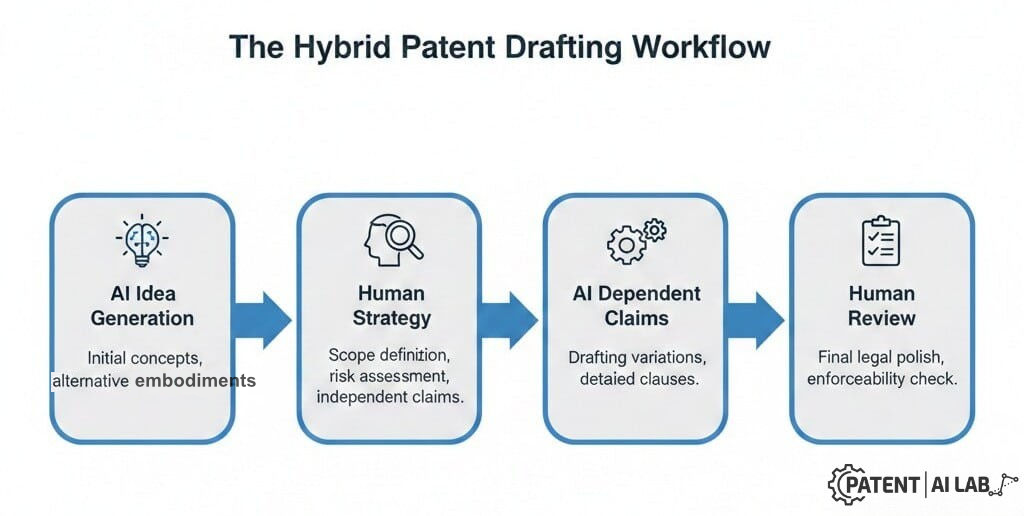
After this experiment, we changed our workflow entirely. We didn’t ban AI, but we demoted it. We now use AI as a pre-drafting accelerator, not a drafter of record. It is fantastic for:
- Structuring ideas.
- Surfacing alternative embodiments (variations).
- Speeding up dependent claim generation.
But the independent claims? Those still start with a human who understands business goals, enforcement risk, and examiner psychology.
Podcast
This automated audio brief outlines the primary data, analysis, and strategic insights covered in this guide.
FAQ: Common Questions on AI Patent Drafting
Can I just copy-paste AI-generated claims into my patent application?
Technically, yes, but it is legally dangerous. AI often hallucinates terms or creates “means-plus-function” limitations that restrict your scope. Always have a registered practitioner review the output.
Does using AI for patent claim writing save money?
It saves time on the first draft, which can reduce billable hours. However, if the attorney has to spend hours fixing a “hallucinated” claim, you might end up paying the same amount for a lower-quality result. Use it to organize thoughts, not to replace the expert.
To better estimate your total budget beyond just the initial drafting phase, read our complete breakdown on the true cost of Patenting a Mobile App.
Will the USPTO reject my patent if I use AI?
The USPTO currently does not reject patents solely because AI was used in drafting. However, the inventor must be a human. You cannot list the AI as an inventor. The responsibility for the content lies 100% with the human signing the documents.
What is the best patent claim generation tool right now?
There is no “magic button.” Tools like Rowan Patents, Juristat, or even specialized GPT wrappers are popular, but they are tools for professionals, not replacements for them.
Sources and Legal Framework
The legal standards and tool analyses presented in this guide are grounded in official federal statutes and intellectual property organizations. You may verify specific legal frameworks via the following resources:
-
1. USPTO Guidance on AI Inventorship
Official documentation on how the United States Patent and Trademark Office handles AI-assisted inventions and claim drafting tools.
Read the USPTO Federal Register Notice -
2. Claim Definiteness (35 U.S.C. § 112)
The legal standard requiring patent claims to particularly point out and distinctly claim the invention, highlighting the risks of vague AI generations.
View the Legal Statute via Cornell Law -
3. Prior Art & Obviousness (35 U.S.C. § 102 & § 103)
The foundational laws determining whether an AI-generated claim is truly novel or easily rejected due to over-broadening.
See USPTO MPEP Guidelines -
4. WIPO International Filings (PCT)
Legal framework regarding the preparation of major international patent filings mentioned in our internal experiment.
Visit the Official WIPO PCT Portal
Disclaimer & Legal Notice
PatentAILab is an independent educational research platform and is not a licensed law firm or financial advisory service. The data, patent analysis, and strategic insights provided in this article are for informational and educational purposes only and do not constitute legal, investment, or business advice. Intellectual property outcomes depend on specific technical facts, jurisdictional laws, and drafting execution. Always consult a certified patent attorney and a qualified financial advisor before making IP filing or venture capital investment decisions.


[…] In practice, asking “Can AI code be patented?” is the wrong question. The better question is: “Is the human contribution around that code concrete, technical, and defensible?” If you are unsure how to prove this to an examiner, check out our detailed guide on Patenting AI Inventions.Proving human conception in the age of generative models requires a specific strategy. For a deeper look at the legal boundary, read our analysis: Can AI for Patent Claim Writing Really Replace a Human? […]