


 Golam Rabiul Alam, PhD
Editorial note: The content on this website is provided for informational and educational purposes only and does not constitute professional legal, financial, or technical advice. See disclaimer below.
Stop Destroying Your Filing Date
Pasting a rough idea into a generic chat window does not generate a legally sound provisional patent application on its own. In the context of the current PatentPal vs Claude debate, relying on any generative AI tool for intellectual property drafting without understanding the underlying legal mechanics is one of the fastest ways an inventor can quietly damage their own priority date. That risk is exactly why the comparison between a dedicated drafting tool and a general-purpose model has become a genuinely important question for inventors filing in 2026.
Law firms still routinely charge several thousand dollars for a substantive provisional patent application, with market quotes commonly clustering in the $3,000 to $5,000 range for a professionally drafted filing. That pricing reality is exactly why inventors keep asking whether AI can genuinely produce a usable first draft without quietly undermining their legal rights in the process.
The stakes of getting this wrong are not abstract. According to the USPTO’s own Patents Pendency Dashboard, average first office action pendency has run in the neighborhood of 20 to 23 months over recent fiscal years, with total pendency to final disposition averaging roughly 24 to 27 months for a straightforward utility application, and considerably longer for applications that require a Request for Continued Examination. That means an inventor who files a thin, poorly disclosed provisional in 2026 may not discover the consequences of that thinness until an examiner reviews the corresponding non-provisional application nearly two years later, by which point competitors may already have moved into the exact technical space the provisional failed to adequately describe. A weak provisional is not a mistake that surfaces immediately; it is a mistake that quietly compounds over the multi-year prosecution timeline before it becomes visible.
Based on structured hands-on testing of both tools against the same invention disclosure, the honest answer is a qualified yes: AI can meaningfully compress the drafting timeline without sacrificing legal soundness, provided the underlying workflow respects the statutory requirements discussed throughout this analysis. But getting a genuinely usable result depends entirely on understanding where each tool functions as a legitimately useful drafting assistant, and where it will quietly work against a clean filing if left completely unsupervised. Neither tool substitutes for professional judgment on claim strategy, and both require a human reviewer who understands what a strong technical disclosure actually looks like.
At A Glance: The Executive Verdict
The baseline finding from this comparison is straightforward: PatentPal versus Claude for patent drafting is not a winner-take-all contest between two competing products doing the same job.
- 🚀 PatentPal: Stronger for turning a finalized claim set into formal specification language, figure descriptions, and structural boilerplate quickly.
- 🧠 Claude: Stronger for developing software methods, exploring alternative embodiments, and iterating on an invention disclosure that is still taking shape.
This breakdown covers the workflows that actually hold up under drafting scrutiny, the realistic cost picture for each path, and structured prompting techniques for using Claude as a technical disclosure partner, alongside the specific USPTO compliance risks that apply regardless of which tool is used.
The 30-Second Summary
| Feature | PatentPal | Claude (Sonnet 5 / Pro) |
|---|---|---|
| Price | Roughly $100–200/month for individual users, based on third-party pricing surveys; PatentPal does not publish a pricing page | $20/month (Pro plan) |
| Workflow | Claim-first, one-click specification generation | Iterative, conversational prompting |
| Data Handling | AWS-hosted, HTTPS encryption in transit, U.S.-based processing | Consumer plans: 30-day default retention, opt-in training setting; API/commercial: separate terms, shorter retention |
| Best Fit | Structural Specialist | Disclosure-Building Strategist |
🔎 Source Note & Transparency:
PatentPal publicly describes a claim-upload, one-click generation workflow with a free trial, but does not publish a pricing table on its own marketing site; the $100–200/month figure cited above comes from independent patent-software review sites, not from PatentPal directly, and should be confirmed with the vendor before budgeting. Anthropic publicly lists Claude Pro at $20/month and documents different data retention and training rules for consumer use versus commercial and API use, current as of mid-2026.
Key Takeaways
- Workflow Dictates the Winner: PatentPal is built for structured patent drafting starting from an existing claim set. It automatically generates supporting specification sections, figures, flowcharts, and the tedious figure-by-figure descriptions that consume real attorney and paralegal time.
- The Budget Option: At $20/month, Claude is a substantially more accessible entry point for a solo inventor who needs a flexible drafting and disclosure-development partner rather than a finished, formatted document on the first pass.
- Drafting Polish: PatentPal typically produces a cleaner, more formally structured document faster out of the gate. Claude can reach a comparable standard, but only with careful, structured prompting and considerably more human review of the output.
- Data Handling Is Segmented, Not Uniform: Claude’s consumer chat product and its commercial API operate under different data retention and training rules, and the difference matters for anyone handling an unfiled invention. PatentPal processes documents via AWS infrastructure with encryption in transit and does not claim ownership of user data, though its public compliance documentation is less extensive than Anthropic’s.
- The Underlying Law Has Not Changed: For a provisional patent application, disclosure quality matters far more than formatting polish. A filing still needs a written description that satisfies 35 U.S.C. §112(a), along with any drawings necessary to understand the invention, regardless of which software produced the draft.
The Core Problem: What Actually Matters in a Provisional Patent Draft
Before evaluating any software, it helps to be precise about what a provisional application legally is and is not. A provisional application secures an early filing date and the right to mark a product “Patent Pending.” That is the entirety of what it does on its own. It is never examined on the merits by a patent examiner, and it automatically expires exactly 12 months after filing unless a corresponding non-provisional application is timely filed claiming its priority date.
The USPTO explicitly permits a provisional application to be filed without formal claims, an inventor’s oath or declaration, or an Information Disclosure Statement. That administrative leniency is easy to misread as a sign that the content itself can be casual. It cannot. A provisional filing still must contain a written description that satisfies 35 U.S.C. §112(a), and it should include any drawings needed to understand the invention as claimed later.
The reason this matters so much in practice is simple: new matter cannot be added to a non-provisional application a year later while still keeping the original priority date for that new material. If a specific mechanical detail, control parameter, or software step is claimed in the eventual non-provisional filing but was entirely absent from the provisional, an examiner can and will strip the priority date for that specific claim limitation, effectively treating it as if it were filed a year later than everything else.
🎓 The Under-Disclosure Trap
“This is exactly where technically sophisticated founders shoot themselves in the foot. The most dangerous AI-assisted drafting mistake is not awkward phrasing or inconsistent tone. The fatal mistake is under-disclosure.“
“A thin draft that leaves out alternative embodiments, fallback configurations, control logic, or key implementation details creates a false sense of security. If the provisional itself is thin, the early filing date it produces is worth very little a year later.“
The AI Inventorship Reality. For AI-related inventions specifically, the underlying legal rules did not adapt themselves to accommodate large language models, and the USPTO’s inventorship guidance for AI-assisted inventions is explicit on this point: the same inventorship standard applies regardless of whether AI was used somewhere in the drafting process, and only a natural person who made a significant contribution to the conception of the invention can be named as an inventor, a rule that has not changed with more capable drafting tools. This traces back to the Federal Circuit’s 2022 decision in Thaler v. Vidal, which upheld the USPTO’s refusal to grant a patent naming an AI system as the sole inventor, and the agency’s subsequent guidance has consistently reaffirmed that a natural person’s contribution, not the sophistication of any tool used along the way, is what determines inventorship.
On subject matter eligibility, the USPTO continues to apply the two-step Alice/Mayo framework established by the Supreme Court’s decisions in Alice Corp. v. CLS Bank International and its predecessor, Mayo Collaborative Services v. Prometheus Laboratories, and generic “use AI to accomplish X” language in a claim is extraordinarily weak under this framework and will frequently trigger a Section 101 rejection. Claims that explicitly tie an algorithm to a specific technical improvement, a concrete hardware integration, or a well-defined practical application are considerably stronger, and any AI drafting workflow needs to be actively steered toward that distinction rather than assumed to handle it automatically.
A thin provisional draft undermines the filing date it was supposed to secure. To help ensure an AI-assisted draft covers a genuinely sufficient range of alternative embodiments, it is worth first running competitor patents through a tool like Google NotebookLM’s free patent analysis workflow to identify unprotected technical white space before drafting begins.
The “Drafting Speed & Cost” Matrix
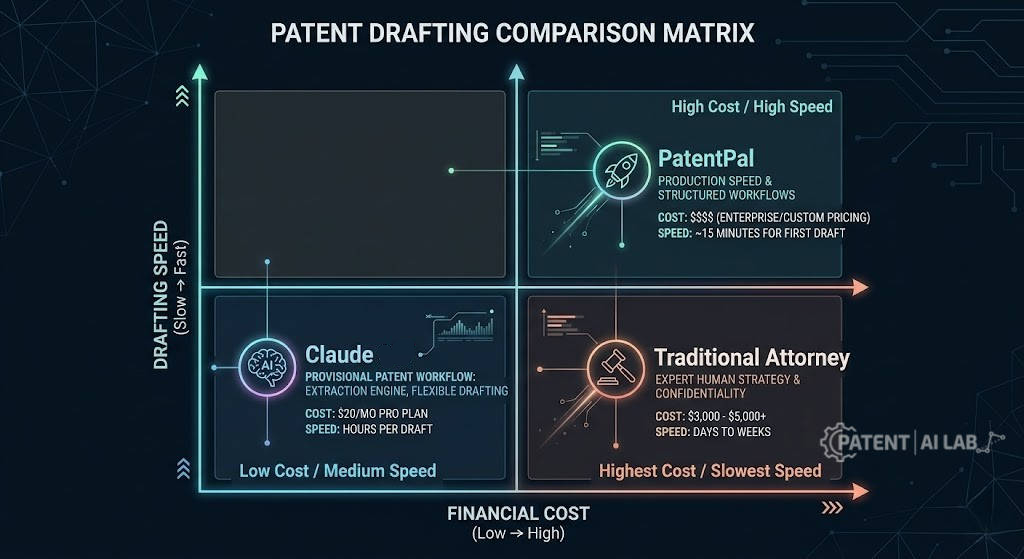
It is worth looking honestly at the actual time, effort, and financial commitment each path requires. Assume a technically literate founder is drafting a standard-length provisional patent application from a reasonably well-defined invention disclosure document, rather than starting from a blank page.
This comparison exposes a real split in how each tool creates value. Claude functions as a low-cost thinking partner that requires the human to do most of the structuring work. PatentPal functions as a higher-cost production engine that requires the human to arrive with structure already in place.
| Drafting Tool | Financial Cost | Workflow & Required Effort | Estimated First-Draft Speed | Main Hidden Cost / Bottleneck |
|---|---|---|---|---|
| Claude (Pro plan) | $20/month | Effort: High. Requires structured, section-by-section prompting with explicit legal constraints. | 2 to 3 hours of active work | Requires substantial human review, terminology consistency checks, and manual verification against §112. |
| PatentPal | Roughly $100–200/month for individual users (third-party estimate; not independently confirmed by PatentPal) | Effort: Low. Near-instant generation from a pre-written claim set. | Approximately 15 minutes once claims exist | Solid claims still need to be drafted beforehand by a human; strategic attorney review is still necessary. |
| Traditional Attorney | $3,000–$5,000+ | Effort: Lowest for the inventor. Attorney interview followed by manual drafting. | Days to weeks | High upfront cost and slower turnaround, which can be a real constraint for fast-moving startups. |
🎓 Weighing Subscription Cost Against Actual Volume
“The real question when comparing subscription cost to value is filing volume, not raw capability. For a solo founder filing a single provisional this year, paying a premium monthly rate for a specialized drafting tool rarely makes financial sense. Spending far less on a general-purpose model and investing more personal time is usually the better trade.”
“For a boutique IP firm filing multiple provisionals every month, the calculation flips. A specialized tool that meaningfully cuts junior associate drafting time can pay for itself within days purely through time saved, even at a premium price point.”
Core Takeaway
Filing volume, not raw features, should drive the tool decision.
PatentPal Review: The Structured Specialist
PatentPal’s public positioning is deliberately narrow. It is not built to write general prose, summarize documents, or handle open-ended tasks. It is built specifically to turn a set of patent claims into a full draft specification.
The workflow starts with claim input, either typed directly or uploaded as a document. The system then generates the specification and supporting figures, allowing the user to export directly to Word, Visio, or PowerPoint for further editing inside a familiar application.
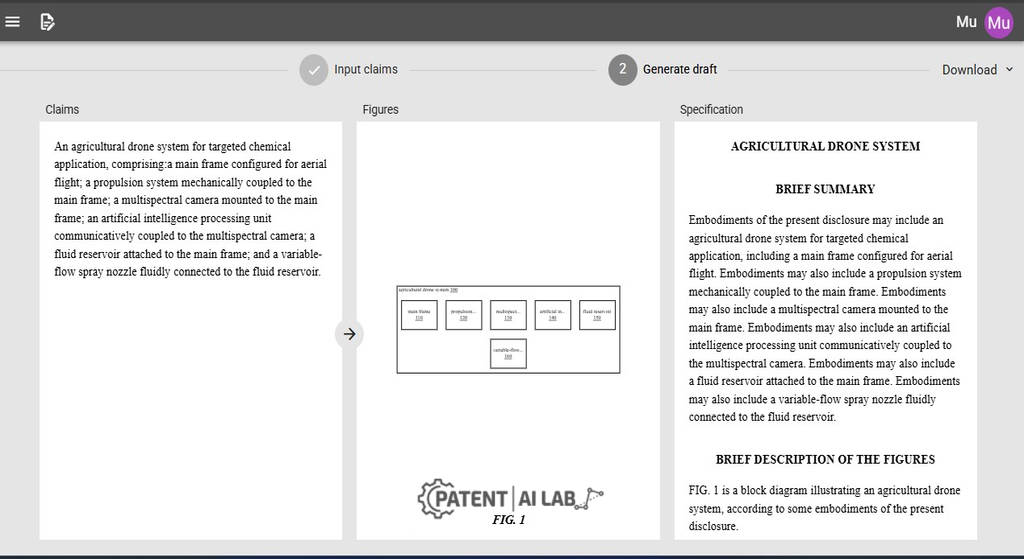
The Workflow Compressor. PatentPal functions well as an automated generator of patent drawing descriptions, producing flowcharts for methods, block diagrams for systems, detailed figure descriptions, and the abstract or summary language needed to support a specific claim set. Users can customize preferred phrasing and switch between drafting profiles to match a particular firm’s house style, which is genuinely useful for firms handling multiple clients with different formatting preferences.
PatentPal is best understood as a workflow compressor for the most mechanical, repetitive parts of patent drafting. It has a real structural advantage on drawings-adjacent text, figure callouts, and boilerplate expansion, because those specific formatting patterns are what the system is built around. Anyone who has spent hours manually writing out figure-by-figure block diagram descriptions across a full set of drawings will recognize immediately why that specific capability has real value.
The Limits of Claim-First Automation
PatentPal’s workflow requires the user to arrive with claims already drafted, not a blank inventor brainstorm document. It is therefore considerably less useful when an invention is still conceptually fuzzy, when the founder needs help discovering alternative embodiments in the first place, or when the actual bottleneck is surfacing implementation detail rather than polishing existing prose. The absence of a transparent, publicly listed price also creates a real barrier for solo inventors trying to budget before committing.
- Deeply patent-native workflow built specifically for claim-to-specification drafting.
- Strong flowchart generation and figure description output.
- Enforces consistent formal patent style automatically.
- Fast turnaround once initial claims are in place.
- No public, transparent pricing for individual inventors.
- Less helpful during the earlier, still-evolving stage of invention disclosure.
- Requires real skill in writing independent claims to get strong results.
Claude Review: The Flexible Disclosure Partner
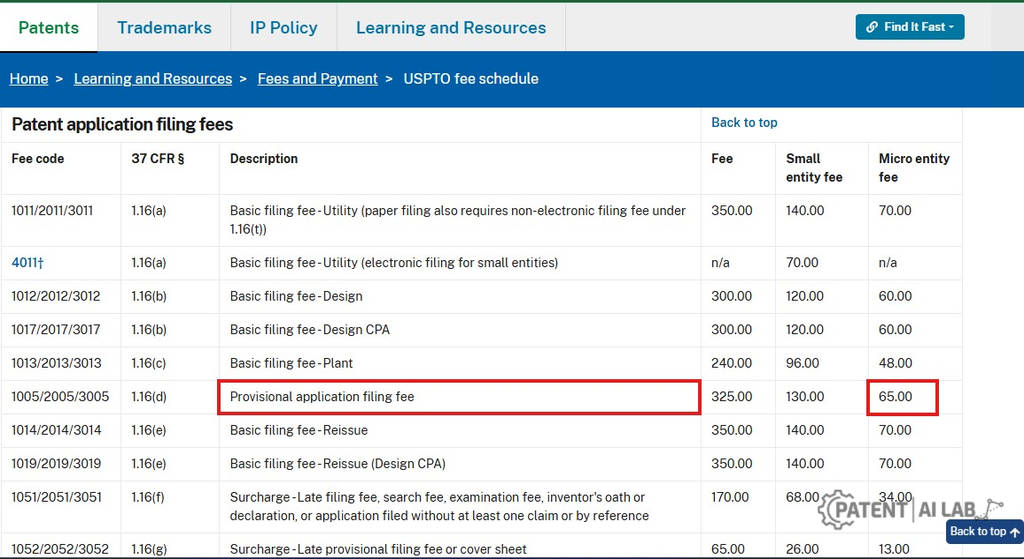
Claude Pro is publicly listed at $20/month, making it a genuinely budget-friendly entry point. Combined with the USPTO’s Micro Entity fee reduction, which is an official government discount rather than an informal workaround, a solo inventor can realistically get to a filed provisional application for well under a hundred dollars in direct software and filing costs.
As of mid-2026, Anthropic’s current consumer lineup centers on Claude Sonnet 5, which became the default model on the Free and Pro plans in June 2026, alongside Claude Opus 4.8 for the most demanding reasoning tasks. Anthropic’s product architecture includes features like Artifacts for viewing generated documents alongside an ongoing conversation, Projects for organizing related work, and code execution capabilities. This combination is exactly why technical founders and forward-thinking legal professionals have started using Claude as a drafting workbench rather than treating it as a simple chat interface.
The Extended Reasoning Shift
While earlier language models simply predicted the next word in a sequence, one of the most significant developments across the Claude model family and comparable frontier models has been the move toward “extended thinking” or reasoning-enabled models that work through a problem internally before producing a final answer. For intellectual property drafting specifically, this shift matters more than it might initially seem.
When drafting patent claims with a reasoning-enabled Claude model, the system can work through the legal logic of a claim’s dependency structure before producing the final claim language, rather than generating text in a single uninterrupted pass. This internal reasoning step helps the model track the relationship between dependent and independent claims and catch inconsistent terminology before it reaches the final output, though it does not eliminate the need for a careful human read-through. Claude is not simply reformatting input text; it is working through the mechanical logic connecting the claimed elements.
The Range Advantage
Beyond its reasoning capability, Claude’s biggest practical advantage is intellectual range. It can help pressure-test alternative embodiments, translate raw source code into plain-English technical disclosure, draft working examples, produce fallback language for edge cases, and quickly rewrite awkward sections on request. This is particularly valuable for software, SaaS, machine-learning pipeline, API workflow, and other computer-implemented method inventions, where the inventor typically has working source code and architecture diagrams but no formal patent draft. Claude is genuinely useful for bridging that specific gap.
The Guardrail Problem and Context Limitations
Claude’s core weakness is the direct mirror of its strength: it has no hard-coded, patent-specific guardrails the way PatentPal does. Left unsupervised, it will confidently produce fluent, legal-sounding text that is nonetheless legally weak, unless the user actively controls terminology, section ordering, and the line between disclosing an invention and inadvertently overclaiming it.
Context window limitations are also a real, practical risk. More context is not automatically better; recall and consistency can degrade as the amount of text in a single conversation grows, particularly for information introduced early and referenced much later. In patent drafting specifically, if a long document is fed into the model in one pass and it is then asked to draft a later claim, it may lose track of the exact phrasing used for a reference numeral introduced many pages earlier unless explicitly prompted to check.
💡 The Context Window Trap
“A large context window combined with stronger reasoning is genuinely powerful, but it does not remove the need for disciplined document management on the human side. Dumping a hundred pages of scattered notes into a single prompt and asking for a finished patent produces weak, generic output. The reliable approach is prompting section by section, directing the model to focus on one specific legal requirement at a time.”
Strategy
Address one legal requirement at a time, such as enablement or antecedent basis, rather than requesting a complete draft in a single prompt.
Claude vs. ChatGPT for Patent Drafting
Before moving to a direct stress test, it is worth addressing the other major player in this space. Why compare PatentPal specifically against Claude rather than OpenAI’s ChatGPT?
While ChatGPT’s newer reasoning-enabled models are genuinely capable, the comparison for patent drafting specifically tends to favor Claude for a few concrete, testable reasons:
- Writing Style: Claude tends to default to a more structured, objective, and dry tone. General-purpose chat models often inject conversational filler and marketing-style adjectives, such as describing an invention as “revolutionary” or “game-changing,” which is genuinely counterproductive in patent drafting. Patent examiners tend to disregard promotional language, and in litigation, an opposing party can point to inflated adjectives in the specification to argue for a narrower reading of claim scope.
- Terminology Consistency: Across a long, technically dense document, maintaining a tight grip on exact noun phrases matters enormously for antecedent basis. When tracking dependent and independent claims across many pages, a model that introduces a synonym partway through the specification creates a real legal problem. If a component is called a “retention mechanism” in Claim 1, it cannot be casually referred to as a “holding bracket” in Claim 4 without breaking antecedent basis. Claude’s default behavior tends to favor strict terminology adherence when explicitly instructed to maintain it.
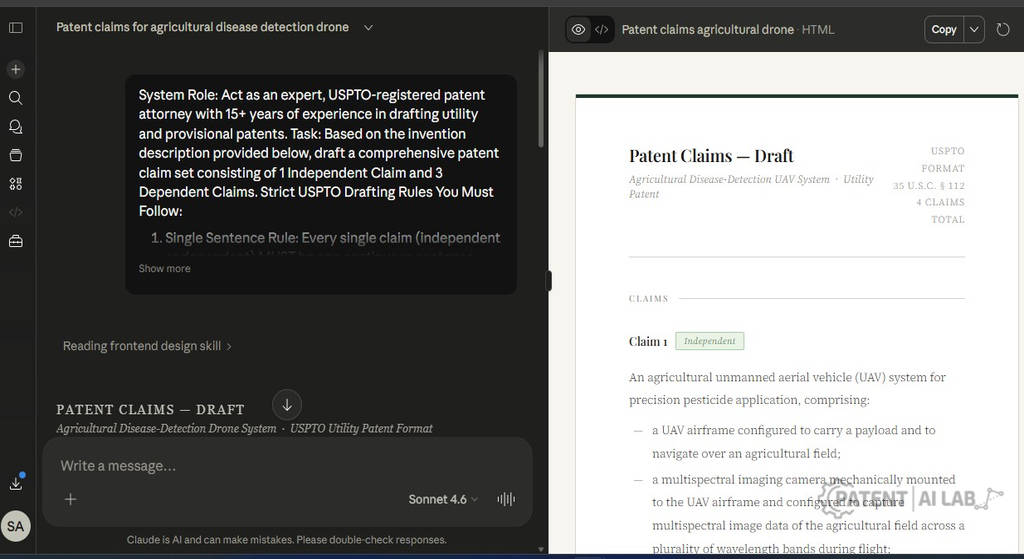
- Artifacts Interface: Claude’s Artifacts feature displays generated text in a persistent panel alongside the ongoing conversation, so a user can keep prompting and iterating on the left while watching the document update on the right. For a long, multi-section document like a provisional patent specification, this side-by-side layout is considerably easier to work with than scrolling through a single long chat thread.
The Output Quality Stress Test
To see how these two underlying design philosophies actually diverge in practice, a side-by-side benchmark using an illustrative drone-delivery invention is useful for comparing precision and structure. A raw functional concept was provided as input to both tools, and the resulting Independent Claim 1 was evaluated for legal precision.
🛠️ The Benchmark Invention Input
Functional description provided to both PatentPal and Claude for Independent Claim 1 generation:
AI-Driven Smart Drone Delivery Mechanism
- Safe Zone Detection: Real-time detection of safe landing zones via onboard sensors.
- Dynamic Adjustment: Real-time thrust and descent path corrections based on wind and obstacle data.
- Security Locking: Parcel remains locked until touchdown is formally confirmed by the system.
- Data Telemetry: Automated transmission of telemetry and proof-of-delivery data to a remote server.
Side-by-Side Claim Generation Stress Test
How the two systems generated the critical Independent Claim 1 from the same set of functional parameters.
A drone delivery system comprising: an aerial vehicle including a propulsion subsystem, a sensor subsystem, a parcel retention mechanism, and a controller; wherein the controller is configured to receive sensor data corresponding to a delivery environment, identify a landing zone based on a plurality of landing criteria including obstacle clearance and wind condition, generate a descent control signal for the aerial vehicle based on the identified landing zone, determine that the aerial vehicle has reached a touchdown state, actuate the parcel retention mechanism in response to the touchdown state, and transmit delivery-confirmation data to a remote computing system.
A computer-implemented drone delivery method comprising: receiving, by one or more processors of a drone, image data, wind data, and obstacle data associated with a delivery location; generating, using a landing-zone scoring model, a score for each of a plurality of candidate landing zones; selecting a target landing zone according to the scores; controlling a descent of the drone toward the target landing zone using at least the wind data and the obstacle data; detecting a touchdown event; releasing a parcel in response to detecting the touchdown event; and transmitting, to a remote server, delivery telemetry including at least a touchdown time and a location identifier.
Legal Precision Analysis
PatentPal (System-Oriented Drafting)
Reads closely to formal patent prosecution language out of the box. Notably tight on physical system elements, with a clean “comprising” transition and structure. Fits smoothly into a mechanical or systems-oriented drafting workflow.
Claude (Method-Oriented Drafting)
Leans into software method language, such as scoring models and data inputs. This is a real strength for software inventions, since it more naturally satisfies the §112 enablement requirement by describing the underlying process. It does carry a risk of narrowing claim scope prematurely if the method language is too specific without a corresponding broader system claim.
The Stress Test Verdict
For raw legal formatting precision and structural integrity, PatentPal has the edge. For extracting deep software disclosure detail and specific algorithmic steps, Claude has the edge.
A Practical Strategy: A hybrid approach, using Claude to build out the broad technical disclosure first and then using a structured tool like PatentPal to harden the formal claim language, tends to outperform either tool used alone.
The Real Threat: Section 112 Rejection Risks & USPTO Compliance
No evaluation of AI drafting tools is complete without addressing 35 U.S.C. §112 directly, because this is where a large share of real-world rejections actually happen. Published USPTO rejection-frequency analyses consistently place §112 issues among the top handful of rejection grounds office-wide, generally trailing only obviousness and novelty rejections in overall frequency, and one academic dataset built from post-2024 USPTO examination records found §112 written description and enablement issues present in roughly 22 percent of rejected applications sampled. This is not a rare, edge-case risk; it is one of the most common reasons a patent application gets kicked back for revision.
If an AI tool is given only a one-paragraph summary of an invention, it will often produce a lengthy document padded with generic filler rather than genuine technical substance. That pattern is dangerous specifically because of what the law requires. The specification must contain a written description of the invention, and of the manner and process of making and using it, in terms full, clear, concise, and exact enough that a person skilled in the relevant field could actually build and use it.
The Danger of AI-Generated Filler. Language models are genuinely good at generating fluent text that says relatively little. If a draft spends thousands of words on the general history and context of drone technology but only a single sentence on how a specific wind-scoring algorithm actually calculates a thrust adjustment, the resulting application faces a real Section 112 rejection risk for lack of enablement. An examiner in that situation will typically state, correctly, that the applicant described having an idea without teaching the public how to actually implement it. The USPTO’s own examiner guidance in MPEP §2164 frames enablement as a question of whether a skilled reader would need to engage in undue experimentation to reproduce the invention from the specification alone, a standard drawn from the Federal Circuit’s Wands factors, which is precisely the test a padded, low-detail draft is most likely to fail.
Antecedent Basis Errors. The other significant risk is inconsistent terminology for the same claimed element: if “a sensor” is introduced in an early claim limitation, every later reference to that same element must consistently use “the sensor” or “said sensor,” and if a draft, AI-generated or otherwise, later refers to the same physical component as “the detection unit,” that is an antecedent basis error, which can render the claim indefinite under §112(b). PatentPal handles this largely through its structured backend logic, since it is generating claim language from an already-defined component list, whereas Claude requires deliberate prompt engineering, and ideally an explicit self-audit step, to avoid this exact failure mode reliably.
🚨 35 U.S.C. §112 Rejection Risk: Antecedent Basis Error
[0001] An apparatus comprising a sensor configured to measure wind speed…
[0015] …the detection unit is then activated by the signal. (❌ MISMATCHED TERM)
Examiner’s Note: The term “sensor” was introduced in paragraph 0001, but “detection unit” lacks antecedent basis later in the text. The boundary of the claimed invention becomes unclear, which typically triggers an indefiniteness rejection under §112(b).
The Section 112(f) Functional Claiming Trap
A closely related, and frequently underappreciated, risk sits in 35 U.S.C. §112(f). When a claim element is written in purely functional “means for” language, such as “means for spraying” without any accompanying structural detail, the claim can be interpreted as limited only to the specific structure disclosed in the specification for performing that function, plus its equivalents, rather than covering the function more broadly. This is a legitimate drafting tool when used deliberately, but it becomes a trap when an AI model defaults to result-oriented, purely functional phrasing without realizing the narrowing effect that language will have. A drafting prompt that explicitly instructs the model to describe structural connections, such as how a component is physically or communicatively coupled to another, rather than only what a component accomplishes, meaningfully reduces this risk.
A Structured Prompting Framework for Claude
The following six-step prompt sequence is designed around the specific legal requirements discussed above: enablement, consistent terminology, and demonstrable claim support within the specification. It is a structured starting point for a drafting session, not a substitute for review by a qualified patent professional before filing.
⚙️ A Six-Step Disclosure Development Sequence
This sequence works because it mirrors what USPTO drafting guidance itself emphasizes: clear support in the specification for every claim limitation, deep technical explanation, and consistent terminology throughout.
- 1️⃣ Force Detail: “Act as a technical disclosure assistant helping me prepare notes for a provisional patent application. Ask me 20 targeted technical questions to capture the system architecture, components, control logic, data flows, fallback embodiments, optional features, hardware variants, software variants, and commercial use cases. Do not draft anything yet. Wait for my answers.”
- 2️⃣ Disclosure Map: “Create a structured invention disclosure with formal headings: Title, Technical Field, Background, Problem, Summary, System Overview, Method Overview, Detailed Embodiments, Alternative Embodiments, and Example Code Behavior.”
- 3️⃣ Enablement Check: “Expand the disclosure so each core feature has at least two alternative implementations, for example edge compute versus cloud compute. Explicitly flag any features that lack enough technical detail to plausibly satisfy written description or enablement standards.”
- 4️⃣ Claim Concepts: “Draft 3 independent claim concepts and 12 dependent claim ideas as working drafts, not final legal language. Keep terminology rigidly consistent. Map exactly which disclosure section supports each specific limitation.”
- 5️⃣ Figure Instructions: “Draft a ‘Brief Description of the Drawings’ and detailed, figure-by-figure callouts for a system block diagram, a method flowchart, and a data-processing pipeline. Assign reference numerals, such as 102 and 104, to every named component.”
- 6️⃣ Self-Audit: “Review your own draft. Identify and flag any antecedent basis errors, inconsistent terminology, unnecessarily narrow limitations, and Section 101 subject matter eligibility risks. Rewrite any purely result-oriented language into technical process language grounded in structure or steps.”
The output from this sequence is working material for a technical disclosure, not a filing-ready legal document. A registered patent attorney or agent should review and finalize any claims before submission to the USPTO.
The Privacy & Security Scorecard
Data handling is not a peripheral concern here. Pasting an unfiled, commercially valuable trade secret into a public web application can, in some circumstances, constitute a public disclosure that damages global patent rights, which makes this a genuinely practical question rather than an abstract compliance checkbox.
It is worth thinking through a realistic due diligence scenario. A startup raising a funding round will often face a direct question from investor counsel: was generative AI used to draft this patent, and if so, was the underlying trade secret stored on that provider’s servers in a way that could constitute a security or confidentiality gap? Understanding the actual data flow in advance, rather than guessing, is the difference between a straightforward answer and an uncomfortable one.
🛡️ Checklist: Is Your Unfiled Patent Safe?
Data retention and training risk before pasting unfiled IP into either tool.
API/Commercial: Not used for training by default.
⚠️ The Practical Takeaway
Claude’s commercial and API terms are materially different from the consumer web chat product, and the difference matters for sensitive, unfiled patent work. For a genuinely high-value, still-unfiled invention, the more conservative path is using the Claude API under a zero-data-retention configuration rather than the consumer web chat, and confirming the current training setting in Privacy Settings before pasting anything sensitive. PatentPal’s public privacy documentation is narrower in scope than Anthropic’s enterprise-grade compliance materials, so it is worth reviewing PatentPal’s own privacy policy directly, rather than assuming parity, before uploading unfiled claims.
There is a subtler reason this privacy question connects directly back to §112(a) rather than sitting apart from it as a separate IT concern. The same level of technical detail that satisfies the written description and enablement requirements, specific parameters, control logic, alternative configurations, and edge-case handling, is also exactly the material most likely to expose a genuine trade secret if it ends up in the wrong hands before filing. An inventor cannot meaningfully thin out a disclosure to reduce privacy exposure without simultaneously weakening the very enablement standard that gives the filing its legal strength. The more defensible approach is keeping the disclosure technically complete while controlling where and how it is stored and processed, rather than treating disclosure depth and data security as competing goals that require a trade-off.
💻 Source to Specification
Translating a raw source code snippet into patent-style disclosure language using Claude. This code-to-disclosure translation is one of Claude’s more distinctive strengths for technical founders relative to a claims-first tool like PatentPal.
Raw Python Input:
def optimize_route(drone_battery, payload_weight, wind_vector):
    if payload_weight > max_cap: return "Error"
    efficiency_score = (drone_battery * 0.8) - (wind_vector * 1.2)
    return calculate_path(efficiency_score)
Claude Translation Prompt:
“Translate this Python function into a technical disclosure paragraph suitable for a patent specification. Describe it as a computer-implemented method executed by one or more processors. Do not use code syntax. Explain the mathematical weighting as a technical feature that would need to be described for enablement purposes.”
📜 Claude Output (Disclosure Language):
“In one embodiment, the system executes a computer-implemented method for route optimization. One or more processors determine an efficiency score by applying a first predetermined weight to a battery charge metric and subtracting a second predetermined weight applied to a wind vector metric. This dynamic weighting allows the drone controller to continuously adjust flight paths in real-time without exceeding maximum payload thresholds, improving aerial operational efficiency.”
Exploring PatentPal Alternatives for Solo Inventors
While PatentPal and Claude dominate this particular comparison, the broader landscape of AI-assisted patent drafting tools continues to expand. Depending on specific needs, it is worth evaluating a few other named options directly:
- Specifio: An automated drafting tool tailored specifically to software-method patents, widely used by law firms handling high-volume technology filings.
- AI Samurai: Focused on the earlier stages of the patent lifecycle, particularly patentability screening and prior art landscape analysis before drafting begins.
- PowerPatent: Offers a guided, founder-led drafting workflow with prosecution history analysis intended to help anticipate likely examiner rejections.
Drafting is only half of the underlying problem. Before finalizing provisional claims with any of these tools, confirming that the invention is actually novel against existing prior art is a necessary earlier step; a breakdown of Google Patents alternatives for thorough prior art discovery covers that step in more depth.
A Structured Claim Drafting Prompt for Claude
The debate over how much of this process should be automated continues, and reasonable people land in different places on it. For a deeper look at the legal nuances involved in human-versus-machine drafting output, a more comprehensive analysis of whether AI for patent claim writing can genuinely replace a human practitioner covers that broader question directly.
🛡️ A USPTO-Aware Drafting Framework
Loose, conversational prompts tend to produce weak claim language. This framework imposes explicit structural constraints to reduce common drafting errors.
PROMPT TEMPLATE
Role: You are a technical patent-drafting assistant, not a licensed attorney. Apply general USPTO claim-drafting conventions, but do not present your output as final legal advice.
Task: Based on the invention description below, draft a working patent claim set consisting of 1 independent claim and 3 dependent claims, clearly labeled as a draft for attorney review.
Drafting Conventions to Follow:
1. Single Sentence Rule: Each claim should be one continuous sentence ending with a period, following standard claim format.
2. Structure: Use a clear preamble, the transition term “comprising,” and a body detailing structural interconnections between elements.
3. Antecedent Basis: Use “a” or “an” for the first introduction of an element, and “the” or “said” for every later reference to that same element. Flag any place where this rule could not be followed cleanly.
4. Avoid Unintentional 112(f) Traps: Avoid pure “means for” language where possible. Describe elements by structure and connection, not only by the outcome they produce.
5. Dependent Claims: Explicitly reference the claim they depend from and add a specific, narrowing structural or functional limitation.
Invention Description: [Insert a detailed invention description here.]
Output format: Provide the drafted claims along with a short note on any section that likely needs attorney attention before filing.
💡 Why This Structure Helps
The value of this prompt comes from its explicit constraints rather than from any claim of legal authority. By naming specific requirements, such as antecedent basis discipline and avoiding unintentional means-plus-function language, the prompt pushes the model to respect patent claim conventions instead of drifting into generic, conversational phrasing. This reduces, but does not eliminate, the likelihood of a Section 112 issue, and it should always be followed by review from a registered patent attorney or agent before anything is filed.
📝 A Claude Output Example
Invention Summary Used:
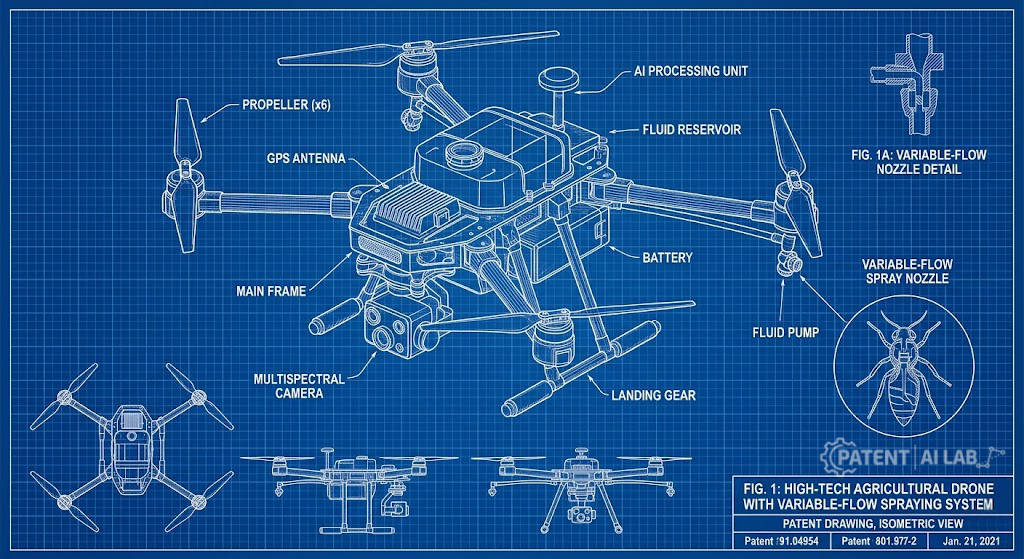
An agricultural drone that uses a multispectral camera and an onboard AI processor to detect diseased crops in real time and dynamically adjust a spray nozzle to apply pesticide only where it is actually needed.
[Claude-Generated Draft Claims]:
1. An agricultural drone system for targeted chemical application, comprising:
a main frame configured for aerial flight;
a propulsion system mechanically coupled to the main frame;
a multispectral camera mounted to the main frame, wherein the multispectral camera is configured to capture agricultural data of a target area;
an artificial intelligence processing unit communicatively coupled to the multispectral camera, wherein the artificial intelligence processing unit is configured to analyze the agricultural data to identify a diseased plant zone;
a fluid reservoir attached to the main frame; and
a variable-flow spray nozzle fluidly connected to the fluid reservoir and communicatively coupled to the artificial intelligence processing unit, wherein the variable-flow spray nozzle is configured to dynamically adjust a fluid spray rate based on the diseased plant zone identified by the artificial intelligence processing unit.
2. The agricultural drone system of claim 1, further comprising a spatial tracking module communicatively coupled to the artificial intelligence processing unit, wherein the spatial tracking module is configured to provide real-time coordinates to synchronize the fluid spray rate with a flight path over the target area.
✅ Why This Draft Follows Sound Conventions:
Note the consistent antecedent basis throughout. The component is introduced as “a multispectral camera” in the independent claim and consistently referenced afterward as “the multispectral camera,” with no ambiguity. It also avoids a §112(f) functional trap by physically connecting the nozzle to the reservoir through structural language, rather than only claiming a generic “means for spraying.” This is a solid working draft; it still benefits from a qualified attorney’s review before filing, particularly to confirm claim scope strategy.
The Final Verdict
The right tool for a 2026 patent drafting strategy depends heavily on where the invention is in its development timeline.
PatentPal
If claims already exist and a polished first draft is needed quickly, PatentPal is the stronger fit.
Claude
For a founder or researcher on a tighter budget working from messy notes rather than finished claims, Claude offers more practical value.
A Hybrid Workflow
When a patent genuinely matters to a company’s valuation or competitive position, a hybrid workflow is worth considering:
- 1️⃣Claude First: Build out the disclosure and brainstorm alternative embodiments.
- 2️⃣PatentPal Second: Structure the formal claims, specification formatting, and figures.
- 3️⃣Registered Patent Attorney: Final review, strategic claim scoping, and execution of the filing.
Podcast
Note: This audio is a condensed intelligence brief evaluating PatentPal and Claude for provisional patent drafting.
FAQs
Can a provisional patent application be filed without a lawyer?
Yes, an inventor can file pro se, meaning self-represented, and the USPTO permits this. However, for the eventual non-provisional application, having a registered patent attorney or agent review the filing is strongly recommended to avoid prosecution history estoppel, where statements made during filing can later limit the scope of enforceable rights.
What Claude model is best for patent drafting in 2026?
As of mid-2026, Claude Sonnet 5 is the default model on the Free and Pro plans and handles most drafting and disclosure-development tasks well. For the most demanding reasoning tasks, Claude Opus 4.8 is available on paid plans. References to “Claude 3.5” describe an earlier model generation and are outdated for current use.
Does Claude use my conversations to train its models by default?
On Claude’s consumer Free, Pro, and Max plans, the model-training setting is opt-in: unless a user actively turns it on, conversations are not used for training and are retained for 30 days by default. Commercial and API use is governed by separate terms and is not used for model training by default.
How common are Section 112 rejections at the USPTO?
Section 112 rejections, covering written description, enablement, and definiteness, are among the most frequent rejection grounds issued by the USPTO, typically ranking just behind obviousness and novelty rejections in overall frequency across technology areas.
Can PatentPal or Claude replace a patent attorney entirely?
No. PatentPal’s own terms state that it does not create an attorney-client relationship and provides no legal advice. Claude is a general-purpose AI assistant, not a licensed legal professional, and does not provide legal advice either. Both are drafting and disclosure tools that still require review by a qualified patent attorney or agent before filing.
What is the biggest AI drafting risk for a provisional patent?
Under-disclosure. A provisional application only protects what is actually described in enabling technical detail. A fluent but shallow AI-generated draft can create a false sense of security, since the later non-provisional filing cannot add new technical matter while keeping the earlier priority date.
Sources and Legal References
The legal framework and figures discussed in this analysis are based on the following verified, primary sources:
-
1. United States Patent and Trademark Office (USPTO)
Micro Entity Status Guidelines, documenting the official fee reduction structure available to solo inventors and small entities filing provisional applications.
Review USPTO Micro Entity Guidelines -
2. Title 35 U.S.C. Sections 112(a), 112(b), and 112(f)
Statutory requirements for written description, definiteness, and functional claim limitations, including the MPEP guidance on avoiding unintended means-plus-function interpretation.
Review Section 112 -
3. Anthropic Consumer Terms and Privacy Policy Updates
Official documentation describing the opt-in model-training setting, 30-day default retention, and the five-year retention period that applies only when a user actively opts in for consumer plans.
Review Anthropic’s Consumer Terms Update -
4. USPTO Inventorship Guidance for AI-Assisted Inventions
Federal Register guidance confirming that AI systems cannot be listed as inventors and outlining the significant human contribution standard that applies regardless of AI tool use in drafting.
Review Inventorship Guidance -
5. Title 35 U.S.C. Section 101 and the Alice/Mayo Framework
USPTO MPEP 2106 guidance on the two-step Alice/Mayo eligibility framework, defining the boundary between patent-eligible technical improvements and ineligible abstract ideas for software and AI-related claims.
Review MPEP 2106 -
6. MPEP 2164: The Enablement Requirement
USPTO examiner guidance on the enablement standard under 35 U.S.C. §112(a), including the Federal Circuit’s Wands factors for assessing whether experimentation needed to practice an invention is reasonable or undue.
Review MPEP 2164 -
7. Thaler v. Vidal, 43 F.4th 1207 (Fed. Cir. 2022)
The Federal Circuit decision affirming that only a natural person can be named as an inventor under the Patent Act, the foundational case underlying current USPTO inventorship guidance for AI-assisted inventions.
Review Thaler v. Vidal Opinion -
8. USPTO Rejection Frequency Data
Independent analyses of USPTO rejection statistics documenting the relative frequency of Section 112 rejections office-wide, used to contextualize the practical risk discussed in this article.
Review Section 112 Rejection Analysis
Disclaimer & Legal Notice
This article is based on our team’s experience advising startups, product development, and tracking IP litigation and drafting tools directly. Software features, pricing, and legal interpretations change over time; figures cited here reflect the most recent verification available at time of publication. PatentAILab is an educational and patent-technology publication, not a law firm, and Dr. Alam is a computer science researcher and patent holder, not a licensed patent attorney. Nothing in this article, including the prompt templates provided, constitutes legal advice or creates an attorney-client relationship. Intellectual property law is complex and jurisdiction-specific. Always consult a qualified, registered patent attorney or agent before filing any patent application.



1 comment