

 Golam Rabiul Alam, PhD
Last year, I sat in on a call between a SaaS founder and a seasoned software patent attorney. The founder was ecstatic. His team had used ChatGPT to generate a core chunk of backend logic that dramatically reduced API latency.
He assumed the hard part was done. “The code works. It’s novel. We’ll patent it,” he said. That confidence worried me. Not because the idea was bad, but because I’d already watched two similar applications stall at the USPTO. Same assumption. Same blind spot.
The real issue was not the quality of the code. It was how that code came into existence and how it was framed. Most developers miss this distinction: Working software and a patentable invention are not the same thing.
At A Glance
As of November 2025, the USPTO issued revised guidance answering a critical question: can AI code be patented? The new rules state that code generated by AI (like ChatGPT) cannot be patented unless a human can prove they “conceived” the core invention.
The guidance clarifies that AI is legally viewed as a “tool” and cannot be listed as an inventor. To secure a software patent in 2026, developers must document their prompts and architectural decisions to prove the “inventive concept” originated from a human mind.
Can AI Code Be Patented? (The 2026 Update)
Short answer: Yes, AI-generated code can be patented, but only if a human can prove they conceived the core technical solution. The USPTO classifies AI strictly as a tool. You cannot patent code if the AI generated the inventive architecture without significant human contribution and documentation.
Understanding the strict USPTO rules for patenting AI software 2026 is critical. Here is the contrarian take based on the latest USPTO Revised Guidance. Code generated by ChatGPT is not automatically unpatentable, but treating the AI as the “creator” guarantees rejection.ection.
Under the Revised November 2025 USPTO Guidance, the agency simplified the rules. They officially rescinded the complex “Pannu Factors” previously used for AI-assisted inventions.
The legal focus is 100% on human conception. This means if you cannot prove you had a specific, settled idea of the technical solution before the AI generated the code, your patent is at risk. The USPTO treats AI simply as a tool, much like a calculator or a CAD program, meaning the human must remain the sole intellectual driver of the invention.
The USPTO does not care that an AI wrote the syntax. They care whether a human can credibly claim they “conceived” the invention before the code existed.
Most teams get this backward. They focus on the output (the code). Examiners focus on the origin (the conception).
If the AI merely translated your idea into syntax.
If the AI supplied the “aha!” moment or the architecture.
The Evidence: What Worked vs. What Failed
Across three filings I reviewed closely, only one moved forward without major “inventorship” objections. The difference wasn’t luck. It was a documentation discipline.
Here is what my team did differently on the successful case.
We treated ChatGPT as a drafting tool, not a design authority. Before any prompt was written, the inventors documented the technical problem, prior approaches, and their proposed solution in plain English. Only then did they ask the AI to help express that solution in code.
During prosecution, when the examiner raised questions about AI involvement (which they now do routinely), we could clearly show human decision points. That changed the tone of the review entirely.
The “Safe Inventor” Checklist
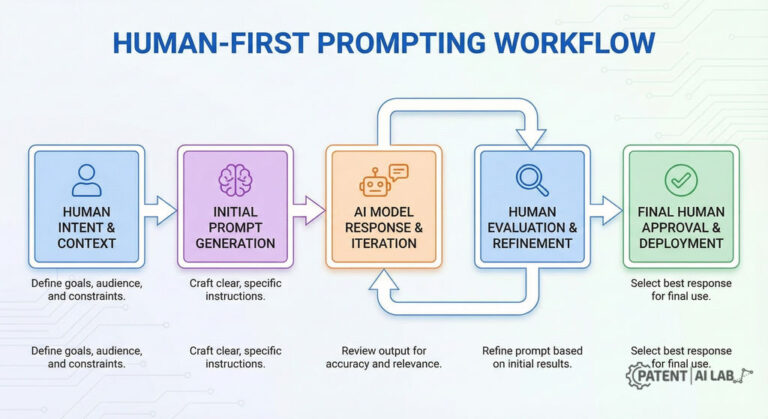
If you are wondering exactly how to prove human conception for AI generated code, this compliance checklist outlines the exact steps required for 2026:
Human Definition
Human defines the technical problem and constraints before prompting.
Why It Matters: Establishes human conception prior to any machine involvement.
Architecture Proposal
Human proposes the specific logic flow or system design.
Why It Matters: Prevents the AI from claiming the core structural architecture.
AI Implementation
AI is used only to write the syntax or “reduce to practice.”
Why It Matters: Aligns with current federal regulations treating AI strictly as a tool.
Selection & Modification
Human evaluates AI output, fixes errors, and selects the final code.
Why It Matters: Demonstrates human oversight and validation of the final claim elements.
Logging
All major design decisions are logged in an Invention Disclosure Form (IDF).
Why It Matters: Provides concrete evidence of human inventorship during USPTO examination.
Contrast this with the failed cases. Founders who used prompts like “Design a new algorithm to optimize latency” were rejected. Why? Because the AI did the thinking, and the AI cannot sign the oath.
The Risks Most Teams Miss
The “Foreign Priority” Trap
Many startups don’t realize that if you file a patent in a jurisdiction that allows AI inventors (rare) or you list the AI on a foreign application, the US will reject your priority claim. You cannot fix this later.
The “Public Disclosure” Risk
If you paste your proprietary logic into a public LLM (like standard ChatGPT) to generate code, you may have just “publicly disclosed” your invention. This can immediately kill your patent rights in Europe and start a 1-year countdown in the US.
Strategic Vulnerability
If your competitors assume AI output is unprotectable, but you quietly build strong, human-authored claims around your AI-assisted workflow, you gain a distinct intellectual property advantage.
To understand how these rules apply to backend logic and math, read our breakdown on Can You Patent an Algorithm?
Final Reflection and Recommendation
If your team is using AI to generate production code and you care about IP, slow down. Document first. Decide second. Prompt last. Then involve a software patent attorney who is comfortable questioning where the “idea” actually came from.
Do that, and the question “Can AI code be patented” stops being scary. Ignore it, and you may find out too late that you own a lot of code, but zero rights.
Podcast
This automated audio brief outlines the primary data, analysis, and strategic insights covered in this guide.
FAQ: AI Code & Patents
Can I copyright code written by ChatGPT?
Generally, no. The US Copyright Office has stated that works created solely by AI are not copyrightable. However, if you significantly modify the code or arrange it in a unique way, you may be able to protect the human-created elements, but not the raw AI output.
Does the USPTO know if I used AI?
They are starting to ask. The new Duty of Disclosure requires you to disclose evidence if the AI’s contribution calls inventorship into question. Hiding the use of AI, if it was material to the invention’s conception, can render your patent unenforceable due to “inequitable conduct.”
What if I use AI just to fix bugs?
That is perfectly fine. Using AI as a tool for debugging, refactoring, or translating code (e.g., Python to C++) is considered “reduction to practice” and does not threaten your status as the inventor, provided you defined the original logic.
Sources and Legal References
The regulatory frameworks and statutory rules cited in this article are sourced directly from federal patent authorities:
-
1. United States Patent and Trademark Office (USPTO) Guidance
Official guidelines detailing practitioner obligations, transparency standards, and software verification rules for AI-assisted application drafting.
Read Official Federal Register Notice -
2. Title 37 CFR Section 1.56 (Duty to Disclose)
The statutory framework governing the absolute duty of disclosure and candor required from applicants during prosecution.
Review Section 1.56 Statute -
3. Title 37 CFR Section 11.18 (Signature and Certification)
Federal mandates regarding personal signature certification and human verification of technical facts presented in a submission.
Access Certification Requirements
Disclaimer & Legal Notice
PatentAILab is an independent educational research platform and is not a licensed law firm or financial advisory service. The data, patent analysis, and strategic insights provided in this article are for informational and educational purposes only and do not constitute legal, investment, or business advice. Intellectual property outcomes depend on specific technical facts, jurisdictional laws, and drafting execution. Always consult a certified patent attorney and a qualified financial advisor before making IP filing or venture capital investment decisions.




[…] Curious if AI-generated code itself can be protected? Read our deep dive on: Can AI Code Be Patented? A Guide for Developers. […]