


 Golam Rabiul Alam, PhD
Hardware startups often treat patent risk as a simple math equation: calculate the potential royalty fee and move on. The reinstated verdict in the Sonos Google patent infringement case proves this calculation is dangerously incomplete. Patent lawsuits are no longer just about financial payouts; they are weapons designed to force operational redesigns.
Quick Summary
The Sonos vs Google patent lawsuit summary reaches a turning point in August 2025 as the Federal Circuit reinstates a $32.5M verdict for Sonos, validating the strategy of “continuation patenting.”
For hardware startups, the key lesson is not the monetary penalty, but the threat of product injunctions: Google was forced to degrade user features to avoid further patent infringement damages. This case proves that direct financial payouts are often secondary to the operational cost of forced product redesigns.
In late 2022, my team was advising a mid-sized hardware startup preparing for its first international expansion. They were confident. Their product worked, customers loved it, and their legal review focused mostly on trademarks and supplier contracts. Patents were treated as background noise.
Then the Sonos Google patent infringement saga landed on my desk during a routine risk review.
What caught my attention wasn’t just who won (which changed multiple times between 2023 and 2025). It was how patent infringement damages were framed and justified. Frankly, it exposed a blind spot I see far too often.
Hardware founders assume patent risk is binary: Either you infringe or you don’t. The reality is messier, more strategic, and far more expensive than most teams model.
Sonos Google Patent Lawsuit Summary: The Real Lesson for 2026
The Sonos Google patent lawsuit summary is not primarily about big tech copying a smaller player. That narrative is comfortable, but incomplete. The real lesson is about timing and market dependence.
Sonos didn’t just win because their patents were brilliant. They won because they enforced them at a moment when Google’s ecosystem dependence made “design-around” options painful.
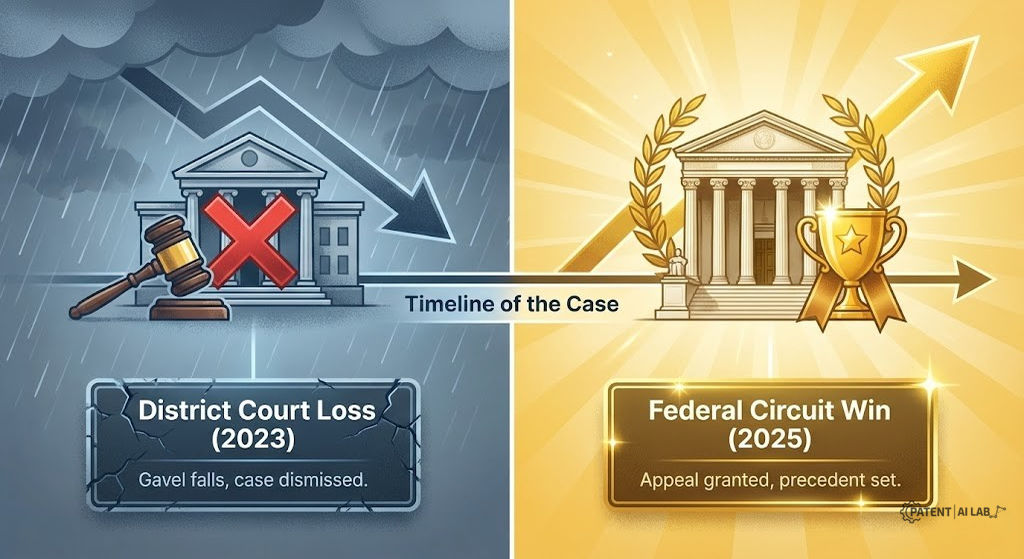
A district judge threw out Sonos’s $32.5M verdict, calling their patent strategy “unreasonable delay” (laches).
The Federal Circuit reversed that decision, effectively validating Sonos’s strategy of keeping patent applications alive for years to capture competitor features later.
Understanding the Sonos vs Google Patent Lawsuit Summary for 2026
The Lesson: Patent infringement damages here were a consequence of strategic exposure, not just technical overlap. For startups, this flips the usual advice on its head. Filing early is useless unless you understand when enforcement pressure actually works.
To avoid facing multi-million dollar infringement damages like this, early detection is key. Every hardware startup should conduct a preliminary Freedom to Operate (FTO) search before finalizing their product design.
2026 Legal Landscape
Following the August 2025 reversal, the Sonos strategy has become the benchmark model for portfolio management. It confirms that as long as your original 18-month publication discloses the technology, you can wait years to refine your claims without losing enforcement rights. This effectively narrows the Prosecution Laches defense to almost zero for modern, post-1995 patents.
The Evidence: How We Broke Down the Risk
When we reviewed the Sonos case internally, we didn’t start with legal theory. We mapped product dependencies. Specifically, we asked a simple question:
“If a court forces a feature removal tomorrow, what breaks downstream?”
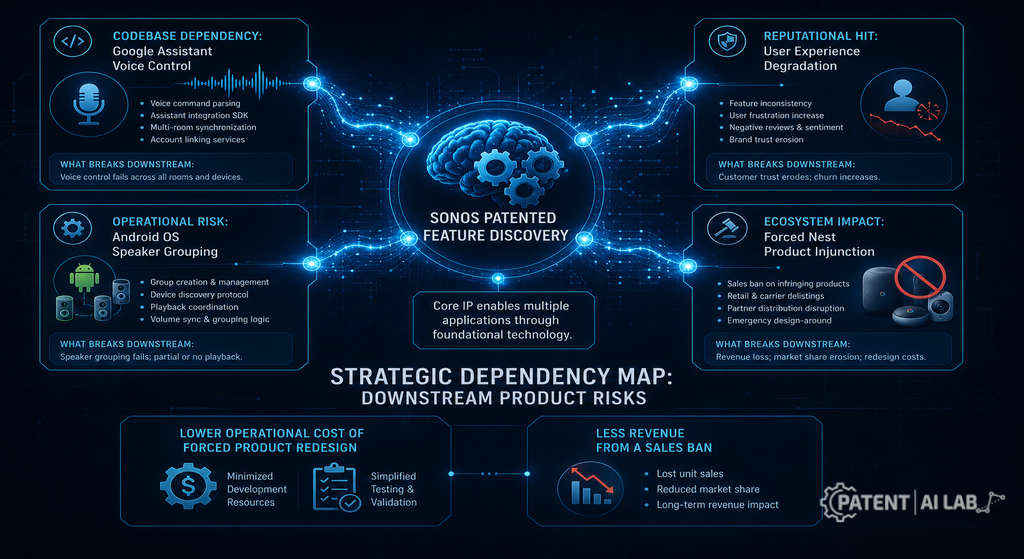
That approach revealed why Sonos had the upper hand. Google’s multi-room audio features were not isolated; they were woven into Google Assistant, Android, and third-party hardware partnerships.
Once infringement was established, the monetary damages ($32.5M) were irrelevant to Google. The real pain was the injunction that forced Google to degrade the user experience for millions of customers.
The “Damages Exposure” Checklist
We translated this into a working checklist for our client. Not a fancy model. Just a brutally honest table that forced uncomfortable answers.
The “Real Cost” Risk Filter
Core Feature Risk
Is the patented feature central to your UX (like “multi-room audio”) or peripheral?
Design-Around Cost
If sued, could you patch it in 2 weeks? Or would it require a hardware recall?
Ecosystem Coupling
How many partners (e.g., Spotify, Alexa) break if this feature is removed?
Enforcement Timing
Are you small enough to be ignored, or big enough to be a target?
Damage Reality
Are you worried about the royalty fee ($2/unit) or the lost revenue from a sales ban?
Seeing these factors side-by-side changed how the founders viewed patent risk. Patent infringement damages were no longer abstract legal numbers. They became operational threats.
If you want to understand how big tech companies build these aggressive portfolios, read our breakdown of Google Patent US12536233B1 Explained: The Survival Guide.
The Overlooked Risk
The biggest risk most hardware startups miss is assuming damages are capped by revenue. They are not.
In the Sonos situation, the real strategic pressure came from the threat of disruption, not just the check they had to write. Courts calculate damages, yes, but businesses feel pain elsewhere first:
Product Delays
Google had to strip features from existing Nest devices.
Reputation Hits
Users were furious when their speakers suddenly “got dumber.”
Design-Around Fallacy
I have yet to see a design-around that is cheap, fast, and invisible to users. Usually, you get one. Sometimes none.
For smart home and IoT developers operating in 2026, the Federal Circuit’s reversal signals a harsh reality. Competitors can and will keep continuation patents alive for years, waiting for your product ecosystem to mature before striking. A reactive legal strategy is no longer viable.
For legal counsels, this means pushing product teams earlier. For business owners, it means asking legal questions that feel “premature.”
Final Recommendation: Audit Like a Supply Chain
After working through this case, I now advise hardware teams to audit patent exposure the same way they audit supply chains.
- Where are the single points of failure?
- Where does someone else’s IP quietly underpin your differentiation?
- If you cannot answer that clearly, you are exposed.
The Sonos vs. Google verdict taught me that patent infringement damages are rarely the headline risk. The real danger is losing control over your product roadmap at the worst possible moment.
My recommendation is simple and uncomfortable: Do the hard mapping work early. Not because you expect to be sued, but because when market dynamics shift, it happens fast.
Next Step: You may also check our deep dive on the legal risks in tech product development.
Podcast
This automated audio brief outlines the primary data, analysis, and strategic insights covered in this guide.
FAQ: Sonos vs. Google & Patent Damages
Who won the Sonos vs. Google lawsuit?
It is a mixed bag, but Sonos scored a major victory in 2025. After a district judge tossed the verdict in 2023, the Federal Circuit reversed that decision in August 2025, validating Sonos’s patents and reinstating the $32.5M damages award.
How are patent infringement damages calculated?
Damages are usually calculated based on a “Reasonable Royalty” (what Google would have paid Sonos if they had licensed it legally) or “Lost Profits” (sales Sonos lost because Google infringed). In this case, the jury awarded ~$2.30 per infringing unit.
What is “Prosecution Laches”?
Prosecution laches is an equitable defense in patent law. It occurs when a patent applicant intentionally and unreasonably delays the patent approval process at the USPTO to secretly keep an application alive, wait for competitors to develop similar tech, and then suddenly enforce it to extract maximum patent infringement damages. While Judge Alsup used this to invalidate Sonos’s patents in 2023, the Federal Circuit severely restricted its application in August 2025.
Why should startups care about a $32M verdict?
Because for a startup, a lawsuit like this is an extinction event. Google can afford $32M; a startup cannot afford the legal fees to even get to the verdict. The lesson is to identify “blocking IPs” early to avoid being sued into bankruptcy.
Sources and Legal References
The regulatory frameworks, appellate decisions, and strategic legal insights cited in this article are sourced directly from federal court records and authoritative patent law journals:
-
1. U.S. Court of Appeals for the Federal Circuit (August 2025 Reversal)
The appellate decision in Google LLC v. Sonos, Inc. (Appeal No. 24-1097) that overturned the district court’s application of prosecution laches and reinstated the $32.5M jury verdict.
Read the Appellate Analysis (Patently-O) -
2. U.S. District Court for the Northern District of California (2023 Ruling)
The initial post-trial order by Judge William Alsup that found Sonos patents unenforceable due to unreasonable delay, setting the stage for the 2025 appeal.
Review the District Court Order Summary -
3. Title 35 U.S.C. Section 120 (Continuation Patent Practice)
The federal statute governing the benefit of an earlier filing date, which legitimizes the strategic continuation patenting strategy validated by the Federal Circuit.
Access the Federal Statute
Disclaimer & Legal Notice
PatentAILab is an independent educational research platform and is not a licensed law firm or financial advisory service. The data, patent analysis, and strategic insights provided in this article are for informational and educational purposes only and do not constitute legal, investment, or business advice. Intellectual property outcomes depend on specific technical facts, jurisdictional laws, and drafting execution. Always consult a certified patent attorney and a qualified financial advisor before making IP filing or venture capital investment decisions.





1 comment