


 Golam Rabiul Alam, PhD
Three years ago, I was pulled into a late-stage product review for a hospital-grade AI triage tool. The model worked. The pilots were clean. Clinicians liked it. But securing valid AI medical device patents is rarely about how well the algorithm performs.
Then the legal team froze everything. It was not because of performance issues. It was because our patent strategy was built on assumptions that no longer matched real MedTech trends. We were filing like it was 2019, but the USPTO and the FDA had moved on.
That moment changed how I evaluate healthcare AI. Most teams obsess over model accuracy and FDA clearance timelines. Few understand how patent behavior dictates what actually reaches patients. After auditing multiple filings across diagnostics and workflow automation, one pattern is clear. The 2026 patent race is no longer about protecting innovation. It is about surviving regulatory gravity.
At a Glance
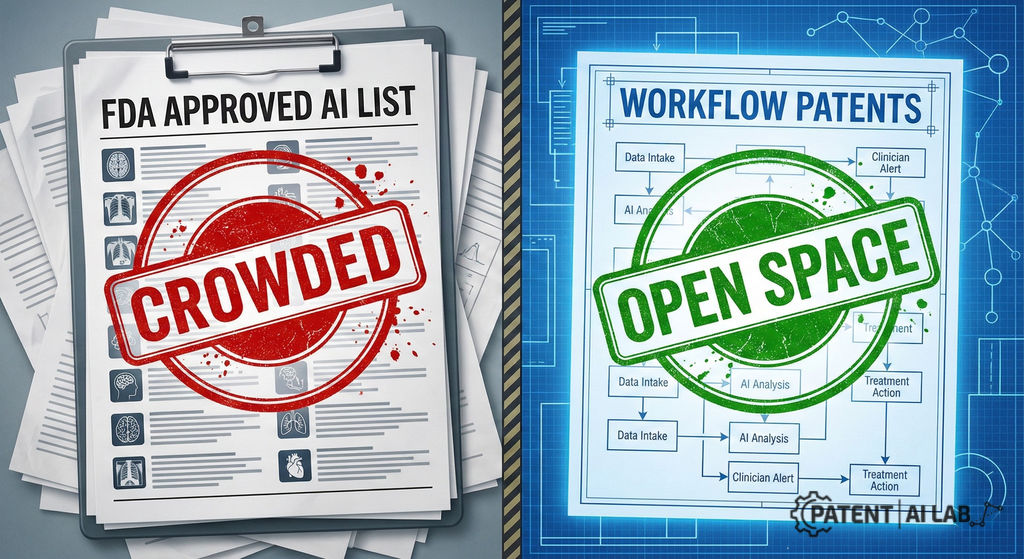
As of 2026, the FDA Approved AI Medical Devices List exceeds 1,200 entries. However, 77% are concentrated in Radiology, creating a highly saturated patent space for new imaging startups. Successful MedTech patent trends now prioritize protecting clinical workflows and human-in-the-loop safeguards over raw algorithms. This audit explains how to navigate the 510(k) equivalence trap and why pre-regulatory patent filing is critical.
Is the FDA Approved AI Medical Devices List a Roadmap?
Short answer: Only if you read it the wrong way.
The common belief is that the FDA Approved AI Medical Devices List shows where innovation is headed. That is a flawed assumption. In practice, it shows where risk tolerance has collapsed.
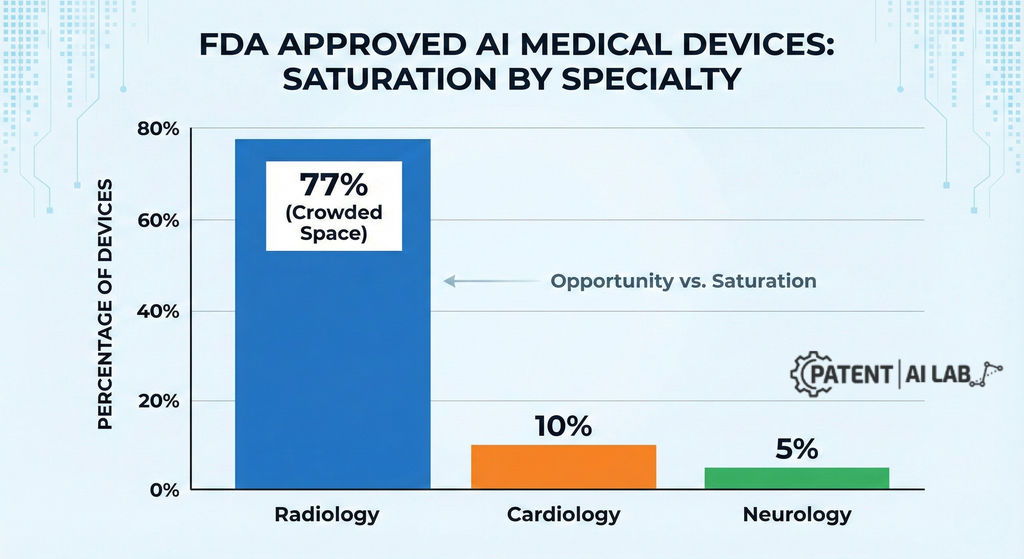
Most approvals cluster around narrow, assistive use cases, not because those are the best ideas, but because they are the easiest to defend legally and patent defensively. As of May 2026, the FDA has authorized over 1,200 AI/ML-enabled devices, yet 77% of them remain concentrated in Radiology.
Many startups treat this list like a shopping catalog. They copy the modality, duplicate the claims language, and file a slightly narrower patent. That approach feels safe, but it guarantees a crowded claim space and weak enforceability.
The Strategic Reality: The FDA list is a map of what not to copy directly. It reveals saturation points where patent examiners, regulators, and litigators are already on high alert.
While avoiding crowded claim spaces is essential for novelty, it is equally important to manage the financial overhead of complex filings. To ensure your strategy remains cost-effective, you should also consider The Patent Claim Optimization Strategy to avoid falling into the USPTO excess claim fee trap.
Audit Findings: How We Changed Our Process
On one project, we audited 42 recently granted MedTech patents tied to FDA-cleared AI tools. What stood out was not the algorithms. It was the framing. The strongest patents avoided claiming “intelligence.” They claimed workflow inevitability.
We shifted our internal process in three ways:
Metric-Free Claims
We stopped anchoring claims to model performance metrics (e.g., “99% AUC”). Those age badly. Instead, we tied claims to decision timing and clinical handoff moments.
Pre-Regulatory Filing
We wrote provisional filings before regulatory submission, not after. This sounds obvious, but many teams wait. That delay costs priority.
The “Label Test”
We stress-tested claims against likely FDA labeling language. If a claim could not survive the exact wording regulators prefer (e.g., “assistive” vs. “diagnostic”), we cut it.
The Conceptual Checklist (Our Filter)
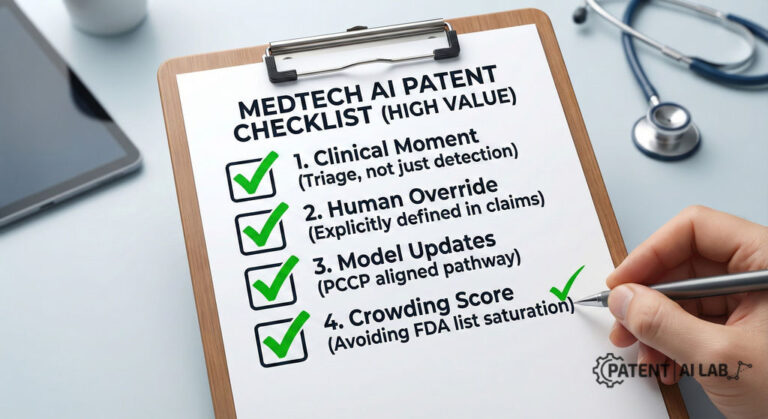
Here is the simple, effective checklist we now use before filing:
Claiming the “Task”
(e.g., Detecting a nodule)
Claiming the Moment
(e.g., Triage prioritization order)
Implicit or ignored
Explicitly defined in the claim structure
Static claims
Described a Model Update Pathway (PCCP aligned)
Ignoring prior art
Check overlap with the FDA Approved AI Medical Devices List
Implicit or ignored in the claims.
Explicitly defining the “Verification Gateway.” We claim the specific interface where the human clinician reviews, modifies, or overrides the AI output before it hits the clinical record.
Any row with high crowding and high label risk gets rewritten or dropped. This process reduced our office actions and shortened prosecution cycles significantly.
Emerging 2026 Frontiers: Multimodal AI & Security
The Pivot to Multimodal Large Models (LMMs)
While 2025 focused on Generative AI for administrative drafting, 2026 is seeing a massive shift toward Multimodal Large Model (LMM) patents. We are moving beyond single-modality AI (just looking at an X-ray) to Contextual AI. These are systems that simultaneously analyze imaging data, electronic health records (EHR), and real-time patient vitals to generate a unified diagnostic hypothesis. If you are filing in 2026, your patent should describe the cross-modal data fusion process, as this is where the most defensible IP now lives.
Cybersecurity as a Patentable Feature
With the FDA’s increased scrutiny on medical device security, we are seeing a shift where Cybersecurity is no longer just a checkbox. It is a patentable feature. Modern MedTech patent trends now include ‘Secure-by-Design’ claims, focusing on encrypted AI inference at the edge and blockchain-verified audit trails for training data. Protecting how your AI stays secure and tamper-proof during clinical deployment is becoming as valuable as the algorithm itself.
Five Trends Shaping AI Medical Device Patents
Based on this audit, five distinct trends dominate the 2026 landscape:
System Behavior Over Algorithm Claims
Patent examiners are pushing back on pure mathematics. They require “clinical flow” claims that detail exactly how AI output triggers a hardware event or a user notification.
Defensive Patenting Around Updates
Continuous learning introduces regulatory friction. The FDA requirement for Predetermined Change Control Plans (PCCPs) means patents must now box model updates into predictable lanes to avoid continuous re-certification cycles.
Imaging Saturation
With over 950 radiology devices cleared by 2026, the AI for imaging space is highly saturated. If your product operates here, your differentiation must be strictly procedural, not technical.
Human-in-the-Loop as a Legal Strategy
Integrating human-in-the-loop language is not just an ethical preference. It is a deliberate legal tactic used to bypass “mental process” rejections (Alice § 101) at the USPTO.
Geographic Hedging
Companies are filing narrower claims in the US to satisfy conservative FDA stances, while filing broader international claims in Europe and Asia to hedge against regulatory limits.
Evaluating Regulatory Risk
The biggest risk I see is false confidence. Teams assume FDA clearance + A Patent = Safety. It doesn’t.
If your claims mirror what is already on the FDA Approved AI Medical Devices List, you may clear faster, but you will defend weaker. Since 97% of these devices are cleared via the 510(k) pathway (claiming equivalence to existing tools), your patent might actually prove that you aren’t novel.
The Smart Move: Aim for slightly harder regulatory conversations if it gives you cleaner claim space. That balance is uncomfortable, but it’s where durable value lives.
Final Reflection
If I were starting a new healthcare AI product tomorrow, I’d bring patent counsel into sprint planning, not post-MVP. I’d map MedTech patent trends before feature prioritization, not after. And I’d treat the FDA list as a warning signal, not a blueprint.
Statistics for Verification
Looking Ahead: The Shift to 2027
As we approach 2027, the focus shifts from Point-of-Care AI to Autonomous Orchestration. We are entering the era of AI-to-AI communication, where diagnostic systems automatically trigger robotic surgery or pharmacy workflows. The winners will not be those with the best models, but those who have patented the clinical nervous system.
The strategy is simple: Do not just file for what your AI does today; file for the infrastructure it will control tomorrow.
Podcast
This automated audio brief outlines the primary data, analysis, and strategic insights covered in this guide.
FAQ: Navigating AI Medical Device Patents and FDA Regulations
Can I patent an AI algorithm for medical diagnosis?
Technically, it is very difficult to patent the algorithm itself (the math) due to USPTO “Subject Matter Eligibility” rules (Section 101). However, you can and should patent the system behavior. This includes how the data is collected, how the AI triggers a clinical workflow, or how it integrates into a specific hardware device. The trend in 2026 is moving away from “diagnostic methods” (which are hard to patent) toward “clinical decision support systems” (which are easier).
Does being on the “FDA Approved AI Medical Devices List” help my patent?
It is a double-edged sword. FDA clearance (especially 510(k)) requires you to prove your device is “substantially equivalent” to an existing product (a predicate).
– The Trap: If you argue to the FDA that you are “just like Product X,” the patent examiner might use that same admission to say your invention isn’t “novel” enough to be patented.
– The Fix: You need a coordinated strategy where your regulatory claims (equivalence) and patent claims (novelty) don’t contradict each other.
What is a “Predetermined Change Control Plan” (PCCP) and why does it matter for patents?
A PCCP is a regulatory plan approved by the FDA that allows an AI model to evolve (learn) over time without needing a new 510(k) for every update. For patents, this is critical. Instead of patenting a “static” model (which becomes obsolete in 6 months), you should try to patent the method of updating or the specific guardrails described in your PCCP. This “future-proofs” your IP against your own software updates.
Why are there so many Radiology AI patents?
Radiology (Imaging) was the “low-hanging fruit” for early AI, leading to massive overcrowding. As of 2026, Radiology accounts for roughly 77% of all FDA-authorized AI devices. This saturation means broad patents in imaging are nearly impossible to get now. New entrants must focus on very specific “niche” workflows or multi-modal data (e.g., combining MRI + Genomics) to find open patent space.
Sources and Legal References
The data presented in this audit is derived from federal regulatory databases and peer-reviewed clinical studies as of May 2026. You may verify specific figures and legal standards via the following official resources:
-
1. FDA AI/ML-Enabled Medical Devices Database
Verifies the 1,200+ authorized devices and the 77% radiology saturation statistic mentioned in this audit.
View Official FDA List -
2. JAMA Network: AI Clinical Validation Audit
Source for the 2026 study regarding the 50% data gap in FDA summary reports for AI medical devices.
Read Full JAMA Study -
3. USPTO Section 101: Subject Matter Eligibility
Official legal framework for “Alice” rejections and the criteria for patenting AI system behaviors (MPEP 2106).
Read USPTO Eligibility Guidelines -
4. FDA Predetermined Change Control Plan (PCCP)
Official guidance on managing AI model updates without repetitive re-certifications.
Access FDA PCCP Guidance
Disclaimer & Legal Notice
PatentAILab is an independent educational research platform and is not a licensed law firm or financial advisory service. The data, patent analysis, and strategic insights provided in this article are for informational and educational purposes only and do not constitute legal, investment, or business advice. Intellectual property outcomes depend on specific technical facts, jurisdictional laws, and drafting execution. Always consult a certified patent attorney and a qualified financial advisor before making IP filing or venture capital investment decisions.





Add comment