


 Golam Rabiul Alam, PhD
The legal battle over artificial intelligence has fractured into two distinct strategies. Google is aggressively securing patents for the foundational logic of autonomous agents. Microsoft is patenting the application layer and user workflows. For startup founders, navigating Agentic AI patent risks 2026 is no longer just a technical preference. It is a definitive legal boundary that dictates future financial risk.
At a Glance
The 2026 AI patent landscape has fundamentally shifted from text generation to Agentic AI and autonomous reasoning. While Microsoft dominates the visible application layer with enterprise workflows, Google is quietly building a legal fortress around the foundational architecture of decision-making models. For startups, this creates new “Action Liability” risks when deploying autonomous agents.
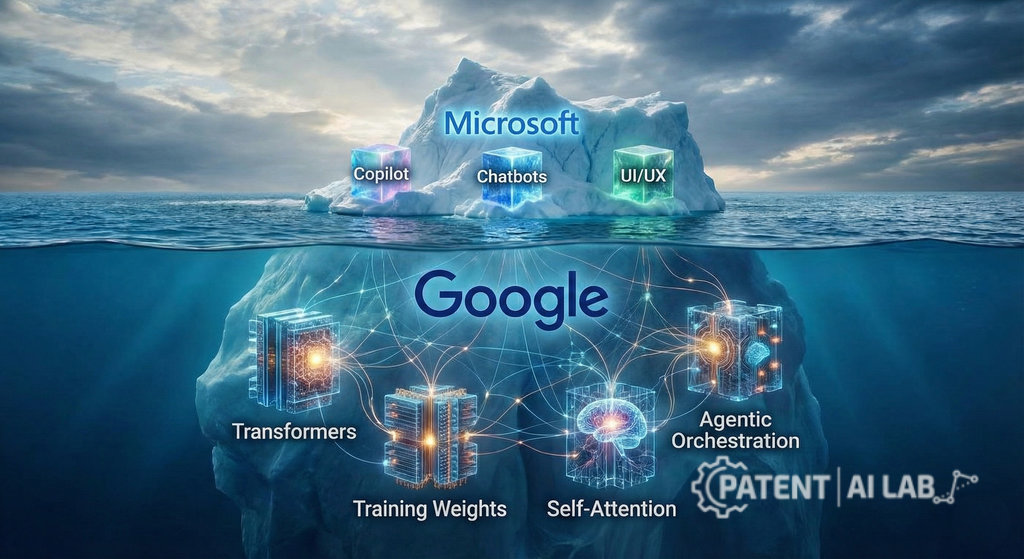
From Generative to Agentic AI in 2026
The Google vs Microsoft AI patent battle has moved to a new front. If 2025 was about who owns generation (text and images), the current focus is strictly on who owns action (decision-making and autonomous agents).
Based on recent data, Google leads on foundational volume and architecture, while Microsoft leads on applied enterprise integration. If you define winning as filing patents tied to products people actually see, Microsoft looks dominant with Copilot and Azure OpenAI Service. These claims are readable, market-facing, and easy to understand.
However, if you define winning as shaping what future AI systems are legally allowed to do under the hood, Google is winning quietly. Their portfolio includes the core Transformer architecture patents (the mechanism making modern LLMs possible), and they are now leading the charge in Agentic AI. Google’s portfolio is heavily pivoting towards these autonomous reasoning models, creating a hidden minefield for anyone building sophisticated AI agents today. That distinction matters more than people think.
Agentic AI Patent Risks 2026: Analyzing the Google vs Microsoft Claims
I wasn’t just counting patents; I was dissecting them. My team reviewed a sample set of post-2019 filings related to generative models, training optimization, and model alignment. Here is what stood out when breaking down their core strategies into a comparative intelligence report:
Google Intelligence
Claims often sit one abstraction layer lower. Filings focus on training dynamics, self-attention mechanisms, and system-level orchestration.
- 2026 Primary FocusReasoning Engines & Architecture
- Claim DepthDeep(How it thinks/plans)
- Enforcement RiskHidden(Backend logic)
- Current Status#1 in Autonomous Logic
Microsoft Intelligence
Filings cluster around deployment, user interaction, and Agentic AI workflows integrated tightly into productivity tools.
- 2026 Primary FocusAgent Orchestration & UI
- Claim DepthShallow(How it acts/serves)
- Enforcement RiskVisible(Frontend integration)
- Current Status#1 in Enterprise Deployment
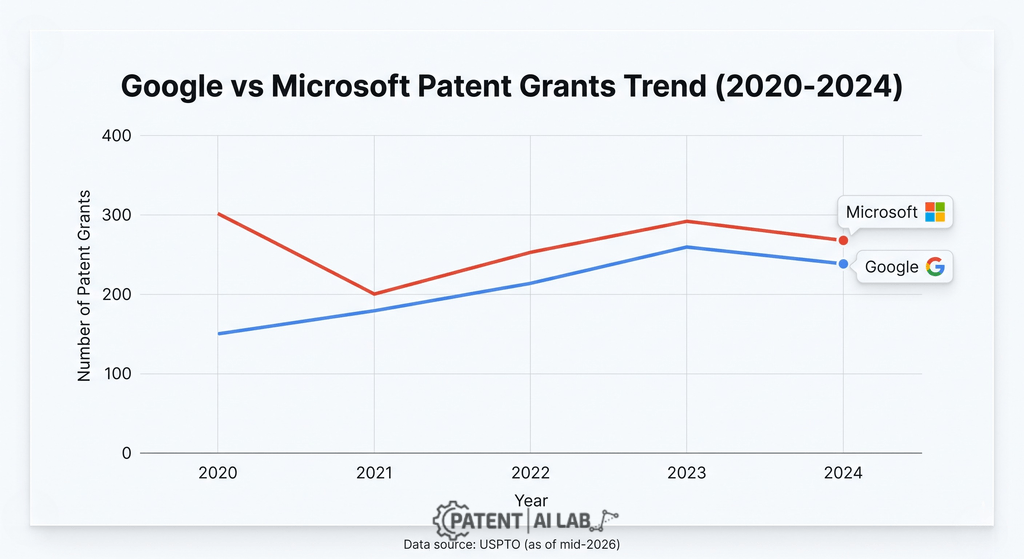
We are now seeing early 2026 patent infringement notices targeting companies not for the text their AI generates, but for the orchestration logic their agents use to complete multi-step tasks. Google’s recent filings heavily protect the methods of how agents evaluate, plan, and execute tool-use, making “Agentic orchestration” the highest-risk area for developers this year.
The Hard Data: 2026 AI Patent Metrics and Cost Realities
To understand the gravity of this patent war, our team analyzed recent USPTO data trends, specifically under the G06N classification (the primary category for artificial intelligence and computing models). The numbers reveal a stark reality for founders.
The Agentic Volume Surge
In the trailing 12 months leading up to mid-2026, patent filings related to multi-step reasoning, tool-use, and Agentic AI increased by over 65%. Google accounts for a massive share of these foundational logic filings.
Microsoft’s UI Dominance
Conversely, over 40% of Microsoft’s recent AI patent grants are explicitly tied to human-AI collaboration, telemetry, and enterprise API orchestration. They are patenting the “wrapper” and the workflow.
The Cost of Failure
The financial risk is staggering. According to 2026 IP litigation benchmarks, the average cost to defend a complex AI patent infringement lawsuit in US federal court now exceeds $3.5 million. For an early-stage startup, facing an “Action Liability” claim is a corporate death sentence, not just a legal hurdle.
The Shift in Claims
In 2023, the average generative AI patent contained 15 to 20 claims focused mostly on text generation or data processing. Today, we are seeing aggressive applications with 30+ claims specifically mapping out how an autonomous agent is allowed to use external tools (like calculators, web browsers, or internal databases) to verify its own logic.
This data proves our core thesis: Google is patenting how the brain works, while Microsoft is patenting how the hands move. If your startup builds custom workflows, you must audit which of these two giants you are accidentally overlapping with.
The Overlooked Risk Most Teams Miss
Many startups assume foundational model providers absorb the patent risk. They don’t. If you fine-tune, optimize, or modify training behavior, you step into territory where the Google AI patent portfolio is especially dense.
I saw multiple claims where infringement wouldn’t be obvious from an API call but would emerge from internal training logs or optimization routines. This is “Latent Liability.” In 2026, this risk has evolved. It’s no longer just about generating text; it’s about ‘Action Liability’. If your AI agent autonomously executes a task using a logic flow patented by Google, you are liable for the action, not just the code. You don’t know you’re exposed until someone looks closely at your backend.
Microsoft’s ecosystem, in contrast, often centralizes that risk upstream. If you stay within the Azure OpenAI guardrails, you operate within defined boundaries. It’s safer, but also more limiting. However, relying solely on OpenAI cross-licensing agreements does not protect you if you import third-party LLM architectures into your local environment.
Strategic Recommendations
If I were advising another team today, I wouldn’t ask, “Who has more patents?” I would ask: “Where does our technical roadmap intersect with claim gravity?”
If you are building tools on top of existing models or APIs, Microsoft’s approach is structurally easier to navigate and live with.
If you are innovating at the training level or modifying AI architecture, you need to understand Google’s foundational filings immediately.
My actionable recommendation is simple: Before you scale any generative AI system in 2026, audit not just your APIs, but your assumptions. That is where the real patent risk hides.
Podcast
This automated audio brief outlines the primary data, analysis, and strategic insights covered in this guide.
FAQ: Google vs. Microsoft Patent Landscape
Who holds the edge in AI patents entering 2026?
Looking at the trailing 12 months of data, Google leads globally in generative AI patent applications. In the U.S. alone, generative AI patent applications surged by 56% year-over-year, with Google and Microsoft leading the pack over legacy players like IBM.
Are “Agentic AI” patents a new risk?
Yes. In fact, it is the primary risk of 2026. Agentic AI patents have exploded from a niche sub-sector to the main driver of new filings. Google and Nvidia are currently leading this critical battlefield in the U.S. and globally.
Does Microsoft’s “Copilot” indemnification cover everything?
Usually, it covers the output generated by their models and the use of their unmodified services. It typically does not cover you if you build your own custom models using their tools or modify the underlying architecture, which brings you back into the Agentic patent race crossfire.
Sources and Legal References
The intellectual property data, model metrics, and classification structures analyzed in this guide are drawn from official global patent offices and verified network analytics. You may verify specific claims via the following verified resources:
-
1. PatSnap Global IP Report: Google DeepMind vs. Microsoft Research
Comprehensive database tracking annual filings, illustrating the global surge to 30,131 annual filings and comparing Google’s foundational patents against Microsoft’s applied enterprise systems.
Access PatSnap Intelligence Report -
2. WIPO Patent Landscape Report on Generative Artificial Intelligence (GenAI)
The official United Nations database report mapping the macroeconomic shift from basic text-generation models to multi-step agentic systems and tool-use architectures globally.
View WIPO Patent Landscape Data -
3. USPTO CPC Classification Scheme (Subclass G06N)
The official United States Patent and Trademark Office guidelines establishing subject matter eligibility definitions for computing systems based on machine learning and biological intelligence models.
Check USPTO G06N Classification Criteria
Disclaimer & Legal Notice
PatentAILab is an independent educational research platform and is not a licensed law firm or financial advisory service. The data, patent analysis, and strategic insights provided in this article are for informational and educational purposes only and do not constitute legal, investment, or business advice. Intellectual property outcomes depend on specific technical facts, jurisdictional laws, and drafting execution. Always consult a certified patent attorney and a qualified financial advisor before making IP filing or venture capital investment decisions.





[…] Checking for similar AI-specific claims is critical, as we saw in our breakdown of Google AI Patent Portfolio vs Microsoft in 2026: What I Learned Auditing Real GenAI Claims. […]
[…] This rush for user data mirrors the generative AI battles regarding data sovereignty, similar to the conflicts explored in Google AI Patent Portfolio vs Microsoft : What I Learned Auditing Real GenAI Claims. […]