


 Golam Rabiul Alam, PhD
Financial analysts track NVIDIA’s teraflop metrics. A direct audit of their recent patent filings reveals a different priority. NVIDIA is actively shifting its intellectual property focus away from individual chip speed. The new objective is securing legal control over entire data center orchestration.
At A Glance
The Shift from Silicon to System: NVIDIA’s patent strategy is undergoing a fundamental pivot. Instead of fighting solely on chip speed, NVIDIA is building a patent portfolio around system orchestration, effectively treating the entire data center as a single computing unit.
The Bottom Line
- The Pivot: A sharp decline in “raw compute” filings versus a surge in “interconnect and management” claims.
- The Goal: Lock in customers with a hardware architecture (like Blackwell B200) that competitors cannot legally replicate.
- The Risk: If Edge AI (On-Device NPU) adoption accelerates, NVIDIA’s centralized moat faces an existential threat.
The 2026 Outlook
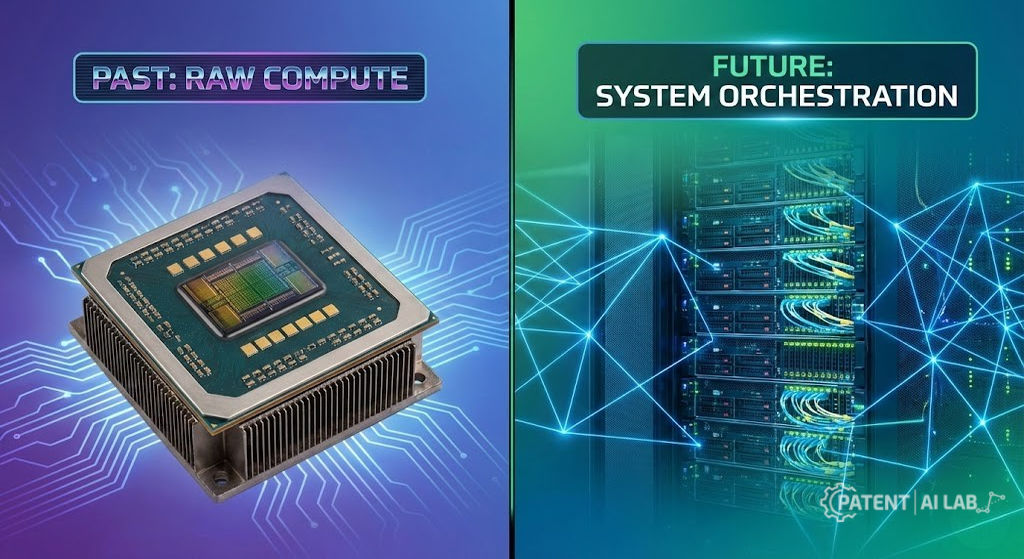
- Strategic Shift: NVIDIA is aggressively shifting patent filings from “raw compute” (speed) to “system orchestration”. They are essentially moving the goalposts from building the fastest chip to owning the entire data center network.
- System-Level Protection: This new phase of NVIDIA’s patent strategy aims to create a legal fortress around the entire system (like the Blackwell GB200 NVL72), making it nearly impossible for competitors to simply swap out an NVIDIA GPU for an AMD one.
- Declining “Speed” Claims: Recent filing trends show a noticeable flattening in patents for single-chip arithmetic speed. NVIDIA signals that raw teraflops are becoming a commodity; the real margin is now in the interconnect (NVLink).
- Edge AI Risks: This strategy bets big on centralized cloud computing. The primary risk? A rapid market shift toward decentralized On-Device AI (NPUs), where heavy processing moves from NVIDIA’s servers to user devices.
The Core Analysis
Market analysis often focuses heavily on NVIDIA’s chip speeds. However, evaluating NVIDIA’s patent strategy reveals a different trajectory. The firm is adjusting its primary focus from building faster individual chips to securing legal protection across the entire data center architecture.
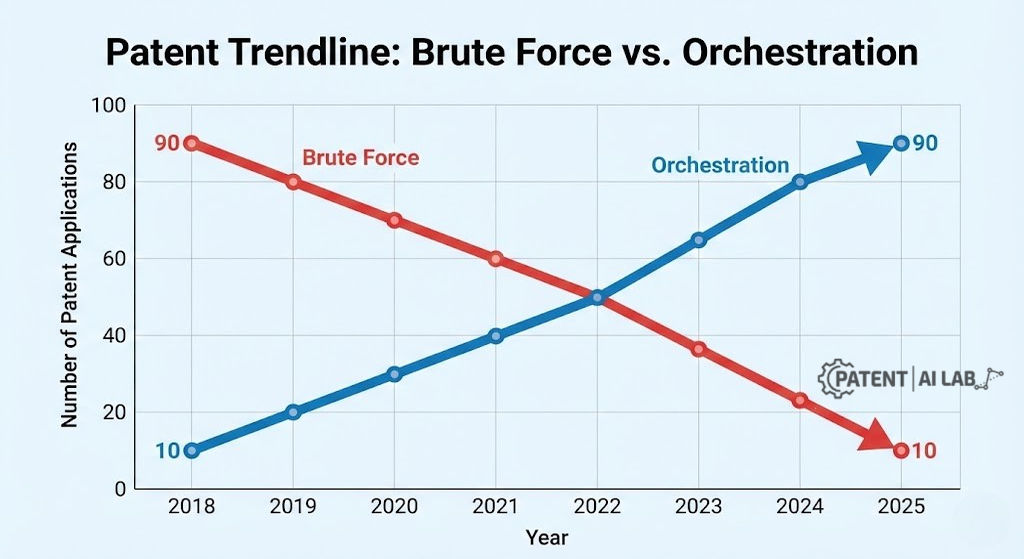
The Signal: We observed a distinct decline in patents for raw compute (brute force speed) and a rapid increase in system-level orchestration claims.
The Implication: NVIDIA is betting that future margins will not come from the chip itself, but from how the chip talks to the rest of the data center.
The Technical Shift
Recent filings show a clear departure from traditional performance claims. The focus has moved to the “connective tissue” of the data center.
- Fading: Claims for raw execution units and single-chip speed.
- Rising: Coordination logic, scheduling between GPU clusters, memory coherency across accelerators, and workload-aware power gating.
This transition is evident in the shift from Hopper to the Blackwell (B200) architecture, and continues into the projected 2026 ‘Rubin’ (R100) platform utilizing NVLink 6 technology. NVIDIA’s patent strategy now emphasizes securing optical interconnects and packaging methods (such as TSMC’s CoWoS) to maximize bandwidth. This builds a physical hardware advantage to complement their CUDA software platform. The engineering objective is connecting multiple GPUs to function as a unified processor via next-gen NVLink switches.
This move to control the entire system stack is a direct response to major cloud providers building their own custom silicon and infrastructure, a battleground we explored in Google AI Patent Portfolio vs Microsoft : What I Learned Auditing Real GenAI Claims.
Patent Filing Trend Analysis
Analyzing post-2022 filings provides a clear view of NVIDIA’s patent strategy and exactly where the firm allocates its legal budget. The data reveals a departure from traditional performance metrics toward data center integration.
Raw Compute
FlatteningDefensive / Legacy
Competitor Chipmakers
Orchestration
Rapidly RisingBlocking / Forward-looking
Cloud Deployers & Integrators
Interconnect
Steady GrowthSystem Lock-in
System Architects
Quick Trend Snapshot
- 📉 Decreasing: Patents for single-chip arithmetic speed.
- 📈 Exploding: Patents for multi-chip orchestration, power gating, and NVLink communication.
Market Vulnerabilities
This specific execution of NVIDIA’s patent strategy carries conditional risks. The intellectual property framework assumes large-scale, multi-accelerator AI systems will remain the dominant industry standard for the foreseeable future.
If the market pivots toward “Edge AI” featuring specialized, standalone accelerators, orchestration-heavy patents lose utility. Additionally, system-level patents present enforcement challenges, often requiring proof of how a customer operates their private server farm rather than simply analyzing a competitor’s chip.
The primary threat is not another cloud competitor; it is the rise of efficient NPUs (Neural Processing Units) in consumer edge devices. If AI processing shifts from centralized cloud servers to local smartphones and laptops, NVIDIA’s massive data center patents become less critical. This transition toward local hardware is the core battleground driving the current ecosystem, a dynamic we analyzed in Apple Intelligence vs. Google Gemini: The Battle for Your Data & Privacy.
Methodology
To reach these conclusions, we bypassed marketing abstracts and analyzed post-2022 architectural filings using three specific signals:
Claim Dependency Depth: Differentiating between specific hardware implementations and broad conceptual filings.
Continuation Frequency: Identifying the technological areas where the firm is aggressively filing secondary applications to solidify logic.
Constraint Targets: Analyzing whether the claims are designed to block competing chip manufacturers or system integrators.
Assess patent volumes as strategic indicators rather than quantitative scoreboards. To accurately interpret NVIDIA’s patent strategy, monitor the specific technological categories where filing frequency decreases. These purposeful omissions indicate exactly where the firm anticipates future hardware commoditization.
Podcast
This automated audio brief outlines the primary data, analysis, and strategic insights covered in this guide.
FAQ: NVIDIA’s Patent Strategy 2026
Is NVIDIA stopping development of faster chips?
No. The decline in “raw compute” patents does not indicate NVIDIA has stopped engineering faster GPUs. It signals their assessment that raw speed is becoming a commodity that is harder to defend legally. They are shifting their IP protection to the system level (how chips communicate), as they project long-term profit margins lie in orchestration, even if competitors match their raw teraflops.
Why are “orchestration” patents harder to enforce?
To prove someone infringed on a chip patent, you can just buy their chip and look at it under a microscope. To prove someone infringed on an “orchestration” patent (e.g., how a data center manages power across 1,000 GPUs), you often need evidence of how the customer operates their private server farm. This opacity makes litigation much more difficult and expensive.
What is the “Edge AI” risk mentioned in the bear case?
NVIDIA’s current patent strategy protects massive, interconnected data center systems. If the AI market shifts toward running models on local devices (phones, laptops, cars) using smaller, standalone chips (“Edge AI”), NVIDIA’s new “orchestration” patents become less relevant. They would be holding the keys to a castle while everyone else is building cottages.
Does this analysis include CUDA software patents?
This specific analysis focuses on hardware architecture and system logic filings. While CUDA remains a massive software moat, the hardware patent trends reveal how NVIDIA plans to lock in customers physically, not just digitally.
Sources and Legal References
The hardware orchestration trends, interconnect infrastructure details, and intellectual property data cited in this analysis are sourced and cross-referenced from official federal databases and primary engineering documents:
-
1. USPTO Patent Public Search Database
The official federal repository used to audit NVIDIA’s post-2022 utility patents, structural continuity frequencies, and orchestration claim patterns.
Access USPTO Public Search -
2. NVIDIA Data Center Architecture Documentation
Official technical specifications confirming the transition toward system-level interconnects and NVLink integration cited in the analysis.
Review NVIDIA Data Center Specifications -
3. TSMC Advanced Packaging (CoWoS) Specifications
Foundry technical data verifying the physical packaging limits and methods necessary for the high-bandwidth multi-chip execution referenced in NVIDIA’s filings.
Verify TSMC Packaging Technology
Disclaimer & Legal Notice
PatentAILab is an independent educational research platform and is not a licensed law firm or financial advisory service. The data, patent analysis, and strategic insights provided in this article are for informational and educational purposes only and do not constitute legal, investment, or business advice. Intellectual property outcomes depend on specific technical facts, jurisdictional laws, and drafting execution. Always consult a certified patent attorney and a qualified financial advisor before making IP filing or venture capital investment decisions.





[…] While Apple focuses on privacy-first consumer AI, other tech giants are playing a different game. See how chipmakers are shifting their focus in our analysis of Nvidia’s Patent Strategy 2025. […]