


 Golam Rabiul Alam, PhD
The Unvarnished Truth About the Best AI Patent Valuation Tools, The “Hidden Cost” of Free Data, and How to Calculate Patent Value Yourself Without Getting Laughed Out of the Boardroom.
At A Glance: Patent Valuation
If you are currently Googling “how much is my patent worth calculator” hoping for a quick answer, pause. While AI patent valuation tools have evolved significantly by 2026, relying on a free patent valuation calculator for a fundraising deck or licensing negotiation is financially dangerous.
Most of these tools output a number that is “directionally interesting” but lacks the three pillars of defensible valuation:
- Enforceability risk (Section 101/102 analysis)
- Real-world market comparables
- Deal-context data
A defensible valuation comes from a proven method (Income/Market/Cost) supported by evidence, not a black box algorithm.
Key Takeaways
- The Variance Trap: Free calculators often produce massive valuation gaps (e.g., $5k vs $1M) because they guess the hardest inputs: royalty rates and market capture.
- “AI” isn’t Magic: Most patent value estimator AI is simply pattern scoring and citation benchmarking, not a predictive financial model.
- The Legal Landmine: A valuation that ignores 35 U.S.C. §101 risk (especially for software/AI) is fundamentally flawed. If you can’t enforce it, it’s worth $0.
- The “Hidden Cost”: Uploading your patent number into a free patent value calculator online often triggers a sales funnel. Your data is the product.
- The Best Approach: If you must DIY, use a comparable-market anchor (real license deals) plus a risk-adjusted DCF.

The Black Magic of IP: Why Patent Valuation is So Hard
You have probably searched for “Best AI patent valuation tools” because you need a number. Maybe investors are asking for your IP assets’ value, or you are trying to sell a dormant patent.
Patent attorneys call patent valuation “black magic.” Why? Because a patent doesn’t have a price tag like a house or a used car. A house has “comps” on the same street. A patent is a negative right: it is the right to stop others from doing something. Its value is entirely hypothetical until someone actually wants to do what you are prohibiting.
In 2026, the complexity has only increased. The Patent valuation methods for startups have shifted from simple cost-based models to complex, risk-adjusted algorithms. Even the European Patent Office is focusing on algorithmic valuation with their CodeFest 2026 challenge, proving that AI valuation is the future standard.
The Three “Unknowns” That Drive Price
If you hire a consultant for $20,000, they aren’t just doing math. They are assessing these three critical variables that free tools ignore:
- Enforceability Risk (The Legal Filter):
Can you actually keep the patent alive? If you sue a competitor, will they invalidate your patent at the PTAB (Patent Trial and Appeal Board)? For AI and software, the USPTO’s subject matter eligibility framework is a massive hurdle. If your claims are deemed an “abstract idea,” the value is zero. Automated tools rarely read the claims deep enough to catch this. - Commercial Fit (The Market Filter):
A bulletproof patent in a dead market is worthless. Technology Readiness Level (TRL) matters. A patent on a fusion reactor concept (TRL 2) is worth less today than a patent on a slightly better coffee cup lid (TRL 9), simply because the coffee lid has an immediate, addressable market.
For instance, supply chain dominance can double a patent’s value, a phenomenon we proved in our analysis of the Tesla vs China Robot War. - Deal Reality (The Buyer Filter):
Patents rarely sell for what the inventor thinks they “deserve.” They sell for what a buyer can justify to their CFO. This is where Comparable market transactions come in—data that is almost always behind a paywall.
The Variance Problem: Human Expert vs. Free AI Tools
Let’s look at a concrete, real-world scenario. We ran a hypothetical granted US patent (let’s say, a software optimization for battery life) through three different free patent valuation calculators and then asked an expert IP strategist to value it based on current litigation trends.
The results expose the danger of relying on automated IP valuation software without human oversight.
Accuracy Test Table (Human vs AI)
| Valuation Source | Output Value | What it’s really doing (The Algorithm’s Logic) |
| Expert Attorney | $50,000 | Heavily discounts for narrow claim scope, high §101 invalidity risk, and lack of current market adoption. Uses Risk-adjusted net present value (rNPV). |
| Free AI Tool #1 | $1,000,000 | Assumes optimistic revenue capture (5%) + standard royalty (3%) + ignores invalidity risk. Often uses a simple “Cost Plus” or generic income model. |
| Free AI Tool #2 | $200,000 | Uses generic industry averages; assumes the patent is “valid” because it is granted. Ignores the fact that competitors have already designed around it. |
| Free AI Tool #3 | $5,000 | Penalizes heavily because the patent is young (low forward citations) and treats it as an unproven asset. |
The Visual Reality:
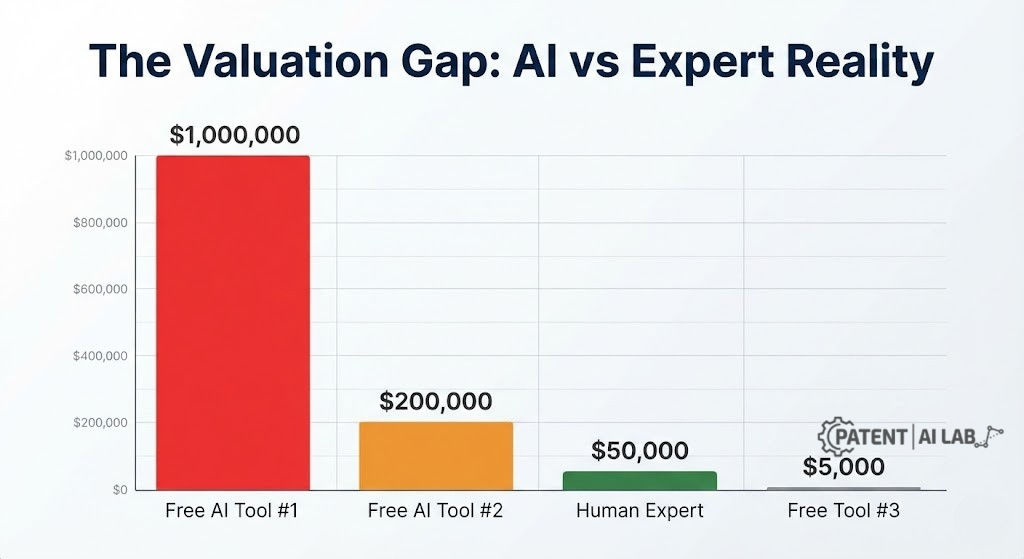
$1,000,000 | ████████      Free Tool #1 (The "Ego Boost")
  $200,000 | ███           Free Tool #2 (The "Average")
   $50,000 | █             Expert Human (The "Reality Check")
    $5,000 | ▏            Free Tool #3 (The "Lowball")
Analysis:
The tools aren’t “broken.” They are just blind. Tool #1 sees a massive market size for “Battery Software” ($50 Billion) and applies a tiny percentage. The Expert sees that the independent claim requires a specific type of sensor that nobody uses anymore. Automated IP valuation software cannot read claims like a litigator.
What Free Calculators Miss: The Input Factors Checklist
Before you trust a free patent value calculator online, you need to know what it doesn’t know. Most tools ask for your patent number and industry. That is not enough to determine Intangible asset pricing.
The “Blind Spot” Checklist
Use this as a pre-flight list. If the tool doesn’t ask for these, the output is a guess.
- [ ] Claim Scope Reality: Does the patent cover the entire product or just a tiny feature? (e.g., The whole smartphone vs. the shape of the volume button). This dramatically affects the Royalty base.
- [ ] §101 Risk (AI/Software): Is the invention a practical technical improvement or an abstract idea? This is the #1 killer of software patent value in 2026.
- [ ] Competitor Litigation History: Does the likely buyer (e.g., Apple or Google) settle lawsuits, or do they fight to the death? IP litigation damage calculation tools usually factor this in; free tools do not.
Real-world litigation destroys theoretical value. We analyzed how legal battles impact IP worth in our deep dive on Neuralink vs. Meta: The ‘Mind Control’ Patent War. - [ ] Design-Around Cost: If you demand a $1M license, can the competitor spend $50k to change their code and ignore you? If yes, your patent is worth $50k max.
- [ ] Remaining Term: A patent expiring in 2 years is worth a fraction of one expiring in 15 years.
- [ ] Technology Readiness Level (TRL): Is this a prototype or a shipping product?
- [ ] Evidence of Adoption: Are there sales, pilot programs, or reverse engineering teardowns proving infringement?
The “Hidden Cost” Analysis: Privacy and Upsells
⚠️ Warning: Read This Before Uploading Your Patent Number
Many “free” tools ask for your patent number, email, and company info. Before you submit, read the privacy policy and marketing consent language.
Assume any details you enter can be:
- Stored in third-party databases
- Profiled for lead generation
- Used for unsolicited sales outreach
Note: The USPTO has separately warned practitioners to manage confidentiality and other risks when using AI-based tools.
“Free” is rarely free. When you type your patent number and email into a patent value estimator AI, you are entering a sales funnel. This is the “Hidden Cost” of free data.
Flowchart: The Data Trade-Off
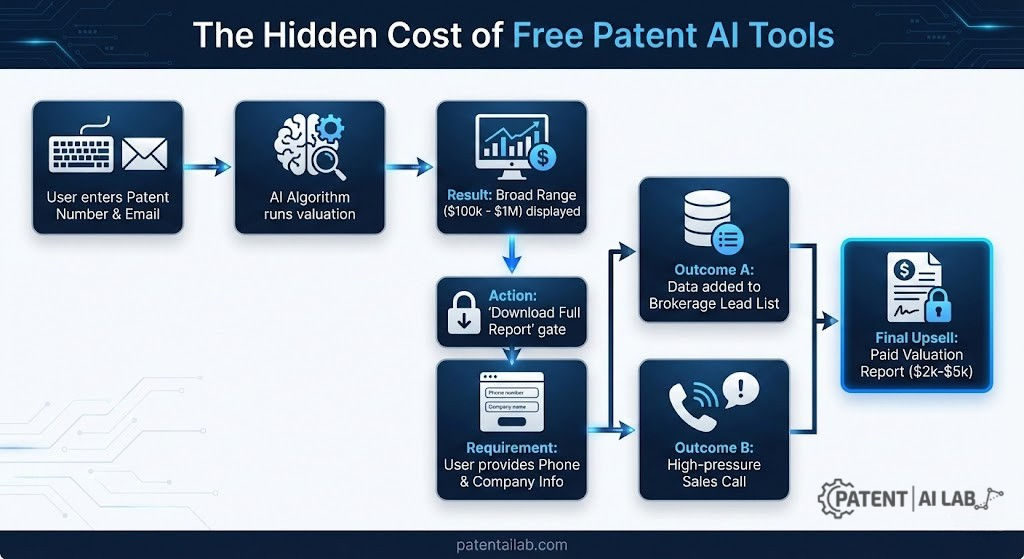
graph TD
    A[User Enters Patent Number + Email] --> B{Algorithm Runs};
    B --> C[Tool Outputs Broad Value Range ($100k - $1M)];
    C --> D[Gate: 'Download Full Report' to see details];
    D --> E[User Provides Phone/Company Info];
    E --> F[Data Added to Brokerage Lead List];
    F --> G[Sales Call: 'We noticed you have a valuable patent...'];
    F --> H[Upsell: Paid Valuation Report ($2k-$5k)];
The Reality:
This business model isn’t unethical—companies need to make money. But you must be aware of it. If you are working on a stealth startup or a sensitive acquisition, putting your patent list into a third-party lead generation tool is a security risk. Your “search” tells them exactly what you are working on.
The Tools That Matter in 2026 (Detailed Review)
If you are looking for the best AI patent valuation tools, you need to distinguish between “Toys” (Lead gen tools) and “Power Tools” (Professional Analytics).
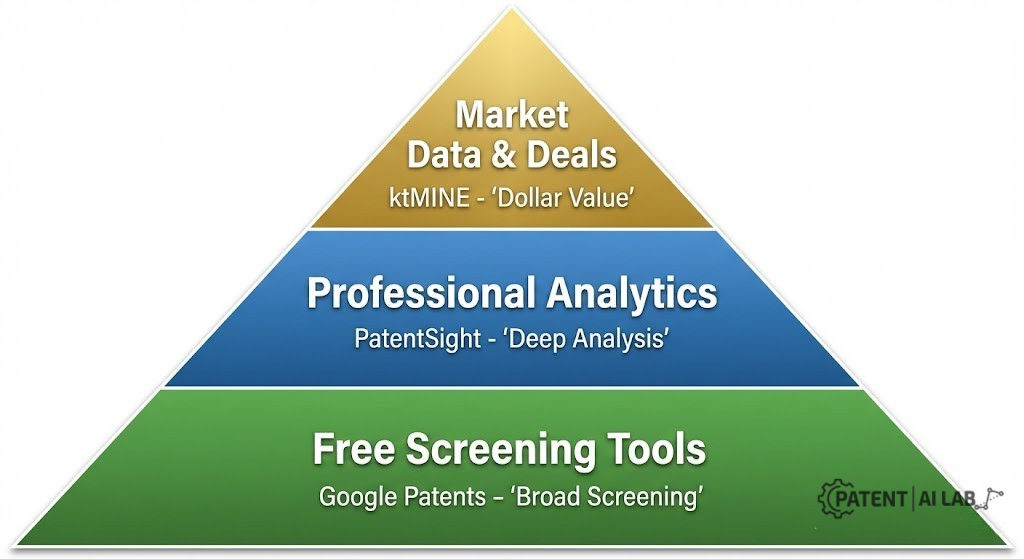
Tier 1: Free / Low-Cost (Screening Only)
- Google Patents (Citations): Not a dollar value, but the “forward citation” count is the rawest proxy for industry interest. If your patent is cited by Apple, Microsoft, and Samsung, it has attention.
- LetsPrototype / TPA Global: These offer quick, user-input-driven estimates. Good for learning how different variables (like market size) change the output.
- Use Case: Internal brainstorming, checking if a patent is “junk” or “potentially interesting.”
Tier 2: Professional Analytics (The Real Deal)
- LexisNexis PatentSight: Uses the “Patent Asset Index.” It doesn’t give you a dollar sign; it gives you a “Technology Relevance” score based on how often other companies build on your tech. This is patent portfolio analytics at a high level.
- Clarivate Derwent Innovation: Heavy-duty search and analytics used by Fortune 500s to determine IP litigation damage calculation tools and landscape strength.
- Use Case: M&A due diligence, portfolio pruning (deciding which patents to abandon), competitor benchmarking.
Tier 3: The Market Data Anchors (Essential for Valuation)
- ktMINE / RoyaltyRange / RoyaltyStat: These are databases of real license agreements. They won’t “value” your patent, but they tell you that “Similar patents in Cloud Computing licensed for 3.5% royalty in 2024.”
- Use Case: Building the Comparable market transactions argument for a detailed valuation report.
How to Calculate Patent Value Yourself (The DIY Method)
If you don’t have $10,000 for a consultant, you can do this yourself. The method below is what professionals use, stripped of the jargon. It uses the Income Approach (specifically Relief-from-Royalty) combined with Risk-Adjusted Net Present Value (rNPV).
Step 1: Build the Fact Pack
Do not guess. Gather:
- Remaining Life: (20 years from filing date – today).
- Addressable Revenue: Not the “Global AI Market.” The specific revenue of the products that would infringe your claim.
- Claim Chart: A simple list matching your claim elements to a competitor’s product features.
Step 2: Find the “Anchor” (Royalty Rate)
You need a Royalty rate estimation algorithm, or common sense.
- Software/AI: typically 3% – 8% of net sales (depending on how core the feature is).
- Hardware/Consumer Goods: typically 1% – 5%.
- Life Sciences/Pharma: typically 2% – 10%+ (can be much higher).
Tip: Check public SEC filings (10-K exhibits) or tech transfer websites for “comparable licenses.”
Step 3: Run the Numbers (The DCF Model)
You are calculating: How much royalty would I pay if I didn’t own this?
The Formula:
Value = (Projected Revenue × Royalty Rate × (1 - Tax Rate)) / (1 + Discount Rate)^Years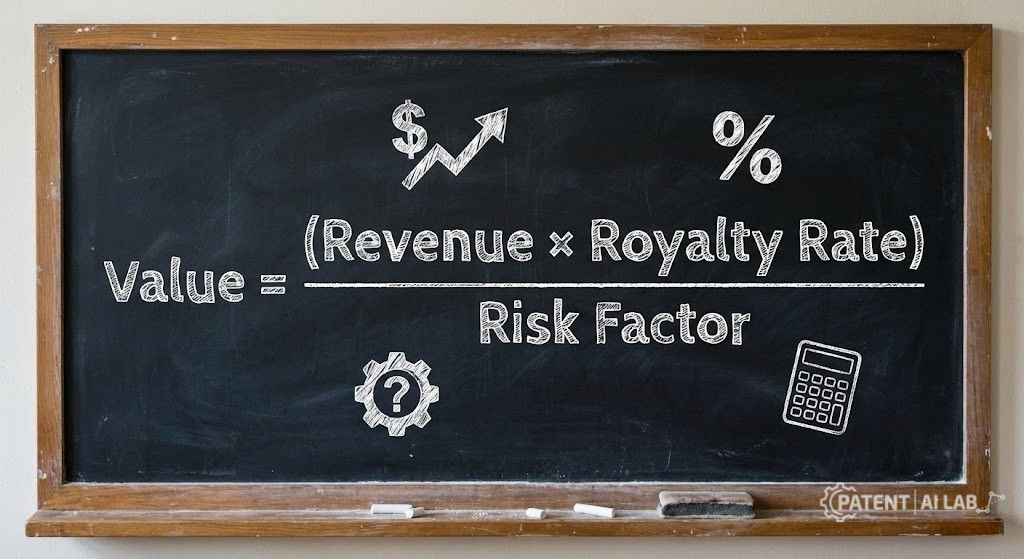
📊 Interactive Patent Valuation Calculator (rNPV)
Adjust the sliders below to estimate the 5-year risk-adjusted Net Present Value based on the DCF method.
(25% – 40% is standard for early-stage tech)
Estimated Risk-Adjusted Value
*This is an educational estimate, not legal or financial advice.
💻 Simple Python Logic for DIYers
You can run this logic in Excel or Python. This is a basic implementation of Discounted Cash Flow (DCF) analysis.
def calculate_patent_value(revenue_forecast, royalty_rate, discount_rate, risk_probability):
    """
    revenue_forecast: List of projected revenue for remaining years
    royalty_rate: e.g., 0.03 for 3%
    discount_rate: e.g., 0.25 (25% is standard for IP risk, much higher than Real Estate)
    risk_probability: 0.0 to 1.0 (Chance of surviving court/market)
    """
    net_present_value = 0.0

    for year, revenue in enumerate(revenue_forecast, 1):
        # Calculate Royalty Savings (The Cash Flow)
        cash_flow = revenue * royalty_rate

        # Discount back to today (Time Value of Money)
        discounted_cash = cash_flow / ((1 + discount_rate) ** year)
        net_present_value += discounted_cash

    # Apply the "Real World" Risk Adjustment (rNPV)
    final_value = net_present_value * risk_probability
    return final_value

# Example Scenario:
# 5 years of growing revenue, 3% royalty, 25% discount rate (High Risk), 50% chance of success
revs = [2000000, 2500000, 3000000, 3500000, 4000000]
value = calculate_patent_value(revs, 0.03, 0.25, 0.50)
print(f"Estimated Risk-Adjusted Value: ${value:,.2f}")
Note: This code provides a baseline estimate based on the Discounted Cash Flow (DCF) model. Always consult a certified valuation analyst (CVA) for deal-critical numbers.
Step 4: The Sensitivity Table (Crucial)
Never present one number. Present a matrix. This is what makes you look like a pro.
- Conservative: 1% Royalty, 10% Market Share, 60% Enforceability Risk.
- Base Case: 3% Royalty, 20% Market Share, 50% Enforceability Risk.
- Aggressive: 5% Royalty, 30% Market Share, 40% Enforceability Risk.
Investors respect a range. They laugh at a single, confident number because they know the future is uncertain.
The Legal Reality Check: USPTO & AI in 2026
You cannot value a patent in 2026 without understanding the current legal climate. The Cost vs Market approach in AI valuation is heavily influenced by whether the patent is actually valid.
The USPTO AI Guidance (2024-2026 Context)
Effective July 2024, the USPTO updated its guidance on Subject Matter Eligibility. This is critical for software patent valuation multiples.
- The Framework: Does the claim integrate the "abstract idea" into a practical application?
- The Impact: If your patent describes "Using AI to calculate a loan score," it is likely worthless (ineligible). If it describes "A specific technical improvement to the way a neural network processes memory," it is high value.
- Valuation Adjustment: If your claims are generic "Do it on a computer" claims, you must discount your valuation by 70-90% to account for the high probability of invalidation under Section 101.
Inventorship Risks
Recent guidance confirms that only natural persons can be inventors. If you used generative AI to conceive the core idea of your patent and failed to disclose it, the patent could be unenforceable. A buyer will dig into this during due diligence. If your "inventor" log shows ChatGPT did the heavy lifting, your asset value might be $0.
Industry Benchmarks: Royalty Rates (Reference Data)
One of the biggest questions is, "What royalty rate should I use?" Here are general industry benchmarks used in royalty rate estimation algorithms:
| Industry | Typical Royalty Rate (Net Sales) | Valuation Multiples (Approx) |
| Software / SaaS | 5% - 15% | 3x - 5x Revenue |
| Consumer Electronics | 1% - 3% | 1x - 2x Revenue |
| Automotive | 0.5% - 2% | Volume-based (Per Unit) |
| Pharma / BioTech | 5% - 20%+ | High multiples of Peak Sales |
| Medical Devices | 3% - 7% | 2x - 4x Revenue |
Note: These are averages. A standard-essential patent (SEP) might command less per unit but have huge volume, while a monopoly drug patent commands huge rates.
Verdict: Best Path for Startups & Inventors
So, can free calculators be trusted?
No. Not for the final number. But they are useful for learning the mechanics.
Your Recommended Workflow:
- Screening: Use a free patent valuation calculator (like LetsPrototype) to get a baseline and understand the variables.
- Analysis: Use patent portfolio analytics (like PatentSight or just rigorous Google Patents research) to check citations and competitor activity.
- Valuation: Perform a DIY calculation using the Discounted Cash Flow (DCF) method shown above.
- Validation: If the number is central to a funding round or M&A deal, hire a professional to run a comparable market transactions search.
Patent valuation is an art supported by data. Do not let an algorithm tell you what your life's work is worth without checking the math yourself.
📚 Sources, Data Anchors & Legal Frameworks
- 35 U.S.C. § 101 (Alice/Mayo Standard): USPTO guidelines for software and AI subject matter eligibility analysis.
- USPTO Guidance (July 2024 Update): Current framework for AI-assisted inventions and natural person inventorship requirements.
- European Patent Office (EPO): CodeFest 2026 insights regarding algorithmic patent valuation and technical benchmarks.
- LexisNexis PatentSight: Global Patent Asset Index used for technology relevance and portfolio analytics.
- ktMINE / RoyaltyRange: Industry-standard databases for Comparable Market Transactions and real-world royalty rate benchmarks.
- PTAB (Patent Trial and Appeal Board): Recent litigation trends and validity data for risk-adjusted rNPV calculations.
- 35 U.S.C. § 102: Statutory framework for novelty and prior art analysis in Intellectual Property worth estimation.
Podcast
Disclaimer
This article is based on our team's experience advising startups, product development, and tracking IP litigation. Tools and legal interpretations change over time. Please note that PatentAILab is an educational platform and not a law firm. This content is for educational purposes only and does not constitute legal advice. Intellectual property laws (especially regarding AI) are complex and change frequently. Always consult a qualified patent attorney for your specific situation.
FAQs (People Also Ask)
What is the most accurate way to value a patent?
The most defensible approach is the Income Approach (specifically Relief-from-Royalty) combined with a Market Approach anchor. You forecast the revenue the patent protects, apply a royalty rate derived from comparable license deals, and discount for risk (rNPV).
How much does a professional patent valuation cost?
A "Certified Patent Valuation" from a firm typically costs between $15,000 and $40,000. Lighter "valuation opinion" letters may cost $5,000 to $10,000.
Why do free tools give such different values?
Because they guess the "inputs" that matter most. Small changes in the Royalty Rate (e.g., 2% vs 5%) or Discount Rate (20% vs 40%) can change the final value by millions of dollars.
How does USPTO eligibility affect patent value?
If a patent (especially AI/Software) has a high risk of being invalidated under 35 U.S.C. §101 (Alice/Mayo test), buyers will heavily discount the price. A patent is only worth what you can enforce.
What is the "Cost Approach" in valuation?
This method asks, "How much would it cost to reinvent this?" It is often used for early-stage technology or internal software but usually undervalues high-potential IP because it ignores future profit potential.
Can I use AI to write my valuation report?
Yes, you can use LLMs to structure the memo or find general royalty ranges, but do not input confidential data. Use the prompt template provided in the "DIY" section to generate a professional-looking summary of your own math.




[…] Acquisition Blocks: A Tier-1 tech acquirer (Google/Apple) refuses to buy a startup because the core model license (e.g., LLaMA Community) has a “poison pill” clause triggering at scale.A bad license doesn’t just block a sale; it destroys your IP valuation. Before you pitch to investors, make sure you aren’t overvaluing your assets—check our guide on Best AI Patent Valuation Tools 2026: Can Free Calculators Be Trusted? […]