


 Golam Rabiul Alam, PhD
Rivals pitch loud AI chatbots. New data exposes secret Apple On-Device AI Patents moving to production. Apple builds silent hardware moats instead. They quietly lock down the future of local iOS computing. If you build mobile apps, this silent strategy changes your runtime environment completely.
At A Glance
Apple’s latest iOS release deploys advanced hardware-centric machine learning structures. By tracking underlying USPTO filings, we isolate five core patent vectors that secretly alter your app runtime environment.
5 Core Patent Themes Monitored:
- Local Models: Secure generative inference without cloud network dependency.
- Context Automation: Intent prediction and pre-loading actions across apps.
- Federated Privacy: Decentralized device training using mathematical noise.
- App Orchestration: Semantic intelligence layers running workflow loops without APIs.
- Adaptive Scaling: Dynamic model token distribution mapped to silicon power.
How Apple Uses Patents to Shape iOS
Apple patents do not guarantee immediate features. Under USPTO rules, a patent must protect a concrete technical implementation, not just an abstract concept. Apple files broadly to build a defensive legal perimeter, then selectively deploys technology to production.
According to the official MPEP Section 2106 subject matter eligibility standards, software claims must improve the underlying computer functionality. Abstract AI models without hardware integration face quick rejections. Active Apple On-Device AI Patents clear this strict legal bar.
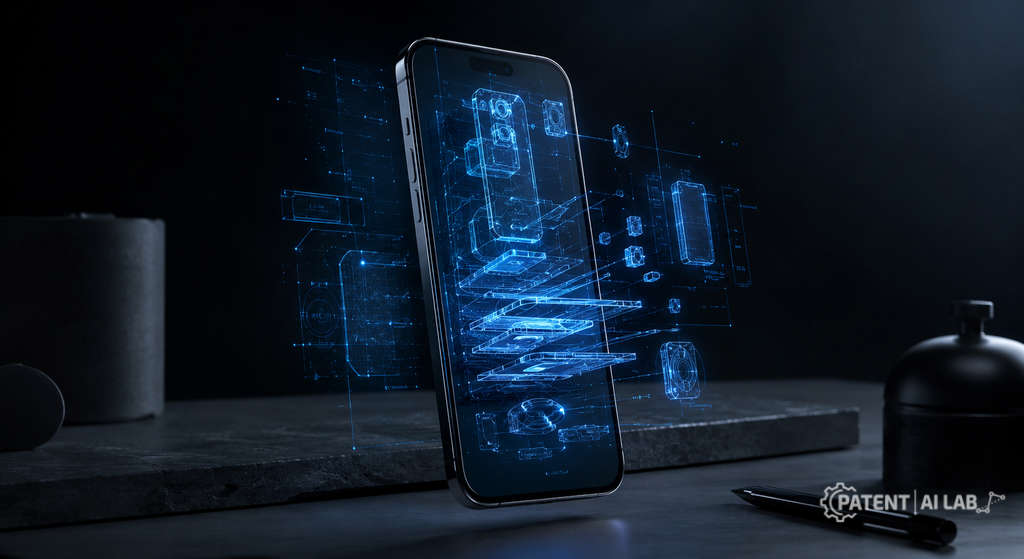
Local Generative Inference Architecture
Recent Apple On-Device AI Patents cover systems where generative models run on local hardware. These setups adapt text and images without sending raw user data to cloud networks.
The Legal and Technical Improvement Framework
From a USPTO perspective, this avoids the abstract software trap. Apple anchors its claims to a hardware-software co-optimized computing system. This clear tie to concrete system behavior ensures protection under active examination rules.
let prompt = "Summarize my last meeting notes"
let output = LocalAIGenerator.generate(prompt, privacyMode: .onDeviceOnly)
This code pattern demonstrates zero network dependencies. The system locks processing within the local chip boundary. It splits data shards across isolated memory segments, bypassing standard CPU wait times and completely eliminating cloud API latency.
Context-Aware iOS Automation Beyond Shortcuts
New Apple On-Device AI Patents outline background automation frameworks. These systems observe user habits, predict intent across apps, and trigger tasks without explicit commands.
The system clears eligibility checks because it lowers resource consumption. Pre-loading data nodes based on predictive habits stabilizes memory cycles. This directly improves device-level operational efficiency.
if user.opens(App.Calendar) after App.Mail:
    preload(MeetingNotes)
Federated Learning With Private Behavior Models
Decentralized model optimization highlights key Apple On-Device AI Patents like US12052315B2. This setup trains transformer blocks across millions of devices. Personal data stays safe on your hardware.
The integration of mathematical differential noise during the global parameter update phase protects user identity. This gives the ecosystem a deep defensive regulatory moat against modern compliance laws.
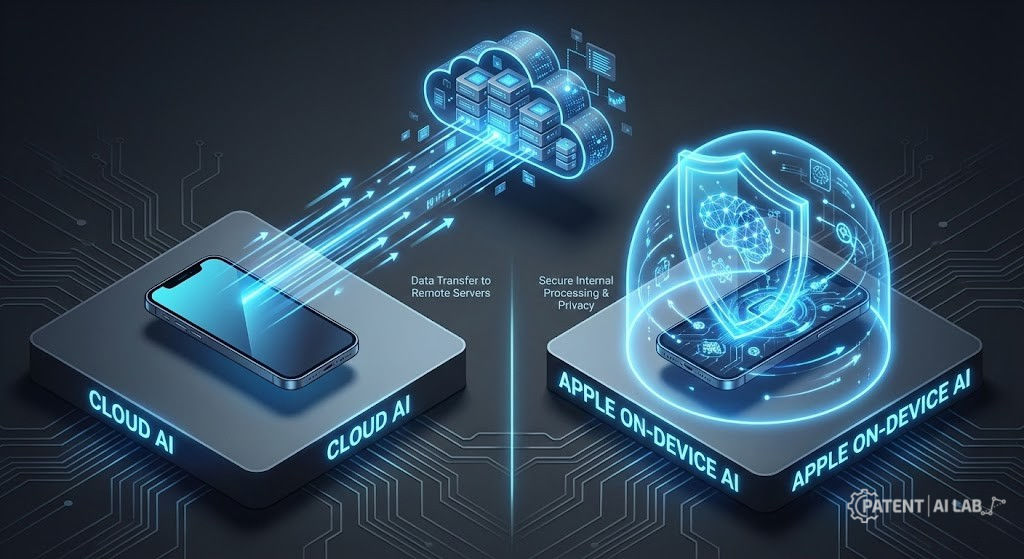
Cross-App Semantic Intelligence Layers
New Apple On-Device AI Patents describe a secure internal orchestration layer. This layer reads semantic data across apps and translates data formats without third-party APIs.
For example, if you copy a receipt image, the platform extracts raw billing nodes, matches financial rows inside target spreadsheets, and formats text briefs for email drafts without requiring explicit user code scripts.
Hardware-Adaptive Model Scaling Nodes
Core Apple On-Device AI Patents focus on scaling model depths based on chip power. The same OS deployment alters token distributions to protect local thermal baselines.
Older devices run light, compressed weights. New platforms use parallel pipelines on A19 and M5 chips. This structure supports deep background inference actions safely.
Decoding Apple On-Device AI Patents vs iOS Features
Patent Architecture Matrix
Target Environment: iOS Core LayerOn-device generative AI models
Context-aware system automation
Decentralized private federated learning
App intelligence & orchestration layer
Hardware-adaptive machine learning
Real-World Implications by Audience
For Developers
Expect fewer public APIs from Apple. More intelligence will run directly at the OS level. You will have less control but get better automation tools as Apple deploys these Apple On-Device AI Patents.
For Startup Founders
Competing with iOS core features is now harder. Do not build basic AI wrappers. Your vertical apps need clear and unique technical features to survive. Analyze these active Apple On-Device AI Patents before building your software models.
For Patent Attorneys
Apple files broad, defensive patents. This increases lawsuit risks for software with similar setups. Always audit claim boundaries before shipping system updates.
For Investors
Apple reduces big server dependency risks. Local machine learning cuts hardware operating costs. This shift improves long-term profit margins across the ecosystem.
Future Outlook: Apple’s AI Direction (2026–2028)
Analyzing the core Apple On-Device AI Patents provides a clear view of their hardware pipeline. In 2026, iOS integrates deeply with advanced silicon nodes, moving operations entirely away from core CPU runtimes.
Strategic Roadmap Matrix
Timeline Horizon: 2026–2028Patent velocity maps out Apple’s next deployment pipeline. In 2026, iOS integrates deeply with advanced silicon nodes, moving operations entirely away from core CPU runtimes.
What Apple Will Deploy:
- Offline Assistants: Devices process fully autonomous task chains inside local partitions.
- Isolated NPU Allocation: Future updates dedicate specific Neural Engine blocks to background OS-level orchestration.
- Zero-Data-Leak Personalization: Personal transformers adapt output behaviors locally with zero server touchpoints.
What Apple Will Restrict:
- Proprietary Model Weights: Apple protects core neural layers inside closed-source enterprise vaults.
- Masked Logic Layer: The operating platform blocks raw ecosystem intelligence APIs from rival developer networks.
Check our guide on VR tech: Apple’s New VR Patent: What It Reveals About the Future of Vision Pro.
While Apple focuses on privacy-first architecture, other tech giants play a different game. See our full analysis: NVIDIA’s Patent Strategy: The Hidden Pivot from Silicon to System.
Podcast
Note: This audio is a condensed summary. Please refer to the written text for precise legal and compliance definitions.
FAQs
Are these Apple On-Device AI Patents publicly confirmed?
No direct mapping is confirmed. This analysis is based on USPTO filings and observed iOS behavior.
Does Apple use generative AI like ChatGPT?
Yes, but implemented differently. Apple prioritizes on-device inference and privacy.
Can developers access these AI systems?
Limited access. Most intelligence operates below the app layer.
Are these Apple On-Device AI Patents enforceable?
Yes, if claims are tied to specific technical implementations.
How can competitors verify these claims?
Review Apple USPTO filings and analyze iOS system behavior changes across devices.
Sources and Legal References
The system architecture data, silicon performance vectors, and USPTO legal eligibility guidelines analyzed throughout this research briefing are sourced directly from official intellectual property registries and authorized engineering repositories:
-
1. USPTO Subject Matter Eligibility Portal (MPEP 2106)
The primary regulatory framework used by examiners to evaluate software, neural networks, and computer functionality improvements under 35 U.S.C. 101 rules.
Access USPTO Eligibility Guidelines -
2. Apple Machine Learning Research Hub (Local Model Optimization)
Official engineering publications by Apple Core ML teams, validating the runtime deployment of on-device foundation models, low-latency quantization, and Neural Engine parallelisms.
Review Apple ML Engineering Research -
3. Apple Private Federated Learning Documentation (Patent: US12052315B2)
The active utility registry detailing client-device model training with local noise injection algorithms to enforce operational user privacy boundaries.
Search Patent ID US12052315B2 -
4. WIPO Patentscope Global Registry (Cross-App Semantic Orchestration)
The international patent database hosted by the World Intellectual Property Organization, verifying Apple’s defensive multi-jurisdictional filings for zero-API application orchestration lines.
Access WIPO International Patent Index -
5. Federal Register Intellectual Property Directives (89 FR 58128)
The official federal tracking index specifying claim limitations and concrete system interactions required for artificial intelligence software patent grants.
Verify Active Federal Register Entries
Disclaimer & Legal Notice
PatentAILab is an independent educational research platform. The case studies, patent analysis, and strategic insights provided across this platform are intended strictly for informational and educational purposes. They do not constitute formal legal, corporate, or financial advisory services. Intellectual property outcomes depend on dynamic jurisdictional laws and specific technical drafting. Always consult a certified patent attorney before making IP filings or investment decisions.





[…] While NVIDIA bets on massive centralized systems, the industry is simultaneously pushing toward local, on-device processing—a massive shift we detailed in our analysis of Apple’s Secret AI Agenda (2026): On-Device Inference & 5 Hidden Patents. […]
[…] While Meta captures motion and Neuralink captures intent, Apple is quietly building a monopoly on biological context—a strategy we analyzed deeply in our breakdown of Apple’s Secret AI Agenda (2026): On-Device Inference & 5 Hidden Patents. […]