

 Golam Rabiul Alam, PhD
The China vs US AI Patents 2026 Audit
Article at a Glance
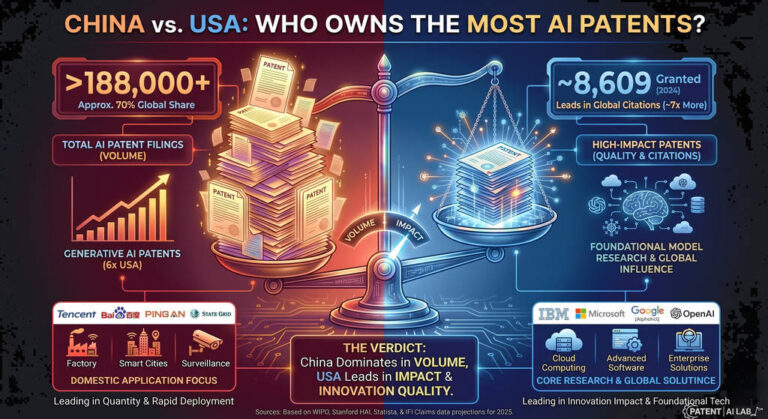
✓ Volume vs. Quality: China commands roughly 70% of global AI patents, leading the U.S. 6-to-1 in generative AI. However, the U.S. maintains an edge in international citations and core research quality.
✓ Strategic Impact: This shifting IP landscape directly impacts VC funding decisions, global tech recruiting, and enterprise supply chain compliance across 2026.
In analyzing the China vs US AI Patents 2026 landscape, a brutal reality emerges about who truly owns the future of artificial intelligence. It is not about the captivating headlines or the latest venture capital fundraising rounds. It is strictly about patent ownership, which serves as the concrete legal proof of who is claiming the architecture of tomorrow. To put it simply, China currently possesses significantly more AI patents overall than the United States, and the gap in generative AI is staggering.
That doesn’t mean the U.S. is irrelevant. This is far from the case. However, you should be aware of the actual figures and their implications for investing, strategy, and tech professions.
China vs US AI Patents 2026: The Core Statistical Baseline
China
(Massive Volume Lead)
United States
(Lower Volume, High Citation)
The Generative AI Gap
Between 2014 and 2023, China filed approximately 38,210 generative AI patents compared to the US’s 6,276. This defines the new baseline for global tech dominance.
These figures show why patent analysts now include “AI patent statistics by country” and “generative AI patent growth by country” in serious assessments of global tech power.
The Real Meaning of the Numbers
Without making any drama, let’s unpack this.
1. In terms of quantity, China leads
By a large amount. China leads the world in both the total number of AI patents and the growth of generative AI patents by country.
2. The United States is stronger in quality
Look behind the numbers. U.S. patents are more frequently filed in foreign jurisdictions and typically receive higher scores in international citations. Quality is still important.
If you want to see how this dynamic plays out across other emerging sectors, check out our deep dive into the top countries ruling the AI and blockchain patent race, which further highlights this ongoing battle between volume and actual innovation.
3. Economics and policy are important
AI inventions are more easily registered for and granted patents in China due to the country’s more lenient patent laws. The American system is more costly, slower, and more stringent.
4. Strategy is influenced by geopolitics
Chinese innovators have been forced to focus on algorithms and applications independent of Western silicon supply due to export restrictions on chips and computing in 2024–2026. Patent filings reflect that change.
This geopolitical shift isn’t just limited to silicon restrictions; in fact, shifting supply chains are a major reason why US tech giants are actively reassessing their IP strategies between India and China.
Visual Insight
Here’s a simple graph description you can build from this data:
(Y-axis: number of patents; X-axis: countries)
This visual makes one thing clear: China isn’t just ahead; it’s dominating in generative AI patent filings. (CNBC)
Why This Is Important to You
Hiring & Recruiting
Companies with large patent portfolios attract elite research talent and capital. China is aggressively leveraging its IP volume to pull top-tier researchers at scale.
Funding Decisions
Venture Capitalists (VCs) and corporate investors are increasingly looking at patent ownership as a primary signal of long-term commercial value and defensibility.
Global Competition
American companies lead in commercial AI products and basic research. However, when it comes to codifying progressive inventions and growing app architectures, China is taking the lead.
Models and revenues are the two main metrics most analysts use when examining AI leadership. That is a critical miscalculation.
Patent ownership dictates a completely different reality: it claims the future architecture. China’s massive patent volume does not automatically mean superior consumer products today, but it signals where global innovation is being codified into legal rights. High quantity may not equal immediate quality, but ignoring this volume is a severe strategic liability.
Practical Takeaways for Real Decisions:
-
Track patent trends quarterly. Look at both filings and grants—grants tell you which patents are actually accepted and legally enforceable.
-
Watch where filings go international. A Chinese or U.S. patent filed in Europe or Japan shows a globally funded strategy.
-
Map patents to your niche. Generative AI isn’t one uniform area. Specific models and processing methods are the real patent targets.
-
Consider patent quality metrics (like citations and international filings), not just raw counts.
Tool Recommendation: To track these quality metrics without burning your budget on expensive enterprise software, you can use AI to do the heavy lifting.
See How Google NotebookLM Handles Patent Analysis →
Podcast
This automated audio brief outlines the primary data, analysis, and strategic insights covered in this guide.
FAQ
Who filed more AI patents in 2026, China or the USA?
By volume, more AI patents are filed and owned by China. In generative AI, the lead is particularly significant.
Do more patents mean better AI technology?
Not always. You need to understand the real numbers and what they mean for investing, strategy, and tech jobs.
Do AI patents matter to startups?
Yes. Patents affect long-term defensibility, partnerships, and investment. If your team is building the tech right now, read our practical guide on whether developers can actually win at patenting AI algorithms to avoid early prior art traps.
Sources and Statistical References
The data and statistics presented in this analysis are derived from global intellectual property organizations and verified financial reporting. You may explore the specific patent volume data and market trends via the following resources:
-
1. WIPO: Patent Landscape Report on Generative AI
The primary United Nations global dataset verifying the 38,210 vs 6,276 Generative AI patent gap between China and the US.
Read Official WIPO Report -
2. SCMP: Chinese Generative AI Patents Top US 6-to-1
In-depth journalistic analysis of the UN data regarding China’s rapid acceleration in machine learning patent filings.
View SCMP Analysis -
3. CNBC: China Leads the Generative AI Patents Race
Market perspective on how Tencent, Baidu, and other Chinese tech giants are dominating the global volume metric.
Read CNBC Financial Report -
4. Global Artificial Intelligence Statistics & Trends
Aggregated industry data points reflecting the broader commercial and structural impact of global AI adoption.
View Industry Dashboard
Disclaimer & Legal Notice
PatentAILab is an independent educational research platform and is not a licensed law firm or financial advisory service. The data, patent analysis, and strategic insights provided in this article are for informational and educational purposes only and do not constitute legal, investment, or business advice. Intellectual property outcomes depend on specific technical facts, jurisdictional laws, and drafting execution. Always consult a certified patent attorney and a qualified financial advisor before making IP filing or venture capital investment decisions.





[…] you want to know China vs. USA: Who Owns the Most AI Patents in 2026? Read this data […]
[…] As you prepare your application, it’s helpful to understand the global landscape. The race for AI dominance is intensifying, and you can see the latest data in our report on China vs. USA: Who Owns the Most AI Patents? […]