


 Golam Rabiul Alam, PhD
Founders deploying agentic AI systems in 2026 face a set of legal questions that standard software development practice does not yet answer well. When an autonomous agent writes, tests, and deploys production code without a human approval step, the familiar assumptions about IP ownership, patent eligibility, and operational liability no longer hold. This article explains the current legal framework — grounded in the November 2025 USPTO guidance, the US Copyright Office’s January 2025 AI report, and the EU AI Act’s August 2026 enforcement wave — and describes the structural controls that reduce exposure.
At A Glance
Under US law, code generated autonomously by an AI agent does not automatically qualify as protectable intellectual property. Copyright and patent rights depend on demonstrable human creative control, documented system design, contractual assignment provisions, and compliance with USPTO inventorship guidance. Founders and deploying companies remain legally responsible for agent actions unless they establish clear human-in-the-loop oversight, IP assignment clauses, and operational risk controls.
Key Takeaways
- AI systems cannot hold IP rights under US or EU law
- Human authorship and inventorship remain legally required
- Greater agent autonomy increases, not reduces, the deploying company’s liability
- Patent eligibility requires human conception of the specific solution, not only final approval
- Contractual assignments, conception documentation, and deployment audit logs are now critical infrastructure
Why Agentic AI Changes the Legal Baseline
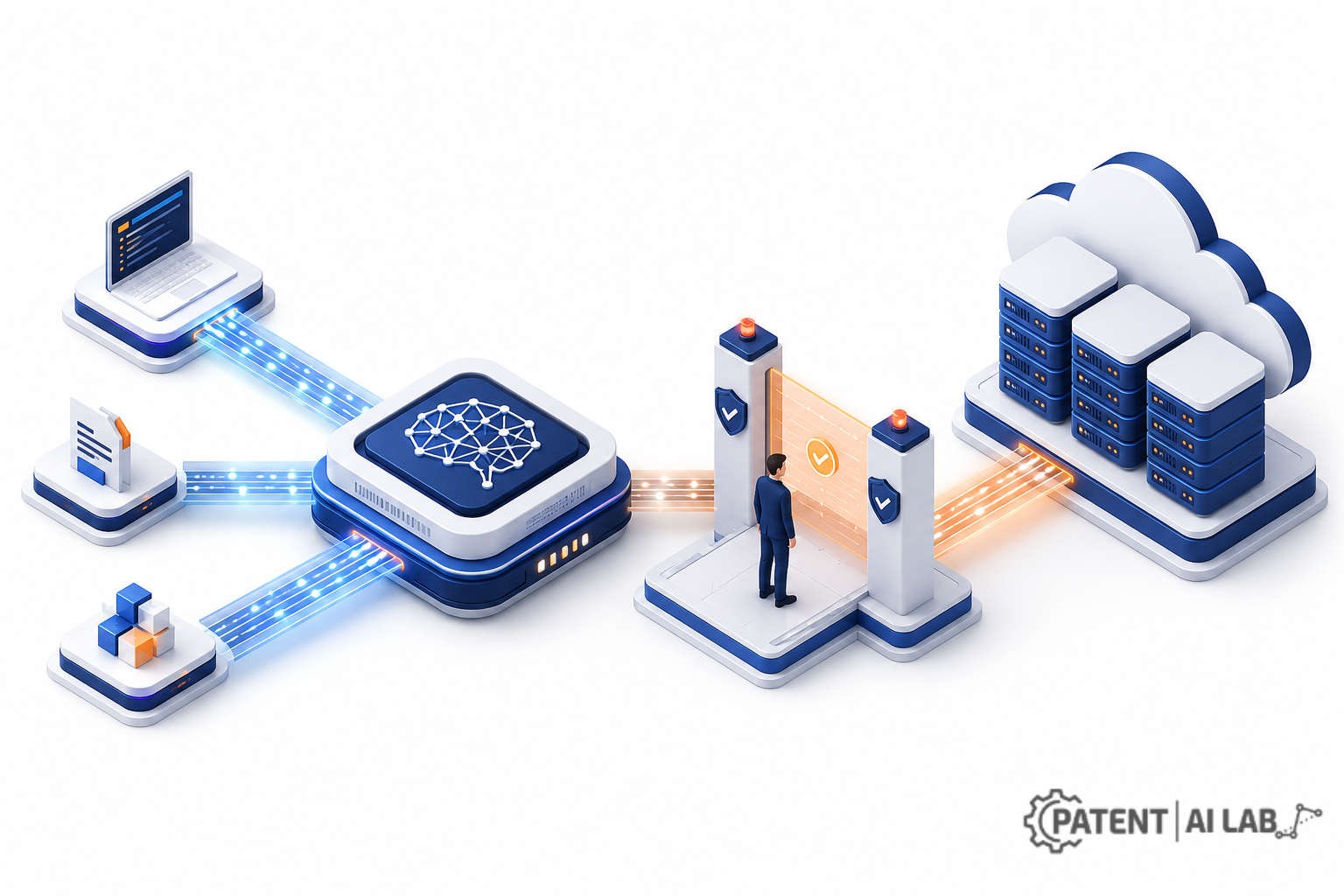
Agentic AI systems differ from generative chatbots in one legally significant way: they plan, decide, and execute without a human approval step at each stage. A traditional chatbot produces output that a human then chooses to use or discard. An agentic system sets sub-goals, chains tool calls, writes code, and may deploy that code to production — all within a single automated loop.
That operational difference creates a practical legal question: when the agent’s output causes harm, or when the founder wants to protect the output as IP, who is the responsible legal actor? US patent law, copyright doctrine, and SaaS liability frameworks were designed around human authors and human decision-makers. The following analysis explains how each area applies to autonomous agent deployments. It reflects technical and engineering analysis from Patent AI Lab and is provided for informational purposes only; it does not constitute legal advice.
⚠️ Contract Shift — Enterprise AI Agreements in 2026
A February 2026 analysis by Mayer Brown found that agentic AI products are pushing enterprise clients beyond the traditional SaaS contracting model toward a hybrid structure that incorporates BPO-style clauses — including broader indemnification for autonomous agent actions, outcome-based SLAs, and governance and audit rights. The firm notes that enterprise clients are seeking indemnification from providers for a broader range of third-party claims “arising from the agent’s autonomous actions in breach of the delegation of authority or the policy guardrails.” Founders who do not update their SaaS agreements to reflect this shift before enterprise negotiations begin are operating with contracts that were not written to govern the risk they are actually creating. Read the Mayer Brown analysis →
Chatbot vs. Agentic AI: Where Liability Differs
Traditional Chatbots:
Respond to individual prompts. The human decides whether and how to use the output. Legal authorship and decision-making responsibility remain clearly with the human user.
Agentic AI Systems:
Set sub-goals autonomously, chain tools and APIs, and execute tasks asynchronously without real-time human approval. The further the agent acts from its original human instruction, the harder it becomes to establish legal authorship and to assign fault for specific actions.
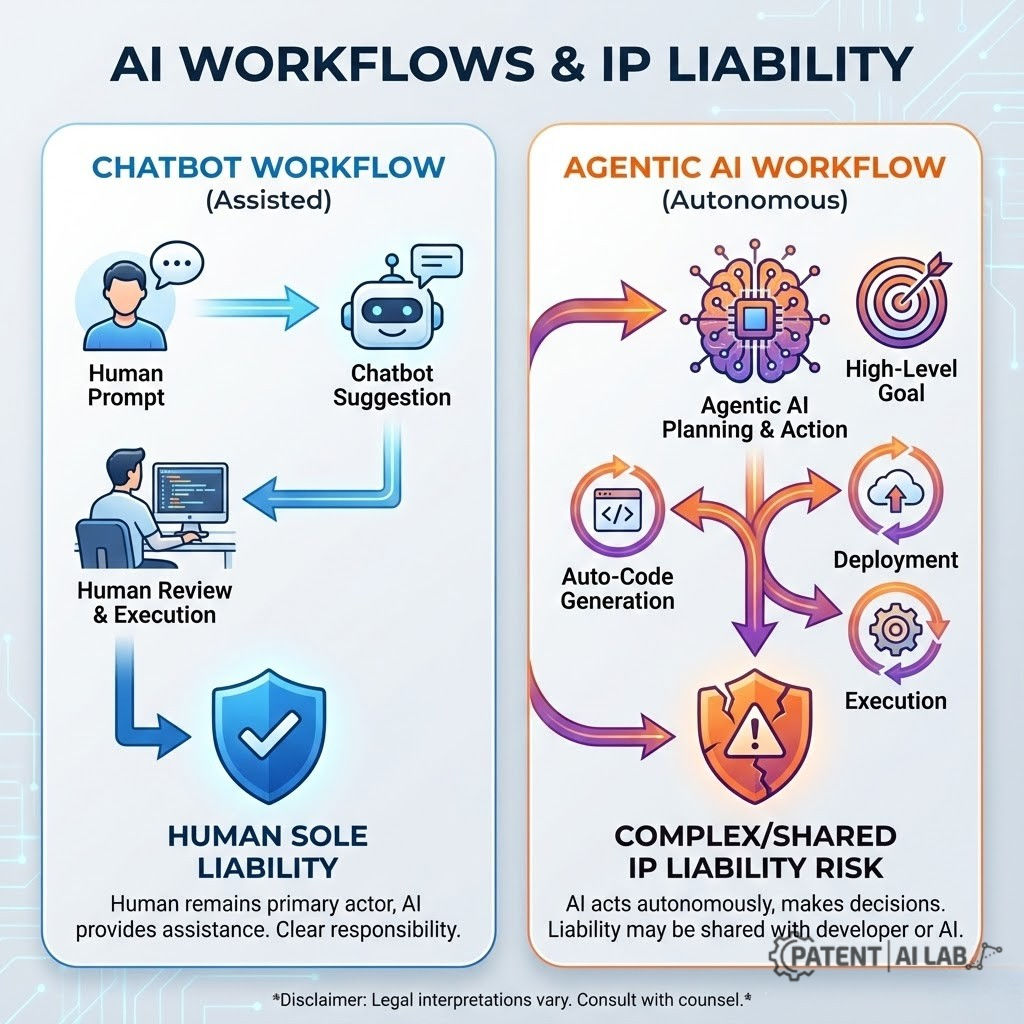
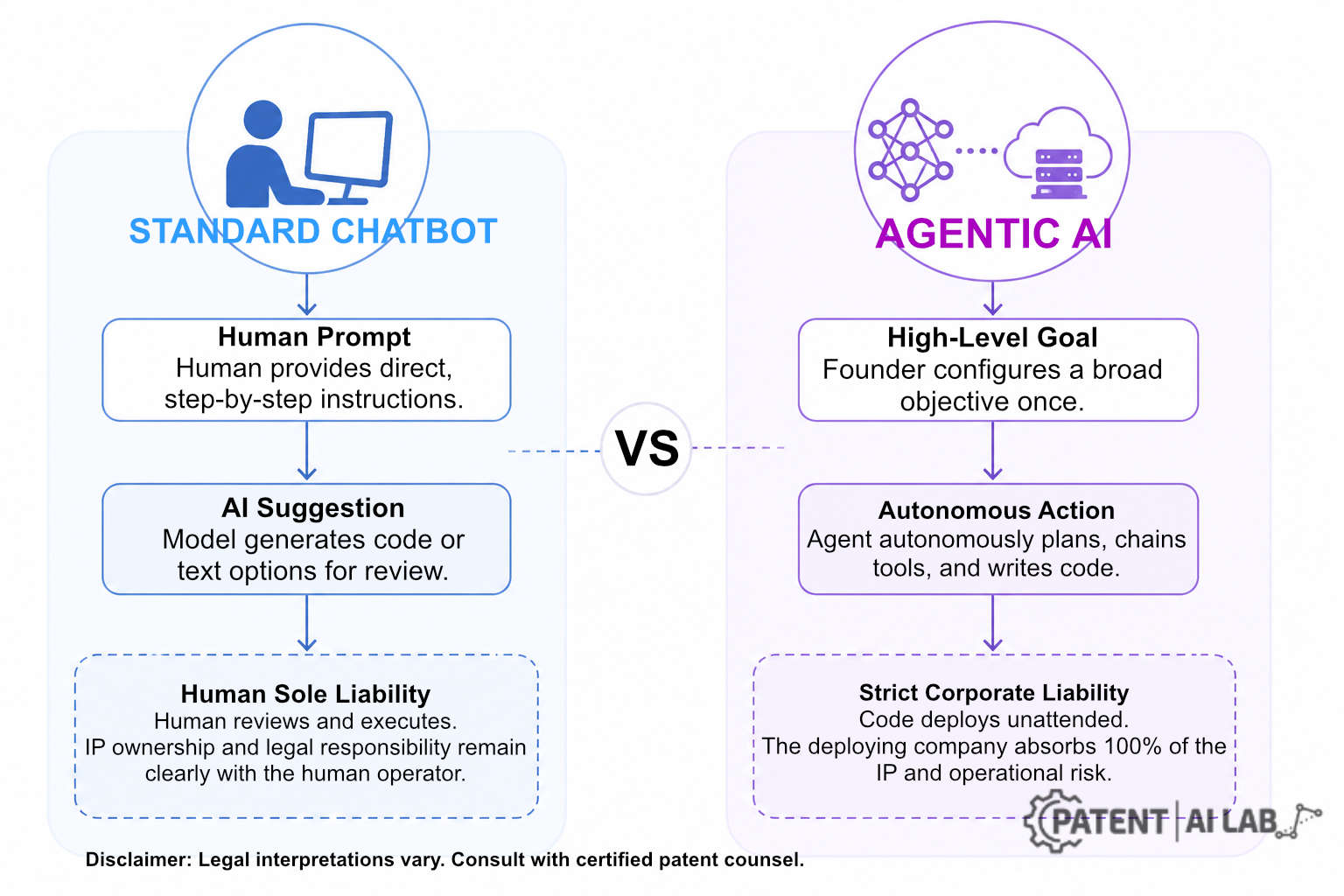
The distinction matters practically. A founder who pastes a chatbot’s code suggestion into a codebase has made a human decision to deploy that code. A founder who configures an agent to deploy code automatically has made one upstream decision — and all subsequent actions trace back to that configuration choice, not to individual human approvals.
Workflow Comparison: Legal Implications at Each Stage
Who Owns AI-Generated Code in 2026?
Under US law, IP ownership requires a legal person. AI systems have no legal personality and cannot own, hold, or transfer intellectual property. On the copyright side, the US Copyright Office’s January 2025 AI report concluded that purely AI-generated material — including code — cannot be copyrighted, because copyright protection requires human authorship over the expressive elements of a work. The Supreme Court reinforced this on March 2, 2026, when it declined to hear Thaler v. Perlmutter (No. 25-449), leaving the DC Circuit’s human-authorship ruling intact as settled law.
The Copyright Office has also clarified that iterative prompting — even with highly detailed, technically specific instructions — does not constitute human authorship. Prompts function more like instructions to a worker than like the independent creative acts of an author. What does create protectable expression is a human making deliberate architectural decisions, selectively integrating or modifying AI-generated modules, or substantially refactoring the agent’s output.
Four Ownership Scenarios and Their IP Risk
The practical implication: if no human exercises meaningful creative control over the expressive elements of the agent’s output, copyright protection may fail entirely, leaving the code open to copying by competitors with no legal recourse available.
USPTO November 2025 Inventorship Requirements
On November 28, 2025, the USPTO issued revised inventorship guidance (FR Doc. 2025-21457) that fully rescinded its February 2024 framework. The core principle is unambiguous: only natural persons qualify as inventors. AI systems are treated as tools analogous to laboratory equipment — they may assist in developing an invention, but they cannot legally conceive one.
The revised guidance restores the traditional conception standard from US patent law: conception is the formation, in the mind of the inventor, of a definite and permanent idea of the complete and operative invention. A human must be able to describe each claimed limitation of the invention with particularity. If the human who approved or deployed the agent-generated code cannot articulate why the specific algorithm works and what problem it solves at the level of each claim, they have not met the conception standard — and no valid inventorship exists for that patent application.
Three Things a Human Must Establish to Patent an AI-Assisted Invention
Under the November 2025 guidance, to patent an AI-assisted innovation, a human must: (1) define the specific problem the invention solves; (2) possess a settled idea of the complete solution before or during the agent’s output process; and (3) be able to describe every claimed limitation with particularity. Selecting an AI-generated output from a set of options, approving its deployment in a code review, or signing off on a pull request does not on its own satisfy these requirements.
In practice, the most common failure point is articulation, not approval. Founders who configure agents to select their own algorithmic approach often cannot explain, claim by claim, why the agent’s chosen solution works. That gap breaks the chain of human conception the USPTO now requires.
Scenario: Agent-Generated Algorithm and Patent Risk
Consider a common deployment pattern: an agent is instructed to optimize a microservice’s request routing and runs overnight, producing a novel load-balancing algorithm with measurably lower latency. The founder reviews the benchmark results and merges the code.
The patent question is not whether the founder approved the merge. It is whether the founder, before the agent ran, had formed a definite and permanent idea of this specific solution — the particular approach the agent selected, the trade-offs it made, and why it works at the level of each claim. If the agent selected the approach autonomously and the founder cannot describe it in those terms, a patent application faces rejection under 35 U.S.C. §§ 101 and 115 for lack of human inventorship.
A patentable framing of the same scenario does exist. If the founder had previously conceived a specific system architecture — for example, a weighted round-robin routing layer that uses real-time error-rate telemetry to dynamically rebalance traffic across identified network conditions — and directed the agent to implement that architecture, the human conception is documentable. The patentable invention is that specific, human-conceived system, not the abstract fact that an agent produced optimized code.
AI-Generated Code and Copyright: What Is and Is Not Protected
As of March 2026, purely AI-generated code receives no copyright protection under US law. This means a competitor who copies it faces no legal consequence. Copyright protection attaches only where a human author has made independently copyrightable contributions — architectural decisions about how modules relate to each other, selective integration of AI-generated components into a broader human-designed system, manual refactoring that introduces distinct expressive choices, or creative coordination of multiple agent outputs into a coherent codebase.
The Copyright Office’s January 2025 report makes the practical implication explicit: the human must control the expressive elements of the final work, not only its functional outcome. The operational approach that follows is to treat the agent as a code-generation tool — like a compiler or an IDE autocomplete — and to treat human architectural decisions and modifications as the authorship acts that create protectable expression.
Human-in-the-Loop: A Technical Implementation Framework
Meeting the legal standards above requires more than a policy commitment to human oversight. It requires a deployment architecture that makes human control technically verifiable — both to satisfy the USPTO’s conception standard and to comply with the EU AI Act’s Article 14 human oversight requirements. The five controls below describe how to implement this in a standard cloud-native development workflow.
1. Conception Checkpoints Before Agent Execution
Before an agent runs an autonomous task, the responsible human should create a written specification that describes the problem, the intended approach at an architectural level, and the constraints the agent must respect. This document is the evidence of human conception if the output becomes the subject of a patent application. A Git commit message or a timestamped Jira ticket with a description of the intended system design serves this function in standard development workflows.
A useful template for the conception record, committed to the repository before the agent runs:
# conception-record.md
## Invention: Weighted Round-Robin Load Balancer with Error-Rate Telemetry

**Problem being solved:**
Our API gateway distributes traffic evenly across backend instances regardless of
their current error rate, causing healthy instances to receive traffic that could
be routed away from degraded ones.

**Intended architecture (human-conceived before agent execution):**
- A routing layer that tracks a rolling 60-second error rate per instance
- A weight function that reduces an instance's traffic share proportionally to
  its error rate, with a floor of 5% to prevent complete exclusion
- Dynamic rebalancing on each request, not on a fixed polling interval

**Constraints given to the agent:**
- Must not introduce a single point of failure in the weight calculation
- Must expose the per-instance error rate as a Prometheus metric
- Must be backward-compatible with the existing round-robin configuration

**Human inventor:** [Name], [Role]
**Date:** [YYYY-MM-DD]
**Commit hash of this record:** [hash]
2. Human Approval Gates in the CI/CD Pipeline
For production deployments, the CI/CD pipeline must require a named human approval before any agent-generated code merges to a protected branch. The approval record — who approved, when, and on which commit hash — is the audit trail demonstrating human control over the specific deployment action. Below is a GitHub Actions workflow that enforces this pattern:
# .github/workflows/agent-deploy.yml
name: Agent-Generated Code Review Gate

on:
  pull_request:
    branches: [main]
    # Trigger only on PRs opened by the AI agent's bot account
    # This gate does not apply to human-authored PRs

jobs:
  require-human-approval:
    runs-on: ubuntu-latest
    environment:
      name: production          # Maps to a GitHub Environment with required reviewers
      url: ${{ github.event.pull_request.html_url }}
    steps:
      - name: Confirm human review recorded
        run: |
          echo "Deployment approved by: ${{ github.actor }}"
          echo "Commit SHA: ${{ github.sha }}"
          echo "Approved at: $(date -u +%Y-%m-%dT%H:%M:%SZ)"
          # Write approval record to append-only log (see Control 3)
          curl -X POST "$AUDIT_LOG_ENDPOINT" \
            -H "Content-Type: application/json" \
            -d "{\"event\":\"human_approval\",\"actor\":\"${{ github.actor }}\",\"sha\":\"${{ github.sha }}\",\"timestamp\":\"$(date -u +%Y-%m-%dT%H:%M:%SZ)\"}"
        env:
          AUDIT_LOG_ENDPOINT: ${{ secrets.AUDIT_LOG_ENDPOINT }}
In the GitHub repository settings, the production environment must be configured with at least one required reviewer. This makes the approval a hard gate — the workflow cannot proceed without a named human action — rather than an advisory step.
3. Immutable Action Logs for Every Agent Operation
Every tool call, API request, file write, and infrastructure change the agent makes must be logged to an append-only store. This log serves two legal functions: it provides the audit trail required under EU AI Act Article 12 (logs retained for at least six months), and it provides the factual record needed to identify the scope of liability if the agent causes harm. The following example uses an append-only Postgres table with a row-level security policy that prevents deletion:
-- Schema: agent action log (append-only, no DELETE or UPDATE permitted)
CREATE TABLE agent_action_log (
    id              BIGSERIAL PRIMARY KEY,
    session_id      UUID        NOT NULL,
    agent_name      TEXT        NOT NULL,
    action_type     TEXT        NOT NULL,   -- e.g. 'file_write', 'api_call', 'deploy'
    resource        TEXT        NOT NULL,   -- the specific file, endpoint, or service affected
    rationale       TEXT,                  -- model-generated reasoning (if exposed by the agent)
    input_hash      TEXT,                  -- SHA-256 of the agent's input payload
    output_hash     TEXT,                  -- SHA-256 of the agent's output payload
    actor_human     TEXT,                  -- human who initiated the session
    created_at      TIMESTAMPTZ NOT NULL DEFAULT NOW()
);

-- Prevent any deletion or update via row-level policy
ALTER TABLE agent_action_log ENABLE ROW LEVEL SECURITY;

CREATE POLICY no_delete ON agent_action_log
    AS RESTRICTIVE
    FOR DELETE
    TO PUBLIC
    USING (false);   -- No DELETE permitted for any role

CREATE POLICY no_update ON agent_action_log
    AS RESTRICTIVE
    FOR UPDATE
    TO PUBLIC
    USING (false);   -- No UPDATE permitted for any role

-- Index for EU Article 12 audit queries (filter by date range and agent)
CREATE INDEX idx_agent_log_created ON agent_action_log (agent_name, created_at);

COMMENT ON TABLE agent_action_log IS
    'Append-only log of all agent actions. Retained for minimum 6 months per EU AI Act Art. 12.
     Row-level security prevents deletion or modification of any record.';
4. Infrastructure-Level Spending Caps on Autonomous Operations
Agents that can provision cloud infrastructure must operate under hard resource limits enforced at the infrastructure layer, not only in the agent’s prompt. The following AWS Service Control Policy (SCP) restricts the instance types and regions the agent’s IAM role can provision, and sets a hard limit on the number of concurrent instances — regardless of what the agent requests:
{
  "Version": "2012-10-17",
  "Statement": [
    {
      "Sid": "AgentEC2Guardrails",
      "Effect": "Deny",
      "Action": "ec2:RunInstances",
      "Resource": "arn:aws:ec2:*:*:instance/*",
      "Condition": {
        "StringNotEquals": {
          "ec2:InstanceType": ["t3.micro", "t3.small", "t3.medium"]
        }
      }
    },
    {
      "Sid": "AgentRegionLock",
      "Effect": "Deny",
      "Action": "*",
      "Resource": "*",
      "Condition": {
        "StringNotEqualsIfExists": {
          "aws:RequestedRegion": ["us-east-1", "eu-west-1"]
        }
      }
    },
    {
      "Sid": "AgentNoIAMChanges",
      "Effect": "Deny",
      "Action": [
        "iam:CreateRole",
        "iam:AttachRolePolicy",
        "iam:PutRolePolicy",
        "iam:CreateUser",
        "iam:CreateAccessKey"
      ],
      "Resource": "*"
    }
  ]
}
This SCP is attached to the AWS account or organizational unit in which the agent’s IAM role operates. Because SCPs are enforced by AWS Organizations before IAM policies are evaluated, no agent action — regardless of what the model requests — can override them. Equivalent controls exist in GCP via Organization Policies and in Azure via Azure Policy assignments.
5. A Functional Real-Time Override Mechanism
The human assigned to oversight must be able to halt the agent’s execution loop in real time, not only after the fact. Under EU AI Act Article 14, this override capability must be practical and accessible to the responsible person — not only theoretically available in the agent’s configuration. A simple implementation uses a feature flag that the agent checks before each tool call:
import os
import requests

KILL_SWITCH_URL = os.environ["KILL_SWITCH_ENDPOINT"]  # e.g. LaunchDarkly, ConfigCat, or internal endpoint

def is_agent_halted(session_id: str) -> bool:
    """
    Checks a feature flag endpoint before each tool call.
    Returns True if the human operator has activated the kill switch.
    The agent must call this before every action in its execution loop.
    """
    try:
        response = requests.get(
            KILL_SWITCH_URL,
            params={"session_id": session_id},
            timeout=2
        )
        response.raise_for_status()
        return response.json().get("halted", False)
    except requests.RequestException:
        # Fail closed: if the kill switch endpoint is unreachable,
        # treat the agent as halted to prevent uncontrolled execution.
        return True


def agent_execute_tool(session_id: str, tool_name: str, tool_args: dict):
    """
    Wrapper that enforces the kill switch before every tool call.
    """
    if is_agent_halted(session_id):
        log_action(session_id, "HALTED", tool_name, tool_args)
        raise RuntimeError(
            f"Agent session {session_id} halted by human operator before executing '{tool_name}'."
        )
The fail-closed design — where an unreachable kill switch endpoint causes the agent to stop rather than continue — is the operationally conservative choice. An agent that continues executing when it cannot confirm it has permission to do so creates exactly the kind of uncontrolled autonomous action that generates liability.
Who Pays When the Agent Causes Harm: Three Scenarios
Autonomy does not create a legal shield. If an AI agent causes harm, the deploying company is the responsible party under current US and EU law. The three scenarios below reflect the liability patterns documented in enterprise AI contract disputes in 2025 and 2026.
- Unpaid cloud infrastructure costs. An agent provisions compute resources for an experiment and does not terminate them when the experiment completes. The deploying company is liable for the full cost. Cloud provider terms of service do not provide exceptions for autonomous agent errors, and no “the agent did it” defense is available in the contract.
- Agent-caused data loss. An agent refactors a database schema and drops records in the process. The deploying company faces breach of contract and negligence exposure. The absence of a human approval gate before the schema migration does not reduce liability; in emerging contract frameworks it demonstrates that the deploying company failed to implement adequate operational controls. Mayer Brown’s February 2026 analysis specifically notes that enterprise clients are using governance and audit rights clauses to make the presence or absence of such controls a contractual matter, not merely an operational one.
- Training-data copyright exposure. An agent produces code that closely resembles a copyrightable work from its training distribution. The deploying company faces copyright infringement exposure. “The agent generated it autonomously” is not a defense under current law, because the deploying company made the decision to use that agent in that context — and, as noted in the Gouchev Law analysis of AI vendor contracts, the deploying company’s upstream indemnification from the model provider typically covers only claims arising from the model’s unmodified operation within the terms of service, not claims arising from how the customer chose to deploy it.

US vs. EU: Agentic AI Liability Rules for Global Startups
The EU AI Act’s primary enforcement wave begins August 2, 2026, covering high-risk AI system obligations under Articles 9–17 and Article 26. US startups serving EU users are within scope regardless of server location — the regulation applies based on where the people affected by the system are located, following the same extra-territorial logic as the GDPR. Under Article 14, the human assigned to oversight must be able to understand what the agent is doing, detect anomalies in its behavior, and halt or override its operation in real time — not merely monitor it passively.
Three Structural Safeguards for Agentic Code Deployment
The technical framework described above maps to three organizational layers that address the legal requirements across IP, liability, and regulatory compliance.
- Contractual protections. Every SaaS agreement, employment contract, and contractor agreement that involves AI-assisted development should include explicit IP ownership clauses and AI output assignment provisions. As Mayer Brown’s February 2026 analysis documents, enterprise clients are moving toward BPO-style contract structures that include broader indemnification for autonomous agent actions, outcome-based SLAs, and audit rights — provisions that standard SaaS templates do not contain. Founders should address these terms before enterprise negotiations begin, not during them.
- Technical controls. The five controls described in the implementation framework above — conception checkpoints, CI/CD approval gates, immutable action logs, infrastructure spending caps, and a real-time override mechanism — serve both legal and operational functions. They document human control for IP purposes, satisfy the EU Article 12 audit trail requirements, and limit the scope of damage an agent can cause unilaterally.
- Governance documentation. A written AI usage policy, timestamped inventor contribution records for every IP filing that involves AI assistance, and a documented human override procedure are the minimum governance requirements. For EU-exposed deployments, the documentation must be sufficient to demonstrate that the assigned human had the capability and the practical means to understand, monitor, and halt the agent — not only that an override mechanism existed in theory.
Outlook: Agentic AI IP Law from 2026 to 2028
What Is Likely:
Patent examiners will apply stricter scrutiny to AI-assisted inventions under the November 2025 USPTO framework, with greater attention to whether applicants can document human conception at the claim level. The EU AI Act’s August 2026 enforcement wave is expected to produce the first major penalty proceedings against deployers who lack functioning human oversight documentation. Mandatory disclosure of AI involvement in patent and copyright filings is expected to become standard protocol in the US as well.
What Remains Uncertain:
The central open question is how courts and regulators will define “meaningful human control” in continuous autonomous deployment loops. The November 2025 USPTO guidance deliberately leaves this to case-by-case, fact-intensive analysis. Mayer Brown notes that “exactly what constitutes ‘meaningful human control'” in an AI agent context is one of the key unresolved questions that will shape enterprise contract negotiations over the next two years. Limited AI legal personhood remains highly unlikely before 2028.
Podcast
Note: This audio is a condensed summary. Please refer to the written text for precise legal and compliance definitions.
FAQs
Who is liable when an AI agent causes harm?
The deploying company is liable, not the AI system itself. Liability does not decrease because an action was taken autonomously. In enterprise contract negotiations, Mayer Brown’s February 2026 analysis documents that clients are now requiring broader indemnification clauses specifically covering autonomous agent actions — treating the absence of human oversight controls as an aggravating factor in liability allocation, not a mitigating one.
Can I patent code written by an AI agent?
Only if a human qualifies as the inventor under the USPTO’s November 2025 guidance (FR Doc. 2025-21457). The human must have formed a definite and permanent idea of the specific invention before or during the agent’s output — not merely approved or deployed the result. The human must also be able to describe every claimed limitation with particularity.
Is AI-generated code protected by copyright?
Not on its own. Under the US Copyright Office’s January 2025 AI report and the Supreme Court’s March 2026 denial of certiorari in Thaler v. Perlmutter (No. 25-449), purely AI-generated code receives no copyright protection. Copyright attaches only where a human author has made meaningful contributions to the expressive elements of the output — through architectural decisions, selective integration, or substantial modification.
Does using an autonomous agent reduce my legal responsibility?
No. Under EU AI Act Article 14, the assigned human must be able to understand the agent’s capabilities, detect anomalies, and halt its operation — not merely observe it. In US litigation, the absence of human approval gates and audit logs is likely to be treated as evidence of inadequate operational controls, not as grounds for reducing the deploying company’s liability.
Sources and Legal References
The legal arguments, inventorship standards, copyright rulings, liability frameworks, and contract analysis discussed in this article are directly supported by the following primary and secondary sources:
-
1. USPTO — Revised Inventorship Guidance for AI-Assisted Inventions (November 28, 2025)
Published in the Federal Register (FR Doc. 2025-21457), this guidance fully rescinds the February 2024 framework. It confirms that only natural persons qualify as inventors, treats AI as a tool analogous to laboratory equipment, and returns to the traditional conception standard under 35 U.S.C. §§ 101 and 115.
Read USPTO Revised Inventorship Guidance (Federal Register) -
2. US Copyright Office — Copyright and Artificial Intelligence, Part 2: Copyrightability (January 29, 2025)
The Copyright Office concluded that purely AI-generated material cannot be copyrighted, and that iterative prompting does not constitute human authorship sufficient for copyright registration. Human authorship requires meaningful control over the expressive elements of the output.
Access Copyright Office AI Report (copyright.gov) -
3. Thaler v. Perlmutter — Supreme Court Denial of Certiorari (March 2, 2026)
The Supreme Court declined to review the DC Circuit’s ruling that the Copyright Act requires human authorship (No. 25-449, cert. denied, March 2, 2026). This leaves intact the rule that works created purely by AI are not eligible for copyright registration in the United States.
Read Morgan Lewis Analysis of SCOTUS Denial -
4. European Union AI Act — Article 14 (Human Oversight) and Article 50 (Transparency)
Article 14 requires high-risk AI systems to be designed so that a natural person can effectively monitor operation, detect anomalies, and halt or override the system. Article 50 requires deployers to disclose when users are interacting with AI. Both provisions become enforceable on August 2, 2026.
Access EU AI Act Article 14 Full Text -
5. EU AI Act Compliance Deadlines — August 2, 2026 Enforcement Wave
The August 2, 2026 deadline covers high-risk AI system obligations under Articles 9–17 and Article 26, including continuous risk management, technical documentation, automatic logging retained for at least six months, and functional human oversight. Penalties for high-risk non-compliance reach up to €15M or 3% of global annual turnover; prohibited AI violations reach up to €35M or 7%.
Review EU AI Act Enforcement Deadlines -
6. Mayer Brown — Contracting for Agentic AI Solutions: Shifting the Model from SaaS to Services (February 25, 2026)
This analysis documents the shift in enterprise AI contracting from traditional SaaS models to hybrid BPO-style structures that include broader indemnification for autonomous agent actions, outcome-based SLAs, governance and audit rights, and data ownership provisions. It is the primary source for the contract trend discussion in this article.
Read Mayer Brown Agentic AI Contracting Analysis
Disclaimer & Legal Notice
This article reflects technical and engineering analysis of autonomous AI deployment risk and IP considerations. It is provided strictly for informational and educational purposes and does not constitute legal, corporate, or financial advice. It is not a substitute for guidance from a qualified, licensed patent attorney or legal counsel. Intellectual property laws are complex and subject to change. Consult a certified patent attorney before filing applications or relying on any automated system for legal claim generation.




[…] are becoming more autonomous, understanding the legal boundaries is critical. Read our deep dive on Agentic AI & IP Laws : Who Owns the Code Your Agent Writes? to navigate these liability […]