


 Golam Rabiul Alam, PhD
About This Analysis: This article is authored by Dr. Golam Rabiul Alam, a software engineer and AI systems researcher. The content reflects an engineering and technical compliance perspective on active IP litigation and open source tooling — not legal counsel. For decisions specific to your organisation, consult a qualified software copyright attorney. See disclaimer below.
Developers treating GitHub Copilot as a liability-free junior engineer are navigating significant legal uncertainty. The current GitHub Copilot lawsuit status in 2026 shows that the Doe v. GitHub class action has escalated beyond theoretical copyright debates into active appellate litigation over DMCA Section 1202. If your AI-assisted code strips open source license headers and your team ships that output, your SaaS company absorbs copyright infringement risk that courts are only beginning to define. Here is what the litigation actually says, what it means for your codebase, and how to audit your code before deploying it.
At A Glance
The GitHub Copilot copyright lawsuit (Doe v. GitHub, 4:22-cv-06823-JST, N.D. Cal.) challenges whether AI coding tools can train on public open source code and output similar code without preserving licenses or copyright notices. The case centers on copyright infringement, open source license violations, and DMCA Section 1202. As of the most recent court filings (2026), with oral arguments heard at the 9th Circuit in February 2026, this litigation is shaping new compliance standards for AI-generated code, pushing developers and SaaS companies to adopt stricter IP risk controls.
Key Takeaways
- Doe v. GitHub is now at the 9th Circuit, with oral arguments held February 11, 2026, over whether DMCA Section 1202(b) requires identical copies for liability. The ruling will define AI copyright risk for every commercial developer.
- The district court dismissed the DMCA 1202(b) claims because Copilot’s outputs were modifications rather than verbatim copies. The 9th Circuit appeal now determines whether that identicality requirement survives.
- Open source compliance audits must now explicitly include AI-generated code, with tools like FOSSA and SCANOSS scanning at the snippet level for license conflicts.
- SaaS founders must treat AI-assisted code as a regulated, high-risk asset, especially when AGPL-licensed libraries are involved in network-accessible products.
- Waiting for a final appellate ruling is not a valid compliance strategy. The risk window is open now.
What the Doe v. GitHub Lawsuit Is Actually Deciding
The GitHub Copilot copyright lawsuit, officially known as Doe v. GitHub (Case No. 4:22-cv-06823-JST, N.D. Cal.), is one of the most consequential AI copyright disputes in progress.
The central question courts must now answer: when an AI model trains on open source code and generates statistically similar output, does the absence of the original license header constitute removal of Copyright Management Information under 17 U.S.C. § 1202(b)?
Filed as a class action against GitHub, Microsoft, and OpenAI, the case targets GitHub Copilot and the underlying Codex model. Plaintiffs, representing a proposed class of open source contributors, argue that Copilot was trained on millions of public GitHub repositories and outputs code that is substantially similar to licensed work, without including copyright notices, preserving license terms (GPL, MIT, Apache), or providing attribution.
As of the most recent court filings (2026), the case is no longer just about Copilot. It is reshaping how AI companies, SaaS founders, and developers think about open source license compliance, AI training data governance, DMCA Section 1202 liability, and software IP risk assessment. The following reflects Dr. Golam Rabiul Alam’s technical and engineering analysis of the litigation and its compliance implications from a software systems perspective. It is provided for informational purposes only and does not constitute legal advice.
Doe v. GitHub: Case Facts, Defendants, and Core Claims
Doe v. GitHub is a U.S. class action lawsuit filed in November 2022 by anonymous software developers in the Northern District of California (Case No. 4:22-cv-06823-JST). The plaintiffs seek $9 billion in statutory damages.
Defendants
- GitHub, Inc.
- Microsoft Corporation
- OpenAI, LLC and related entities
Product at Issue
GitHub Copilot, an AI coding assistant powered by OpenAI’s Codex model, and trained on public GitHub repositories.
Core Claim
Copilot was trained on public GitHub repositories and sometimes outputs code substantially similar to licensed open source code, without including copyright notices, preserving license terms (GPL, MIT, Apache), or providing attribution. The plaintiffs argue this violates copyright law and DMCA Section 1202.
Why Every SaaS Team Has Skin in This Case by 2026
In 2022, Copilot was a novelty. In 2026, AI-generated code is embedded in production systems across the industry. Understanding the current <strong>GitHub Copilot Lawsuit Status</strong> is no longer just for lawyers—it is a core risk management task for engineering leaders. According to FOSSA and SCANOSS’s April 2026 partnership announcement, nearly 40% of code is written by AI tools where enabled, nearly 40% of the code is written by the tool, particularly in popular languages like Python. That scale transforms a niche copyright dispute into a systemic IP risk that touches the codebase of any team using AI coding assistants.
The litigation has already shifted enterprise behavior, independent of any final ruling. SaaS vendors are rolling out mandatory AI code scanning before deployment, and investors and acquirers have begun including AI-assisted code provenance questions in due diligence checklists.
Three Legal Arguments: What Plaintiffs Claim and What Courts Have Said
1. Copyright Infringement
Plaintiffs claim that training an AI on copyrighted code and reproducing similar outputs constitutes infringement. The defendants argue that training is a transformative use and outputs are statistically generated, not copied. Courts have shown skepticism toward blanket transformative-use arguments where outputs directly resemble protected expression. This question remains unresolved at the district level and will be further shaped by parallel litigation in other circuits.
2. Open Source License Violations: The GPL Problem
This is the most operationally relevant issue for development teams. Many open source licenses require attribution, license inclusion, and share-alike obligations. GPL, in particular, requires that derivative works be distributed under the same terms. Plaintiffs argue that Copilot outputs code without any of these. Defendants counter that the model does not process licenses as instructions and that outputs are not legally derivative works. Courts have not yet ruled on the substantive license compliance question.
A specific risk worth noting: AGPL (GNU Affero General Public License) triggers its share-alike requirement when software is accessed over a network, not only when binary code is distributed. A SaaS product that incorporates AGPL-licensed code output from an AI tool, and makes that software available to users via a browser, may be required to release its full source code regardless of whether the code was “distributed” in the traditional sense.
3. DMCA Section 1202: The Statute That Survived and the Question the 9th Circuit Must Decide
This is where the litigation stands most precisely in 2026. DMCA Section 1202 (17 U.S.C. § 1202) prohibits the removal or alteration of Copyright Management Information (CMI), defined by statute as the title, author name, copyright owner information, and terms and conditions of use conveyed in connection with a work. Statutory damages under Section 1202 range from $2,500 to $25,000 per violation under 17 U.S.C. § 1203.
Plaintiffs argue that Copilot learned from code with copyright headers and outputs similar code without those headers. That is CMI removal. The district court dismissed the 1202(b) claims, finding that Section 1202(b) has an identicality requirement: CMI must be removed from an identical copy, not merely a substantially similar one. Since Copilot’s output is more often a modification than a verbatim copy, the district court found plaintiffs had pleaded themselves out of their own claims. The 9th Circuit heard oral arguments on this exact question on February 11, 2026. The ruling will determine whether Section 1202(b) applies only to verbatim copies or extends to substantially similar AI-generated outputs.
Where Doe v. GitHub Stands at the 9th Circuit: 2026 Oral Arguments
What the Record Shows:
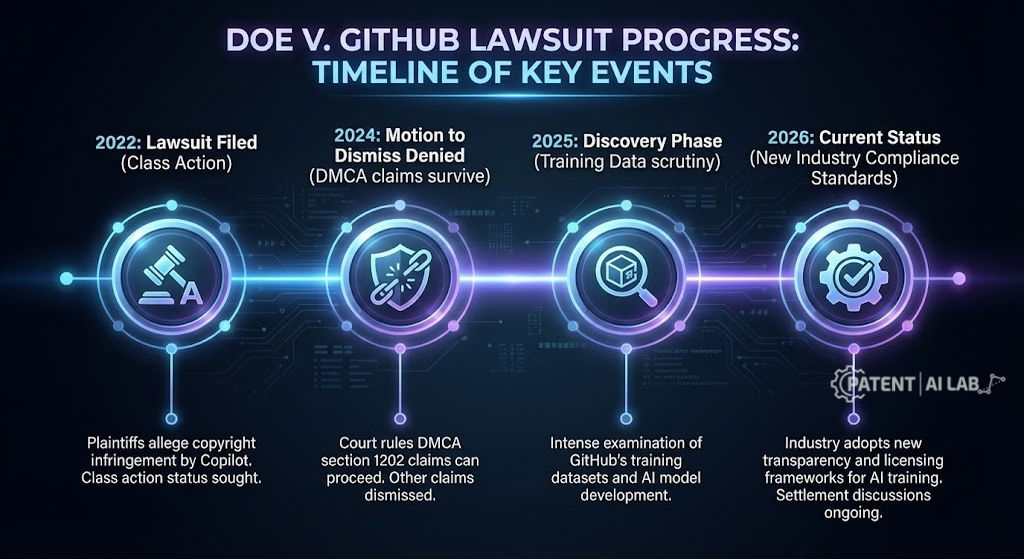
The 9th Circuit heard oral arguments in Doe v. GitHub (docket 24-7700) on February 11, 2026, in San Francisco. The certified question on appeal is whether Section 1202(b) of the DMCA requires identical copies for CMI removal liability. Sixteen IP law professors from the Samuelson Clinic at UC Berkeley filed an amicus brief in support of GitHub, arguing Section 1202 was designed to deter digital piracy of perfect copies and should be limited to identical copies. News/Media Alliance filed an opposing brief urging the court to reject the identicality requirement. No ruling has been issued as of the date of this article.
What Remains Legally Unresolved:
Whether the identicality requirement survives in the 9th Circuit. The fair use boundaries of AI training remain untested at the appellate level. The substantive open source license compliance question has not yet been adjudicated. What constitutes “substantial similarity” in AI-generated code outputs has not been formally defined.
Even without a final verdict, the litigation has already changed industry behavior.
⚖️ Litigation Update
Most recent court filings (2026) Status: The Doe v. GitHub appeal (9th Cir. No. 24-7700) remains pending following the February 11 oral arguments on the Section 1202(b) identicality question. Courts are actively scrutinising whether the removal of copyright headers during AI training satisfies the scienter requirement under 17 U.S.C. § 1202. In response, enterprise SaaS vendors are now integrating snippet-level AI code scanning — including FOSSA’s April 2026 partnership with SCANOSS — into CI/CD pipelines before deployment.
How AI-Generated Code Creates Copyright and DMCA Exposure: The Compliance Gap
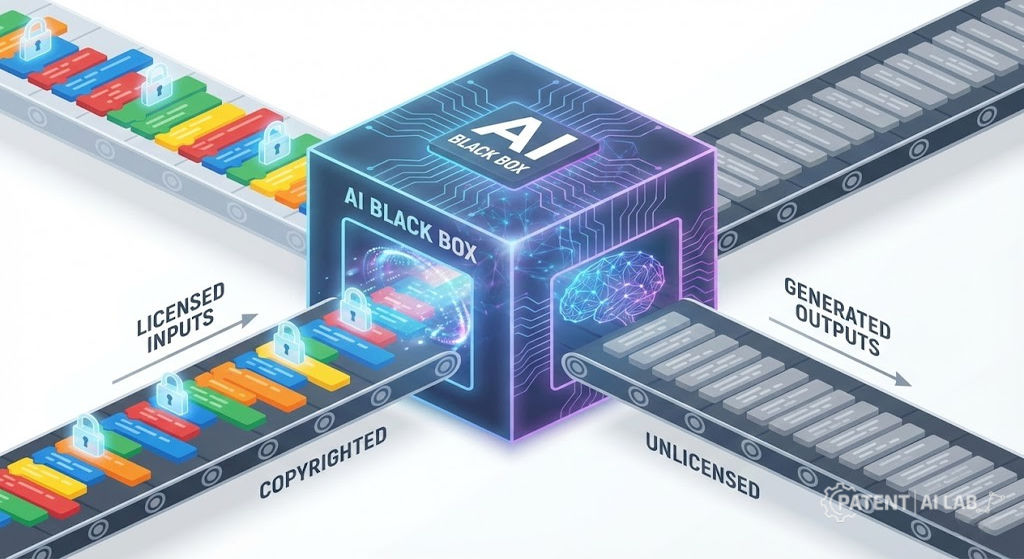
The Liability Chain (Conceptual)
Open Source Code (GPL/MIT/Apache/AGPL)
        ↓
AI Model Training (copyright headers ingested, not preserved as structured output)
        ↓
Statistical Pattern Learning (model learns code structure, not license obligations)
        ↓
AI-Generated Code Output (no license header, no attribution, no share-alike signal)
        ↓
Developer Ships Code (no compliance scan run on AI output)
        ↓
Potential Copyright Infringement + DMCA Section 1202 Exposure
This compliance gap is what the 9th Circuit must define the legal perimeter of. The legal outcome of the identicality question determines whether step four in this chain constitutes actionable CMI removal.
Practitioner Scenario: The Latent GPL Contamination Trap
The following scenario is a hypothetical example synthesised from the technical compliance risks described in this article by Patent AI Lab to illustrate how the compliance gap operates in practice.
A developer uses Copilot to build a data processing module for a B2B SaaS product. Copilot outputs a sorting function that is substantially similar to a GPL-licensed implementation in a public repository. The developer reviews the logic, finds it correct, and ships it. No compliance scan is run on the AI output.
Three scenarios follow from this fact pattern:
- If the 9th Circuit removes the identicality requirement, the developer’s company faces potential DMCA Section 1202 exposure because the copyright header in the original GPL source was not preserved in the output.
- If the output is deemed a derivative work, GPL’s share-alike obligation may require the full SaaS product to be released under GPL terms, which is incompatible with proprietary licensing models.
- In an M&A due diligence process, the absence of a compliance scan creates a documentation gap that can delay or reduce the valuation of an acquisition. Acquirers now routinely include AI code provenance in IP audit requirements.
Running a Snippet-Level Compliance Scan on AI-Generated Code: A Practical Implementation
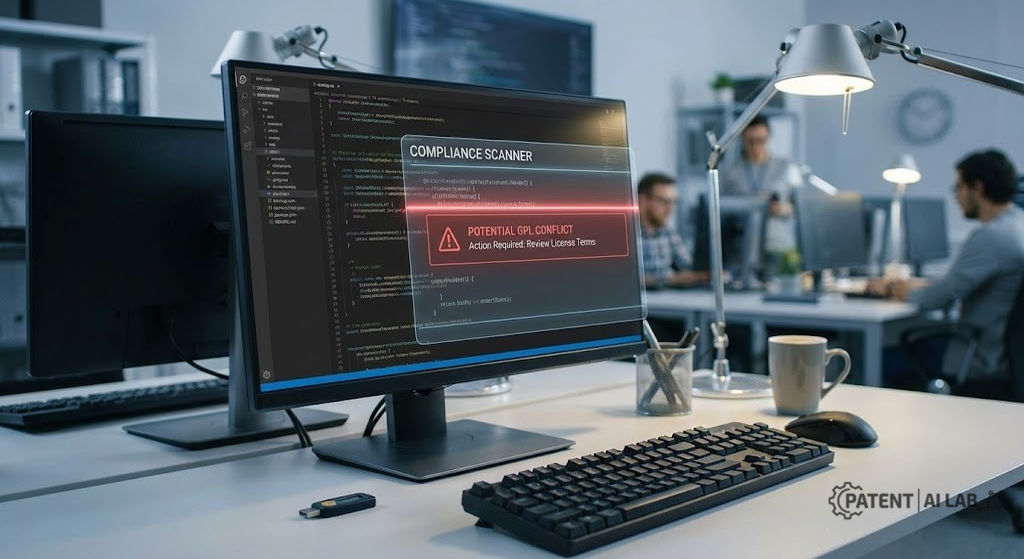
The following satisfies the compliance audit requirement described throughout this article. FOSSA and SCANOSS announced a partnership in April 2026 specifically to address snippet-level detection of AI-generated code that matches open source repositories.
SCANOSS’s snippet detection engine operates by matching subgraph fingerprints of code structure against its open source knowledge base. The following shows how to integrate this into a CI/CD pipeline gate that blocks deployment when a license conflict is detected.
# SCANOSS AI Code Compliance Gate — GitHub Actions
# Technical workflow: Detects AI-generated code snippets that match GPL/AGPL/LGPL-licensed
# open source code without attribution, as required by open source licence policy requirements.
# Fail-closed: if the scan API is unreachable, the workflow blocks deployment.

name: AI Code License Compliance

on:
  pull_request:
    branches: [main, release/*]

jobs:
  scanoss-compliance:
    runs-on: ubuntu-latest
    steps:
      - name: Checkout code
        uses: actions/checkout@v4

      - name: Install SCANOSS CLI
        run: pip install scanoss

      - name: Run snippet-level scan
        id: scanoss_scan
        run: |
          # Scans full working directory at snippet level
          # --output produces a JSON report for parsing
          scanoss-py scan . --output scan_results.json
        # Fail-closed: if scanoss-py is unavailable or errors, job fails here

      - name: Parse results for copyleft violations
        run: |
          python3 << 'EOF'
          import json, sys

          # Load SCANOSS output
          with open("scan_results.json") as f:
              results = json.load(f)

          violations = []
          # AGPL and GPL require source disclosure — flag as blocking
          COPYLEFT = {"gpl-2.0", "gpl-3.0", "agpl-3.0", "lgpl-2.0", "lgpl-2.1", "lgpl-3.0"}

          for filepath, matches in results.items():
              for match in matches:
                  spdx = match.get("licenses", [{}])[0].get("spdx_id", "").lower()
                  if spdx in COPYLEFT:
                      violations.append({
                          "file": filepath,
                          "matched_component": match.get("id", "unknown"),
                          "license": spdx
                      })

          if violations:
              print("COMPLIANCE BLOCK: Copyleft violations detected in AI-generated code:")
              for v in violations:
                  print(f"  - {v['file']} matches {v['matched_component']} ({v['license']})")
              print("Review required before merge. See open source licence policy documentation.")
              sys.exit(1)  # Blocks pull request merge

          print("Compliance scan passed. No copyleft matches detected.")
          EOF
This gate should be combined with FOSSA’s license policy enforcement, which evaluates compatibility between detected licenses and the organisation’s allowed-license policy at the dependency level, not only the snippet level.
What SaaS Founders and Investors Need to Document Before the 9th Circuit Rules
According to proprietary analysis by Patent AI Lab, investor and acquirer due diligence checklists in AI-assisted development contexts now routinely include three categories of questions that founders must be able to answer affirmatively: whether AI-assisted code generation is tracked at the file level, whether outputs are scanned for license conflicts before deployment, and whether training data sources used by the AI tool are documented and disclosed by the vendor.
Failure to address these questions does not currently create automatic liability. But the absence of documentation creates a risk window that grows as the 9th Circuit appeal progresses. If the court removes the identicality requirement, teams without a compliance audit trail face retroactive exposure on code already shipped.
Copyright lawsuits are one dimension of the IP risk landscape for AI-assisted products. For a full framework covering copyright, patent, and trade secret protection, see our guide on Is Your SaaS Code Safe? Copyright vs. Patent vs. Trade Secrets.
Five Controls Developers Must Run on Every AI-Generated Codebase
Developer Compliance Checklist
- Add explicit AI training restrictions in LICENSE files using standardised language (e.g., “No use in AI training datasets without written permission”).
- Use repository metadata (README, CODEOWNERS, .noai convention) to signal training restrictions, where platform tooling respects them.
- Monitor your AI vendor’s training data disclosure policy. GitHub Copilot’s filter settings (the Copilot duplicate detection feature) can reduce verbatim-match risk but do not eliminate substantially-similar-output risk.
- Document AI-assisted code generation at the PR or commit level, so any post-hoc audit can scope which files require compliance review.
- Run snippet-level open source compliance scans (SCANOSS, FOSSA) on AI outputs as a CI/CD gate before code reaches production. See the implementation above.
No single control eliminates risk. The value is in the layered audit trail, which is what reduces exposure and satisfies investor due diligence.
Traditional Coding vs. AI-Assisted Coding: IP Risk Comparison
USPTO Inventorship and Patent Eligibility: What AI Code Means for Your Patent Strategy
While Doe v. GitHub is a copyright case, it intersects with patent strategy. Under current USPTO guidance (AI and Inventorship: Guidance and Frequently Asked Questions, February 2024), abstract ideas implemented by AI are not patentable on that basis alone, human inventive contribution remains a statutory requirement, and AI-generated code does not qualify as an inventor under 35 U.S.C. § 100(f). This means companies cannot rely on patents to provide a shield against copyright exposure tied to AI-generated code, since patents require affirmative proof of human conception that AI output alone cannot satisfy.
For a practical framework on navigating the intersection of AI code and software patent eligibility, see our guide on Surviving the Alice Nightmare: Software Patent Eligibility Explained.
The Core Risk in Plain Language
“The real risk is not that AI writes code. The risk is that it writes code with no legal memory.”
Widely cited framing in AI IP compliance commentary; consistent with the district court’s finding in Doe v. GitHub (N.D. Cal., 2023) that Copilot’s outputs are modifications lacking the copyright management information present in their training sources.
What Happens to AI Coding Tools After the 9th Circuit Rules
Two outcomes are possible from the pending 9th Circuit ruling on the identicality question. If the court upholds the identicality requirement, the DMCA 1202(b) claims in Doe v. GitHub will be dismissed, and plaintiffs must rely on direct copyright infringement theories. If the court removes the identicality requirement, every AI coding tool that generates outputs resembling licensed code without CMI faces potential Section 1202 liability, and the $9 billion statutory damages claim in this case moves forward to discovery. The latter outcome would accelerate mandatory license-aware output filtering, contractual AI indemnity provisions in SaaS agreements, and regulatory pressure for training data disclosure. As AI tools evolve from code assistants to fully autonomous agents, liability questions expand further. See our analysis of Agentic AI and IP Laws: Who Owns the Code Your Agent Writes?
Podcast
Note: This audio is a condensed summary. Please refer to the written text for precise legal and compliance definitions.
FAQs
Does Copilot violate GPL licenses?
Courts have not ruled definitively on the open source license compliance question. The risk depends on whether Copilot’s output is a derivative work under the applicable license, and the degree of similarity to the original licensed code. Run snippet-level compliance scans on AI outputs before shipping.
Is AI training on open source code illegal?
Not per se. The legal risk increases when outputs reproduce protected expression without attribution, and the 9th Circuit’s ruling on the identicality requirement will further define the boundary.
What is DMCA Section 1202 and why does it matter for AI code?
17 U.S.C. § 1202 prohibits removing or altering copyright management information conveyed in connection with a work. Statutory damages range from $2,500 to $25,000 per violation. Plaintiffs in Doe v. GitHub argue AI outputs constitute CMI removal. Whether the statute requires identical copies is the question currently before the 9th Circuit.
Should companies ban AI coding tools?
Most organisations do not ban them outright. The documented approach is to implement compliance controls: snippet-level scanning, CI/CD gates for copyleft detection, and documentation of AI-assisted code at the commit level.
Sources and Legal References
The litigation status, statutory text, and compliance tool information in this article are based on primary legal documents, court filings, and official sources active as of the most recent court filings (2026):
-
1. Doe v. GitHub, Inc. et al. — 9th Circuit Appeal No. 24-7700
The interlocutory appeal heard on February 11, 2026, addressing whether DMCA Section 1202(b) requires identical copies for CMI removal liability. Court docket information and oral argument schedule verified through CourtListener.
View Case Docket on CourtListener -
2. Digital Millennium Copyright Act — 17 U.S.C. § 1202
The federal statute governing Copyright Management Information integrity. Section 1203 establishes statutory damages of $2,500 to $25,000 per violation, forming the basis of the $9 billion claim in Doe v. GitHub.
Read DMCA Section 1202 at copyright.gov -
3. District Court Ruling — Motions to Dismiss (N.D. Cal., 2023)
The district court’s finding that Section 1202(b) has an identicality requirement, dismissing the 1202(b)(1) and 1202(b)(3) claims with prejudice because Copilot’s output was more often a modification than a verbatim copy. Verified through FindLaw case record.
Read District Court Ruling on FindLaw -
4. UC Berkeley Samuelson Clinic Amicus Brief — Doe v. GitHub
Amicus brief from sixteen IP law professors supporting the identicality requirement for Section 1202(b), arguing the statute was designed to deter digital piracy of perfect copies and should not be extended to substantially similar AI outputs.
Read Amicus Brief Summary at Berkeley Law -
5. FOSSA–SCANOSS Partnership Announcement (April 2026)
Partnership announcement documenting that, in files where Copilot is enabled, approximately 40% of code is written by the tool. Confirms that snippet-level open source scanning is now the industry response to AI-generated code compliance risk.
Read Partnership Announcement at SCANOSS -
6. USPTO AI Inventorship Guidance (February 2024)
USPTO guidance establishing that AI systems cannot be named as inventors under 35 U.S.C. § 100(f), and that human inventive contribution remains a statutory requirement. Relevant to the intersection of AI-generated code and patent strategy.
Read USPTO Inventorship Guidance on Federal Register
Disclaimer & Legal Notice
This article reflects Dr. Golam Rabiul Alam’s technical and engineering analysis of active IP litigation and compliance tooling from a software systems perspective. It does not represent the views of any law firm or licensed legal practitioner. Legal interpretations, case status, and tool capabilities change over time. PatentAILab is an educational platform and not a law firm. This content is for informational purposes only and does not constitute legal advice. Always consult a qualified software copyright attorney before making legal decisions or executing open-source audits.




1 comment