


 Golam Rabiul Alam, PhD
Editorial note: The content on this website is provided for informational and educational purposes only and does not constitute professional legal, financial, or technical advice. See disclaimer below.
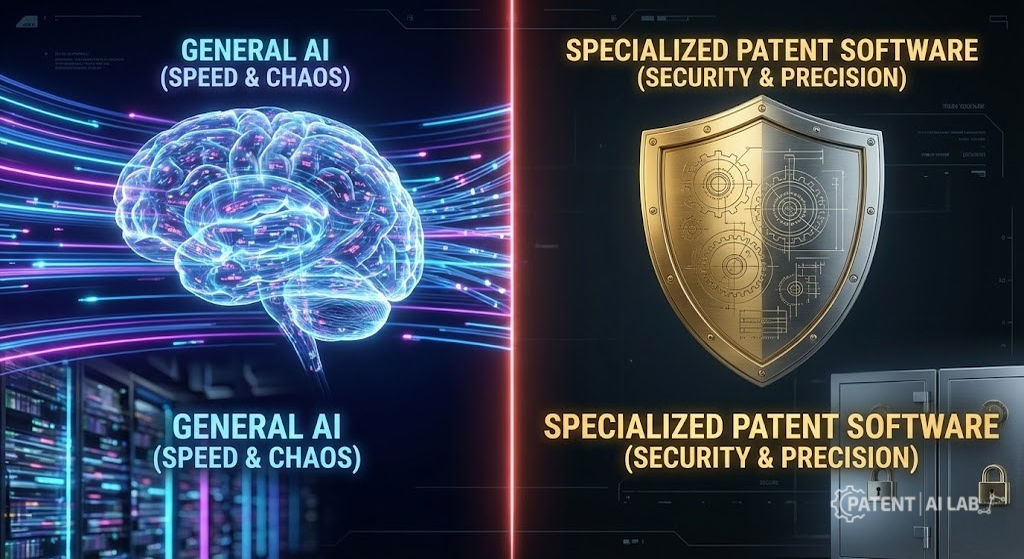
Law firms and founders are treating ChatGPT like a senior patent agent, and existing USPTO rules already address why relying on general tools instead of dedicated AI patent drafting software creates a severe liability problem. General LLMs predict the next probable token; they do not mathematically verify antecedent basis or validate 35 U.S.C. 112 compliance. Under 37 CFR 11.18(b), any practitioner signing a USPTO filing certifies they performed a reasonable inquiry into its contents. Relying solely on an AI tool’s output does not satisfy that standard. This analysis examines where general AI tools succeed, where they structurally fail, and why specialized AI patent drafting software fills a compliance gap that no amount of prompt engineering resolves.
At A Glance
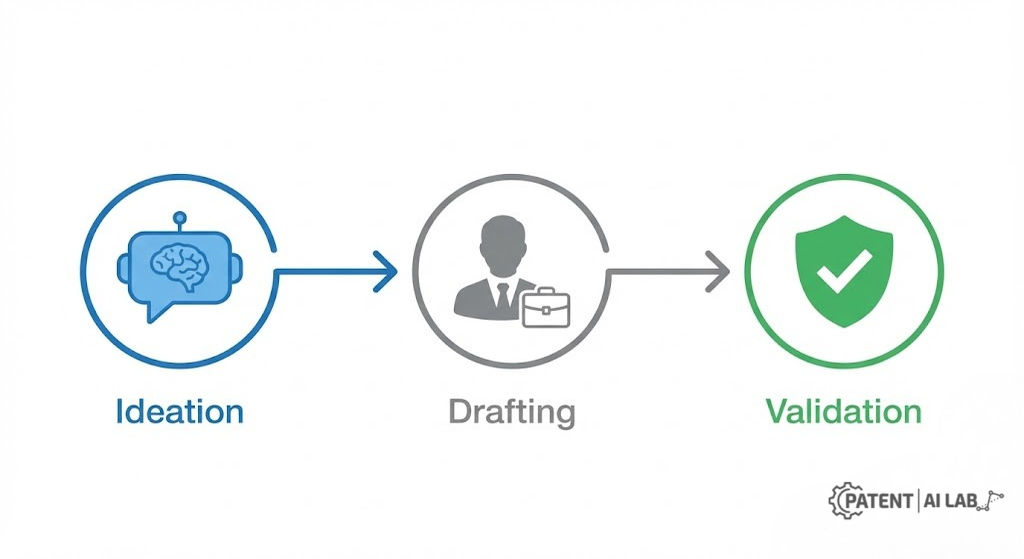
General AI tools excel at fast patent drafting and ideation but fall short on accuracy, USPTO compliance, data security, and liability protection. Specialized patent software addresses the structural gap general LLMs cannot close. The most defensible professional workflow is hybrid: general AI for first-draft scaffolding, specialized tools for validation before filing, with mandatory human attorney review at every stage.
Key Takeaways
- General AI is powerful for drafting but legally insufficient for final claims without specialized validation.
- Antecedent basis errors are the most common LLM-generated deficiency and a primary cause of 35 U.S.C. 112(b) rejections.
- Automated error checking is non-negotiable for USPTO compliance; rule-based engines catch what LLMs cannot self-audit.
- Data security and client confidentiality obligations apply regardless of which AI platform is used.
- Hybrid workflows deliver the highest quality output and reduce prosecution risk over the life of the patent.
Why This Comparison Matters in 2026
AI-assisted drafting is no longer experimental in patent practice. It is routine. The substantive question has shifted from whether to use AI to which AI patent drafting software is appropriate at which stage of prosecution, and what professional obligations attach to each choice.
Patent claim drafting has a low tolerance for imprecision. An antecedent basis error introduced by a language model, undetected before filing, creates a structural deficiency that survives into prosecution and, in contested proceedings, can become the basis for a 35 U.S.C. 112(b) invalidity challenge. This is the compliance gap the “IP premium” in specialized software is designed to close. The gap is not about drafting quality in a stylistic sense; it is about whether the output can withstand examination and enforcement.
This article compares two categories of AI tool across the tasks that matter in patent practice:
- General-Purpose LLMs: ChatGPT Enterprise (OpenAI) and Claude 3.5 Sonnet and Opus (Anthropic)
- Specialized Patent Software: Rowan (Clarivate), Specifio, PatentPal, and ClaimMaster
The evaluation covers claim drafting quality, error detection, data security, and cost-benefit realities. This analysis is for educational and informational purposes only. It does not constitute legal advice. For guidance specific to your prosecution strategy or jurisdiction, consult a qualified patent attorney.
USPTO Guidance on AI-Assisted Patent Drafting: What Practitioners Must Know
On April 11, 2024, the USPTO published guidance on AI use in practice before the Office (89 FR 25609), effective immediately. The guidance did not introduce new regulations. Instead, it applied six existing rules to AI contexts, clarifying how current professional obligations govern AI-generated content submitted to the USPTO. On November 28, 2025, the USPTO issued revised inventorship guidance (FR Doc. 2025-21457) that rescinded its February 2024 inventorship framework and reanchored inventorship analysis on the traditional legal standard of conception: only a natural person who formed a definite and permanent idea of the complete operative invention can be named as an inventor, regardless of how extensively AI assisted in generating the claim language.
The April 2024 guidance is explicit on the point that matters most for practitioners choosing AI tools: “Simply relying on the accuracy of an AI tool is not a reasonable inquiry.” The party presenting any USPTO filing under 37 CFR 11.18(b) must have reviewed and verified the contents. That obligation does not transfer to the AI system. It follows the human signature on the paper.
Five obligations govern AI-assisted patent practice under existing USPTO rules:
- Inventorship: AI cannot be listed as an inventor. Confirmed under both the 2024 and November 2025 guidance. The touchstone remains human conception, defined as the formation of a definite and permanent idea of the complete operative invention in the mind of a natural person.
- Duty of reasonable inquiry: Practitioners must review and verify all AI-generated content before submission. Reliance on an AI tool’s output alone does not satisfy 37 CFR 11.18(b).
- Enablement: Disclosures must enable a person skilled in the art under 35 U.S.C. 112(a). AI-generated alternative embodiments that appear in the claims but lack a significant human contribution must be disclosed under the duty of candor.
- Hallucination risk: The guidance specifically identifies AI systems’ tendency to “omit, misstate, or hallucinate information” as a primary compliance concern. Features hallucinated by an LLM and incorporated into claim language without verification can invalidate claims during post-grant proceedings.
- Confidentiality: Practitioners must not reveal information relating to client representation without informed consent. This obligation applies to data transmitted to any AI platform, including cloud-based general-purpose LLMs.
Since AI agents are becoming more autonomous, understanding the legal boundaries around code and output ownership is equally critical. Read our deep dive on Agentic AI & IP Laws: Who Owns the Code Your Agent Writes? to navigate these liability risks.
⚖️ What the USPTO Guidance Actually Says on Reasonable Inquiry
The April 2024 guidance (89 FR 25609, federalregister.gov) quotes 37 CFR 11.18(b) directly: by presenting any paper to the USPTO, a party certifies that all statements known to them are true and that they performed an inquiry reasonable under the circumstances. The guidance then states: “Simply relying on the accuracy of an AI tool is not a reasonable inquiry.” The practitioner must review the document and verify its contents before signing. This standard applies to every submission type, from patent applications to office action responses to IDS filings.
The Contenders: General LLMs vs. AI Patent Drafting Software
General-Purpose LLMs: ChatGPT Enterprise and Claude 3.5
ChatGPT Enterprise offers strong natural language generation and rapid claim scaffolding. Its “do not train on your data” enterprise policy addresses one confidentiality concern, but the platform has no patent-specific validation engine. It cannot self-audit for antecedent basis compliance, reference numeral consistency, or claim dependency integrity. It does not know what the specification says unless the practitioner pastes it into the prompt, and even then, it has no mechanism to flag when generated claim language introduces elements absent from the disclosure.
Claude 3.5 Sonnet and Opus demonstrate stronger logical coherence in structured outputs, a lower hallucination rate than GPT-4 class models in dependency-heavy tasks, and more consistent antecedent usage across long claim sets. In direct testing, Claude tends to maintain the referential chain between dependent claims more reliably than ChatGPT Enterprise. That said, Claude shares the same structural limitation: it is a language model, and it has no rule-based validation layer. It cannot verify claim support against the specification it has not seen, and it will not flag a missing antecedent as a 112(b) problem unless the practitioner identifies the error themselves in the prompt.
Specialized Patent Software: What Rule-Based Validation Actually Does
Rowan (Clarivate): An integrated drafting environment designed specifically for the patent application lifecycle. Rowan’s validation layer runs real-time, rules-based checks on antecedent basis, reference numeral consistency across claims, specification, and drawings, and claim dependency integrity. It is built for law firm and corporate IP team workflows, with output formats aligned to USPTO prosecution requirements. A user survey cited by Clarivate reports an average productivity gain of 36% for practitioners who adopted the platform.
Specifio: Converts structured technical descriptions into claim language, with particular strength in software and system patent contexts. Built-in consistency checks flag terminology mismatches between claims and specification sections. Its output is narrower and more tightly mapped to the disclosure than general LLM output, which reduces the risk of introducing unsupported elements.
PatentPal: Generates claim language tied directly to specification support, with output delivered in Docx format compatible with standard prosecution workflows. Designed specifically for US patent practice.
ClaimMaster: The established verification standard for practitioners who draft in Microsoft Word. ClaimMaster does not replace drafting; it validates the draft before filing. Its 2024.5 release introduced a new language processing engine tested against thousands of published claims to improve antecedent basis detection accuracy and reduce false positives. It identifies missing antecedent basis, ambiguous antecedent references, singular/plural mismatches, reference numeral inconsistencies between claims and drawings, claim dependency errors, and other issues enumerated in MPEP-based proofreading rules. Its 2026 release added integration with current-generation LLMs through a chat interface, allowing practitioners to combine AI-assisted drafting with its established rule-based verification in a single workflow.
Round 1: Claim Drafting Quality — The Raw Output Test
Before drafting, ensuring you have the right prior art picture is essential. Learn the best search strategies in our guide to Vector vs Boolean Patent Search: The 4-Step Hybrid Workflow.
The Fictional Invention Test: Actual Output Compared
Invention: An AI-based system that dynamically allocates GPU resources across cloud workloads using real-time energy pricing and latency predictions.
Prompt submitted to both models: “Draft an independent system claim for an AI-based cloud GPU allocation system using real-time energy pricing and latency prediction.”
ChatGPT Enterprise produced this claim draft (condensed for illustration):
1. A system for allocating GPU resources in a cloud computing environment, comprising:
   a processor configured to receive real-time energy pricing data from an external source;
   a prediction module configured to estimate network latency across available cloud nodes;
   an allocation engine configured to optimize GPU assignment based on the received energy
   pricing data and the estimated latency; and
   a memory storing instructions executable by the processor to perform the allocation.
The structure is readable and the functional language is clear. Two problems are immediately visible. First, “the received energy pricing data” in element four has antecedent basis in element one, but “the estimated latency” references “the estimated network latency,” a term that does not match the introductory language in element two, which says “estimate network latency,” not “the estimated network latency.” That mismatch is a 112(b) antecedent basis deficiency. Second, “configured to optimize GPU assignment” is functional language with no structural definition of what optimization means, which invites a 112(f) means-plus-function challenge if the specification does not provide corresponding structure.
Claude 3.5 Sonnet produced this alternative draft (condensed for illustration):
1. A system for dynamically allocating graphics processing unit (GPU) resources across
   cloud computing workloads, the system comprising:
   one or more processors; and
   a non-transitory computer-readable medium storing instructions that, when executed
   by the one or more processors, cause the system to:
      receive real-time energy pricing data associated with a plurality of cloud nodes;
      generate a latency prediction for each of the plurality of cloud nodes based on
      current network conditions;
      compute an allocation score for each of the plurality of cloud nodes using the
      real-time energy pricing data and the corresponding latency prediction; and
      assign a pending workload to a selected cloud node based on the allocation score.
Claude’s output handles the dependency chain more precisely. “The real-time energy pricing data” in the third limitation has a clean antecedent in “real-time energy pricing data” in the second limitation. “The corresponding latency prediction” references “a latency prediction” introduced in the third limitation. The referential chain is intact. The structure is also cleaner for 112(f) purposes because it avoids “configured to” in favor of functional method steps tied to a Beauregard-style claim format. That said, “a plurality of cloud nodes” introduced in the second limitation and then referenced as “each of the plurality of cloud nodes” is grammatically sound, but whether “plurality” is correctly supported by the specification depends on disclosure language not visible to the model during drafting. Neither model can check specification support; they are producing language without seeing the full disclosure.
Specialized tools (Specifio, PatentPal) produce narrower claims that map more directly to structured technical descriptions provided during intake. The creative flexibility is lower, but claim-to-specification alignment is higher because the tool constrains output to elements present in the input disclosure.
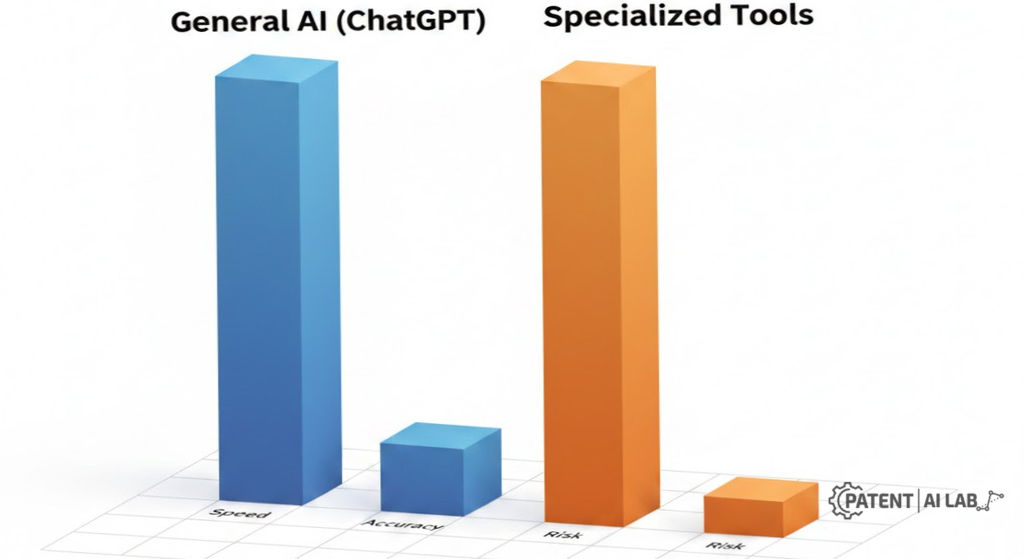
Round 1 Verdict (Winner: General AI for first drafts). ChatGPT and Claude are faster and more flexible for initial claim scaffolding. Claude produces cleaner antecedent handling in standard cases. Neither general model guarantees legal sufficiency, and neither can detect errors in its own output without external verification.
Round 2: Error Checking — Where AI Fails and Rules-Based Tools Deliver
Error detection is the central compliance problem in AI-assisted patent drafting, and it is the one area where general-purpose LLMs have a structural architectural limitation that better prompting cannot fix. An LLM predicts probable next tokens based on training data. It does not parse a claim as a legal document with defined terms, antecedent references, and specification-support requirements. It cannot independently determine that “the allocation engine” in claim 4 lacks antecedent basis because claim 1 introduced “an allocation engine” and claims 2 and 3 did not reference it. It can make this determination if the practitioner asks the right question, but it has no automatic detection mechanism.
The most common LLM-generated errors in patent drafts fall into three categories. Missing antecedent basis occurs when a subsequent limitation refers to an element with the definite article “the” or “said” that was never introduced with the indefinite article “a” or “an” in the same claim or a parent claim. Inconsistent reference numerals occur when a figure element is called “processing unit 14” in the drawings and “processing module 14” in the specification, with the claims using yet a third term, creating a consistency problem across the application. Unsupported functional claiming occurs when claim language uses terms like “optimizing,” “managing,” or “coordinating” as black-box functions without structural definition or corresponding specification support, creating exposure under 35 U.S.C. 112(f).
The table below characterizes each tool’s detection capability across these error types, based on documented product functionality and practitioner review evidence:
Error Detection Capability by Tool Type
| Error Type | ChatGPT Enterprise | Claude 3.5 | ClaimMaster / Rowan |
|---|---|---|---|
| Antecedent basis detection | Low — only when explicitly prompted; cannot audit its own output | Medium — better self-consistency but no systematic rule-check | Automated, rule-based; ClaimMaster 2024.5 tested on thousands of published claims |
| Reference numeral consistency | Poor — no cross-document parsing capability | Poor — same architectural limitation as ChatGPT | Near-perfect — Rowan synchronizes part numbers across claims, specification, and drawings in real time |
| Claim dependency errors | Frequent — especially in long claim sets with multiple dependent branches | Occasional — better at maintaining dependency chains in shorter sets | Rare — rule-based dependency parsing detects structural errors as they are entered |
| 112(f) functional claiming flags | None — no patent profanity or 112(f) trigger detection | None — same limitation | ClaimMaster detects “patent profanity” terms and flags potential 112(f) exposure |
The practical consequence of this gap: when ChatGPT Enterprise is asked to verify a claim draft it just produced, it frequently reports no errors even when structural deficiencies are present. This is not a failure of effort; it is a consequence of how the model operates. It generates text that reads as internally consistent without parsing the claim under the legal rules that define what consistency means in a USPTO filing. ClaimMaster and Rowan detect these issues through rule-based engines that apply MPEP-grounded proofreading logic independently of any language model. Round 2 Winner: Specialized Software.
Round 3: Data Security and Attorney-Client Privilege
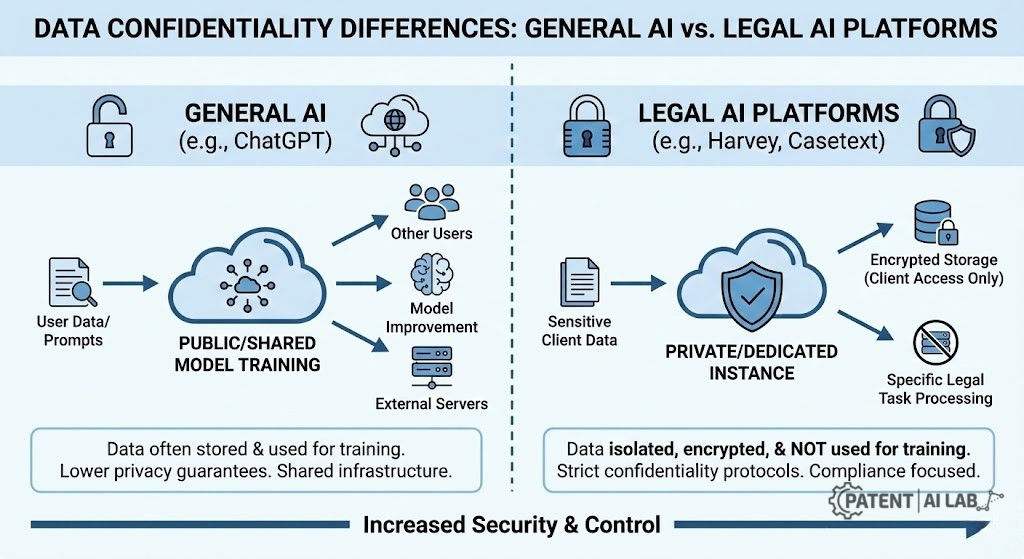
Patent drafts are privileged material. Submitting them to a general-purpose cloud AI platform creates a confidentiality exposure that the USPTO’s April 2024 guidance addresses directly. Under 37 CFR 11.106, practitioners must not reveal information relating to client representation without informed consent. The guidance identifies this obligation as applying to the use of AI tools and reminds practitioners that cloud-based systems may process and store data in ways that are inconsistent with client confidentiality requirements. ChatGPT Enterprise’s “do not train on your data” policy addresses one dimension of that concern, but it does not constitute the kind of documented, auditable data isolation that enterprise law firm procurement processes require.
Specialized patent platforms are built from the ground up for the legal environment. On-premise deployment options, such as ClaimMaster’s local installation model, ensure that draft application text never leaves the practitioner’s network. Enterprise-grade specialized platforms document data handling in formats that support client audits and professional responsibility compliance reviews.
Round 3 Verdict (Winner: Specialized Software). For law firms, the ability to document data isolation, produce client audit trails, and demonstrate that tool selection satisfied professional responsibility obligations often justifies the cost premium independent of any drafting quality consideration.
Formatting and Output Standards: Full Feature Comparison
The table below compares the two tool categories across every dimension that affects the quality and defensibility of a patent application from first draft to filing. The specialized column reflects the combined capabilities of the tools reviewed; no single platform necessarily delivers all attributes listed.
Cost Reality: Is the IP Premium Worth It?
Specialized patent tools typically cost in the mid-to-high four figures per seat annually, compared to low four figures for ChatGPT Enterprise. The cost difference is real, but it should be evaluated against what the premium is actually buying. It is not a drafting speed premium; general LLMs win on first-draft speed. It is a compliance and risk-reduction premium. A single prosecution round triggered by an avoidable 112(b) antecedent basis rejection can generate response costs that exceed the annual subscription difference multiple times over. In post-grant proceedings, an undetected structural deficiency in claim 1 that traces to an LLM-generated antecedent error can result in partial or complete claim invalidation, eliminating the value of the patent itself.
The cost calculation also differs by practice type. Solo practitioners and small firms doing high-volume provisional drafting may find hybrid workflows using general AI for first drafts with ClaimMaster verification to be the most cost-efficient option. Large firm IP departments and corporate legal teams managing active patent portfolios will typically find the integrated environment of platforms like Rowan justified by the reduction in prosecution overhead and the auditability requirements of enterprise clients. Review how patent prosecution costs scale across jurisdictions in our US vs UK Software Patent Cost Analysis.
The 2026 Verdict: The Hybrid Workflow Is the Professional Standard
When evaluating the landscape of AI patent drafting software, the comparison between general LLMs and specialized engines is not a binary choice in professional practice. The two categories perform different functions, and the practitioners who produce the highest-quality work are combining them deliberately rather than treating either as a complete solution.
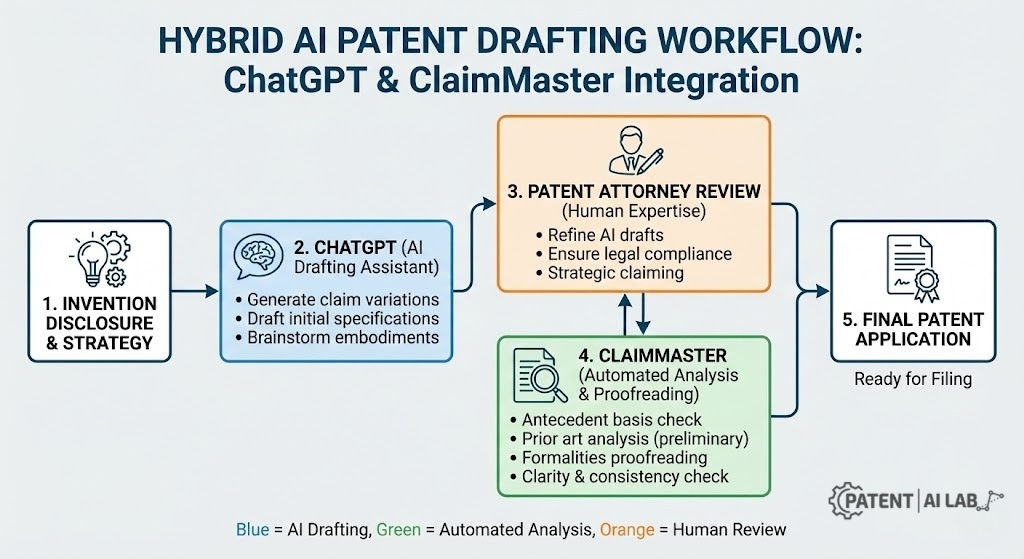
The workflow that satisfies both quality and compliance requirements has three stages. In the first stage, ChatGPT Enterprise or Claude handles rapid ideation: generating alternative embodiments, producing first-draft independent claims, and drafting background and summary sections from inventor disclosures. This is where general LLMs add the most value relative to their cost. In the second stage, the draft moves to specialized validation tools. ClaimMaster verifies antecedent basis across all claims, checks reference numeral consistency against the drawings, flags dependency errors, and identifies potential 112(f) exposure. Rowan users accomplish validation within the same drafting environment through its integrated real-time rules engine. In the third stage, the practitioner reviews the validated draft with the understanding that no automated system substitutes for the reasonable inquiry 37 CFR 11.18(b) requires. The attorney’s review of the verified output is not a rubber stamp; it is the step that makes the filing legally defensible.
- Use ChatGPT or Claude for rapid ideation, expanding alternative embodiments, and drafting early scaffolding.
- Move the draft to specialized validation tools (ClaimMaster, Rowan, or equivalent) for antecedent basis checking, reference numeral consistency, dependency verification, and formatting before submission.
- Human review is legally mandatory and cannot be delegated. Under 37 CFR 11.18(b), the practitioner who signs the filing certifies a reasonable inquiry into its contents. That obligation follows the human signature.
Future Outlook: What to Watch in Patent AI Beyond 2026
What Is Likely:
The boundary between general AI and specialized patent software is converging, not disappearing. ClaimMaster’s 2026 release demonstrates the direction: a rule-based validation engine integrating current-generation LLMs through a structured interface, combining AI drafting assistance with non-AI compliance checking. The trajectory is toward integrated platforms where LLM assistance is sandboxed within environments that enforce patent-specific validation rules. General LLMs used in isolation for final filing preparation will represent an increasingly visible professional responsibility risk as that integrated standard becomes the norm.
What to Watch (Risks):
The USPTO’s November 2025 revised inventorship guidance, implemented under Executive Order 14179, signals continued regulatory focus on the intersection of AI and patent practice. Inventorship documentation requirements will become more stringent as AI-assisted R&D becomes standard. Practitioners should expect the USPTO to issue further guidance on AI use in prosecution, particularly around IDS generation, where the April 2024 guidance already flagged AI’s potential to omit relevant prior art as a duty-of-candor concern. Data security requirements for patent practice tools will continue to harden as enterprise procurement policies align with legal professional responsibility standards.
Podcast
Note: This audio is a condensed summary. Please refer to the written text for precise legal definitions and liability constraints.
FAQs
Is it safe to draft patent claims with ChatGPT?
Safe for early ideation drafts, but not appropriate for filing without specialized validation. The USPTO’s April 2024 guidance (89 FR 25609) states explicitly that relying on an AI tool’s output alone does not satisfy the duty of reasonable inquiry under 37 CFR 11.18(b). Common structural errors like missing antecedent basis and claim dependency failures require rule-based detection tools that general LLMs do not provide.
Does the USPTO allow AI-written patents?
Yes, AI-assisted drafting is permitted. The USPTO’s April 2024 guidance does not prohibit AI use and introduces no new rules. However, AI cannot be named as an inventor under either the 2024 guidance or the revised November 2025 guidance (FR Doc. 2025-21457). The human practitioner remains fully responsible for verifying all contents before submission, and any AI-generated claim language lacking significant human contribution must be disclosed under the duty of candor.
Which LLM performs best for patent claim drafting in 2026?
Claude 3.5 generally outperforms ChatGPT Enterprise in logical consistency and maintaining antecedent integrity across dependent claim sets. It handles dependency chains more reliably in structured outputs. Neither general model provides the rule-based validation that specialized patent software delivers, so the practical answer for professional use is: Claude for first drafts, ClaimMaster or Rowan for validation.
Do specialized patent tools reduce prosecution risk?
Yes. Specialized patent software provides automated verification layers that address the most common 112(b) rejection triggers: missing antecedent basis, reference numeral inconsistencies, and unsupported claim dependencies. ClaimMaster’s rule-based engine, validated against thousands of published claims in its 2024.5 release, creates a documented quality control checkpoint between AI-assisted drafting and USPTO filing. This does not eliminate practitioner liability but substantially reduces the likelihood of avoidable filing errors.
What is the most cost-effective workflow for a solo patent practitioner?
For solo practitioners doing high-volume drafting, the optimal balance is Claude or ChatGPT Enterprise for first-draft ideation combined with ClaimMaster for pre-filing verification. This combination captures the speed advantage of general LLMs while adding the rule-based compliance layer that the USPTO’s reasonable inquiry standard requires. ClaimMaster’s on-premise installation also addresses the data confidentiality dimension without the overhead of an enterprise platform subscription.
Sources and Legal References
The legal standards, compliance obligations, and regulatory references discussed in this analysis are drawn directly from official federal publications and verified primary sources:
-
USPTO — Guidance on Use of AI-Based Tools in Practice Before the USPTO (April 11, 2024 — 89 FR 25609)
Official Federal Register notice applying 37 CFR 11.18(b) (duty of reasonable inquiry), 37 CFR 11.106 (client confidentiality), and the duty of candor to AI-assisted patent practice. Establishes that relying on an AI tool’s output alone does not constitute a reasonable inquiry and that all AI-generated content must be reviewed and verified by the presenting party before filing.
Read the full guidance on federalregister.gov -
USPTO — Revised Inventorship Guidance for AI-Assisted Inventions (November 28, 2025 — FR Doc. 2025-21457)
Rescinds the February 2024 inventorship guidance and withdraws the application of the Pannu joint inventorship factors to AI-assisted inventions. Reanchors inventorship analysis on the traditional conception standard: only a natural person who formed a definite and permanent idea of the complete operative invention qualifies as an inventor. AI systems are classified as tools, not inventors or co-inventors, regardless of their contribution to the claim language.
Read the revised guidance on federalregister.gov -
USPTO — 37 CFR 11.18(b): Signature Requirement and Certification of Reasonable Inquiry
The regulation requiring that any party presenting a paper to the USPTO certify that all statements to their knowledge are true and that the party performed an inquiry reasonable under the circumstances. The April 2024 guidance applies this requirement specifically to AI-generated content.
USPTO Patent Laws and Guidance (uspto.gov) -
ClaimMaster Software — Patent Proofreading Improvements Release Notes (2024.5)
Official release documentation for the new language processing engine introduced in ClaimMaster 2024.5, describing antecedent basis detection improvements tested against thousands of published claims. Confirms the rule-based detection capabilities referenced in the error detection comparison above.
ClaimMaster 2024.5 release notes (patentclaimmaster.com) -
Mayer Brown — USPTO Issues Revised Guidance on Inventorship for AI-Assisted Inventions (December 2025)
Practitioner analysis of the November 2025 revised guidance, detailing the shift from the Pannu-factors framework to traditional conception doctrine and the operational implications for companies using AI in R&D, including documentation requirements and governance frameworks.
Read the Mayer Brown analysis (mayerbrown.com)
Disclaimer & Legal Notice
This article reflects the author’s perspective evaluating generative language models and specialized legal software architectures from a strategic and technical standpoint. It is intended strictly for informational purposes and does not constitute formal legal advisory services or malpractice guidance. It is not a substitute for the advice of a qualified, licensed patent attorney. Software capabilities and intellectual property laws change frequently. Always consult a certified patent counsel before executing applications or relying on automated outputs.


Add comment