


 Golam Rabiul Alam, PhD
When calculating the true software patent cost, bootstrapped founders are burning their entire legal runway chasing a US filing, oblivious to the fact that the UK offers the same early prioritization for a fraction of the price. In 2026, navigating international patent fees without a strict geographic roadmap puts real cash at risk. Filing blindly, without analyzing entity discounts and the hidden costs of software rejections, drains seed budget with little to show for it. The cost breakdown below between the USPTO and UKIPO is a general framework based on official fee schedules, not case-specific legal advice, since the right jurisdiction for any single applicant still depends on the actual claims being drafted, the target market, and the company’s funding plans, and that determination should sit with a qualified patent attorney.
The two jurisdictions also differ in what they are actually testing for, not just what they charge. USPTO examiners spend much of the prosecution budget probing whether a claim survives Section 101, a substantive legal question that can swing the same invention toward approval or rejection depending on drafting. UKIPO examiners instead work from a narrower, more mechanical technical-contribution test, which tends to produce fewer rounds of back-and-forth but is less forgiving of claims that read as pure business logic. That difference in examination philosophy, not just the line-item fees, is what drives most of the cost gap covered in this guide.
At A Glance
In 2026, comparing the US vs UK software patent cost is critical for startups. It is significantly cheaper to file and maintain a software patent in the UK than in the US. UKIPO official fees are lower and renewals start later, but USPTO patents offer access to a much larger market. For bootstrapped startups, filing first in the UK often makes financial sense, while US filings are justified when fundraising or enterprise acquisition is the goal.
Key Takeaways
- The baseline software patent cost is substantially cheaper in the UK, both to file and prosecute.
- US software patents incur massive hidden costs due to ongoing Alice rejections.
- Maintenance is cheaper long-term in the US only if micro entity discounts apply.
- Provisional filings give the US a significant early-stage tactical edge.
- Your patent jurisdiction must follow your business goals, not founder ego.
Why Patent Costs Matter More in 2026
Software startups face a harder IP trade-off than ever. AI-driven code is easier to build but harder to patent, investors increasingly demand defensible proprietary tech during due diligence, and patent budgets compete directly with cloud infrastructure and core engineering talent.
This makes startup IP budget planning critical. Filing in the wrong jurisdiction, or filing too early, can burn limited seed cash without creating real market value. This guide focuses on one core question: when evaluating the US vs UK software patent cost, where do startups actually get better value for money?
Before spending $10k+ on specialized attorney fees, confirm your architecture is actually unique. Use our guide on The Best Free Patent Search Engines for Startups to run your own preliminary due diligence.
💰 Official Fee Update
Please note that the UKIPO officially increased its patent, trademark, and design fees by an average of 25% starting April 1, 2026. This follows the massive USPTO fee hike implemented in early 2025. The data matrices below reflect these newly enforced rates.
Patent Eligibility Basics (Plain English)
Before analyzing the line-item software patent cost, the statutory eligibility boundaries come first.
US (USPTO): Software + Alice Risk
In the US, software applications are judged aggressively under Section 101 and the multi-step Alice test framework. Under this doctrine, abstract ideas are strictly non-patentable. Your software must demonstrate a concrete, system-level technical improvement, not simple business automation.
The practical difficulty is that “abstract idea” is not a fixed checklist. Examiners apply the same two-step Alice framework to very different software claims, so two applications describing similar functionality can land on opposite sides of the line depending entirely on how the technical improvement is articulated in the specification. This is why claim drafting, not just the underlying invention, drives outcome risk in the US.
Execution Examples:
❌ Abstract Idea: Using a generic AI model to match gig-workers faster.
✅ Patentable Improvement: A neural-network-based scheduling framework that dynamically minimizes cloud server overhead by 37% via adaptive execution batching.
Handling these technical rejections is the single biggest budget killer for US filings. To avoid burning seed money on abstract, unpatentable claims, study our framework on Surviving the ‘Alice’ Nightmare.
UK (UKIPO): Technical Contribution Test
The UK operates under a rigid technical contribution standard. Software code is technically excluded “as such”, but it is fully permissible if it solves an external technical problem or optimizes the internal performance of the computing infrastructure. UK examiners are often far more predictable when evaluating core AI infrastructure and backend innovations.
The practical distinction examiners draw is between a business outcome and an engineering mechanism. A claim that simply automates a manual process is treated as excluded subject matter regardless of how the software is implemented. A claim describing how the system achieves that outcome, through a specific data structure, processing sequence, or resource optimization at the infrastructure level, is what the technical contribution test is designed to capture. This narrower but more consistent standard is part of why UK prosecution timelines tend to be shorter than US prosecution for comparable backend software claims.
The Breakdown: USPTO vs UKIPO Fees (Clear Table)
The upfront US vs UK software patent cost shows a stark contrast in foundational expenses.
Official Filing + Attorney Cost Comparison (2026 Estimates)
| Country | Filing Fee | Search & Exam Fee | Grant Fee | Attorney Avg. Cost |
|---|---|---|---|---|
| USA (USPTO) | $70 to $350 | $330 to $1,650 | $258 to $1,290 | $12,000 to $25,000 |
| UK (UKIPO) | £75 | £330 | £0 | £3,000 to £6,000 |
Government entry fees differ, but the primary operational variation comes from specialized attorney billable hours, not administrative office mandates.

USPTO vs. UKIPO Software Patent Cost Comparison Chart
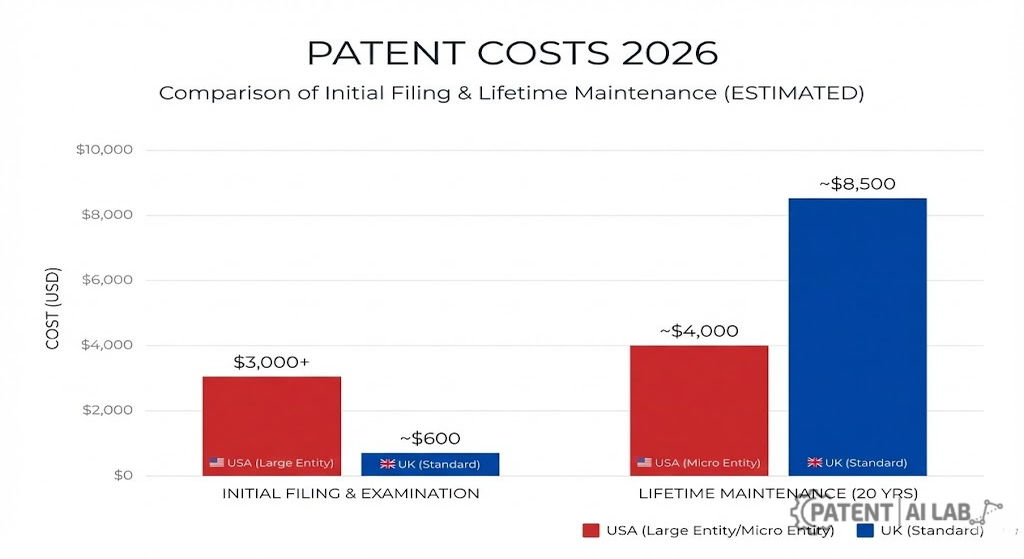
The following detailed schedule breaks down lifetime government processing and maintenance schedules effective in 2026. For cross-border clarity, UKIPO fees are converted based on an indexed exchange rate of 1 GBP = 1.35 USD.
| Cost Category | USPTO (Large Entity) | UKIPO (approx. USD) | Notes |
|---|---|---|---|
| 1. Initial Filing & Examination | |||
| Basic Filing Fee | $350 | ~$101 (£75) | UKIPO fee is for online filing. |
| Search Fee | $770 | ~$270 (£200) | UKIPO fee is for an online search request. |
| Examination Fee | $880 | ~$176 (£130) | UKIPO fee is for an online substantive exam. |
| Subtotal: Initial Fees | $2,000 | ~$547 (£405) | |
| 2. Grant / Issue Fees | |||
| Issue/Grant Fee | $1,290 | $0 | UKIPO has no separate issue fee. |
| 3. Maintenance / Renewal Fees | |||
| When do they start? | Due at 3.5, 7.5, and 11.5 years after grant. | Due annually, starting from the 5th anniversary. | |
| First Payment | $2,150 (at 3.5 years) | ~$122 (£90) (for Year 5) | USPTO fees are lump sums; UKIPO increases annually. |
| Middle Payment(s) | $4,040 (at 7.5 years) | ~$270 (£200) (for Year 10) | |
| Final Payment | $8,280 (at 11.5 years) | ~$1,094 (£810) (for Year 20) | |
| Total Lifetime Maintenance | $14,470 | ~$8,316 (£6,160) | Total to keep patent in force for full 20- year term. |
| 4. Common Additional Fees | |||
| Excess Independent Claims | $600 each (over 3) | N/A | UKIPO does not charge for this. |
| Excess Total Claims | $200 each (over 20) | ~$36 (£27) each (over 25) | UKIPO fee is payable at search request or grant. |
| Request for Continued Exam (RCE) | 1st: $1,500 2nd+: $2,860 | N/A | UKIPO does not have a costly US RCE practice. |
| ESTIMATED LIFETIME COST | ~$17,760 | ~$8,863 | Assumes standard application, full 20 years. |
Provisional Patent Cost Comparison (US Advantage)
US Provisional Applications
- Official Fee: $75-$300 depending on entity mapping.
- Attorney Drafting Cost: $2,000-$5,000 for system disclosure.
- Strategic Window: Purchases 12 full months of international “patent pending” status.
This localized provisional architecture is a major structural advantage for early-stage software companies filing within the US framework.
UK Has No True Provisional
The UK IPO permits a low-cost ‘Priority Filing’ mechanism, but it is fundamentally more rigid. Unlike a US provisional, a priority filing requires a highly complete technical specification to survive subsequent novelty challenges. It remains significantly less forgiving for volatile, iterative software builds.
An exceptional mechanism to lower upfront application overhead is optimizing structural visualization. Read our operational tutorial on How to Generate USPTO-Ready Patent Drawings with AI to bypass custom draftsman fees entirely.
Hidden Costs: Maintenance and Renewal Fees
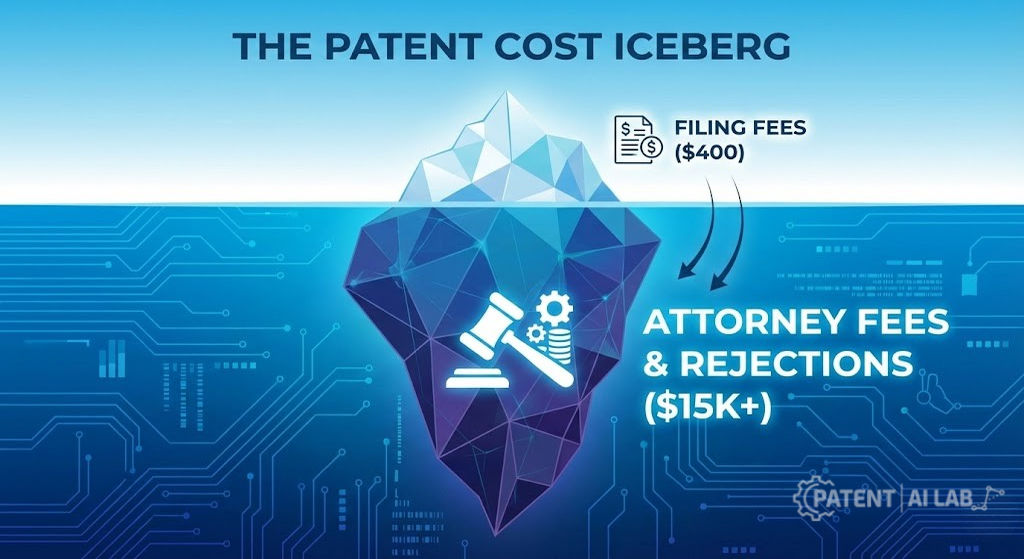
The total software patent cost over a 20-year lifecycle is where budget trajectories diverge completely. To secure maximum legibility across mobile displays, this three-column comparison uses our core layout framework:
Office Actions: The Silent Budget Killer
US Office Actions (Especially Alice)
- Multi-round rejection cycles are the baseline standard, not the exception.
- Each independent amendment response incurs a $2,000-$5,000 billable attorney charge.
- Alice eligibility parameters remain highly subjective and prone to examiner bias.
This is precisely where software patent attorney fees spike unpredictably, creating major cash flow vulnerabilities for early seed operations.
UK Office Actions
- Substantially fewer objection rounds before reaching a conclusive decision.
- Examiners issue highly structured, technical objections focused on core mechanics.
- Drastically lower administrative response and filing costs.
Future Outlook: 2026-2030
What is Likely:
Expect continuous, inflation-indexed official fee adjustments from both the USPTO and UKIPO. To minimize the overall software patent cost, staged global processing—initiating a localized US provisional before executing European or UK extensions within the 12-month window—will become the baseline default for prudent software operations.
What to Watch (Risks):
Do not expect any statutory softening of the Alice doctrine in the US or the technical contribution tests in Europe. Founders must actively monitor their prior corporate filings. Crossing the threshold of four historical applications immediately disqualifies the entity from the critical 80% Micro Entity fee discount.
Podcast
Note: This audio is a condensed summary. Please refer to the written text for precise legal and compliance definitions.
FAQs
Is UK or US patent filing cheaper for software?
Yes. The UK is significantly cheaper upfront and during prosecution phases. The US can become more economical over a 20-year cycle only if the entity qualifies for the strict federal Micro Entity status criteria.
Are software patents easier in the UK?
Generally yes, specifically for backend infrastructure and localized AI implementations that demonstrate a highly structured, objective technical effect.
Can AI-generated code be patented?
Yes, provided that the core invention resides in the technical system architecture, data flow, or processing method rather than a human claim over the raw AI-generated code output itself.
Do investors care where you file?
US institutional VCs heavily favor USPTO applications to protect their target market. European investment pools demonstrate substantially more flexibility toward initial regional filings.
Sources and Legal References
The international fee structures, entity classification criteria, and core statutory software examination policies detailed in this comparison are directly derived from official state agency manifests:
-
1. USPTO — Official Fee Schedule & Entity Definitions (37 CFR)
The official fee catalog governing utility patents, specifying Large Entity rates alongside statutory 60% Small Entity and 80% Micro Entity discounts under established application volume constraints.
Review USPTO Fee Schedules -
2. UK Intellectual Property Office (UKIPO) — Patent Fee Revisions
The official UK administrative fee table tracking baseline filing, search, and substantive examination metrics, including the newly enforced annual escalating renewal fees applied post-Year 5.
Access UKIPO Fee Structures -
3. Cornell Law LII — 35 U.S.C. § 101
The statutory text underlying the Section 101 patentable subject matter standard referenced in the Alice eligibility discussion for US software claims.
Read 35 U.S.C. § 101 -
4. legislation.gov.uk — Patents Act 1977, Section 1(2)
The official UK legislation database hosting the statutory text behind the “as such” software exclusion referenced in the technical contribution discussion for UK software claims.
View UK Legislation
Disclaimer & Legal Notice
This article reflects the author’s perspective evaluating cross-border IP prosecution strategies and corporate patent costs from a strategic and technical standpoint. It is intended strictly for informational purposes and does not constitute formal legal or financial advisory services. It is not a substitute for the advice of a qualified, licensed patent attorney. Intellectual property mandates change frequently. Always consult a certified patent counsel before structuring asset applications or processing foreign filings.


[…] While specialized tools cost more upfront, they reduce the risk of costly rejections. See how this fits into your total budget in our US vs UK Software Patent Cost : Which is Cheaper for Startups? […]
[…] While trade secrets cost nothing to register, patent filing fees are rising. See the full breakdown in our US vs UK Software Patent Cost: Which is Cheaper for Startups?. […]