


 Golam Rabiul Alam, PhD
At A Glance
Solid-state batteries are the “Holy Grail” of EVs. Analyzing solid state battery patents 2026 reveals that Japan (led by Toyota) holds the foundational intellectual property, while China dominates volume filings and manufacturing speed. While Japan perfects the ultimate sulfide-based all-solid-state technology, Chinese firms like CATL are commercializing semi-solid variants faster. Patent quality suggests Japan owns the core blueprint, but China’s scale is closing the commercialization gap rapidly.
Key Takeaways
- Solid-state batteries are the strategic core of EVs.
- Japan leads in foundational patents.
- China leads in scale and speed.
- The US leads in targeted breakthroughs.
- The future is shared dominance, not winner-take-all.
Recent WIPO data shows global solid-state battery patent applications surged to 1,288 in 2025 alone. While Toyota holds over 1,300 foundational patent families, LG Energy Solution has emerged as a specific threat, securing 77 of the most highly cited core patents specifically targeting ionic conductivity and energy density. Meanwhile, CATL just secured an €8.4 billion copper foil supply deal for 2026-2028 to rapidly scale its 500 Wh/kg pilot production lines.
Comparison: Japan’s Patent Power vs. China’s Industrial Scale
| Parameter | Japan (🇯🇵) | China (🇨🇳) |
|---|---|---|
| Core Strength | Intellectual Property (IP) & R&D | Manufacturing Scale & Supply Chain |
| Top Players | Toyota, Honda, Nissan, Panasonic | CATL, BYD, WeLion, Ganfeng Lithium |
| Technology Focus | Sulfide-based Solid Electrolytes | Oxide & Polymer- based, Semi-Solid |
| Mass Production Status | Targeting 2027-2028 (Luxury EVs) | Mass production started (Semi-solid in NIO EVs) |
| Primary Strategy | “Perfecting the Technology” | “Dominating the Market” |
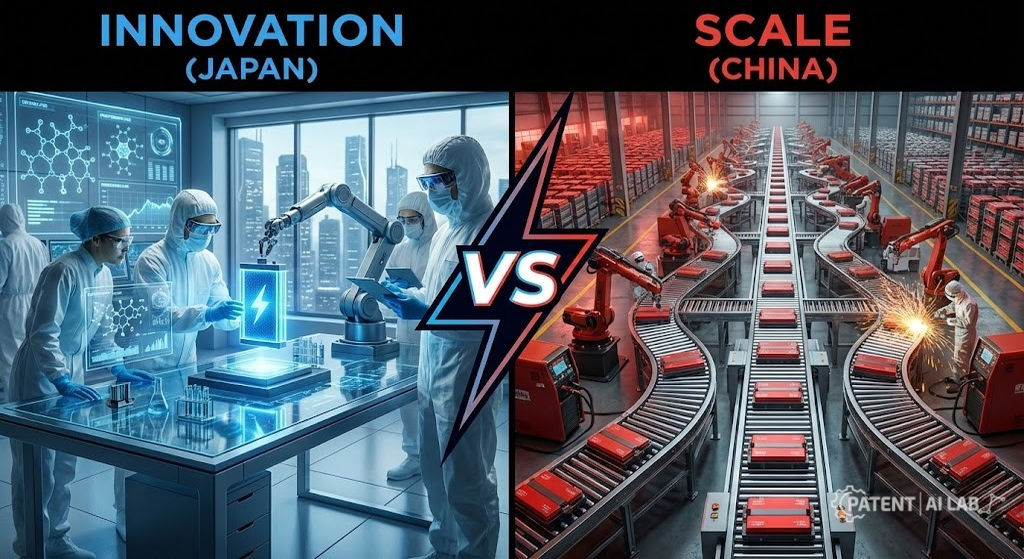
Analyst Verdict 2026: While Japan holds the lead in solid-state battery innovation and patent volume, China is winning the race to commercialization by leveraging its massive manufacturing infrastructure and supply chain dominance to bring the technology to the EV market faster. Simply put—Japan has the blueprints, but China has the factories. China’s speed comes from prioritizing Semi-Solid tech, while Japan waits for the perfection of All-Solid variants.
Why Solid-State Batteries Are the “Holy Grail”
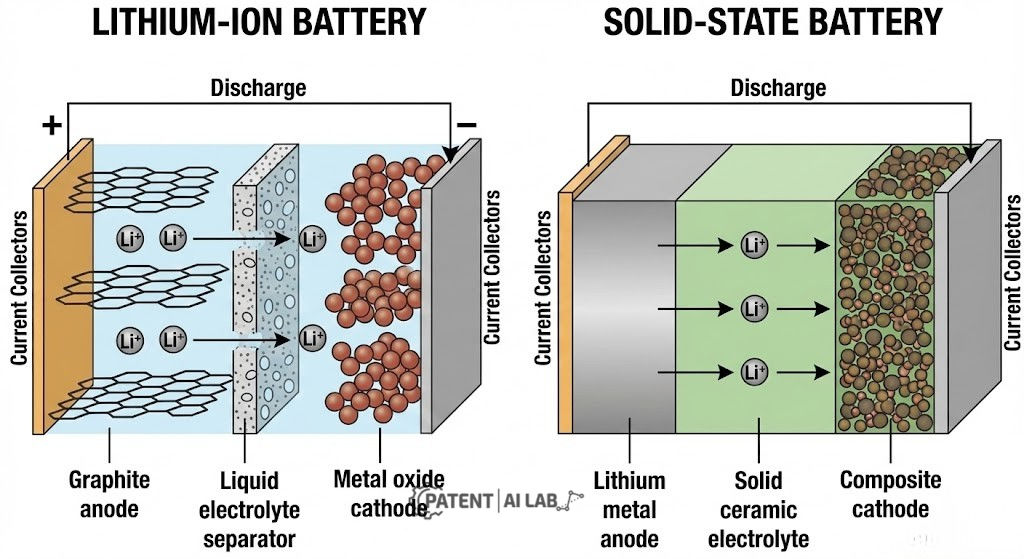
Solid-state batteries replace liquid electrolytes with solid ones. This single change unlocks three critical advantages:
- Higher energy density (longer EV range)
- Improved safety (lower fire risk)
- Faster charging and longer cycle life
By 2026, these benefits are no longer theoretical. Prototypes exist. Pilot lines are running. What separates winners from losers is who controls the patent landscape, especially the core claims covering solid electrolytes, interfaces, and manufacturing methods.
Patents decide who licenses, who pays, and who scales.
Global Solid-State Patent Ranking (2026): The Top 10 Players
Based on active patent families and commercial relevance early in 2026, here is the definitive ranking of who controls the solid-state battery landscape.
Here is the definitive ranking of top companies holding solid-state battery patents as of 2026:
| Rank | Company | Country | Status & Strategy |
|---|---|---|---|
| 1 | Toyota | Japan | The Fortress. Holds ~1,300+ core families. Dominant in sulfide-electrolyte. |
| 2 | Panasonic | Japan | The Veteran. Strong history, partnering with OEMs like Tesla and Honda. |
| 3 | Samsung SDI | South Korea | The Sniper. Most aggressive recent filer; targeting 2027 commercialization. |
| 4 | LG Energy Sol. | South Korea | The Scaler. Holds 77 highly critical core patents for ionic conductivity. |
| 5 | CATL | China | The Volume King. Rapidly rising; focused on manufacturing IP and 500 Wh/kg pilot lines. |
| 6 | Honda | Japan | The Engineer. Distinct IP on avoiding dendrite formation. |
| 7 | Idemitsu Kosan | Japan | The Materialist. Owns critical IP for the electrolyte material itself (Toyota partner). |
| 8 | QuantumScape | USA | The Specialist. High- value pure-play IP (~500 patents) on ceramic separators. |
| 9 | Hyundai / Kia | South Korea | The Challenger. Focusing on cost- reduction and silicon-anode integration. |
| 10 | ProLogium | Taiwan | The Pioneer. Mature “startup” portfolio in oxide-ceramic batteries. |
Want to track these patent filings in real-time? Use The Best Free Patent Search Engines for Startups to monitor the latest solid-state applications yourself.
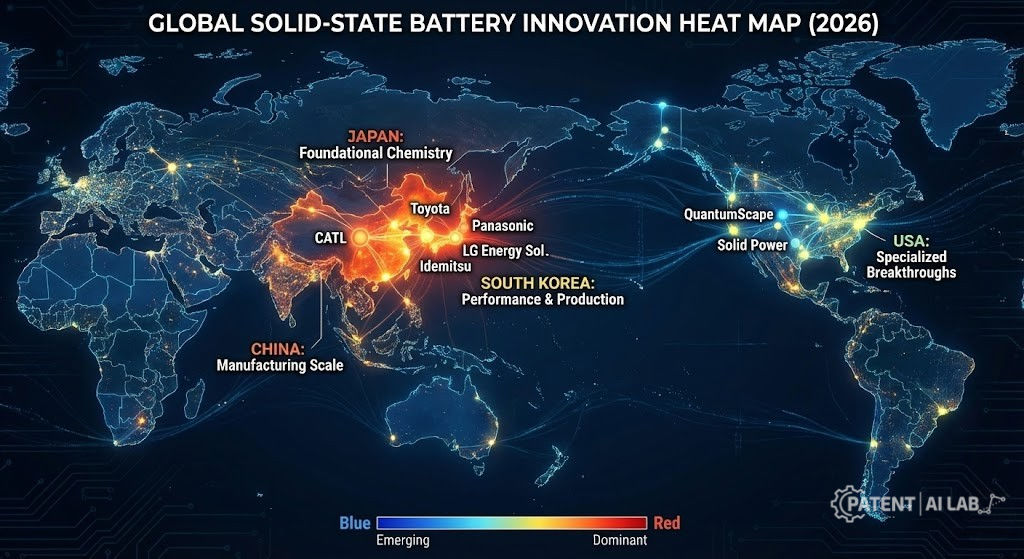
Geographic “Heat Map” Analysis
- Japan (The Core): Remains the “brain” of the industry. Toyota, Panasonic, and Idemitsu hold the foundational patents on how solid-state batteries work chemically.
- China (The Factory): The fastest-growing region. Patents here are shifting from “theoretical” to “practical manufacturing,” focusing on how to build these batteries cheaply.
- South Korea (The Bridge): Samsung and LG are bridging the gap, holding patents that balance high performance with realistic manufacturing goals.
- USA (The Lab): Dominated by specialized startups (QuantumScape, Solid Power) and University IP (MIT, Harvard), focusing on specific breakthroughs like anode-free designs.
Deep Dive: Toyota vs. CATL – The Patent Fortress vs. The Factory
The Core Distinction
Toyota is the “Patent Fortress” for Solid-State Batteries (SSB). They hold the world’s largest portfolio of sulfide-based solid-state patents, a strategy they have been building for 30 years to secure a monopoly on the “next-generation” standard.
In contrast, CATL is the “Manufacturing Engine” for Lithium-Ion & LFP. Their patent portfolio is younger but growing faster, focusing on immediate mass-production technologies (like CTP “Cell-to-Pack” and sodium-ion) rather than just future chemistry.
Building a massive portfolio like Toyota’s isn’t cheap. See the breakdown of maintenance fees in our analysis of US vs UK Software Patent Cost.
Toyota vs. CATL: Patent Portfolio Comparison
| Feature | Toyota (The Specialist) | CATL (The Generalist) |
|---|---|---|
| Primary Patent Focus | Solid-State Batteries (SSB) | Lithium-Ion (LFP), Sodium-Ion, Pack Structure |
| Solid-State Patents | ~1,300+ Core Families | < 500 Core Families (Rapidly Catching Up) |
| Commercial Timeline | 2027–2028: Small volume. Mass >2030. | Now: Shipping semi-solid; SSB pilot lines active. |
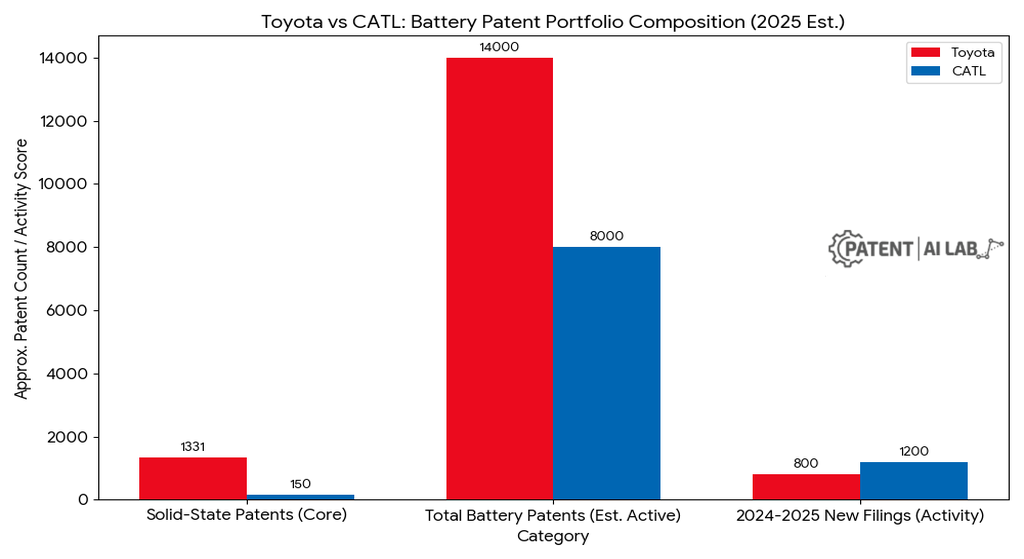
The “Innovation Gap” (Visual Insight)
There is a stark contrast in strategies visible in the patent data. Toyota dwarfs CATL in “Future Tech” (Solid-State) patents, aiming for long-term dominance. Meanwhile, CATL is aggressively outpacing Toyota in “Recent Activity” (new filings for current tech), aiming to win the market today.
Understanding Patent Eligibility (Simple Explanation)
Under current USPTO guidelines, a battery patent must:
- Solve a technical problem
- Use specific materials or processes
- Avoid abstract or purely mathematical claims
For example:
- Eligible (Simplified): A patent claiming a sulfide electrolyte composition that reduces dendrite growth is usually eligible.
- Not Eligible: A claim that simply says “optimize battery charging using AI” without technical detail risks rejection.
Example: AI-Generated Code in Battery R&D (Simplified)
AI is often used to discover new materials. The patent risk lies in how claims are written.
Python

# Conceptual Illustration Only
# AI-assisted electrolyte screening (simplified)
materials = load_material_database()
for compound in materials:
    score = predict_ionic_conductivity(compound)
    if score > threshold:
        shortlist.append(compound)
The code itself is not patentable.
What can be patented is the resulting electrolyte composition or a novel manufacturing process derived from it.
- Japan’s patents usually claim the physical outcome.
- China’s patents often focus on system-level improvements.
Using AI to discover new materials accelerates R&D, but it creates ownership risks. Learn more about liability in Agentic AI & IP Laws: Who Owns the Code Your Agent Writes?
Energy Density Comparison 2026
| Battery Type | Energy Density (Wh/kg) |
|---|---|
| Conventional Li-ion | 250–300 |
| Semi-Solid (e.g., WeLion) | 320–380 |
| Full Solid-State (Pilot) | 350–420 |
| Full Solid-State (Lab) | 400–500+ |
Note: Japan’s patents dominate the 400+ Wh/kg category.
Solid-State Battery Mass Production Timeline
- Japan: Pilot lines Active. Limited EV rollout: 2027–2028. Mass adoption: 2029+.
- China: Semi-solid commercialization: 2026–2027. Full solid-state scaling: 2028–2030.
China may reach market first, but Japan’s tech may age better.
China Dominance in EV Battery Supply Chain
China controls:
- Over 70% of lithium refining
- Majority of cathode and anode processing
- Battery-grade graphite and rare earths
This gives China leverage even if Japan owns patents. US reliance on Chinese battery materials remains high, creating geopolitical risk.
US & UK Position: Small but Dangerous
United States
US startups like QuantumScape and Solid Power hold fewer patents but focus on:
- Lithium metal anodes
- High-risk, high-reward designs
Their portfolios are narrow but powerful. One strong claim can block an entire category.
United Kingdom
UK contributions are mostly:
- University research
- Spin-offs in solid electrolytes and modeling
The UK is influential academically, less so commercially.
Next-Gen EV Battery Market Share (Projection)
| Region | 2030 Market Share (Projected) |
|---|---|
| China | 35–40% |
| Japan | 25–30% |
| Korea | 15–18% |
| USA | 10–12% |
Patent ownership suggests Japan wins on licensing, China on volume.
Real-World Implications
For Investors
- Watch Toyota, Panasonic, Samsung SDI.
- Monitor CATL’s transition from semi-solid to full solid-state.
For Startups
- Avoid broad claims.
- Focus on niche interfaces or manufacturing steps.
For Developers & AI Researchers
- AI helps discovery, not patent eligibility.
- Document physical outcomes carefully.
Podcast
Disclaimer
This article is based on our team’s experience advising startups, product development, and tracking IP litigation. Tools and legal interpretations change over time. Please note that PatentAILab is an educational platform and not a law firm. This content is for educational purposes only and does not constitute legal advice. Intellectual property laws (especially regarding AI) are complex and change frequently. Always consult a qualified patent attorney for your specific situation.
FAQs
Who owns the most solid-state battery patents in 2026?
Toyota, followed by Panasonic and Samsung SDI.
Is China ahead of Japan in solid-state batteries?
In manufacturing speed, yes. In core patents, no.
When will solid-state batteries reach mass production?
Limited production by 2027–2028. Broad adoption closer to 2029–2030.
Are AI-generated battery designs patentable?
Only if the claims focus on physical materials or processes, not the AI itself.





Add comment