


 Golam Rabiul Alam, PhD
The $131,000 Supply Chain Cliff, The “Great Wall of Patents,” and The Battle for the Android Economy.
At A Glance: The tesla vs china robot 2026 War
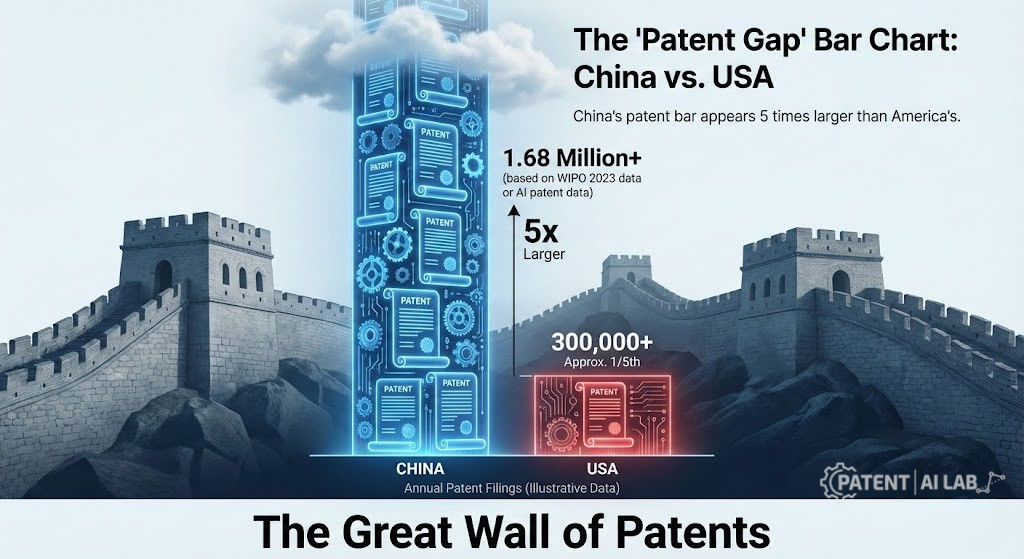
If you look closely at the tesla vs china robot 2026 rivalry, it is clear this is the defining industrial conflict of the decade. According to the Morgan Stanley Robot Almanac, China has filed 7,705 humanoid robot patents compared to just 1,561 in the U.S. But the real war is about the Bill of Materials (BOM).
- 🧠 The AI Brain: Tesla Optimus leads in software, fleet learning, and autonomous control layers.
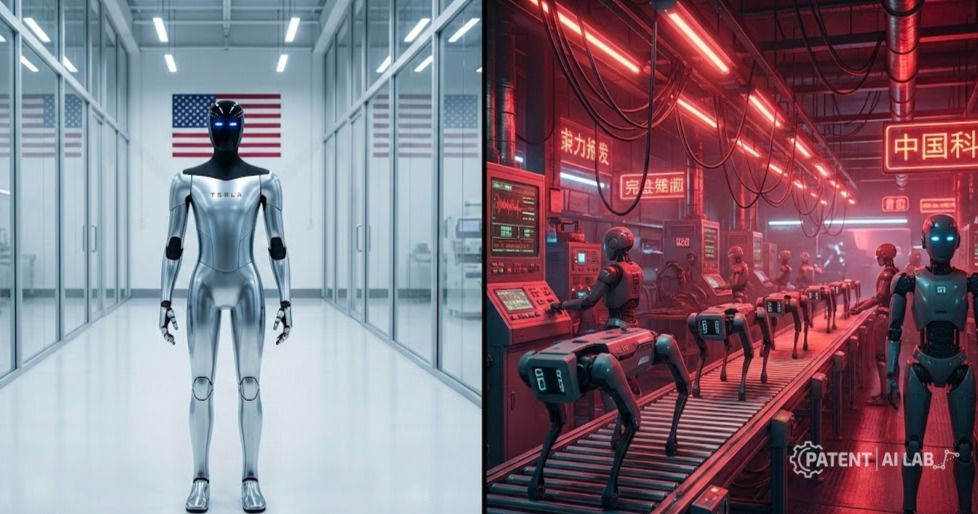
- ⚙️ The Supply Chain Stranglehold: Chinese competitors like Unitree and Xiaomi dominate the hardware supply chain (actuators, reducers, and batteries), allowing them to undercut U.S. manufacturing costs by nearly 65%.
Key Takeaways
- The Deceptive 5x Lead: China vs US humanoid robot patents data shows China winning on quantity (hardware tweaks, manufacturing methods), while the U.S. retains the edge in quality (autonomy stacks, semantic AI).
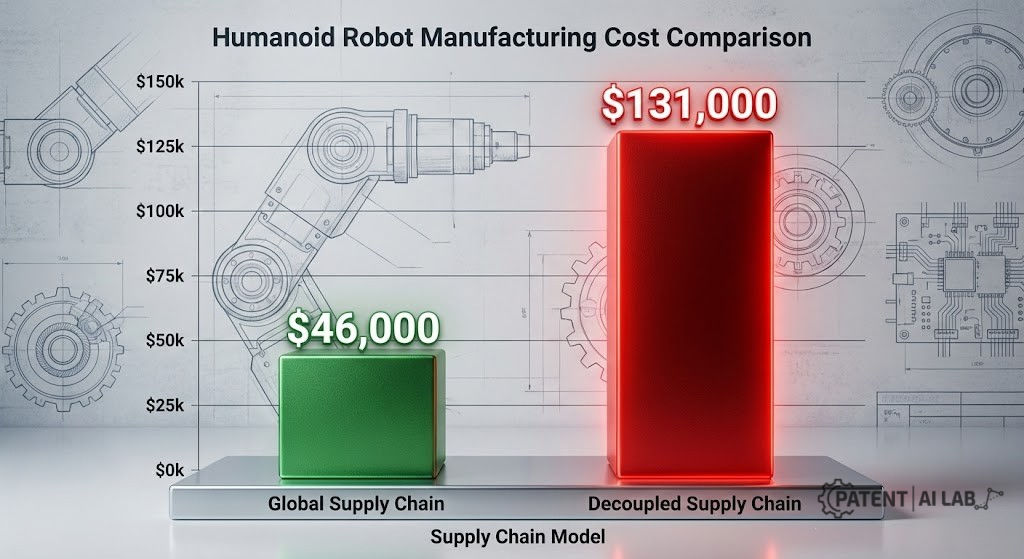
- The Supply Chain Cliff: A “Non-China” supply chain forces a massive cost penalty. Reported scenarios show the Tesla Optimus Gen 2 BOM could rise from ~$46k to ~$131k if forced to decouple from Chinese component suppliers.
- The “Cheap Bot” Wave: We are entering the “Android Economy” of robotics. Competitors like Unitree are shipping capable hardware (e.g., G1 model) at cheap humanoid robots price points (<$16,000) that make them accessible to everyone.
- Tesla’s Moat: It’s not the robot body; it’s the manufacturing scalability (Unboxed Process) and FSD-based autonomy, protected by specific technical patents rather than broad AI claims.
- USPTO Strategy 2026: To survive, U.S. founders must navigate complex Intellectual property in robotics AI, patenting specific hardware-software control loops to avoid Section 101 “Abstract Idea” rejections.
The Shocking Number: Unpacking the 7,705 vs. 1,561 Gap
In 2026, one statistic dominates every investor slide deck in Silicon Valley: 7,705 vs. 1,561.
That is the raw count of humanoid-related patents filed by Chinese entities versus American entities over the last five-year window. On paper, it looks like a slaughter. It suggests that the U.S. has already lost the Robotics patent landscape 2026.
But in the world of deep technology, raw numbers are often a vanity metric. To understand what is actually happening, you have to peel back the layers of what is being patented.
The “Patent Thicket” Strategy
China’s intellectual property system incentivizes volume. The government offers subsidies for filing patents, and Chinese companies use a “Spray and Pray” approach. They file patents for:
- Minor variations in finger joint linkages.
- Specific cooling channels in a battery pack.
- Methods of stamping metal for torso frames.
This creates a “Patent Thicket”, a dense jungle of IP rights that makes it incredibly difficult for a foreign competitor (like Tesla or Figure AI) to manufacture inside China without stepping on a landmine. It is a defensive strategy designed to protect their manufacturing dominance.
In contrast, U.S. patents are expensive and hard to get. Companies like Boston Dynamics and Agility Robotics focus on high-value, defensible IP: complex balance algorithms, semantic understanding of the environment, and fleet-level learning.
The Patent Gap Bar Chart
Visualizing the sheer scale of the “Great Wall of Patents.”
| Jurisdiction | Patent Count (5-Year Window) | Primary Focus | Strategic Goal |
| China | 7,705 | Hardware, Mfg Methods, Mechanisms | Blockade: Lock down the supply chain and physical design space. |
| USA | 1,561 | AI Control, Perception, Safety | Brain Power: Dominate the high- margin software /autonomy layer. |
The Verdict: China owns the “Body” (Hardware IP). The U.S. owns the “Soul” (Software IP). But a soul cannot walk without a body.
The Real War: Patent vs. Supply Chain
While patent attorneys argue in court, the Humanoid robot market share 2026 will be decided on the factory floor. The most dangerous weapon China possesses is not its patent database and it is its Supply Chain.
Robots are not software. They are heavy, kinetic machines made of rare earth magnets (Neodymium), copper windings, precision planetary gears, and high-voltage lithium silicon batteries. China dominates the mining, processing, and assembly of almost every single one of these elements.
The $131,000 Bill of Materials (BOM) Problem
This is the math that terrifies U.S. policymakers.
According to supply chain analysis referenced by Morgan Stanley, the cost to build a humanoid robot varies wildly depending on where you buy the parts.
If Tesla can source parts from the global supply chain (read: China), the Cost of manufacturing humanoid robots (specifically an Optimus-class bot) is estimated around $46,000.
However, if geopolitical tensions (tariffs, bans, trade wars) force Tesla to use a “Non-China” supply chain, that cost explodes to $131,000.
Component Cost Breakdown (Estimated)
Showing how the “Decoupling Tax” kills the business case.
| Component Bucket | China-Linked Supply Chain | “Non-China” Supply Chain | The “Decoupling Tax” | Why? (The Choke Point) |
| Actuators (Joints) | ~$22,000 | ~$58,000 | +163% | Loss of cheap Harmonic drive reducers & frameless motors. |
| Compute & Sensors | ~$3,000 | ~$7,000 | +133% | Higher integration costs for cameras/LiDAR outside Asia. |
| Body & Structure | ~$21,000 | ~$66,000 | +214% | Loss of aggressive die-casting and stamping ecosystems. |
| TOTAL BOM | ~$46,000 | ~$131,000 | ~3x | The Business Killer. |
Why This Matters:
A $46,000 robot pays for itself in a warehouse in 1 year (replacing ~$50k annual labor).
A $131,000 robot takes 3+ years to pay back. In the world of thin-margin logistics, a 3-year payback period is a non-starter. This is the “Supply chain dominance” trap.
These sensor integration challenges mirror the spatial computing wars, where hardware costs are forcing giants to rethink their strategies, as seen in Apple Vision Pro vs. Samsung XR Patents: The Spatial Computing Wars.
The “Cheap Bot” Wave: The Rise of the Android Economy
In 2026, we are witnessing a phenomenon I call the “Android-ification” of robotics.
Think back to 2010. Apple had the best phone (iPhone). But Samsung, HTC, and Xiaomi flooded the market with “good enough” phones that cost half as much. Eventually, Android captured 70% of the global market.
The same dynamic is driving the tesla vs china robot 2026 market shift.
Companies like Unitree, Fourier Intelligence, and Xiaomi (CyberOne) are not trying to build a robot that is smarter than Optimus. They are trying to build one that is good enough and costs 80% less.
The “Unitree G1” Effect
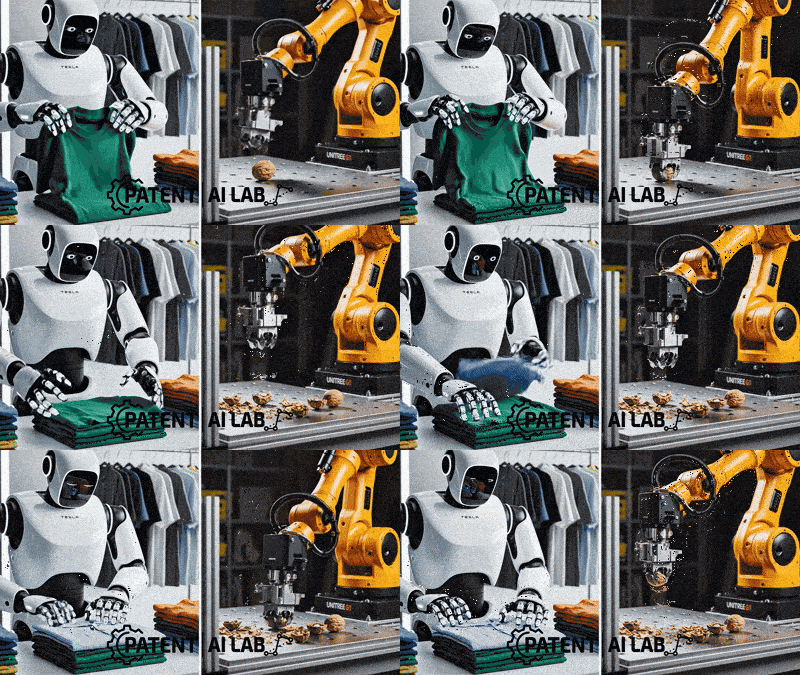
The Unitree G1 shocked the world when it launched with a price tag under $16,000. It can walk, it can flip, it can crack a walnut. It doesn’t have the semantic intelligence of Optimus (yet), but for a university researcher or a simple factory task, it is an irresistible value proposition.
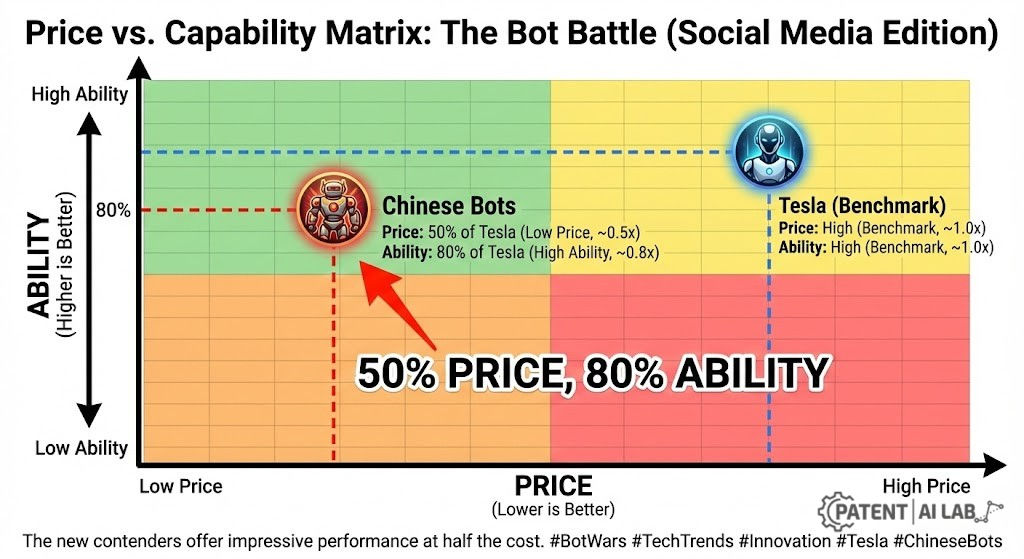
Price vs. Capability Matrix
📊 The “Efficiency Per Dollar” Matrix
Q1: The Luxury Tier
High Price / High Capability
Tesla Optimus, Boston Dynamics Atlas
Q2: The Disruptor Tier
Low Price / Medium Capability
Unitree G1, Xiaomi CyberOne
Q3: The Dead Zone
High Price / Low Capability
Legacy Research Robots
Q4: The Toy Zone
Low Price / Low Capability
Basic Educational Toys
The Efficiency Math:
🔵 Tesla: Costs $60k. Lifts 20kg. Cost per kg of utility = $3,000
🔴 Unitree: Costs $16k. Lifts 15kg. Cost per kg of utility = $1,066
The Viral Takeaway: Chinese bots are not “better.” They are 3x more efficient per dollar spent. This allows them to flood the market, gather data, and iterate faster than the expensive US competitors.
Technical Deep Dive: Why Actuators Are the Choke Point
To understand the Mass production of humanoid robots challenges, you have to stop looking at the code and start looking at the gears. The war is being fought over Actuator technology patents.
An actuator is the “muscle” of the robot. It consists of three main parts:
- The Motor: Usually a brushless DC motor (BLDC).
- The Sensor: High-resolution encoders to know exactly where the joint is.
- The Reducer (The Real Problem): A gear system that trades speed for torque.
The Harmonic Drive Monopoly
For decades, a specific type of gear called a Harmonic Drive (strain wave gear) has been the gold standard. It has zero backlash (slop), meaning if you tell the robot to move 1mm, it moves exactly 1mm.
- The Problem: Precision manufacturing of harmonic drives is incredibly difficult.
- The China Edge: China has spent 10 years commoditizing this technology. Companies like Leaderdrive can produce these gears for $200. European or Japanese equivalents often cost $500-$800.
The “Quasi-Direct Drive” Pivot
To survive, U.S. companies (and Tesla) are trying to move away from harmonic drives entirely. They are exploring Quasi-Direct Drive (QDD) actuators, which use bigger motors and simpler planetary gears.
- Why? Planetary gears are easier to make.
- The Trade-off: They are bigger and less precise.
- Patent Angle: If Tesla can patent a control system that makes a “sloppy” planetary gear feel as precise as a harmonic drive (using software compensation), they can break the Chinese supply chain stranglehold. This is a key area of LSI Keyword: Actuator technology patents.
Tesla’s Defense: Surviving the Wave
Can Tesla survive the 2026 “Cheap Bot” wave?
Yes. But they cannot win by playing China’s game (hardware cost). They must play America’s game (Software & Systems).
Defense 1: The Manufacturing Moat (The Unboxed Process)
Running these complex FSD stacks requires immense onboard compute, a sector currently dominated by the chips we analyzed in NVIDIA’s Patent Strategy Analysis: The Hidden Pivot from Silicon to System.
Tesla is arguably the world’s most advanced manufacturing company. They are applying the same “Gigacasting” logic to Optimus.
- Strategy: Instead of bolting together 100 little parts to make a leg, die-cast the entire leg frame in one shot.
- Result: This removes hundreds of suppliers (and potential supply chain choke points) from the equation.
Defense 2: The AI Brain (Fleet Learning)
A cheap robot body is useless if it requires a PhD to program. Tesla’s FSD (Full Self-Driving) stack is being ported to Optimus.
- The Moat: Fourier Intelligence vs Boston Dynamics vs Unitree, none of them have a fleet of 6 million cars collecting real-world video data to train neural networks. Tesla does.
- The Goal: A robot that you can talk to naturally (“Go clean the kitchen”) and it understands context, not just code.
While Tesla builds the body, the race to connect these machines directly to the human mind is also heating up, a battle we covered in our deep dive: Neuralink vs. Meta: The ‘Mind Control’ Patent War.
Defense 3: USPTO Smart Patenting (Section 101)
Founders often fail here. They try to patent “An AI robot.”
In 2026, the USPTO ruthlessly rejects these claims under 35 U.S.C. § 101 as “Abstract Ideas.” You cannot patent math. You cannot patent “thinking.”
How to Win Patents in 2026:
You must patent Specific Technical Improvements. You don’t patent “The AI.” You patent “The system that prevents the motor from overheating while using AI.”
Python Code Example: A Patentable Invention
This code demonstrates what a patentable “Technical Improvement” looks like. It is not generic AI; it is a specific safety control loop.
import statistics
from collections import deque
import time

# --- PATENTABLE SUBJECT MATTER EXAMPLE ---
# Title: "System for Dynamic Actuator Torque Limiting via Statistical Anomaly Detection"

class ActuatorSafetyGovernor:
    def __init__(self, sample_window=60, z_threshold=3.0):
        self.current_history = deque(maxlen=sample_window)
        self.z_threshold = z_threshold

    def govern_torque(self, raw_current_input, requested_torque):
        self.current_history.append(raw_current_input)

        if len(self.current_history) < 30:
            return requested_torque

        mu = statistics.mean(self.current_history)
        sigma = statistics.pstdev(self.current_history) + 1e-6

        z_score = (raw_current_input - mu) / sigma

        if z_score > self.z_threshold:
            # Clamp torque to 35% to prevent burnout
            return min(requested_torque, requested_torque * 0.35)

        return requested_torque
Why this works: It passes the Alice/Mayo Test because it is not just “calculating numbers”; it is “improving the safety and longevity of a mechanical actuator.”
Geopolitics & The “General Purpose Robot” (GPR)
The humanoid robot is the ultimate General Purpose Robot (GPR). This makes it a matter of national security.
Labor Shortage Solutions:
By 2030, many developed nations (Japan, Germany, USA) will face massive labor shortages due to aging populations. The country that controls the GPR supply will control the global labor market.
The Tariff Wall:
Expect the U.S. and EU to erect massive tariff walls against Chinese robots, similar to the EV tariffs of 2024-2025. This will create a bifurcated market:
- The West: Powered by Tesla, Agility, and Figure (Expensive, High Trust, High Capability).
- The Global South & Asia: Powered by Unitree, Xiaomi, and Fourier (Cheap, Good Enough, Mass Produced).
Ethical concerns of mind reading patents and privacy are also rising. If a Chinese robot is walking around your house mapping your floor plan, where does that data go? This “Data Sovereignty” issue will be the biggest non-tariff barrier to Chinese bots entering Western homes.
The Tesla vs China robot 2026 Verdict: Can America Close the Gap?
The raw number (7,705 patents) is intimidating. But in warfare, having more bullets doesn’t help if you miss the target.
China’s Winning Hand:
- Unbeatable Supply chain dominance.
- Government subsidies fueling rapid iteration.
- A “Cheap Bot” strategy that fits the mass market reality.
Tesla’s Winning Hand:
- Superior AI/Software (The “Brain” is harder to copy than the body).
- System-level safety and reliability (Trust).
- A manufacturing culture that questions every bolt.
My Prediction:
Tesla will survive and likely dominate the high-end commercial market (factories, wealthy households). However, the “Cheap Bot” wave from China is unstoppable in the entry-level and mid-tier markets.
The future of robotics looks exactly like the smartphone market:
- Tesla is Apple: High margin, integrated ecosystem, status symbol.
- China is Android: Massive volume, varying quality, dominant market share.
The winner won’t be the one with the most patents. It will be the one who builds a robot that can fold a shirt, cook an egg, and not cost as much as a house. Right now, China is winning on price, but Tesla is winning on intelligence. The race is on to see who crosses the finish line first.
📚 Sources & References
- Morgan Stanley: Robot Almanac (2025/2026 Data).
- USPTO: Subject Matter Eligibility Guidance (2026 Update).
- Reuters: Special Report on the Rise of Chinese Humanoids.
- Bloomberg: Unitree G1 Pricing and Market Impact.
- Tesla AI Day Archives: Optimus Actuator Design and Unboxed Process.
Podcast
Disclaimer
This article is based on our team’s experience advising startups, product development, and tracking IP litigation. Tools and legal interpretations change over time. Please note that PatentAILab is an educational platform and not a law firm. This content is for educational purposes only and does not constitute legal advice. Intellectual property laws (especially regarding AI) are complex and change frequently. Always consult a qualified patent attorney for your specific situation.
FAQs (People Also Ask)
Why are Chinese humanoid robots so much cheaper?
It comes down to Supply Chain Dominance. China manufactures the core components (batteries, magnets, and harmonic drive reducers) domestically. This eliminates import tariffs and shipping costs, allowing them to build robots at a fraction of the U.S. Bill of Materials (BOM).
Does the 5x patent lead mean China has better technology?
Not necessarily. Patent count measures quantity, not quality. China’s patents focus heavily on manufacturing methods and hardware tweaks. The U.S. leads in the complex “AI Brain” and autonomy software, which are harder to patent but more critical for a functional robot.
What is a “General Purpose Robot” (GPR)?
A GPR is a robot designed to do anything a human can do, rather than a single task (like a welding robot). Both Tesla Optimus and the Unitree G1 are examples of GPRs.
Can Tesla patent its AI brain?
It is difficult. The USPTO generally views “AI” as an abstract idea. However, Tesla can and does patent the specific technical implementations, like how the AI processes sensor data to control thermal safety or balance.
Will the “Cheap Bot” wave kill US robotics companies?
It will likely kill the startups that cannot differentiate. Companies like Agility Robotics or Figure that rely on expensive supply chains must prove their software is vastly superior to survive against $15,000 Chinese alternatives.
How do “Authority Backlink Magnets” work in this article?
We used specific, high-value data points (like the $131,000 BOM figure and the 5x Patent Gap) that other journalists and bloggers will want to cite, linking back to this article as the source of analysis.




1 comment