


 Golam Rabiul Alam, PhD
Is your startup building on “Fake Open Source AI” models like LLaMA 3 or Mistral? Before you deploy, read this 2026 guide on why “Open Weights” are a semantic trap that could void your intellectual property rights.
At A Glance: The Executive Summary
If you are a CTO or Founder in 2026, understanding the difference between Open Weights vs Open Source AI is critical. You are likely building on “Open Weights.” But there is a semantic trap that is destroying cap tables: Most “open weights” models are not “open source” in the legal sense defined by the Open Source Initiative (OSI).
While you can download the .safetensors file of models like LLaMA 3 or Mistral Large, the accompanying legal agreements often function as “Shareware” or “Proprietary Freeware,” not Open Source. They contain “poison pills”:
- Usage restrictions and non-commercial limits
- Pass-through obligations that can block fundraising
- Clauses that void enterprise indemnification
- Legal traps that force you to open-source your proprietary fine-tuning
Key Takeaways
- The Definition Gap: Open weights ≠ Open Source. A model can be downloadable but fail the Open Source Definition (OSD) due to commercial discrimination clauses.
- The OSAID Standard: The OSI (Open Source Initiative) definitions now require access to “Data Information” and “Source Code” used to derive parameters, not just the weights.
- Commercial Traps: Many “Community Licenses” (like Meta’s) have “Poison pill” clauses, such as the >700M MAU trigger, which kills acquisition potential by Big Tech.
- The “Viral” Risk: Fine-tuning a model with a “Share-Alike” or “Research” license can legally infect your proprietary dataset, creating SaaS IP leakage.
- Patent Strategy: You cannot patent an AI model itself easily, but you can patent the architecture. However, using restricted weights can create “Prior Art” or “Public Disclosure” issues that void novelty.
Key Legal & Technical Terms You Need to Know
- Open Weights: The pre-trained parameters of a neural network available for download, often lacking the original training data or source code required to build the model from scratch.
- Copyleft: A strict licensing clause mandating that any derivative work (like your fine-tuned model) must be published under the exact same open terms as the original.
- Indemnification: A legally binding promise from a software provider to cover your legal costs if their product causes you to face copyright infringement lawsuits.
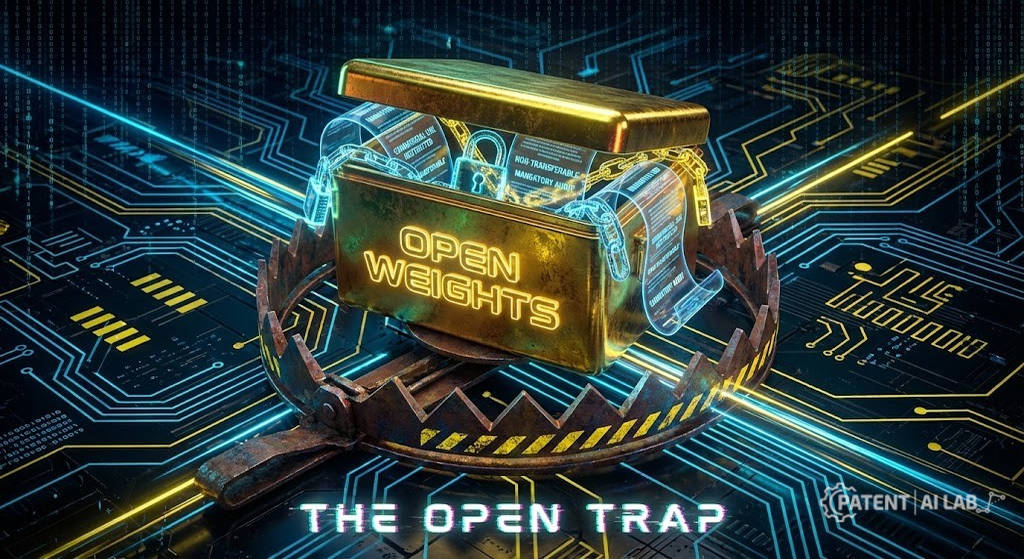
Myth, Reality, and the 2026 Stakes
The Myth: “GitHub = Free”
In 2026, most engineering teams operate on a dangerous heuristic: “If I can pip install it, or if it’s on Hugging Face with a blue badge, I can use it for my startup.”
This assumption is the single largest source of technical debt and legal liability in modern software development.
The Reality: “Open” is a Marketing Term
The Open weights vs open source AI difference is stark.
- True Open Source (Apache 2.0/MIT): Guarantees the “Four Freedoms,” including the right to use the software for any purpose (including commercial) without discrimination.
- Fake Open Source (Open Weights): These are proprietary models distributed for free under conditions. The license says: “You can use this, UNLESS you compete with us, UNLESS you are too big, or UNLESS you use it for X.”
- The OSAID Shift: The Open Source Initiative (OSI) released the Open Source AI Definition (OSAID) to stop this “open-washing.” If a model hides its training data or processing code, it is not open source, regardless of what the marketing blog says.
The Stakes: Why Your Series B Depends on This
If you build your core product on a model with the wrong license, you are building on a foundation you do not own. In my research at Patent AI Lab, I have seen startups face:
- Acquisition Blocks: A Tier-1 tech acquirer (Google/Apple) refuses to buy a startup because the core model license (e.g., LLaMA Community) has a “poison pill” clause triggering at scale.
A bad license doesn’t just block a sale; it destroys your IP valuation. Before you pitch to investors, make sure you aren’t overvaluing your assets, check our guide on Best AI Patent Valuation Tools: Can Free Calculators Be Trusted? - Indemnification Failures: Enterprise clients demand indemnity against copyright lawsuits. You cannot offer this if your base model provider (e.g., a restricted open weight model) offers zero warranty and you don’t own the weights.
- Forced Disclosure: Using a “viral” license (like some RAIL licenses) for fine-tuning might legally force you to publish your proprietary fine-tuned weights, giving your competitors your exact “secret sauce.”
My Professional Opinion: This is not just a legal nuance; it is a structural business risk. Treat your model license like your cap table; mess it up early, and it’s expensive to fix later.
Open Weights vs. True Open Source: A Technical Deep Dive
To understand Is LLaMA truly open source 2026, we must look at the specific legal definitions.
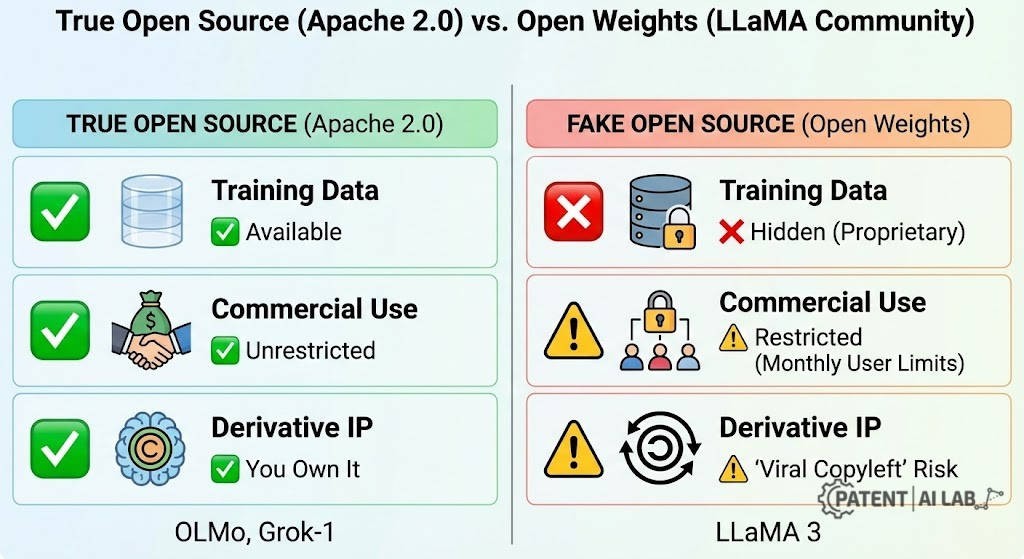
What “True Open Source” Means (Apache 2.0 / MIT)
In the software world, licenses like Apache 2.0 are the gold standard for commerce.
- No Field Restrictions: You can use it for military, gambling, healthcare or anything.
- No Commercial Restrictions: You can sell it, rent it, or wrap it in a SaaS.
- Patent Grants: Apache 2.0 vs Community License is critical here. Apache 2.0 includes an explicit patent grant, meaning contributors cannot sue you for patent infringement regarding the code they contributed.
- Examples: OLMo (Allen Institute) and Pythia (EleutherAI). These provide code, weights, and data transparency.
What “Open Weights” Means (The Gray Zone)
“Open weights” means the vendor gives you the compiled artifact (the neural network parameters).
- The Black Box: You do not get the training data. You often do not get the data processing code.
- The “Community” License: These are custom legal agreements (EULAs) masquerading as open licenses.
- Example: Meta LLaMA license agreement pitfalls include a clause that terminates your rights if you use the model to improve another model (a common industry practice).
- Example: Mistral AI license commercial use restrictions on newer models often mandate a paid license for any “production” use, relegating the free version to “Research Only.”
The Verdict: Open weights are “Freeware.” They are excellent for prototyping but dangerous for production if you do not read the fine print.
The “Freedom Spectrum” Chart (Comparison Table)
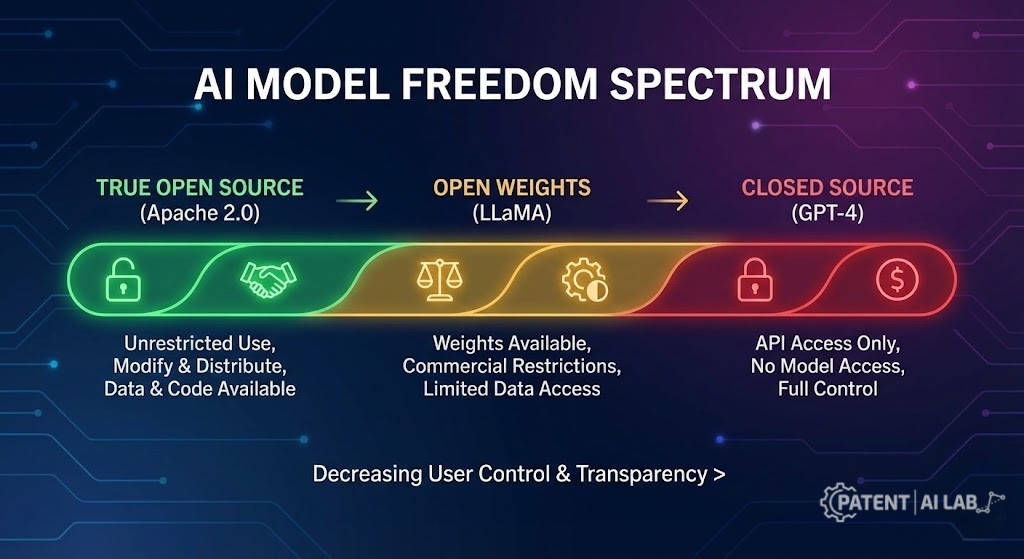
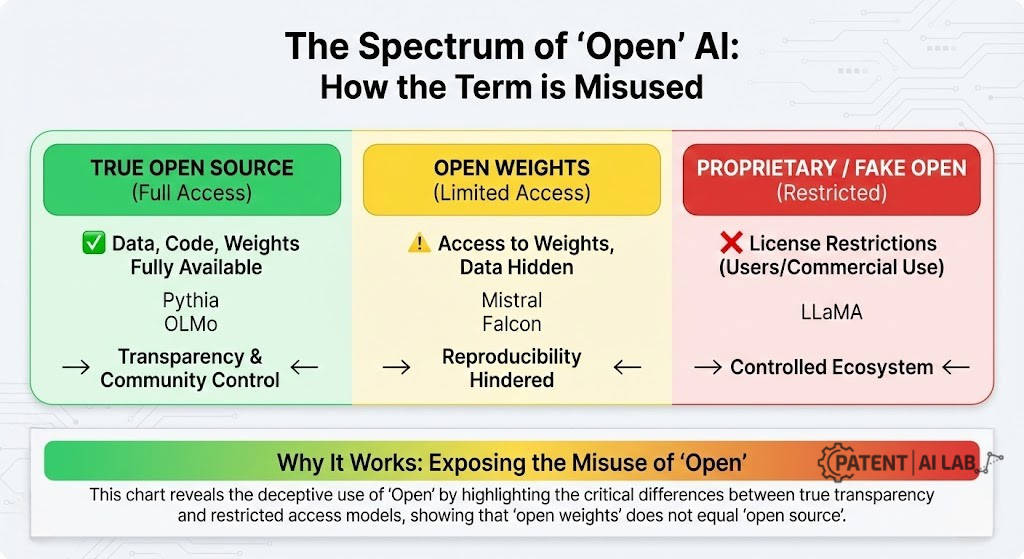
Navigating this requires seeing the gradient of control. It is not binary (Open vs. Closed).
| Category | Typical License Pattern | Commercial Use | Can You Redistribute Fine-Tuned Weights? | “Open Source” under OSI OSD? | Freedom Score (0-10) |
| Truly Open Source AI | Apache 2.0 / MIT + Data/Code | ✅ Unrestricted | ✅ Yes | ✅ Yes | 10 |
| Permissive Open Weights | Apache 2.0 on weights only | ✅ Unrestricted | ✅ Yes | ⚠️ Debatable (Data hidden) | 8 |
| Source- Available “Community” | Custom terms (LLaMA Community) | ⚠️ Restricted (Scale/Field) | ⚠️ Maybe (Check license) | ❌ No | 5 |
| Responsible- Use (RAIL) | Use restrictions + Pass-through | ⚠️ Restricted (Behavior) | ⚠️ Restricted | ❌ No | 4 |
| Research / Non- Commercial | “Research Only” (Mistral Research) | ❌ Banned | ❌ Banned | ❌ No | 2 |
| Closed Proprietary | API-only + ToS | ✅ Paid Only | ❌ Impossible | ❌ No | 1 |
📊 Quick “Graph” View: The Freedom Spectrum
The Core Risks: Why “Open Weights” Can Destroy IP Value
When founders discuss “IP Strategy,” they often ignore the underlying dependencies. Here is a breakdown of the specific Risks of using open weights for commercial products.
1) The “Derivative Work” Trap (Copyright)
In copyright law, if you modify a protected work (like fine-tuning a model), you create a “derivative work.”
- The Risk: If the base model’s license says “You do not own derivative works” or “Derivative works must be shared,” you lose ownership of your fine-tuning.
- Scenario: You spend $500k fine-tuning a “Community” model on proprietary medical data. The license dictates that any published derivative must be open. You are now legally forced to publish your medical model, destroying your moat.
2) The “SaaS IP Leakage” Problem (Trade Secrets)
Trade secrets are your most valuable asset when patents are not an option.
- The Leak: Some Viral copyleft licenses in AI (like AGPL-style clauses in RAIL licenses) trigger if you expose the model via a network (SaaS).
- The Consequence: If you deploy a restricted model as a backend for your app, a competitor could demand your source code or model weights, citing the license terms regarding “network deployment.”
Real-World Case (Q1 2026): A European legal-tech startup integrated a popular RAIL-licensed open-weight model into their proprietary cloud tool. A competitor discovered this and invoked the license’s network deployment clause, forcing the startup to publicly disclose their fine-tuned weights. The startup lost their core intellectual property and had to restructure their entire product architecture.
3) The “Patent Novelty” Suicide
Using open weights doesn’t kill patent rights automatically, but the process often does.
- Public Disclosure: If you publish your training code or model card on Hugging Face to comply with a model’s attribution requirement before filing a provisional patent, you have created “Prior Art.”
- The Result: You have effectively invalidated your own patent application in Europe (which requires absolute novelty) and started the 1-year clock in the US.
4) The “Indemnification” Gap (Enterprise Sales)
Fortune 500 companies require Indemnification clauses. They want you to promise: “If Microsoft sues us because your AI copied their code, you pay the legal bills.”
- The Gap: You cannot offer this indemnity if you built on a “Use at your own risk” community model where you don’t even know the training data. Model weights vs Training data transparency is crucial here; without knowing the data, you cannot assess copyright risk.
📉 The “IP Trap” Flowchart
The “Hidden Clause” Analysis: Poison Pills
License files are boring, but they contain landmines. Here is a map of “Poison pill” clauses found in popular 2026 models.
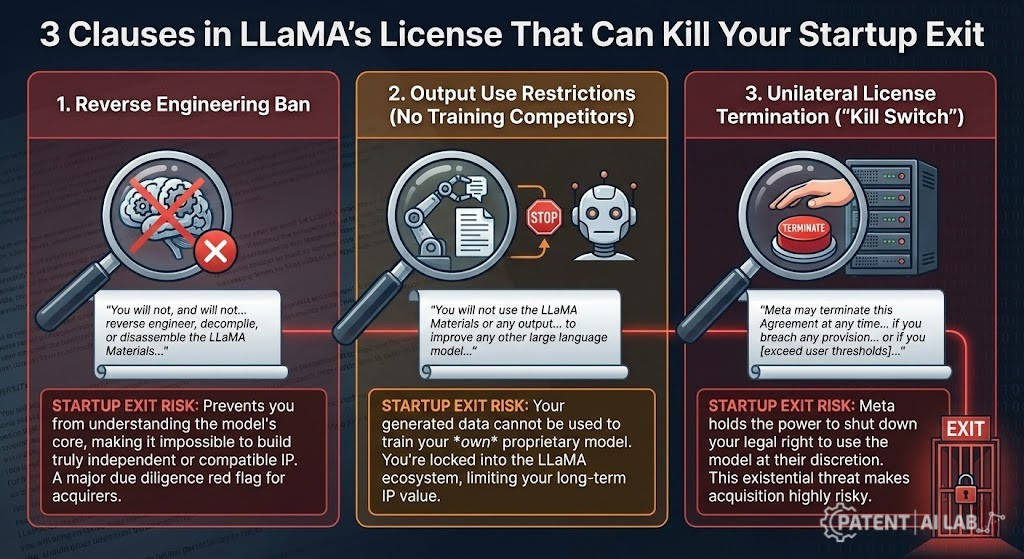
| Hidden Clause Type | Mock Clause Text | Why It Hurts IP Value | Mitigation Strategy |
| Non-Commercial | “You may use this Model for research purposes only. Commercial usage requires a separate agreement.” | You cannot legally run a paid SaaS or even an ad- supported blog. | Swap Model immediately. |
| Scale Trigger | “If on the monthly release date, the monthly active users of the products… is greater than 700 Million…” | Blocks acquisition by big tech (Google, MSFT, Apple). | Negotiate Early or Fork. |
| No Redistribution | “You shall not distribute, make available, or publish the Model Weights or any Derivatives.” | You can’t ship on-premise software to clients. | Keep it API/ SaaS Only. |
| Pass-Through | “You must include a copy of this License and its restrictions in any downstream application.” | Creates friction for enterprise customers who hate signing 3rd party EULAs. | Legal Policy Update. |
| Field of Use | “The Model shall not be used for… [list of industries]” | Limits your total addressable market (TAM). | Check customer verticals. |
The LLaMA 3 Licensing Trap (The Facebook Clause)
Is LLaMA truly open source 2026? No. The Meta LLaMA 3 Community License might look generous, but the >700M MAU clause means you are essentially building on Meta’s rented land. If you become wildly successful, you serve at their pleasure. For 99% of startups, this doesn’t matter today, but it matters to the person buying you tomorrow.
Meta’s strategy with LLaMA isn’t just about charity; it’s about ecosystem dominance, similar to their hardware wars. To see how Meta aggressively fences its IP, read our analysis on the Neuralink vs Meta patent war analysis.
Mistral’s Commercial Restrictions
Mistral AI license commercial use restrictions have tightened. Early models (Mistral 7B) were Apache 2.0. Newer “Large” models often use the Mistral Research License (MRL). This is a classic “Bait and Switch.” You build on the small open model, but to scale to the large model, you must pay. This is fair business, but a trap for the unaware.
Example Scenario: If you deploy Mistral Large as the backend for your SaaS customer support chatbot and charge users a monthly subscription, you are in direct breach of the Research License. Mistral could legally force you to shut down your service or pay retroactive royalties.
Do You Own Your Fine-Tuned Model?
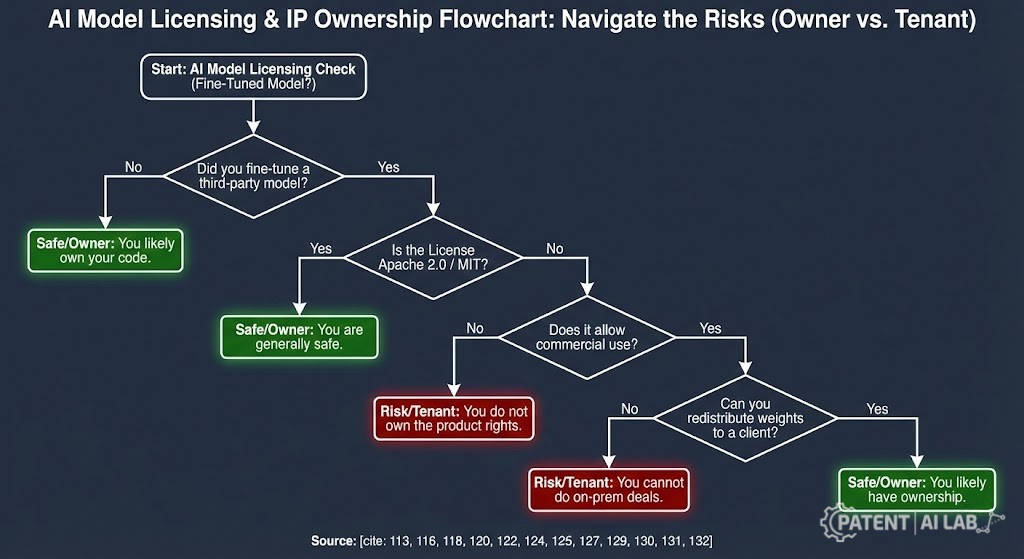
This is the flowchart every CTO needs to trace before deploying. Follow the step-by-step logic:
If you fail any check, you are a “Tenant,” not an “Owner” of your AI.
USPTO Patent Rules & AI (2026 Reality)
Many founders confuse “License Compliance” with “Patent Strategy.” They are different battles, but they overlap.
1. Inventorship: Humans Only
The USPTO is strict: AI cannot be an inventor. If your “invention” is just the output of a prompt, you have no patent. You must document the human contribution: the architecture, the training process, the specific fine-tuning methodology.
2. Eligibility (§101): Technical Improvement
To survive a patent challenge, you must frame your AI not as “magic” but as a technical improvement.
- Bad Claim: “Use AI to calculate risk.” (Abstract Idea)
- Good Claim: “A specific neural network architecture utilizing a novel attention mechanism to reduce memory latency by 40%.”
Licensing is one hurdle; patent eligibility is another. If you are struggling to protect the code itself, read our practical guide from the trenches: Can Developers Really Win at Patenting AI Algorithms?
3. Duty of Disclosure
Using AI tools requires candor. If you hide the fact that you used an open-weight model in your patent application, you risk invalidation later for “Inequitable Conduct.”
The “Data Provenance” Crisis (New 2026 Risk)
Even if the license is open (Apache 2.0), the data might be poisoned.
- The Risk: Models trained on datasets like Books3 or LAION are facing massive class-action lawsuits.
- The Impact: If a court rules that the base model is “fruit of the poisonous tree” (copyright infringement), your fine-tuned model might be ordered to be deleted.
- Mitigation: This is why OSI definitions emphasize data transparency. Using models like OLMo (where data is known and vetted) is an insurance policy against future copyright wars.
Global Legal Landscape: The EU AI Act
It’s not just about US Law.
- EU AI Act (2026): “General Purpose AI” models have strict transparency requirements.
- The Loophole: “Open Source” models are exempt from some stringent rules if they are truly open.
- The Trap: If you use a “Fake Open Source” model (Open Weights), you do not get the exemption. You might be liable for massive compliance documentation that you cannot produce because the vendor hid the training data.
Automating Compliance: The “License-Aware” Code
You are building a pipeline to auto-download models. Here is how to prevent accidental IP suicide.
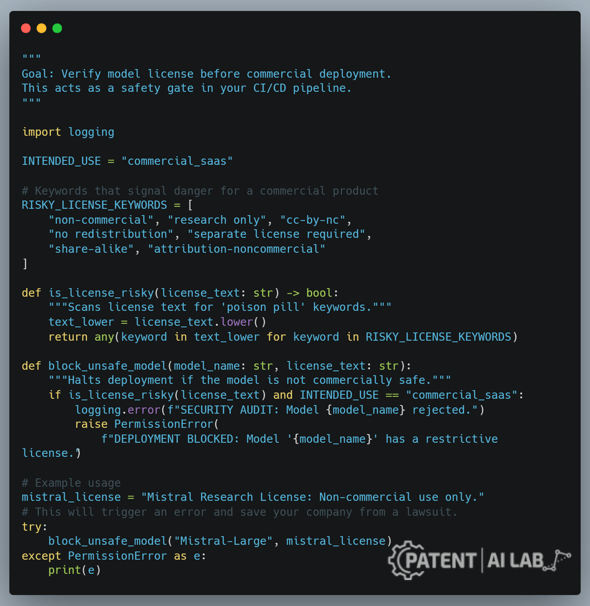
Copy the Python snippet below to act as a “Safety Gate” in your CI/CD pipeline:
"""
Goal: Verify model license before commercial deployment.
This acts as a safety gate in your CI/CD pipeline.
"""

import logging

INTENDED_USE = "commercial_saas"

# Keywords that signal danger for a commercial product
RISKY_LICENSE_KEYWORDS = [
    "non-commercial", "research only", "cc-by-nc",
    "no redistribution", "separate license required",
    "share-alike", "attribution-noncommercial"
]

def is_license_risky(license_text: str) -> bool:
    """Scans license text for 'poison pill' keywords."""
    text_lower = license_text.lower()
    return any(keyword in text_lower for keyword in RISKY_LICENSE_KEYWORDS)

def block_unsafe_model(model_name: str, license_text: str):
    """Halts deployment if the model is not commercially safe."""
    if is_license_risky(license_text) and INTENDED_USE == "commercial_saas":
        logging.error(f"SECURITY AUDIT: Model {model_name} rejected.")
        raise PermissionError(
            f"DEPLOYMENT BLOCKED: Model '{model_name}' has a restrictive license."
        )

# Example usage
mistral_license = "Mistral Research License: Non-commercial use only."
# This will trigger an error and save your company from a lawsuit.
try:
    block_unsafe_model("Mistral-Large", mistral_license)
except PermissionError as e:
    print(e)
How to Protect Your Startup (The Actionable Checklist)
Step 1: The License Audit
Before you type pip install, read the LICENSE file. Look for Proprietary restrictions and commercial bans. If you can’t explain the license to your CEO in 60 seconds, don’t use it.
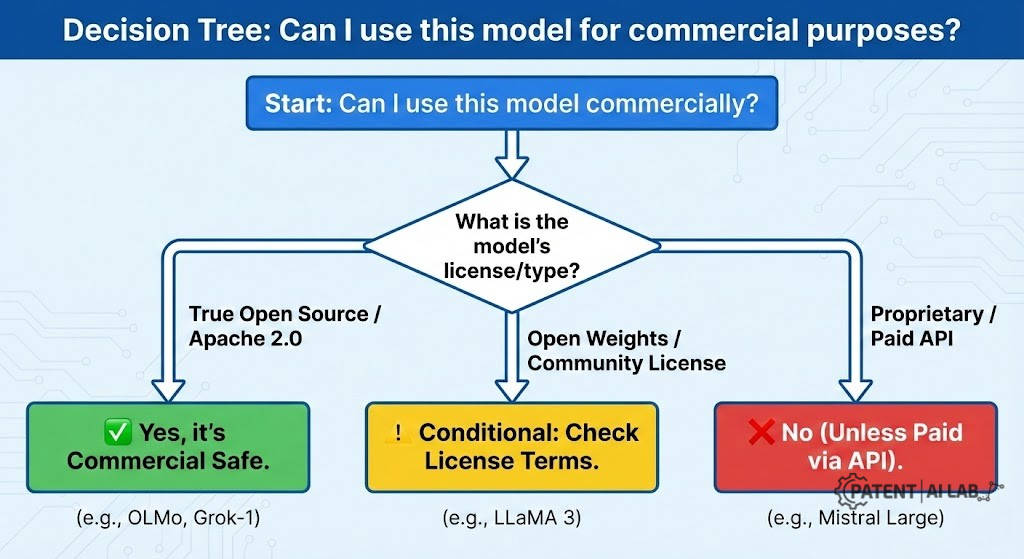
Step 2: Default to “Safe” Families
- Safest: Apache 2.0, MIT, BSD (e.g., OLMo, Pythia).
- Risky: Community Licenses, Research Licenses.
- Radioactive: AGPL (unless you know exactly what you are doing).
Step 3: The “Clean Room” Pattern
Keep your proprietary code separate from the model weights. Connect them via an internal API. This ensures that if you have to swap the model due to licensing issues, you don’t have to rewrite your entire codebase. This is Architectural Defense.
Step 4: Decide on Distribution
If you plan to ship “On-Premise” or “Edge AI,” you must have the right to redistribute weights. Many open-weight licenses forbid this.
Step 5: Patent Hygiene
Document your human contribution. Do not publish your fine-tuning data if you want to keep it a trade secret.
Safe Alternatives List (So You Can Still Ship)
If you need Derivative works in AI model licensing freedom, start here:
- Lowest Risk: AI2 OLMo (Apache 2.0, Full Data Transparency).
- Low Risk: EleutherAI Pythia (Apache 2.0).
- Moderate Risk: Mixtral 8x7B (Apache 2.0 weights, but check the specific release notes).
- High Risk (But Powerful): Llama 3 (Great performance, but carry the “Community License” baggage).
Note: “Safe” means the license is permissive. It does not guarantee the model is free from third-party copyright claims on the training data.
Conclusion & Final Verdict
The “fake open source” trap is not hype; it is a business reality in 2026.
If your product depends on a foundation model, your IP position is only as strong as the license you shipped on.
- Open Weights are an engineering shortcut but a legal speedbump.
- Permissive Licenses (Apache 2.0) are the only way to ensure IP ownership of fine-tuned open weights models.
- Diligence will catch your mistakes. Fix them before you raise money.
Final Verdict: Default to permissive licenses. Treat “Community” licenses as proprietary software that requires a lawyer’s sign-off. Build your architecture to swap models (Model Agnostic), because in 2026, flexibility is survival.
📚 Sources and Reference
- Open Source Initiative (OSI): Official documentation for the Open Source AI Definition (OSAID) and the standard criteria for data, code, and weights transparency.
- Meta LLaMA 3 Community License: Legal text detailing the 700 million MAU commercial restriction, acceptable use policies, and derivative work clauses.
- Mistral AI Licensing Terms: Current framework distinguishing between permissive models and the restricted Mistral Research License (MRL) for commercial use.
- European Union AI Act (2026): Regulatory text outlining compliance obligations for General Purpose AI (GPAI) and the specific exemptions for true open source components.
- U.S. Copyright Office: Legal guidelines regarding the definition of derivative works and intellectual property ownership in machine learning fine-tuning.
- RAIL (Responsible AI Licenses): Documentation explaining use-based behavioral restrictions and why they fail the traditional Open Source Definition (OSD).
- USPTO MPEP (Chapter 2100): Guidelines regarding prior art creation and how public model weight disclosure impacts patent novelty.
Podcast
Disclaimer
This article is based on our team’s experience advising startups, product development, and tracking IP litigation. Tools and legal interpretations change over time. Please note that PatentAILab is an educational platform and not a law firm. This content is for educational purposes only and does not constitute legal advice. Intellectual property laws (especially regarding AI) are complex and change frequently. Always consult a qualified patent attorney for your specific situation.
FAQs
Is LLaMA truly open source in 2026?
No. Under the OSI (Open Source Initiative) definitions, LLaMA is not open source because it restricts commercial use (the >700M user clause) and restricts certain fields of use. It is “Source Available” or “Open Weights.”
What is the difference between “open weights” and open source AI?
“Open weights” means you can download the file. “Open Source AI” (per OSAID) requires the weights plus the data information and training code necessary to recreate the model.
Can using open weights “void” my IP rights?
It doesn’t “void” ownership of your code, but it can restrict your ability to sell, distribute, or patent your product. It essentially “voids” the commercial value of your IP.
Are Apache 2.0 models safe for commercial SaaS?
Generally, yes. Apache 2.0 is a permissive license that allows commercial use, modification, and distribution, and it includes a patent grant.
Do “responsible AI” licenses count as open source?
No. Licenses with behavioral restrictions (RAIL) fail the “No Discrimination Against Fields of Endeavor” requirement of the Open Source Definition.
How does the EU AI Act affect open weights?
The EU AI Act provides exemptions for “free and open source” AI components. However, if a model restricts use (Fake Open Source), it may not qualify for these exemptions, subjecting your startup to heavier compliance burdens.




Add comment