


 Golam Rabiul Alam, PhD
Editorial note: This article evaluates commercial IP software and USPTO examination trends for informational purposes only. It is not legal advice. See disclaimer below.
Relying on keyword-based patent searches is an operational liability. Competitors are mapping technical gaps you have not found, and a weak freedom-to-operate picture exposes your company to real infringement risk. True white space analysis requires AI tools built for the job, not a general-purpose search box. Here is a direct breakdown of the three patent landscape platforms worth evaluating right now, and how to run a gap analysis without burning capital on the wrong software.
At A Glance: Patent Landscape Tools Worth Knowing
Patent landscape software has evolved from simple search-and-export utilities into AI-assisted decision engines. The goal is no longer just finding prior art; it is mapping where freedom to operate actually exists.
The Tool Hierarchy
- 🏆 The Leader (Patsnap): Wins on 3D visualization and AI-guided technical discovery. Best for R&D teams.
- ♟️ The Strategist (LexisNexis PatentSight): Wins on quality and value analysis via the Patent Asset Index. Best for board reporting.
- 💡 The Budget Option (Lens.org): Offers a genuinely free, open citation graph. Best for bootstrapped startups.
Skipping competitor patent mapping raises real infringement exposure. The ongoing Sonos v. Google speaker-grouping dispute shows how unsettled even a jury-decided infringement case can remain on appeal; see the case history below for what actually happened.
Key Takeaways
- White space, defined precisely: it is not empty space. It is a specific technical gap where consumer or commercial demand exists but patent claims are weak or non-existent.
- The AI shift: modern white space analysis software uses AI to suggest why a gap likely exists, rather than passively displaying blank spots on a map.
- Legal safety: locating a gap is only half the work. Any resulting claim must survive the USPTO’s Alice/Mayo eligibility framework, hardened for AI-related claims by the 2024 USPTO guidance update on AI subject matter eligibility.
- Cost reality: enterprise-tier landscape platforms carry a wide price range depending on seats and modules, while Lens.org’s core patent and citation search remains free and requires no account. See the pricing table below for sourced figures rather than a single headline number.

What White Space Analysis Means in Patent Strategy
White space analysis is the strategic process of uncovering under-served technical niches inside a broader technology domain. Modern IP whitespace mapping blends three distinct lenses:
- Semantic clustering: AI models group patent text into conceptual topics (grouping “thermal,” “heat,” and “dissipation” into a single “cooling” cluster) to expose gaps human analysts miss.
- Authority and impact: analyzing citations and family breadth reveals who actually controls the space and measures the strength of their legal grip.
- Ownership timing: identifying sudden filing bursts exposes fading competitors or highlights rising startups.
While a standard Patent Prior Art Search dictates what already exists, white space analysis dictates what is strategically missing.
The goal: validate that a niche is technically real (a solvable engineering problem), commercially relevant (demand exists), and plausibly protectable (claims are legally draftable under current USPTO eligibility standards).
Why This List Covers Three Tools, Not Fifteen
You will find generic articles listing the “Top 15 Patent Tools,” but in a market this crowded, volume is a distraction. Many legacy patent search engines have been slower to move beyond keyword matching than their marketing suggests.
This comparison focuses on software that has demonstrably shipped AI-assisted search or analysis and meaningful visualization, based on each platform’s own published documentation and, where shown below, direct screenshots of the working interface reviewed for this article. Instead of a long mediocre list, three platforms are evaluated against the specific use cases they serve best:
- Patsnap: the strongest fit for technical discovery.
- PatentSight: the strongest fit for business valuation and board reporting.
- Lens.org: the strongest fit for accessibility and open science.
Everything else in the category is closer to a database with a search bar. These three add a genuine analysis layer on top.
Top 3 Patent Landscape Tools, Compared
1. Patsnap: 3D Landscape Mapping for R&D Teams
Patsnap is a leading name in patent visualization software. Its primary strategic asset is the 3D Landscape Map.
- The view: operates as a topographic map where “mountains” represent dense patent clusters (saturated tech) and “valleys” represent potential white space.
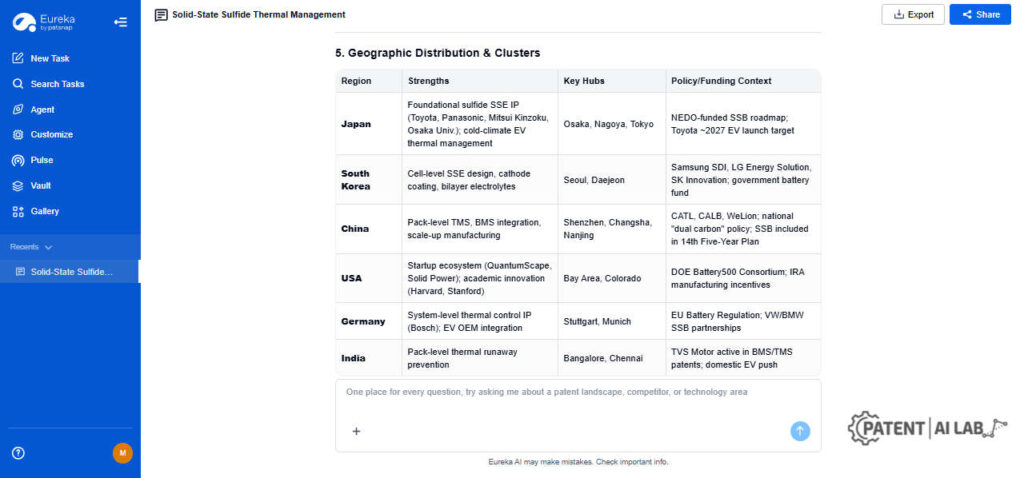
- The capability: Patsnap’s Eureka platform applies AI search and analysis across more than 2 billion structured data points spanning patents, scientific literature, and technical disclosures from over 120 countries. Rather than only mapping terrain, it supports natural-language queries in place of Boolean search strings, letting engineers describe an invention in plain technical language and receive a structured view of where novelty exists and what prior art is closest. The screenshot below shows this in practice on a real query.
- Best use: R&D engineering teams who need IP strategy visualization without routing every early-stage query through outside patent counsel.
2. LexisNexis PatentSight: The Value Engine for Board Strategy
If Patsnap is built for technical explorers, PatentSight is built for corporate strategists. It moves past raw patent counting and measures portfolio strength directly.
The metric: the Patent Asset Index. It calculates portfolio strength as the sum of each patent family’s Competitive Impact, which is itself the product of two components: Technology Relevance, based on the volume of forward citations a family receives, and Market Coverage, based on the combined Gross National Income (GNI) of every jurisdiction in which the family is actively protected. A family with no active protection anywhere has a Competitive Impact of zero regardless of citation count, since Market Coverage is the multiplier, not an additive bonus.
- The white space move: deploy the Bubble Chart (Quantity vs. Quality). Target the “Crowded but Weak” quadrants, which highlight areas flooded with a high volume of low-Competitive-Impact patents. This exposes soft white space where a single, high-quality invention can outcompete a large existing portfolio.
- Best use: automated patent mapping for board-level reporting and M&A due diligence, where the Patent Asset Index is already an established KPI in investor communication.
3. Lens.org (PatCite): The Free Option for Startups
Lens.org is the open-science option in this category, and it is a genuinely capable one for teams operating with zero analytics budget.
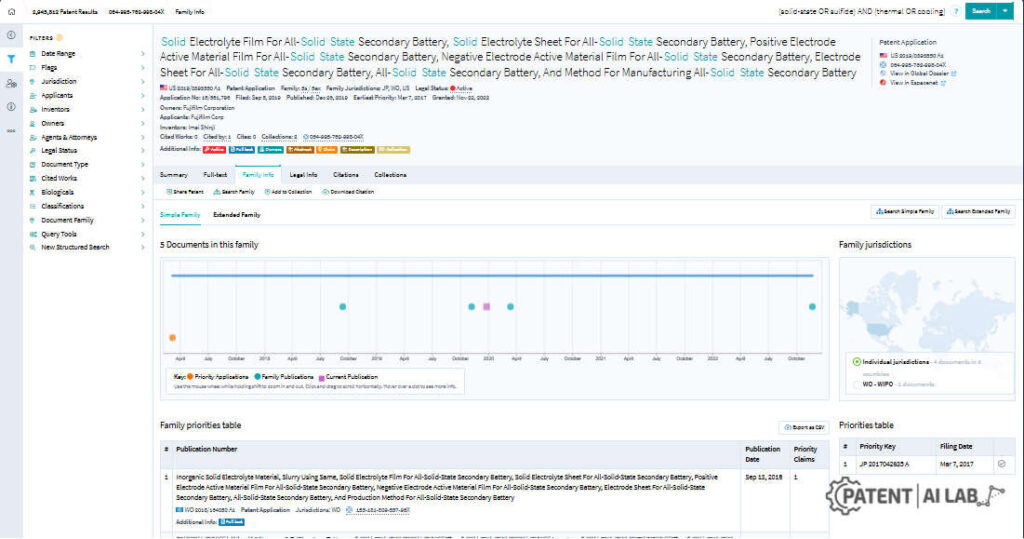
- The view: generates Network Graphs through its PatCite module, which links patents to the more than 200 million scholarly records in Lens.org’s database and shows the citation relationships in both directions, patent to paper and paper to patent. It also plots family timelines and jurisdiction maps directly, shown below for a real patent family.
- The white space move: hunt for structural holes. If Cluster A (AI algorithms) and Cluster B (drug discovery) rarely cite each other, building the technical bridge between them can reveal a genuine commercial opportunity.
- What “free” actually means here: the platform is anonymously accessible with no account required, and all core patent and scholarly search and export functionality is open. A free registered account adds saved search history and bulk export up to 50,000 records at a time; it does not gate the underlying search or citation-mapping capability behind a paywall.
- Best use: rapid citation analysis and academic-to-industry linking, particularly for teams that want to verify whether a hypothesized gap is corroborated by a thin citation trail before spending on an enterprise tool.
Feature Showdown (Comparison)
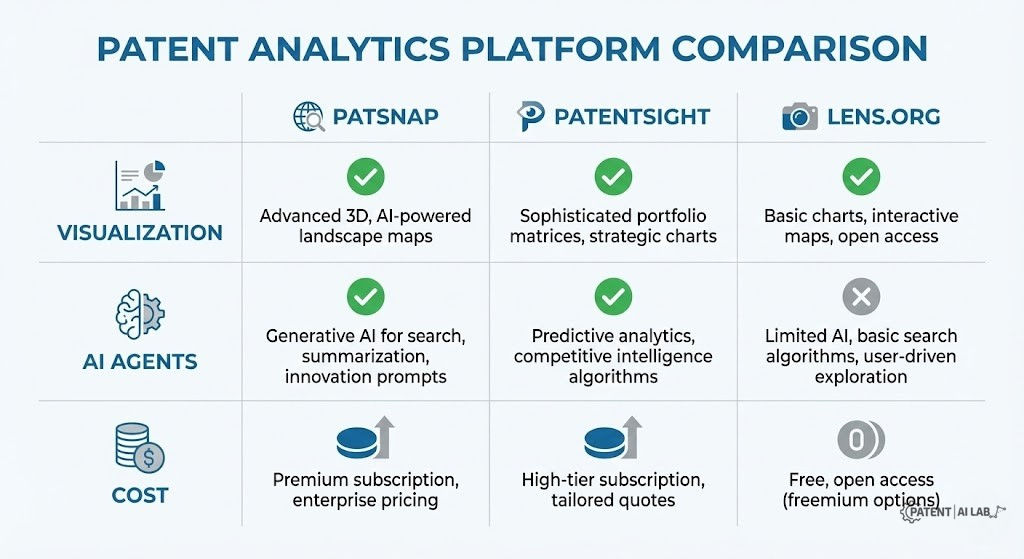
| Tool | Ease of Use & Visuals | AI Capability | Price Reality | Best For |
|---|---|---|---|---|
| Patsnap | ⭐⭐⭐⭐⭐ (3D Maps) | High (Eureka natural-language search and analysis) | Enterprise, seat- and module-dependent | R&D discovery and innovation heatmapping |
| PatentSight | ⭐⭐⭐⭐ (Bubble Charts) | Medium (Protégé AI assistant within PatentSight+) | Enterprise, custom quote | Portfolio value and board strategy |
| Lens.org | ⭐⭐⭐ (Network Graphs) | Low (manual analysis, no AI layer) | Free, no account required for core search | Startups, universities, citation verification |
| Questel (Orbit) | ⭐⭐⭐⭐ | Medium | Mid-to-high, custom quote | Deep legal status checks |
What Enterprise Patent Analytics Tools Actually Cost
Vendor pricing pages for this category are almost universally quote-based, which makes a single headline number misleading no matter which figure gets picked. The table below cross-references multiple published sources for each platform rather than relying on one vendor blog post, so the range reflects genuine market variation, driven mainly by seat count and which analytics modules are attached, rather than uncertainty about the underlying figure.
| Platform | Reported Annual Range | What Drives the Range |
|---|---|---|
| Patsnap | Roughly $15,000 to $40,000+ for a standard corporate license | Seat count, plus optional bio/chemical search and AI modules |
| LexisNexis PatentSight | Roughly $20,000 to $50,000+ | Portfolio size and depth of benchmarking access |
| Lens.org | Free for core patent, scholarly, and PatCite search | Paid API access available separately for high-volume automated queries |
What this means in practice: a team evaluating these platforms should request a live quote scoped to actual seat count and module needs rather than budgeting off a single number seen in a comparison article, including this one. Lens.org’s free tier is the one figure in this table that is not vendor-negotiated, since core search access is published as open and anonymous with no sales conversation required.
Pro Tip: if enterprise capital is unavailable, export citation and family data from Lens.org and visualize it in Gephi or Tableau. This is a genuine way to build a working landscape view without an enterprise contract, though it substitutes analyst time for the automated analytics layer that paid platforms provide out of the box.
Step-by-Step: How to Find White Space
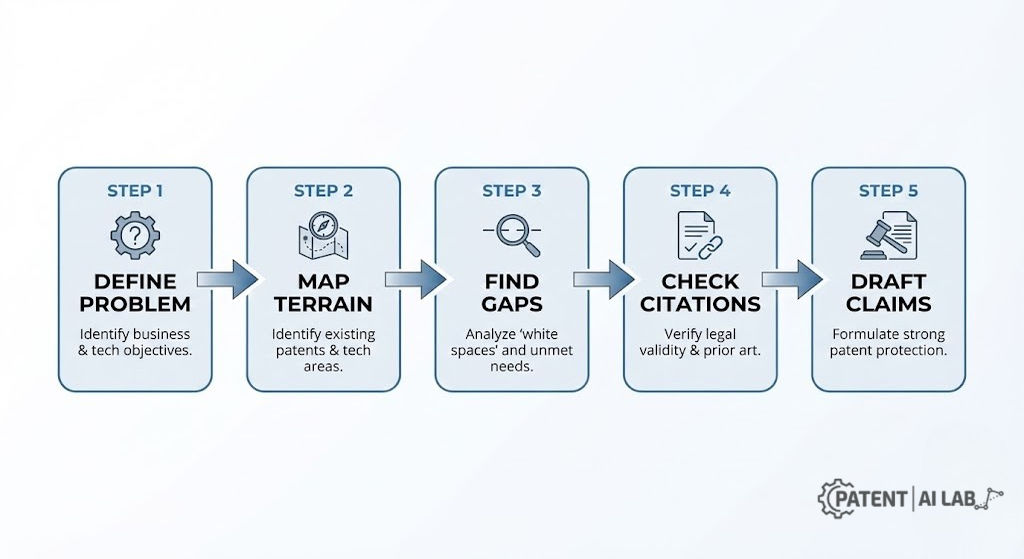
Tools are of limited use without a disciplined process behind them. This five-step workflow isolates a potentially protectable gap using established patent gap analysis techniques.
- Define the market slice. Do not search for generic terms like “batteries.” Search for a specific problem parameter, for example (solid-state OR sulfide) AND (thermal OR cooling). Use CPC codes to filter out noise.
- Map the terrain. Deploy the Patsnap 3D map. Target sparse grids directly adjacent to dense peaks. In PatentSight, isolate players showing high patent quantity but low Competitive Impact, the “crowded but weak” signature described above.
- Identify the quiet ridge. Zoom into the sparse area and analyze the titles. A typical pattern looks like this:
- Observation: heavy patenting on electrolyte chemistry, but minimal filings on active thermal control logic.
- Hypothesis: a real gap may exist in dynamic temperature regulation.
- Validate with citations. Run the same technology terms through Lens.org’s PatCite tool, using the family timeline and jurisdiction view shown above to confirm filing activity in the sparse area. A thin, sparsely connected citation network around the hypothesized gap is corroborating evidence, not proof; combine it with the claim-level review in the next step.
- Draft the hypothesis. Establish the angle in plain terms: “Existing patents focus on passive materials; the unclaimed opportunity may lie in active, closed-loop sensor feedback.” This is a research hypothesis for patent counsel to evaluate, not a conclusion that the space is clear.
USPTO Eligibility and AI Inventorship: What to Check Before Filing
Locating white space is only half the work. A gap is only useful if a resulting patent claim can survive USPTO examination.
Finding a gap is an academic exercise if it cannot be legally protected, and the mechanics of securing a priority date, such as filing a provisional application, are worth understanding even if a licensed attorney ultimately handles the filing. Our related guide, How to File a Provisional Patent Yourself, walks through that process and its limits; it is background reading, not a substitute for review by qualified patent counsel before anything is actually filed.
1. Subject Matter Eligibility (§ 101): What the 2024 AI Guidance Actually Changed
The relevant framework is the USPTO’s 2024 Guidance Update on Patent Subject Matter Eligibility, Including on Artificial Intelligence, effective July 17, 2024. It did not change the underlying Alice/Mayo test; it clarified how examiners should apply Step 2A of that test to AI-related claims, and added three worked examples (Examples 47 through 49) covering anomaly detection, speech signal separation, and personalized medical treatment.
- The trap: Example 47 shows that a claim reciting only “detecting” an anomaly and “analyzing” it with a trained neural network, without more, was found to recite a mental process, since detecting and analyzing in the abstract can be practically performed by a human evaluating the same data. Claims that state only that AI is used to reach an outcome, without a concrete technical mechanism, face the same risk.
- The fix: the same example set shows that tying the claim to a specific technical application, such as detecting malicious network activity and triggering a defined remedial action, integrates the abstract idea into a practical application and supports eligibility. The claim needs a concrete technical improvement to a computer or hardware system, not just an algorithm wrapped around a general outcome.
- Illustrative comparison: “An AI model that predicts battery heat” states an outcome without a mechanism and risks a mental-process rejection under the pattern described above. “A battery controller that adjusts charging current based on real-time impedance data to prevent dendrite formation” ties the same underlying prediction to a specific hardware action, which is the kind of practical application the 2024 guidance treats as eligible. This is an illustration of the eligibility pattern from the guidance, not legal advice on any specific claim.
A follow-up August 2025 USPTO examiner memorandum reinforced this same distinction, cautioning examiners against stretching the “mental process” category to cover claim limitations that require machine-based operations, such as neural network training steps that cannot practically be performed with pen and paper. It did not introduce new legal standards; it sharpened examiner expectations already set out in the 2024 update.
2. AI-Assisted Inventorship: What Must Stay Human
USPTO guidance is unambiguous on this point: an AI system cannot be listed as an inventor, and it cannot independently hold patent rights. Teams may use AI patent analytics tools like the ones compared above to help locate a gap, but the actual conception of the claimed solution, the human contribution that makes the invention non-obvious, must come from a named human inventor. Documenting that human contribution at the time it happens, rather than reconstructing it later, is the practical safeguard against an inventorship challenge.
A Cautionary Example: Sonos v. Google
The Sonos v. Google dispute is a useful case study, not because it shows a clean infringement win, but because it shows how much can still unravel after a jury verdict.
Sonos sued Google in 2020 over two “zone scenes” speaker-grouping patents. In May 2023, a San Francisco jury found Google liable and awarded Sonos $32.5 million in damages. That result was not the end of the case. District Judge William Alsup later threw out the verdict in a post-trial order, holding the asserted patents unenforceable for prosecution laches and invalid for lack of written description support, after finding Sonos had pursued a “daisy chain” continuation strategy over roughly thirteen years before presenting the asserted claims for examination. Sonos appealed, and the Federal Circuit heard oral arguments on July 10, 2025. As of this writing, the appellate ruling is still pending, and this summary reflects the case’s public docket status at that point rather than a final outcome.
Why this matters for a white space strategy: a jury verdict is not a final outcome, and a strong-looking patent family can still be invalidated years later on procedural grounds unrelated to the underlying technology. For anyone building a filing strategy around a mapped gap, continuation timing and written description support are worth treating as first-class risks rather than afterthoughts, alongside whatever a qualified patent attorney advises for the specific claims involved.
Bonus: A Lower-Cost AI Landscape Script
If capital is constrained, this Python script clusters patents from a raw CSV export generated by Lens.org, giving a rough semantic grouping without an enterprise analytics subscription.
# Conceptual: "DIY" Semantic Clustering for White Space Detection
from sentence_transformers import SentenceTransformer
from sklearn.cluster import KMeans
import pandas as pd

# 1. Load exported abstracts (from Lens.org)
data = pd.read_csv("patents.csv")
abstracts = data['abstract'].tolist()

# 2. Encode text into semantic vectors
model = SentenceTransformer("all-MiniLM-L6-v2")
embeddings = model.encode(abstracts)

# 3. Cluster into topics (e.g., 20 clusters)
kmeans = KMeans(n_clusters=20, random_state=42)
data['cluster'] = kmeans.fit_predict(embeddings)

# 4. Analyze: Print keywords for the SMALLEST clusters (Target White Spaces)
print(data['cluster'].value_counts().tail(5))
This script clusters by semantic similarity only. It does not check claim scope, legal status, or eligibility, so a small cluster is a lead worth investigating, not a validated white space finding on its own.
Verdict: Picking the Right Tool
- For the R&D team: Patsnap. Its AI-native search shortens the path from raw data to a technical insight the engineering team can act on.
- For the boardroom: LexisNexis PatentSight. The Patent Asset Index translates patent claims into a quality metric that already has traction in investor communication.
- For the startup: Lens.org. Paired with open-source scripts like the one above, it delivers a real competitive intelligence starting point at no licensing cost.
Podcast
Note: This audio is a condensed intelligence brief. Please review the software matrices above for granular tool capabilities and technical script implementations.
FAQs
What’s the best patent landscape software right now?
It depends on who’s using it. If you’re an engineer trying to find a technical gap, Patsnap’s 3D mapping and AI search are hard to beat. If you’re presenting portfolio strength to a board or during due diligence, LexisNexis PatentSight’s Patent Asset Index is the metric investors already recognize. If you’re a startup with no software budget, Lens.org gives you real citation data for free, no account needed.
What does “white space” actually mean in patents?
It’s a corner of a technology area where people clearly want a solution, but almost nobody has filed a strong patent covering it. Finding one is the start of a research lead, not a green light. You’d still need a patent attorney to confirm the space is actually clear before filing anything.
Do I need to pay for enterprise software, or can I do this for free?
You can get surprisingly far for free. Lens.org’s core search, citation graphs, and PatCite tool don’t require a paid account or even a login for basic use. Enterprise tools like Patsnap and PatentSight add automated AI analysis and board-ready reporting, which is worth paying for once you have real budget, but isn’t required to start mapping a landscape.
Can I list an AI tool as the inventor if it helped me find the idea?
No, and the USPTO is firm on this. Software can help you spot a gap or draft a search query, but the actual named inventor has to be a human being who conceived the solution. Keep a record of your own contribution as you go so there’s no ambiguity later.
Why do AI-related patent claims get rejected so often?
Usually because the claim only describes an outcome, like “an AI model that predicts X,” without explaining the technical mechanism behind it. USPTO examiners have been instructed since mid-2024 to treat that kind of claim as an abstract mental process. Tying the claim to a specific hardware action or technical fix tends to fare much better, though a patent attorney should review the actual language before filing.
Sources and Legal References
The platform metrics, legal framework details, and case history in this article are drawn from the following primary sources, each checked directly during this revision.
-
1. Federal Register — 2024 Guidance Update on Patent Subject Matter Eligibility, Including on Artificial Intelligence
Source for the eligibility framework, effective date, and Examples 47-49 discussed in the USPTO section above.
Review the Federal Register Notice -
2. LexisNexis Intellectual Property Solutions — The Patent Asset Index Methodology
Source for the Technology Relevance and GNI-based Market Coverage components of the Patent Asset Index described in the PatentSight section.
Review the Patent Asset Index Methodology -
3. About The Lens — Lens.org
Source for Lens.org’s free, anonymous-access model and its PatCite scholarly-to-patent citation linking, covering 200 million-plus scholarly records.
Review About The Lens -
4. Patently-O — Federal Circuit Wrestles with Prosecution Laches in Sonos v. Google
Source for the Sonos v. Google case history, the $32.5 million jury verdict, the post-trial vacatur, and the pending Federal Circuit appeal.
Review the Patently-O Case Summary
Disclaimer & Legal Notice
This article reflects the author’s analytical perspective evaluating enterprise intellectual property software, strategic patent execution, and USPTO examination frameworks. It is intended strictly for informational and strategic purposes and does not constitute formal legal advisory services. It is not a substitute for the counsel of a qualified, licensed intellectual property attorney. Patent eligibility standards, specifically regarding software and Section 101, change frequently. Always consult certified legal counsel before drafting claims or initiating patent prosecution.


Add comment