


 Golam Rabiul Alam, PhD
Editorial note: This article examines the statistical and procedural challenges of Pro Se patent prosecution for educational purposes and does not constitute legal advisory services.” See disclaimer below.
Paying the $65 USPTO fee to get “Patent Pending” status is easy. Writing a provisional application that actually protects your priority date is an entirely different skill. Founders often treat this first filing as a quick rough draft, a mistake that quietly invalidates their intellectual property rights exactly twelve months later.
At a Glance
If you are wondering how to file a patent on a budget, you are not alone. As of 2026, the provisional patent application fee is $65 for Micro Entities, $130 for Small Entities, and $325 for Large Entities. While filing without a lawyer is possible, the biggest mistake inventors make is treating the provisional as a “rough draft.”
To ensure valid protection, your DIY provisional must include a complete technical disclosure, alternative embodiments, and clear drawings, exactly like a formal patent application.
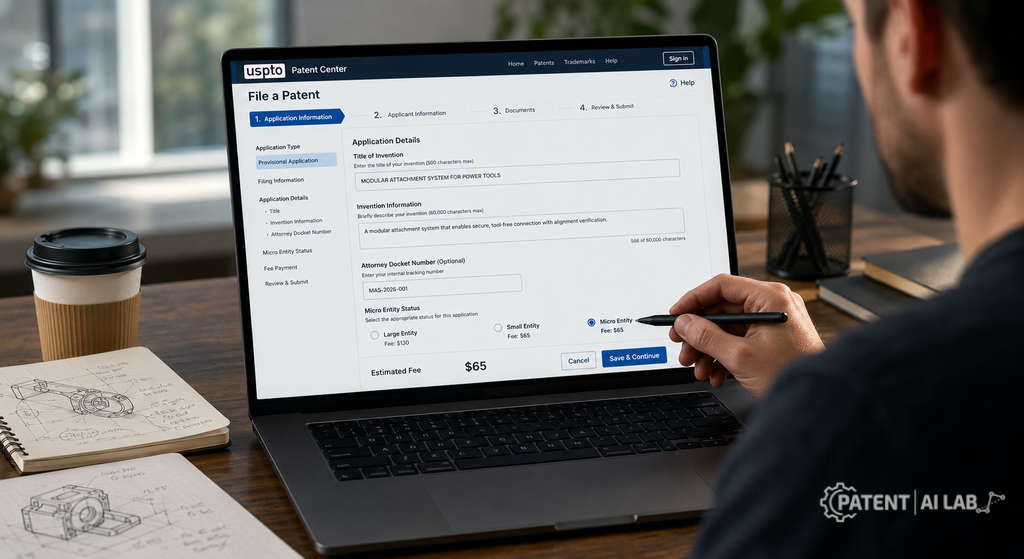
In early 2026, I helped a graduate researcher turn a half-working prototype into something investors could actually discuss. The invention was promising. The budget was not.
The first shock wasn’t the paperwork. It was the provisional patent application fee combined with all the hidden time costs nobody mentions when they casually say, “Just file a provisional.”
What bothered me most was the advice floating everywhere: file fast, file cheap, don’t overthink it.
That advice nearly cost us the invention’s priority date.
This guide is the corrected version of what I wish I had followed from day one. It is for the founder who wants to learn how to file a patent without a lawyer,and without sabotaging their own intellectual property.
How to File a Patent: Can You Really Do It Without a Lawyer?
Short answer: Yes, but only if you stop treating a provisional patent like a throwaway document.
Critical Step: Secure Your $65 Investment
Before you pay the USPTO fee, make sure your idea is actually unique. If someone else already patented it, your money is gone.
First Step: Use these 5 Free Patent Search Tools to check your idea instantly.
Here is the Real Cost (2026 Fees):
Note: To qualify for “Micro Entity” status (80% discount), your gross income from the preceding calendar year must be less than $251,190, and you must be named on fewer than 5 previously filed patent applications.
Quick Steps to File Yourself:
- 1
Search Prior Art: Use Google Patents to ensure your idea is unique.
- 2
Write the Description: Focus on how it works, not just what it does. Include drawings.
- 3
Create a USPTO Account: Register for a “MyUSPTO” account.
- 4
Fill Form SB/16: Use the Patent Center to upload your PDF specification.
- 5
Pay the Fee: Select “Micro Entity” to pay only ~$65.
In practice, a weak provisional is worse than no provisional at all. It gives you false confidence. If your provisional does not fully support the claims you try to file a year later, your “priority date” is basically a mirage.
I’ve seen founders proudly say, “We filed a provisional last year,” only to realize later that their core improvement was never actually described in the text. Priority lost. Game over.
So yes, if you want to know how to file a provisional patent without a lawyer, you can do it. Just remember to act like a careful examiner, not a rushed founder.
Learning how to file a patent also means doing your research. Before you pay the $65 filing fee, you must ensure your invention doesn’t accidentally infringe on existing patents. Here is a step-by-step guide on how to conduct a DIY Freedom to Operate (FTO) search to clear your idea first.
The Step-by-Step Filing Process (2026 Edition)
Below is the process that worked for us, refined after fixing our early mistakes.
Start With “Claim Thinking” (Not Forms)
I did not write formal legal claims, but I thought in claims. I asked one question repeatedly: “If a competitor copied this tomorrow, what exact behavior would I want to stop?”
Every paragraph in the provisional had to answer that question. If the text described the “what,” the patent described the “how.”
Write Before Touching the USPTO Portal
When learning how to file a patent without a lawyer, the best practice is to draft the entire specification in a plain document first. No formatting tricks. No legal filler. Just clear technical language, alternatives, and edge cases.
Technical Tip: USPTO now heavily pushes the DOCX format and has implemented surcharges for non-compliant PDFs in utility filings. While provisionals are currently exempt from the surcharge, getting used to drafting cleanly in Word (DOCX) saves you massive headaches and formatting errors during the Patent Center upload in 2026.
Writing a full patent description can take 20+ hours. If you want to save time, you can use AI to draft it for you in minutes.
Read our review: Can PowerPatent Really Replace a Lawyer?Over-Disclose on Purpose
Common advice says, “Don’t give away too much.” I disagree. Provisional patents reward disclosure, not secrecy. We included variations we had not built yet but could reasonably explain. If you don’t write it down, you don’t own it.
Drawings That Explain, Not Impress
Stick figures beat polished CAD if the idea is clearer. Each drawing answered a technical question, not an aesthetic one. We used PowerPoint to make simple flowcharts and exported them to PDF.
Note: While hand-sketched drawings are accepted for provisional patents, utility patents require strict CAD formatting. If you aren’t an artist, tools like PatentDraw AI (or hiring a draftsman on Fiverr) can save you from a rejection.
The Fee Reality (Micro-Entity Strategy)
Understanding how to file a patent without a lawyer also requires a smart fee strategy. In 2026, filing as a Micro Entity is the only way to make this affordable for individuals. We verified eligibility twice, especially since gross income limits changed in 2025. It mattered.
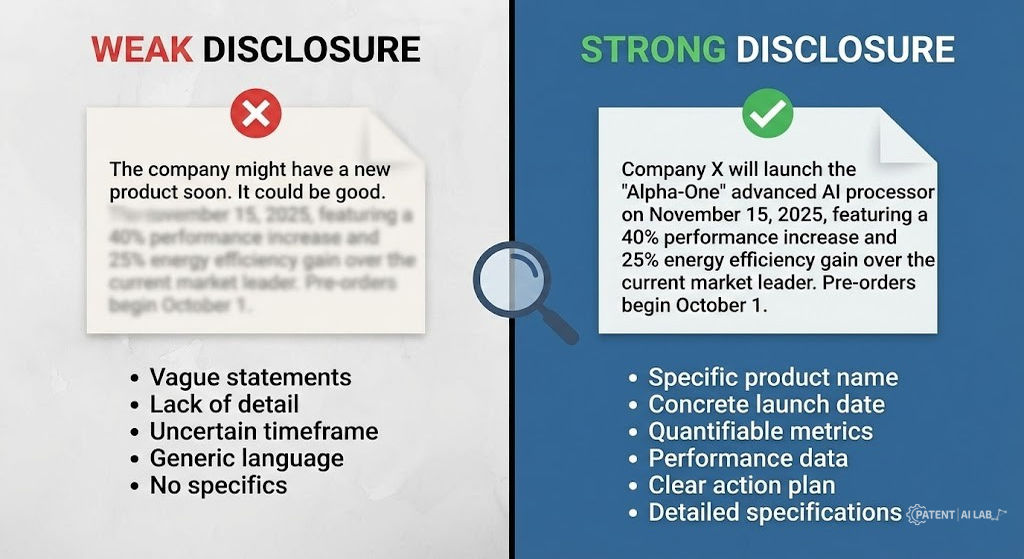
The “Safe Filing” Checklist
If I were to visualize our quality control, it would be a simple one-page checklist. If any row has a “No,” do not file.
Provisional vs. Utility Patent: The Practical Difference
Do not confuse the two. A provisional patent acts as a one-year placeholder to secure your filing date. It is never examined or approved by the USPTO. A utility patent is the formal application that gets examined, costs significantly more, and ultimately becomes a granted patent. Your provisional filing must contain all the technical details you plan to claim in the utility patent a year later.
What It Actually Costs in 2026 (Money vs. Reality)
The provisional patent application fee itself was manageable. The real cost was time.
The Financial Breakdown (Based on early 2026 USPTO fee schedules):
The Hidden Cost
Expect 20 to 30 focused hours if you do this correctly. If you rush it into a weekend, you are gambling with your priority date. That is the uncomfortable truth behind “cheap” provisionals.
The Risk of Illusory Protection
The biggest risk isn’t rejection. Provisional patents are almost never “rejected” because they aren’t examined.
The real risk is illusory protection.If your provisional does not support:
- Your future claims.
- Your commercial version.
- Your obvious next improvements.
Then it will quietly fail when examined a year later. No warning. No appeal. Filing without a lawyer is not reckless. Filing casually is.
Final Reflection
What I learned is simple but unpopular: A provisional patent is not a placeholder. It is a technical disclosure test.
Treat it with the same seriousness you would treat a journal submission or an investor memo. If you are truly committed to learning how to file a provisional patent without a lawyer, do this one thing differently: Slow down before you file, not after.
Podcast
Note: This audio is a condensed summary. Please refer to the written text for precise legal and compliance definitions.
FAQ: How to File a Patent in 2026
Do I need to be a US citizen to file a provisional patent?
No. You do not need to be a US citizen or even reside in the US to file a US provisional patent application. However, you must pay the fees in US dollars.
Does a provisional patent give me “Patent Pending” status?
Yes. Once you receive your receipt and filing date from the USPTO, you can legally use the term “Patent Pending” on your product and marketing materials for 12 months. [United States Patent and Trademark Office (.gov)]
Can I add new features to my provisional later?
No. You cannot “amend” a provisional application. If you invent new features three months later, you must file a new provisional application (another $65) or include them in your non-provisional filing (but the new features won’t get the old priority date).
What happens after 12 months?
The provisional patent expires automatically. Once you master how to file a patent without a lawyer via a provisional, you have exactly one year from the filing date to file a formal utility application to keep your priority date. If you miss this deadline, you lose your priority date.
Sources and Legal References
The regulatory filing frameworks, official statutory fees, and legal analysis cited throughout this guide are sourced directly from federal authorities and verified intellectual property experts:
-
1. United States Patent and Trademark Office (USPTO) Application Basics
Official guidelines verifying provisional application requirements, legal status tracking, and the authorization rules for establishing a priority date.
Access Official USPTO Filing Guidelines -
2. USPTO Fee Schedule and Entity Rules
Official federal rate index validating the provisional application fee structures for large, small, and micro entity applicants.
Review Live USPTO Fee Database -
3. The Rapacke Law Group Legal Analysis
Practitioner evaluation details regarding technical disclosure rules and structural prerequisites for filing a provisional patent without a prototype.
Read Practitioner Patentability Review
Disclaimer & Legal Notice
PatentAILab is an independent educational research platform and is not a licensed law firm or financial advisory service. The data, patent analysis, and strategic insights provided in this article are for informational and educational purposes only and do not constitute legal, investment, or business advice. Intellectual property outcomes depend on specific technical facts, jurisdictional laws, and drafting execution. Always consult a certified patent attorney and a qualified financial advisor before making IP filing or venture capital investment decisions.



[…] That mindset saved my last client nearly four months of rework. And frankly, it made the attorney’s job easier, which is the real goal. On a tight budget? If you prefer to file manually without expensive software, check out our step-by-step guide on How to File a Patent Yourself in 2026 for Only $65. […]
[…] If you are also thinking about protecting your own idea, check out our guide on How to File a Provisional Patent Yourself for $65. […]
[…] File a Provisional First: Secure your ‘Priority Date’ for just ~$60-$150. Read our Step-by-Step Guide on How to File a Provisional Patent Yourself. […]
[…] You cannot license what you do not own. If you haven’t secured your priority date yet, pause here and read our tutorial on How to File a Provisional Patent Yourself for $65: Step-by-Step Guide. […]