


 Golam Rabiul Alam, PhD
Three years ago, my team and I built a machine-learning algorithm for fraud detection in a fintech product. It worked. It wasn’t academically groundbreaking, but commercially, it was lethal.
Then came the investor meeting. They asked one simple question that kicked off six months of legal headaches: “Can you patent it?”
That question forced us into a maze of prior art searches, expensive lawyer calls, and internal debates about secrecy vs. protection. What surprised me most was that the popular advice developers repeat online is often incomplete, sometimes flat-out wrong, and occasionally dangerous.
This is not a theoretical law school essay. This is a practical guide on patenting AI algorithms based on what actually happened when we tried to protect our code.
Article at a Glance
✓ The Protection Paradox: Copyright only protects your specific syntax (your source code). It will not stop competitors from reverse-engineering and rebuilding your AI’s underlying logic in a different language. To protect the function, you need a utility patent.
✓ The Technical Threshold: You cannot patent “abstract math.” Your algorithm is only patentable if it provides a tangible, specific technical improvement (e.g., lowering latency, optimizing memory allocation, or reducing false positives under data constraints).
✓ The GitHub Trap: Publishing your code, algorithms, or research papers before filing a provisional patent instantly destroys your patent rights in most major global jurisdictions (including Europe and China). Legal filing must always precede marketing.
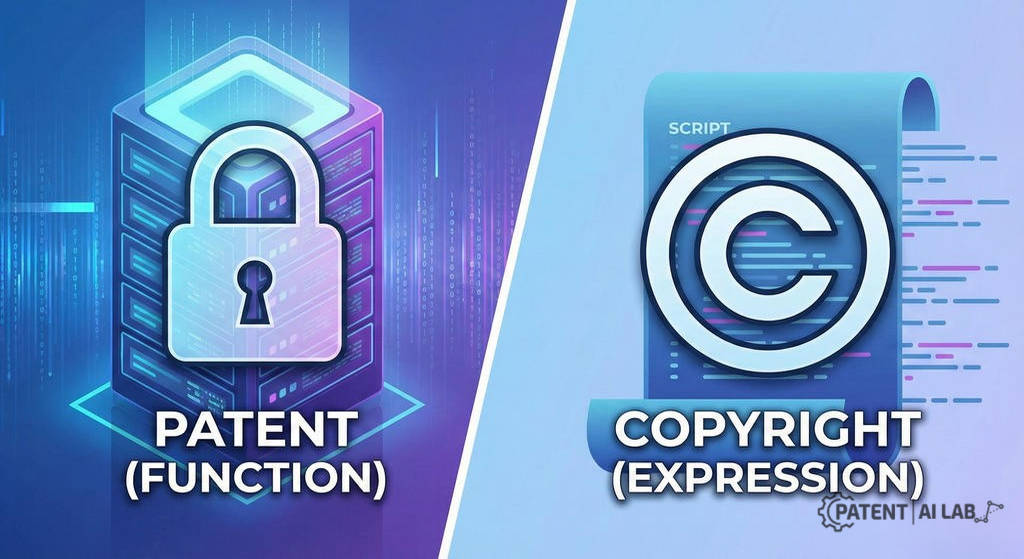
Software Patent vs. Copyright: The “Protection Paradox”
Here is the contrarian truth most developers miss: Copyright is almost never enough for serious AI products.
Many lawyers quietly push startups toward copyright because it is cheaper and simpler. But if you are building a defensible moat, you need to understand the brutal difference between software patent vs copyright.
- Copyright protects expression (The Code): It stops someone from Copying + Pasting your main.py file.
- Patents protect function (The Behavior): It stops someone from rebuilding your logic using a different programming language.
In our case, copyright covered our source code. Great. But the moment a competitor understood our logic, they could rewrite the same functionality using different syntax. We would have zero leverage.
The “Abstract Math” Myth When developers say, “You can’t patent AI algorithms,” what they really mean is “You can’t patent abstract math.” That distinction is critical. You don’t patent the equation; you patent a specific technical method that uses that equation to solve a real-world problem.
The Evidence: How We Tested Patentability (Without Guessing)
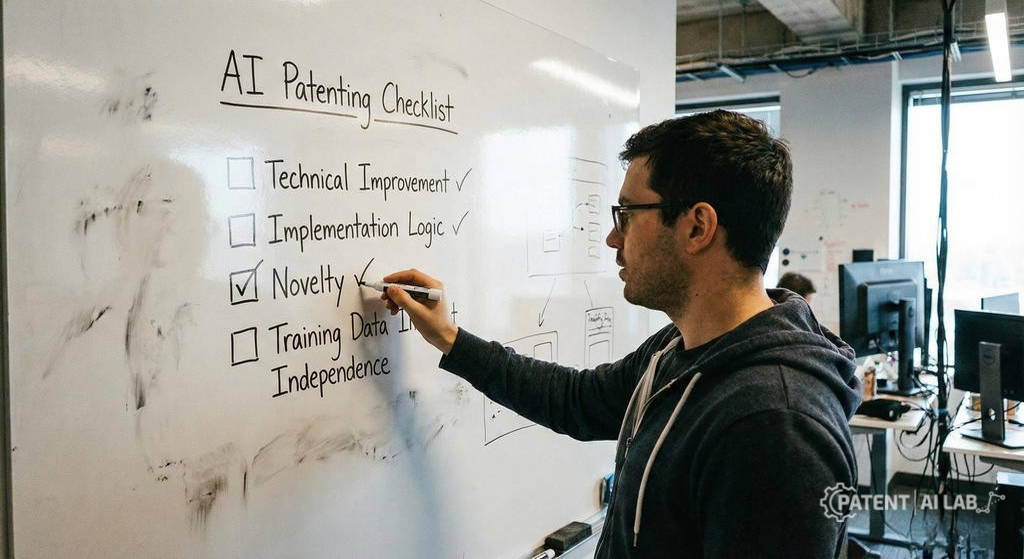
We stopped asking lawyers broad questions. Instead, we started stress-testing the invention ourselves using a “Developer Checklist.” If you are thinking about patenting AI algorithms, run your idea through this filter first.
Technical Improvement: Does the model improve a system metric (latency, memory usage, false positive reduction) rather than just “business revenue”?
Implementation Logic: Can the method be described without referencing specific business rules (e.g., “loan approval”)?
Novelty: Does it work differently than known approaches, or is it just “better tuned”?
Training Data Independence: Can you explain the novelty without relying on the size or quality of your proprietary dataset?
The Engineer Test: Would a skilled senior engineer say, “That’s a clever workaround,” instead of “Yeah, that’s standard”?
Our Verdict: Our fraud model passed because it introduced a specific inference pipeline that reduced false positives under limited data constraints. The “pipeline” was the patent, not the neural network itself.
The Trap: How GitHub Can Kill Your Patent
Here is the risk nobody warned us about: Publishing too early kills your patent options permanently. Marketing wanted a launch blog post. Engineering wanted GitHub stars. Legal quietly panicked.
⚠️ The “Grace Period” Trap: While the US offers a 12-month grace period after public disclosure, most international jurisdictions (including the EPO and CNIPA) require Absolute Novelty. If you push your AI code to a public GitHub repo before filing a provisional application, you effectively kill your patent rights in Europe and China instantly.
If you are debating software patent vs copyright, timing is the deciding factor.
- Copyright: Automatic the moment you write code.
- Patents: If you disclose your invention (GitHub repo, conference slide, YouTube video) before filing, you lose your patent rights in most of the world immediately (Europe, China, etc.).
We nearly made this mistake. We kept the repo private until the provisional application was filed.
Securing this early filing date is a crucial first step. Once filed, you can even explore early monetization strategies, which we cover in our step-by-step guide on How to License a Provisional Patent.
Final Reflection: Specificity Wins
If I had to reduce this to one rule for developers: “Don’t ask ‘Can I patent AI?’ Ask ‘What exact technical pain does my system remove?'”
Patents reward specificity, not ambition. We ended up filing one narrow, enforceable patent instead of three broad, vague ones. It was cheaper and actually valuable.
Podcast
This automated audio brief outlines the primary data, analysis, and strategic insights covered in this guide.
FAQ: Common Questions on AI IP Strategy
Is it better to keep my algorithm as a Trade Secret?
It depends. If your algorithm runs on a backend server where no one can see it (like a black box), trade secrets are often better and cheaper than patenting AI algorithms. But if competitors can reverse-engineer it or independent discovery is likely, a patent is your only shield.
How much does an AI patent cost?
Realistically? Between $10,000 to $25,000 for a quality US utility patent. This is why the “Checklist” above is so important—you don’t want to spend this kind of money on a weak idea.
Does “Software Patent vs Copyright” matter for open source?
Yes. Open source licenses (like MIT or GPL) rely on copyright. However, many large open-source projects (like TensorFlow or PyTorch) also have patent clauses. If you are open-sourcing, you are giving away the “secret,” so rely on copyright and community adoption, not patents.
Can I patent a prompt I wrote for ChatGPT?
No. Prompts are generally considered human input or literary expression (copyright), not a technical invention. You cannot patent a prompt, but you might be able to patent a system that automatically generates and optimizes prompts in a novel way.
Sources and Legal Framework
The legal standards, case laws, and intellectual property frameworks presented in this guide are derived from official federal statutes and international treaties. You may verify specific guidelines via the following resources:
-
1. USPTO Subject Matter Eligibility
The official manual (MPEP 2106) on patenting mathematical algorithms and software-based inventions.
View MPEP Guidelines -
2. Alice Corp. v. CLS Bank International
The landmark Supreme Court case that defined the boundaries of “abstract ideas” in software patents.
Case Summary via Justia -
3. Copyright for Computer Programs (US Copyright Office)
Official guidelines (Circular 61) explaining the boundaries of copyright protection for software and code.
Read Circular 61 (PDF) -
4. WIPO AI and Intellectual Property
Global perspective on protecting AI algorithms under international treaties.
Visit WIPO AI Portal
Disclaimer & Legal Notice
PatentAILab is an independent educational research platform and is not a licensed law firm or financial advisory service. The data, patent analysis, and strategic insights provided in this article are for informational and educational purposes only and do not constitute legal, investment, or business advice. Intellectual property outcomes depend on specific technical facts, jurisdictional laws, and drafting execution. Always consult a certified patent attorney and a qualified financial advisor before making IP filing or venture capital investment decisions.




[…] only hurdle; proving technical improvement is key. For a deep dive on eligibility, read our guide: Can Developers Really Win at Patenting AI […]