


 Golam Rabiul Alam, PhD
At A Glance: The 2026 Licensing Roadmap
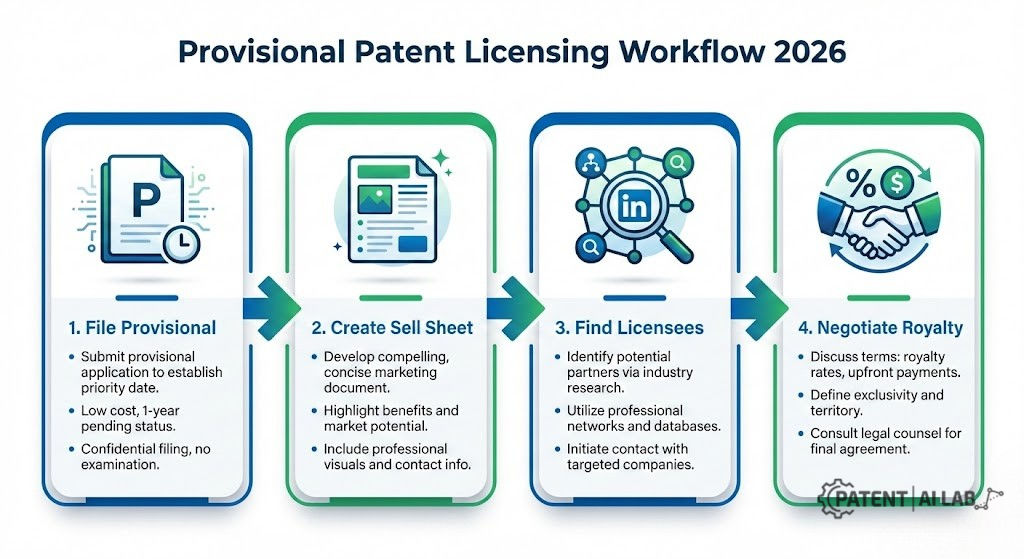
You can license a patent-pending invention even if you only filed a provisional application, but you must understand that you are licensing future rights, not an issued monopoly.
⚙️ The Fast-Track Workflow:
- 📦 Package the Asset: Build a 1-page sell sheet (problem, proof, benefits, simple visuals).
- 🎯 Targeting: Find best-fit licensees (Google operators + LinkedIn title search for “Innovation” or “Product”).
- ✉️ The Pitch: Send a tight, 3 to 6 sentence pitch attaching your sell sheet.
- 🤝 The Deal: Negotiate terms, typically starting around a 3 to 5% running royalty for consumer/tech products.
Key Takeaways
- The “Provisional” Reality: You are licensing a bundle of know-how, priority rights, and future patent potential—not a granted monopoly. Licensees pay for the head start, not just the legal protection.
- Eligibility is Mandatory: For AI/software, the USPTO requires a clear “technical improvement” narrative to pass §101 eligibility. “Using AI to analyze data” is no longer enough.
- Human-Centric Inventorship: Even with AI tools, humans must be the “inventors” who conceived the specific solution. AI cannot be listed as an inventor.
- Valuation Baseline: While variable, a royalty range of 3–5% is standard for many consumer/tech products at this stage.
- The “Sell Sheet” Strategy: Don’t send a full deck first. Use a one-page teaser with problem/solution/proof to get the first meeting.
If you want to earn passive income without the massive risk of building a factory, you must learn how to license a provisional patent. Most inventors I meet are paralyzed by a common myth: they think they need a fully granted patent and a warehouse full of stock to make money. I get it; it feels safer to have a finished product. But the reality is, you don’t need overhead to profit from your ideas. You just need to package your intellect correctly and sell the rights, not the product.
In 2026, the landscape for how to sell a patent pending idea has shifted. It is no longer just about having a “cool concept”; it is about packaging a de-risked asset that integrates into existing product lines. By licensing a provisional patent, you are essentially selling a bundle: your know-how, your priority filing date, and the contract right to future protection.
This guide provides a transparent, step-by-step workflow to help you license provisional patent 2026 assets effectively, covering everything from the sell sheet for inventions template to negotiating royalties for provisional patent deals.
Part 1: The Reality Check & 2026 Legal Landscape
Before sending a single email, you must understand what a provisional patent actually does. A provisional application is a lower-formality filing that locks in an early U.S. filing date and allows you to legitimately say “Patent Pending.” It is not examined, and it automatically expires after 12 months. To retain the benefit, you must file a nonprovisional within that window.
What Are You Actually Licensing?
When you approach a company to license provisional patent 2026 rights, you are licensing a bundle of:
- Invention Know-How: Design details, training data strategies, and implementation tricks.
- Priority Position: The early filing date that predates competitors.
- Future Rights: A contract right to receive royalties if and when the patentable claims issue.
Companies often view provisionals as “interesting but unproven.” To succeed, you must de-risk the opportunity with specific proof and clean paperwork.
Before pitching to companies, you must confirm your idea is truly novel. A licensee will not pay for something that already exists, so be sure to conduct a deep How to Find Hidden Prior Art with AI: A Step-by-Step Guide.
The Rules That Matter in 2026 (Plain English)
In 2026, patent eligibility and inventorship are under strict scrutiny. Ignoring these can kill your licensing deal before it starts.
1. Patent Eligibility is Not Optional
For software and AI inventions, the gatekeeper is 35 U.S.C. §101 subject matter eligibility. The USPTO applies the Alice/Mayo analysis framework found in MPEP 2103–2106.07.
- The Risk: If your invention is described as “using AI to analyze data and make a decision,” it risks being rejected as an abstract idea.
- The Fix: You must describe a technical improvement. Does it offer better model performance, lower compute usage, or improved system reliability?.
2. AI as a Tool, Humans as Inventors
The USPTO’s revised inventorship guidance (Nov 2025) emphasizes that AI is not an inventor. Even if you use AI tools to refine your code or draft text, the conception must come from a human. Licensees will ask about this during due diligence.
3. Evidence Strengthening
USPTO memos highlight tools like Subject Matter Eligibility Declarations (SMEDs) under 37 CFR 1.132. While you may not need this immediately for licensing, having evidence (benchmarks, comparisons) strengthens your position against §101 concerns.
Part 2: Step-by-Step Guide to Licensing
You cannot license what you do not own. If you haven’t secured your priority date yet, pause here and read our tutorial on How to File a Provisional Patent Yourself for $65: Step-by-Step Guide.
I’ve broken this down into a DIY workflow because I hate complex legal jargon. Here is exactly how I would do it if I were starting today.
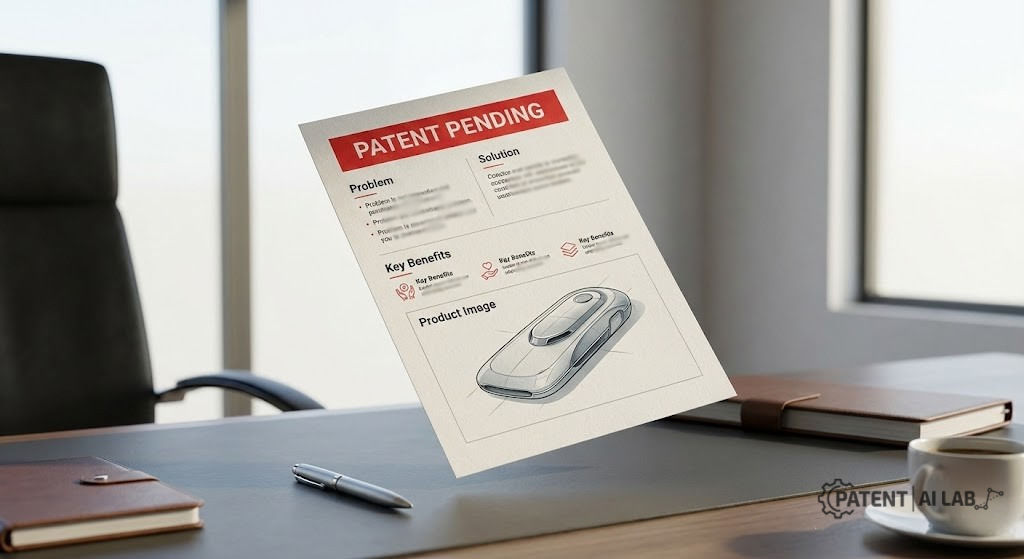
Step 1: The “Sell Sheet” (Your 1-Page Ad)
A sell sheet is a single page designed to make a busy product manager think: “I get it, it’s real, and it fits our roadmap.”
The Winning Structure
Do not send a 20-page slide deck. Use this layout:
- Header: Invention name, “Patent Pending (Provisional Filed: [Date])”, and your contact info.
- Problem (2 lines): Who suffers? What is the cost in risk or time?
- Solution (2-3 lines): What it does and where it plugs in (API, device, workflow).
- Why It’s Different (3 bullets): Measurable advantage, implementation speed, integration ease.
- Proof (Pick 2-3): Demo link, benchmark table, pilot result, or architecture diagram.
- Commercial Fit: Target markets and buyer persona.
- The Ask: “Seeking licensing partner.”
Downloadable Sell Sheet Template
Title: [Invention Name]
One-liner: [What it does + who it helps + measurable outcome]
Problem: [Describe the pain point in 2 lines]
Solution: [Describe the technical solution in 2-3 lines]
Key Benefits:
• [Benefit 1: Measurable metric]
• [Benefit 2: Cost/Time saving]
• [Benefit 3: Integration advantage]
How it Works: [3-5 plain English bullets]
Proof: [Benchmark / Pilot metric] | [Demo Link] | [Screenshot/Diagram]
IP Status: Patent Pending (Provisional filed: [Date])
What I’m Seeking: Licensing partner (non-exclusive or field-limited exclusive)
Contact: [Name, Email, LinkedIn]
Adding Technical Proof (AI/Software Example)
If you are selling intellectual property to companies in the tech space, code snippets build credibility. It shows the invention is real, not just a concept.
Example snippet (Do not paste private core logic, just a benchmark harness):
# Example: quick benchmark harness (toy example)
# Goal: show measurable improvement vs baseline
from sklearn.metrics import f1_score
import numpy as np

y_true = np.array([0,0,1,0,1,1,0,0,1,0])
y_pred_baseline = np.array([0,1,1,0,0,1,0,0,1,0])
y_pred_new = np.array([0,0,1,0,1,1,0,0,1,0])

print("Baseline F1:", f1_score(y_true, y_pred_baseline))
print("New method F1:", f1_score(y_true, y_pred_new))
Your sell sheet caption: “Improved F1 from 0.71 to 0.89 on internal test set; compute unchanged.”
Step 2: Finding Licensees (The Google + LinkedIn Method)
You need to build a target list of 10–30 companies. The ideal licensee already has a product line your invention upgrades, budget for distribution, and a history of partnerships.
Google Operators That Work
Avoid generic searches. Use these operators to find open innovation submission portals and press releases:
- site:com “open innovation” +[industry]
- “[company name]” + licensing + technology
- “[category]” + “seeking innovations”
- intitle:partner intitle:innovation +[keyword]
The LinkedIn Strategy
Do not pay for expensive tools. Use LinkedIn to find the decision-makers:
- Go to the Company Page → People.
- Search for titles: “Innovation,” “Product Manager,” “R&D,” “Licensing,” or “Business Development.”
- Connection Note Script:
“Hi [Name], I built a patent-pending [category] improvement that could fit [product line]. Could I send a 1-page sell sheet to see if it belongs with you or someone on your innovation team?”
Target List Example (IoT/Industrial Use Case)
Here is how you should categorize your targets based on fit and evidence.
| Company Type | Product Line Fit | Contact Role | Evidence they License |
| Industrial Giant X | High (Smart Factory Suite) | Head of Innovation / R&D | “Partner with us” page lists sensor tech |
| HVAC Corp Y | Medium (Commercial AC) | Product Manager (Controls) | Press release on recent AI partnership |
| Tech Platform Z | Low (Cloud Analytics) | VP of Strategic Partnerships | Job posts mention “In-licensing” |
Step 3: The Pitch (Cold Email Script)
Your pitch must be short (6-10 lines max). Do not ask for a Non-Disclosure Agreement (NDA) immediately; most companies will refuse it at the first contact stage to protect themselves.
Look, emailing strangers is scary. You might think they will steal your idea. But remember, big companies are too busy executing their own roadmaps to steal a half-baked idea. Just hit send.
Subject: Patent-pending upgrade for [Product Line] (1-page inside)
Hi [Name],
I’m reaching out because you work on [product/team], and I built a patent-pending method that improves [key metric] for [use case].
In a quick test, it [proof result] without [tradeoff you avoided]. I attached a 1-page sell sheet with the overview and data.
If this is relevant, are you open to a 15-minute call next week? If I’m contacting the wrong person, who owns innovation/licensing for [product line]?
Thanks,
[Name]
[LinkedIn Profile Link]
Follow-up Cadence:
- Day 4-5: One sentence bump + resend attachment.
- Day 10-14: New angle (different benefit).
- Stop: Do not annoy them after 3 attempts.
Part 3: The Deal – Royalties, Terms, and Valuation

Royalties for Provisional Patent Deals
A common question is: What is a fair royalty rate?
There is no universal number, but data gives us a baseline. An analysis of the LES 2021 survey reports an average royalty rate of 4.82% and a median of 4.75% across sampled deals.
For a provisional patent in 2026, 3–5% is a practical starting range.
- Ask Higher (5–8%+): If your invention provides core differentiation, has high switching costs, or strong pilot data.
- Ask Lower (1–3%): If the invention is incremental, requires heavy integration, or is in a low-margin market.
Don’t get greedy here. I’ve seen many deals fall apart because the inventor asked for 10%. Start with 5%, and be willing to negotiate.
Structure: Sales Percentage vs. Lump Sum
Deals rarely rely on just one payment type. According to LES data, 41% of deals used sales-percentage royalties, while 34% used lump sum payments.
📊 Payment Structure Breakdown
A provisional-stage license often benefits from a hybrid model: a smaller running royalty combined with milestone payments to validate progress.
Structuring the Contract: License vs. Assignment
Should you license the patent or sell it outright?
| Option | You Keep Ownership? | Typical Payout | Best When… | Main Risk |
| License | Yes | Running royalties | You want long- term upside | Slow sales = slow money |
| Assignment | No | Lump sum (One-time) | You want certainty now | You lose future upside |
| Option | Yes (Until exercised) | Option fee | Licensee needs time to evaluate | They may “park” the idea |
Patent Licensing Agreement Checklist 2026
When you reach the contract stage, ensure your patent licensing agreement checklist covers these essentials:
- Grant: Exclusive vs. Non-exclusive?
- Territory: US only or Worldwide?
- Royalty Base: Definition of “Net Sales” (watch out for excessive deductions).
- Minimum Guarantee Royalties: Ensures you get paid even if they don’t sell.
- Upfront Fee: Even a small amount ($5k–$50k) proves they are serious.
- Prosecution: Who pays to file the nonprovisional and handle USPTO legal fees?
- Enforcement: Who sues infringers?
- Improvements: Who owns future upgrades?
Part 4: Valuation & Readiness
Before you pitch, assess your provisional patent value valuation. Licensees will silently score you on clarity, patentability, and market proof.
Readiness Scoring Table (DIY)
Use this to see if you are ready to send emails.
| Category | 0 Points | 1 Point | 2 Points |
| Technical Proof | Idea only | Prototype | Benchmark/Pilot data |
| IP Quality | Thin description | Decent detail | Strong enablement |
| Eligibility Story | Abstract idea | Some tech detail | Clear technical improvement |
| Market Pull | Guess | Interviews | LOIs / Paying users |
| Licensee Fit | Broad | Some fit | Perfect slot-in product |
- Total 7–10: You are ready to pitch.
- Total 0–6: Build more proof before contacting companies.
Real-World Implications for AI Founders
In 2026, the intersection of AI and IP is critical. Companies are sharper about §101 risks. USPTO memos specifically distinguish between technical improvements and merely using a computer as a tool. If your sell sheet screams “AI Magic,” you will likely fail due diligence. You must articulate the technical improvement your invention delivers.
Additionally, always maintain a clear chain of human inventorship. While AI generated code is common, the conception must be human to meet USPTO standards.
Licensees are now wary of AI-generated IP risks. To survive their due diligence, you must document your human role clearly by following the protocols in our guide on Patenting AI-Assisted Inventions: 5 Steps to Pass the USPTO’s “Significant Contribution” Test.
📚 Sources & References:
- USPTO, Provisional Application for Patent.
- USPTO, Subject Matter Eligibility (MPEP 2103 to 2106.07).
- Federal Register, 2024 Guidance Update on Patent Subject Matter Eligibility.
- USPTO, MPEP Update on Eligibility Guidance.
- USPTO Memo, Reminders on Evaluating Subject Matter Eligibility (Aug 2025).
- USPTO Memo, Subject Matter Eligibility Declarations (SMEDs).
- USPTO, Revised Inventorship Guidance for AI-Assisted Inventions (Nov 2025).
- Lu & Zhang (SSRN), Financial Terms of 2021 LES Royalty Survey.
Podcast
Disclaimer
This article is based on our team’s experience advising startups, product development, and tracking IP litigation. Tools and legal interpretations change over time. Please note that PatentAILab is an educational platform and not a law firm. This content is for educational purposes only and does not constitute legal advice. Intellectual property laws (especially regarding AI) are complex and change frequently. Always consult a qualified patent attorney for your specific situation.
Frequently Asked Questions (FAQs)
Can you license a provisional patent application?
Yes. You can sign a contract while “Patent Pending.” However, since a provisional is not examined and expires after 12 months, you are effectively licensing your know-how, priority date, and future rights.
How to sell a patent pending idea to companies without manufacturing?
Focus on de-risking the asset. Create a compelling 1-page sell sheet, validate the technology with benchmarks or prototypes, and target companies where your invention fits into an existing product line.
What is a fair royalty rate for a provisional patent?
While it varies by industry, average royalty rates for inventions often fall between 3–5%. Since a provisional patent carries more risk than a granted patent, licensees may negotiate for the lower end of this range or request a hybrid deal with milestones.
Should you ask for an NDA before sending a sell sheet?
Generally, no. Most large companies will refuse to sign a Non-Disclosure Agreement (NDA) for an unsolicited pitch. Keep your initial sell sheet non-confidential and save the sensitive details for when interest is confirmed.
Is licensing better than assigning a patent?
Licensing vs assigning a patent depends on your goals. Licensing allows you to retain ownership and earn passive income over time. Assignment (selling) provides a lump sum and immediate exit but forfeits future profits.
What if my invention uses AI-generated code?
This is acceptable in 2026. However, you must focus on human inventorship. Document which human made the inventive decisions and ensure the patent application describes a specific technical improvement, not just the use of AI tools.


2 comments