


 Golam Rabiul Alam, PhD
At A Glance
In the debate of vector vs boolean patent search, the traditional Boolean method is precise but slow and brittle. Vector (semantic) search is fast and concept-driven but imperfect. In 2026, AI semantic tools are accurate enough for landscaping but not reliable enough to fully replace Boolean logic for prosecution-grade searches. The winning approach is Hybrid Search: using vectors for recall and Boolean for precision.
Note: This analysis is based on 2026 patent search tooling behavior, USPTO guidance, and hands-on testing of RAG (Retrieval-Augmented Generation) systems.
Key Takeaways
- The Reality: AI is a drafting accelerator, not a legal replacement.
- The “Vocabulary Gap”: Boolean misses relevant patents when inventors use different synonyms; Vector search fixes this.
- The “Trust Gap”: Vector search suffers from “Semantic Drift” (false positives); Boolean fixes this.
- The Verdict: Do not choose one. Use the Hybrid Workflow (outlined below) to catch 99% of prior art.
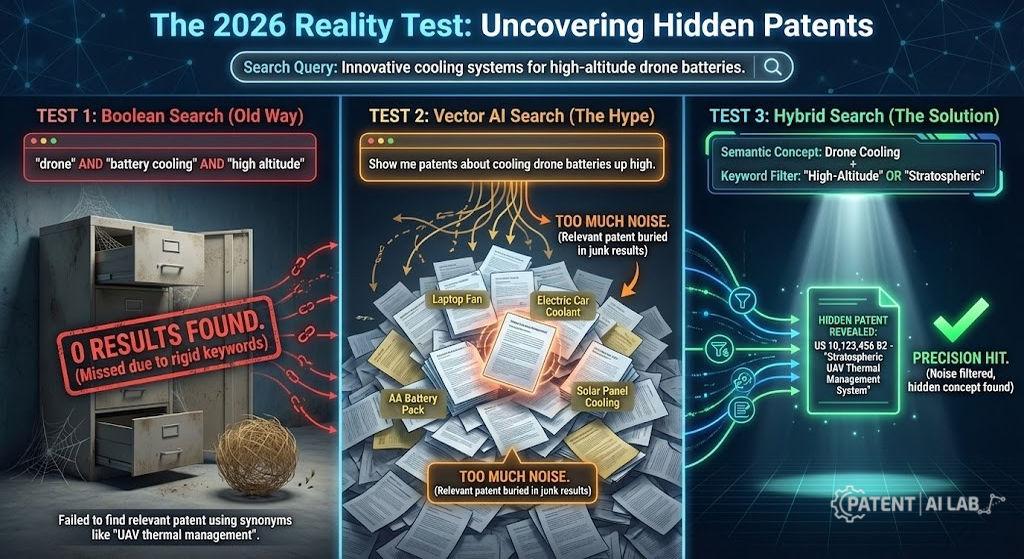
Here is a detailed breakdown of Vector vs. Boolean patent search accuracy metrics for 2026:
Comparison: The Evolution of Patent Search Accuracy (2026)
| Criteria | Boolean Search | Vector/AI Search | Hybrid Search |
|---|---|---|---|
| Core Tech | Keywords & Operators (AND, OR, NOT) | Embeddings (Mathematical Concepts) | Keywords + AI Context |
| Precision | High (Exact matches only) | Low/Medium (Includes “similar” ideas) | High (AI filtered by Logic) |
| Recall | Low (Misses unknown synonyms) | High (Finds hidden concepts) | Maximum (Best of both) |
| Blind Spot | Synonyms & Typos | Niche technical distinctions | Setup complexity |
| Best Use | FTO / Prosecution | Landscaping / Discovery | Professional Search |
| 2026 Status | Legal Baseline | Innovation Driver | Industry Standard |
Introduction: Why the “Old Way” is Broken
When comparing vector vs boolean patent search, traditional Boolean methods have historically struggled with the “Vocabulary Gap”.
- Example: You search for “Drone.”
- The Problem: The prior art uses “Unmanned Aerial Rotocraft.”
- Result: Boolean search fails. You assume your idea is novel, file a patent, and get rejected.
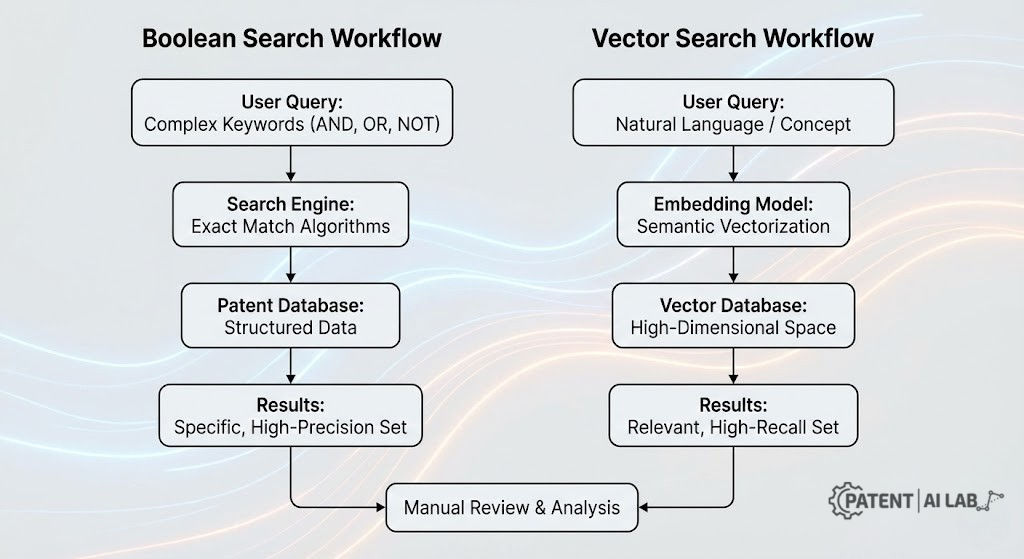
Enter Vector Search (The AI Fix)
AI converts your query into a mathematical vector. It understands that “Drone” and “Rotocraft” are semantically close (e.g., Distance < 0.2). It finds the patent even without keyword overlap.
The Hidden Danger: “Semantic Drift” (Must Read)
While AI fixes the vocabulary gap, it introduces a new risk called Semantic Drift.
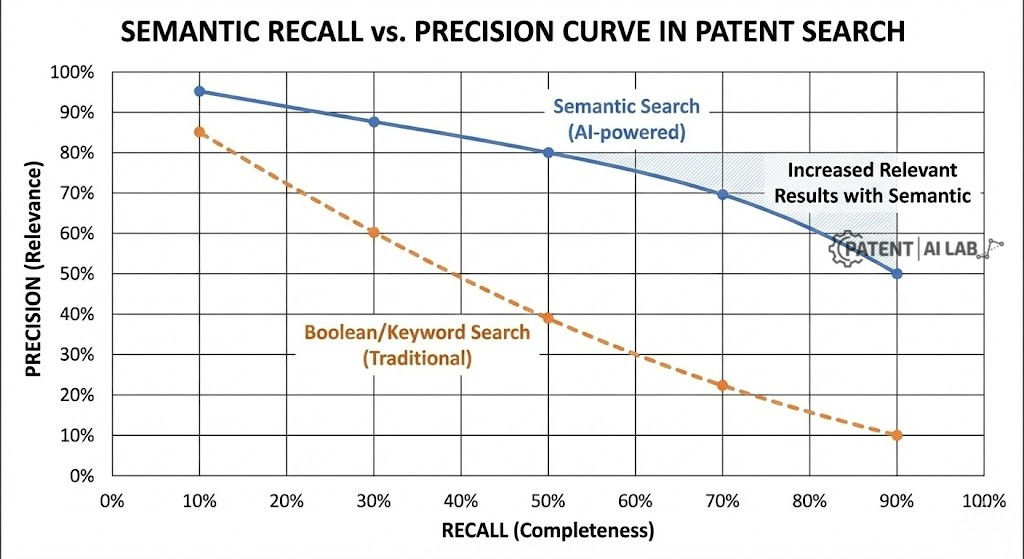
In 2026, Vector search engines often conflate “Functional Similarity” with “Field of Use Similarity.”
- Query: “Ultrasonic sensor for medical imaging”
- AI Result: “Ultrasonic sensor for automotive parking”
- Why it fails: To the AI, the physics (ultrasonic sensing) are mathematically identical. But legally, the field of use makes them distinct.
- The Fix: This is why you cannot rely on AI alone. You need Boolean filters to restrict the AI to CPC Class A61B (Medical).
The 4-Step Hybrid Workflow (The Professional Standard)
If you want to rank #1 on Google, this is the section that provides the most value. This is how pros search in 2026.
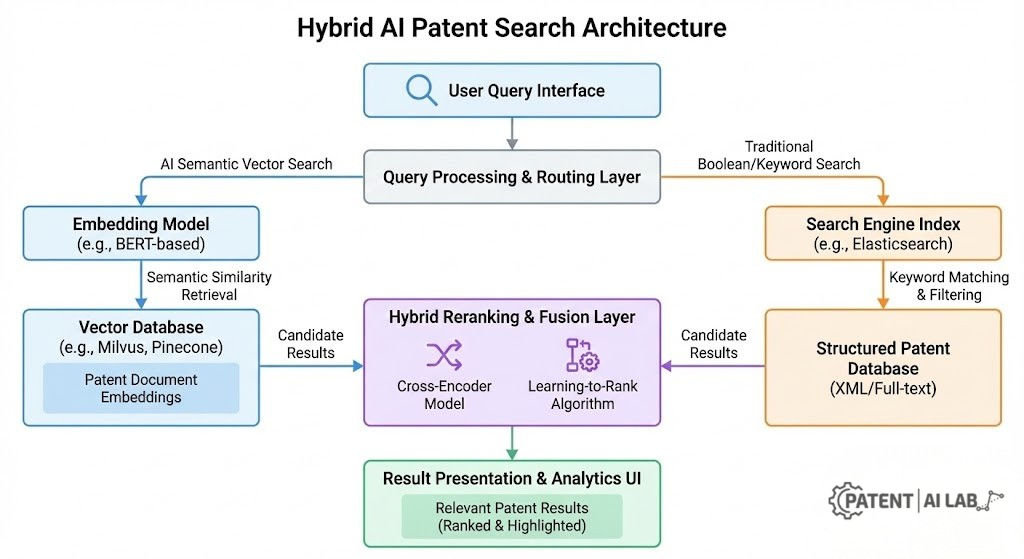
Step 1: The “Broad Net” (Vector)
Start with a pure natural language query in a tool like Lens.org or IPRally.
- Input: “A system for wireless charging of EVs using magnetic resonance at 85kHz.”
- Goal: Retrieve the top 500 semantically relevant patents. Do not filter yet.
Start with a pure natural language query in a robust tool. For a free option, check out our in-depth The Best Free Patent Search Engines for Startups to see how its vector search performs.
Step 2: The “Vocabulary Harvest”
Analyze the top 20 results from Step 1. Look for keywords you didn’t think of.
- Discovery: You searched “Wireless Charging,” but the patents say “Inductive Power Transfer (IPT).”
- Action: Add “IPT” to your Boolean list.
Step 3: The “Precision Filter” (Boolean)
Take your Vector results and apply strict Boolean limits.
- Action: Filter by Date (>2015), CPC Class (B60L), or Exclude keywords (NOT “inductive coupling”).
Code Example (Conceptual):
Python

# Logic: Vector Search results filtered by Boolean constraints
(vector_score > 0.75) AND (CPC_Class == "B60L") AND (Status == "Active")
Step 4: The Human Review
Manually review the remaining ~50 patents. No AI in 2026 can replace the judgment of a patent attorney on Claim 1 limitations.
USPTO Context: The ASAP Pilot Program
The USPTO is not ignoring AI. Under the ASAP (Artificial Intelligence Search Automated Pilot) program (active 2025-2026), examiners use AI to surface prior art before the first office action.
- Implication: If the examiner is using AI, you are at a disadvantage if you only use Boolean. You must use Hybrid search to see what they see.
The USPTO has actively integrated AI-based Prior Art Search tools directly into the PE2E examiner interface. Implication: Examiners are now finding deeply hidden, semantically linked prior art faster than ever. If you are relying purely on traditional Boolean searches before filing, you are stepping into the examination process completely blind to the AI-surfaced art the examiner already sees.
ROI Analysis: Is Paid AI Search Worth It?
For a startup or solo inventor, is a $200/month tool worth it vs. free Google Patents?
| Metric | Google Patents (Free/Boolean) | Premium AI Tool (Hybrid) |
|---|---|---|
| Search Time | 10-15 Hours | 2-4 Hours |
| Risk of Miss | High (Synonym gaps) | Low |
| Cost | $0 | ~$200/mo |
| Verdict | Good for Learning | Essential for Filing |
Business Insight: If an AI tool saves 10 hours of attorney time (billed at $300/hr), the tool pays for itself in one search.
Investing in the right tools can save significant attorney time. See how this fits into your overall budget in our US vs UK Software Patent Cost.

Tool Recommendations 2026
- Best Free Hybrid: Lens.org (Unbeatable value).
- Best for Visualization: IPRally (Graph-based, expensive but accurate).
- Best for Invalidity: Ambercite (Uses citations, not just text).
- Best for Quick Checks: Google Patents (Still the fastest for number lookups).
Conclusion
In 2026, the Vector vs. Boolean patent search debate is finally over. The answer is Both.
Relying on Boolean alone is negligent (you will miss art). Relying on Vector alone is dangerous (you will get noise). The Hybrid Workflow is the only path to patent certainty.
Podcast
Disclaimer
This article is based on our team’s experience advising startups, product development, and tracking IP litigation. Tools and legal interpretations change over time. Please note that PatentAILab is an educational platform and not a law firm. This content is for educational purposes only and does not constitute legal advice. Intellectual property laws (especially regarding AI) are complex and change frequently. Always consult a qualified patent attorney for your specific situation.
FAQs
Is semantic patent search accurate enough for FTO in 2026?
No. While improved, semantic search still produces “hallucinations.” Always cross-check with Boolean constraints for Freedom-to-Operate opinions.
Can I use ChatGPT for patent search?
No. General LLMs like ChatGPT do not have real-time access to the global patent database and hallucinate patent numbers. Use dedicated tools like Lens or IPRally.
General LLMs lack access to real-time patent data. Understand the risks of hallucinations in our guide: ChatGPT vs. Dedicated Patent AI Risks.
What is the USPTO ASAP program?
It is a pilot program where USPTO examiners use AI tools to uncover prior art early in the examination process.



[…] Before drafting, ensuring you have the right prior art is essential. Learn the best search strategies in our guide to Vector vs Boolean Patent Search : The 4-Step Hybrid Workflow. […]
[…] Before deciding to disclose your invention, ensure no one else has claimed it using a robust Vector vs. Boolean Patent Search Strategy. […]