


 Golam Rabiul Alam, PhD
As a computer science professor and the holder of three registered patents, I have sat on both sides of a patent invoice: the side that signs the check, and the side that has to explain to a department head why a “simple” office action response cost four figures. Billing surprises can quietly double the real cost of securing your intellectual property, and in 2026, comparing an hourly vs flat fee patent attorney affects your runway as much as your engineering velocity. Here is how I evaluate that choice as an inventor, not as a lawyer, and where each model tends to trap unsuspecting founders.
At A Glance
In 2026, a flat fee patent attorney tends to save inventors money on software, AI, and startup-driven inventions, while hourly billing still makes sense for complex, uncertain, or litigation-adjacent cases. Flat fees offer cost predictability and fewer billing surprises. Hourly rates can spiral when claims evolve or prior art is dense, though recent USPTO guidance on AI eligibility has somewhat narrowed how often that specific risk materializes.

Why This Question Matters More in 2026
Patent costs are rising on both sides of the Atlantic, and the rise has accelerated since this time last year.
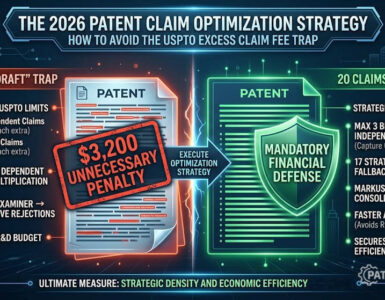
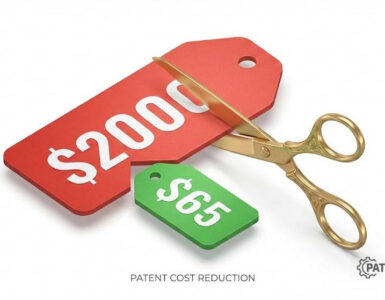
The USPTO’s fee adjustment took effect on January 19, 2025, following a final rule published in the Federal Register. Under that rule, basic filing, search, and examination fees for utility applications rose to a combined $2,000 for undiscounted entities — an increase of roughly 10 percent — while excess claim fees were targeted more aggressively. Each claim beyond the first 20 now costs $200, double the prior $100, and each independent claim beyond the first three rose 25 percent to $600. Firms absorbed some of that increase and passed the rest downstream. At the same time, AI-assisted drafting reduced attorney time on routine work, software and AI patents faced tighter eligibility scrutiny through 2024 (though that scrutiny shifted meaningfully under new USPTO leadership in late 2025), startups began demanding predictable legal budgets the same way they demand predictable cloud bills, and founders started comparing patent attorney costs across the US and UK more closely — especially now that UK official fees have jumped as well.
That combination makes the billing model nearly as important as the attorney’s skill. If you are an AI researcher, bootstrapped founder, or solo inventor, the wrong fee structure can quietly double your real cost of getting to “patent pending.”
Quick Definitions
What Is a Patent Attorney Hourly Rate?
You pay for time spent, usually billed in 6 to 15-minute increments. Typical 2026 ranges, drawn from the same benchmark data the USPTO itself relies on for its own fee calculations, are shown below.
The $447 figure is the exact average billing rate for intellectual property work that the USPTO itself cites in its federal rulemaking, sourced directly from the AIPLA Economic Survey. When a government agency uses a number to calculate its own paperwork burden, it is about as verifiable as a billing benchmark gets. UK ranges reflect broader 2025 market-rate benchmarking rather than a single published survey, since the UK market has no direct AIPLA equivalent.
Hourly billing is most common for ongoing prosecution, office action responses, and strategy-heavy or uncertain work where the scope keeps moving.
What Is a Flat Fee Patent Attorney?
You pay one fixed price for a clearly defined scope of work. Common packages cover non-provisional drafting, provisional applications, single or bundled office action responses, and fixed-price filing through allowance.
The key point — and the one I push founders to interrogate before signing anything — is that scope matters more than price. A $7,000 flat fee that excludes office action responses can end up costing more than a $9,000 flat fee that bundles two rounds of prosecution.
How USPTO Patent Eligibility Impacts Costs
Since Alice Corp. v. CLS Bank, software and AI patents have faced eligibility hurdles under 35 U.S.C. § 101, and that history is exactly why eligibility risk still shapes how firms price their work today.
The picture shifted meaningfully in the second half of 2025. Following his September 18, 2025 confirmation, USPTO Director John Squires placed extra scrutiny on examiner and PTAB rejections of AI-related claims under Section 101. An August 4, 2025 memorandum from Deputy Commissioner for Patents Charles Kim, directed to the technology centers handling AI and software applications, drew a sharper line between claims that merely “involve” an abstract idea and claims that actually “recite” one as their core, and cautioned examiners against stretching the mental-process category to cover machine-executed operations no person could perform in their head.
Then, on September 26, 2025, an Appeals Review Panel led by Director Squires vacated a PTAB Section 101 rejection of a Google AI patent application in Ex parte Desjardins, finding the rejection had evaluated the machine-learning claims at too high a level of generality. The panel credited the claimed invention with reducing storage requirements, lowering system complexity, and preventing what researchers call “catastrophic forgetting” — the tendency of a model to lose earlier-learned tasks while training on new ones — and held that those were genuine improvements to how the machine learning model itself operates, rather than an abstract algorithm running on a generic computer. On November 4, 2025, the decision was formally designated precedential, meaning it now binds examiners and PTAB panels USPTO-wide, and it has since driven updates to the agency’s own examining manual. By December 4, 2025, Director Squires also issued coordinated memoranda formalizing Subject Matter Eligibility Declarations (SMEDs) — a mechanism letting applicants submit expert evidence under Rule 132 to argue that a claimed technical improvement would be apparent to a person of ordinary skill in the art, even where the specification does not spell it out explicitly.
None of this means the courts have softened. An April 18, 2025 Federal Circuit decision, Recentive Analytics v. Fox Corp., affirmed the invalidity of patents covering machine learning applied to broadcast scheduling, holding that generic application of ML techniques to a conventional computing environment is not, by itself, a technological improvement. The USPTO’s friendlier examination posture and the Federal Circuit’s continued strict application of Alice are running on separate tracks, and a well-drafted application now needs to satisfy both.
This matters for billing because eligibility rejections still increase attorney time, even if they are somewhat less frequent for well-drafted AI claims than they were in 2023 and 2024. More claim rewrites mean more billable hours, and the new SMED process adds a genuinely useful but separately billable drafting task. Flat fees, by contrast, force attorneys to price eligibility risk upfront rather than discovering it rejection by rejection.
The practical translation: hourly billing shifts eligibility risk onto you. Flat fees force the firm to absorb it, or at least price it transparently before you sign.
Here is what that looks like in claim language, since this is the part most cost articles skip. The actual Desjardins claim was directed to a computer-implemented method of training a machine learning model that had already been trained on a first task, where the training preserved performance on that first task while learning a second one. Stripped of jargon, a claim built on that same technical-improvement logic reads something like this:
A computer-implemented method comprising: training a machine learning model on a first task; subsequently training the model on a second task using a training technique that constrains a subset of model parameters associated with the first task; wherein the constraining reduces a memory footprint required to preserve performance on the first task relative to retaining a full copy of the model’s prior parameter state.
Notice what is doing the work: not “using a machine learning model” in the abstract, but a specific mechanism (constraining a parameter subset) tied to a specific, measurable technical result (reduced memory footprint). That is the difference between a claim an examiner can wave through under current guidance and one that gets bounced for reciting an outcome without a mechanism. An attorney pricing this work hourly bills for the rejection, bills again for amended claims that add this kind of architectural specificity, and may bill a third time for a Subject Matter Eligibility Declaration if the examiner still isn’t convinced. A firm pricing the same work as a flat fee has every incentive to draft that improvement language correctly on the first pass, since rework comes out of its own margin rather than your invoice.
If your attorney doesn’t have a clear strategy here, my guide on surviving the Alice eligibility test walks through more of these patterns, and my companion piece on reading a software patent in five minutes shows you how to spot weak versus strong claim language yourself, before the bills start arriving.
Real Example: AI-Generated Code Patent
Suppose you built an AI system that generates optimized Python code for database indexing and improves query speed using a novel transformer-based feedback loop. Here is how an hourly vs flat fee patent attorney arrangement plays out in practice for this specific AI invention.
Note: The following cost figures are illustrative estimates based on published market benchmarks, not a guarantee of any specific attorney’s fees. Always confirm scope and pricing in writing before engaging any firm.
Hourly Billing Outcome
If you then receive an Alice rejection plus a Section 102 or 103 prior art rejection, add another $3,000 to $6,000 without much effort. If the firm also prepares a Subject Matter Eligibility Declaration to address the rejection under the current framework, add several more hours on top of that figure.
Flat Fee Outcome
A non-provisional AI or software patent filed under a flat fee arrangement — with claims drafting and eligibility framing included — typically runs $6,500 to $9,500 in attorney costs. You still pay USPTO government fees separately, but your legal spend stops drifting. That is a meaningful difference when a single office action response can add $3,000 to $6,000 under hourly billing.
Hidden Costs of Hourly Billing
Hourly billing is not predatory. It is just risky, and the risk tends to surface exactly when a founder has the least slack to absorb it. The costs I have seen catch people off guard most often: claim revisions triggered by an examiner’s interpretation, time spent on internal review that never shows up as a deliverable, junior associate hours billed and then quietly rewritten by a partner, a degree of over-lawyering driven by malpractice caution rather than your actual risk profile, and repeated eligibility analysis that now sometimes includes a Subject Matter Eligibility Declaration nobody budgeted for.
This is the classic shape of billable-hours inefficiency: you end up paying for uncertainty itself, not just for the work product. One way to keep your attorney’s claim interpretations honest is to learn to read the claims yourself first. My guide on how to read a software patent in five minutes walks through the exact framework I use.

When Hourly Billing Still Makes Sense
Hourly rates are not obsolete — they are situational. I would lean hourly if your invention’s scope is still moving, you expect multiple continuations, you are entering licensing or enforcement discussions, you want a senior partner deeply and personally involved, or the firm offers genuinely transparent time tracking rather than opaque block billing.
It is also worth knowing that, under the 2025 USPTO fee changes, continuations filed more than six or nine years after the earliest priority date now carry new surcharges of $2,700 and $4,000 respectively. That is exactly the kind of evolving-scope complexity where a flexible hourly arrangement tends to outperform a rigid flat fee, because the firm needs room to adjust strategy as your portfolio matures rather than being locked into a scope you defined years earlier.
Flat Fee Patent Attorney: Why Founders Prefer It
Flat fees dominate early-stage patent work for a reason. The benefits are straightforward: a legal budget you can actually plan a runway around, easier investor conversations when someone asks about IP spend, lower anxiety during prosecution, and no hesitation about asking your attorney a clarifying question because every question doesn’t generate a new line item.
⚠️ April 2026 Market Note: AI-Assisted Drafting and Flat Fee Margins
Many IP firms now use AI tools to help draft provisional specifications and claims. If a firm quotes a standard flat fee but leans heavily on AI assistance for the first-pass drafting, their margin on that fee is larger than it would have been three years ago. As an inventor, I think it is a fair question to ask any firm: what drafting tools do you use, and does your flat fee reflect that efficiency? It is a reasonable conversation to have before signing, not an accusation.
Patent Lawyer Cost: US vs UK Comparison
This comparison shifted at the start of April 2026. The UK Intellectual Property Office raised patent fees by an average of 25 to 33 percent — its first patent fee adjustment since 2018 — driven by a 32 percent rise in inflation since fees were last set, which the office had previously absorbed through efficiency gains rather than price increases. Fees charged at the old rate applied only through March 31, 2026, with the new schedule taking effect for any payment made on or after April 1, 2026.
The UK patent search fee alone rose from £150 to £200, and the substantive examination fee rose from £100 to £130. Full 20-year renewal costs climbed from £4,640 under the old schedule to £6,160 under the 2026 schedule. None of those government figures include attorney time. The table below combines official government fees with typical attorney billing for a complete cost picture.
Note: The following figures are representative market estimates based on published government fee schedules and publicly available rate data. Actual attorney fees vary by firm, complexity, and jurisdiction. This is a strategic comparison framework, not formal legal or financial counsel.
UK firms still lean more toward fixed pricing than their US counterparts, though US firms are moving the same direction fast. The UK’s first fee increase in eight years narrows the historical cost gap between the two jurisdictions, but does not erase it.
Patent Prosecution Costs: 2025 to 2026 Trend
Several changes stacked up over the past eighteen months and have collectively pushed prosecution costs higher on both sides of the Atlantic. On the US side, the January 2025 USPTO fee increase raised filing, RCE, and excess claim fees — with excess claim fees doubling per the agency’s final rule — while examiner posture on AI claims shifted under new USPTO leadership following the August 2025 eligibility memo and the November 2025 Desjardins precedent. Continuations also became subject to new surcharges of $2,700 and $4,000 when filed more than six or nine years after the earliest priority date. On the UK side, official patent fees rose by an average of 25 to 33 percent effective April 1, 2026, the first increase since 2018.
The net effect is that average US patent pending cost has trended upward, driven primarily by claim-count and continuation surcharges rather than the base filing fee alone. Flat fee packages have absorbed part of the increase for well-scoped filings; hourly clients have seen the full impact of both the fee increases and any added eligibility-related drafting work. UK applicants now face their first material official fee increase in years, narrowing but not closing the historical US-UK cost gap.
Comparison: Hourly vs Flat Fee Patent Attorney
Retainer Fee Agreement vs Flat Fee
Do not confuse the two. A retainer is money held on account that is still billed hourly against; a flat fee is a capped cost for a defined scope of work. Many founders mistake a retainer for a discount. It is not, and treating it as one is how budgets quietly blow past their intended limit.
How to Choose the Right Model in 2026
Before choosing an hourly vs flat fee patent attorney, I ask firms five specific questions, and I’d encourage any inventor to do the same. Does the flat fee include eligibility strategy, and does that strategy account for current USPTO guidance on AI claims? Are office action responses included or capped, and if capped, at how many rounds? Who actually drafts the claims — a senior attorney or a junior associate? What happens cost-wise if claims need narrowing after a rejection? And can I see anonymized examples of past work in a similar technical area? If the answers are vague, that vagueness is itself the answer, and it usually means walking away.
Note: The email template below is not legal advice. It is a starting framework I use personally to surface fee assumptions early — treat it as a conversation opener, not a legal document.
✉️ The Email Framework I Use as an Inventor
This is the framework I personally use when reaching out to firms to get a clear flat fee and surface any hidden hourly assumptions before committing to anything.
Hi [Attorney Name/Firm],
I am the founder of [Startup Name]. We are preparing to file a non-provisional patent for our [Software/AI] architecture and already have a detailed invention disclosure and technical flowchart ready.
We’re operating on a startup budget and are specifically looking for a predictable flat-fee arrangement. Could you share your standard flat-fee packages for drafting and filing an AI or software patent?
I’d also appreciate knowing whether your pricing reflects the efficiency of modern AI-assisted drafting tools, and whether your flat fee includes handling standard Section 101 (Alice) eligibility framing upfront — including whether a Subject Matter Eligibility Declaration would be billed separately if one becomes necessary.
Looking forward to your rates and next steps.
Best regards,
[Your Name]
[Your Title]

Future Outlook: Where Pricing Is Headed
These are projections based on current verified trends, not guarantees, but the direction of travel through 2026 looks reasonably consistent. Flat fee applications will likely keep dominating early-stage filings. AI-assisted drafting will probably keep compressing hourly margins for routine work. Firms that cling to pure billable-hour models may lose startup clients to competitors offering predictable packages. And hybrid models — flat fee for drafting plus capped hourly for prosecution — are likely to keep emerging as a middle path that suits firms and clients alike.
This mirrors what already happened in contract law and compliance work over the past decade. To reduce attorney hours further, many founders are now layering in AI drafting tools before they ever talk to a firm. My honest review of PowerPatent covers how that hybrid workflow actually performs in practice.
Bottom Line
If you want control, predictability, and founder-friendly pricing, a flat fee arrangement usually saves more in 2026 — particularly now that both USPTO and UK IPO fee schedules have grown more complex. If you want maximum flexibility for an evolving, high-risk portfolio, hourly billing still has a place. The mistake, in my experience, is rarely choosing one model over the other. The mistake is choosing blindly, without asking the five questions above first.
Podcast
Note: This audio is a condensed summary. Please refer to the written text for precise legal and compliance definitions.
FAQs
Is a flat fee patent attorney always cheaper?
No. For complex portfolios or enforcement-heavy strategies, hourly billing can be cheaper over the long term. For a single, well-scoped invention, flat fees usually win.
What is the average patent attorney hourly rate in 2026?
In the US, expect $300 to $600 for most patent prosecutors, with the USPTO’s own benchmark from the 2025 AIPLA Report of the Economic Survey putting the all-firm average at $447 per hour. Elite firms can exceed $900, with some BigLaw IP partners going beyond $1,100.
Does a flat fee include USPTO fees?
Usually not. Always ask directly. USPTO government fees are billed separately, and as of January 19, 2025 those government fees themselves rose by roughly 10 percent across most categories, with excess claim fees doubling.
Are AI-generated inventions harder to price flat?
Yes, though the USPTO’s 2025 guidance updates under Director Squires, including the precedential Ex parte Desjardins decision, have made eligibility outcomes somewhat more predictable for well-drafted AI claims. Good firms still price eligibility risk upfront instead of billing for it endlessly later.
Is a fixed price patent application safe?
Yes, if the scope is clearly defined in writing before you sign. Ambiguity in scope benefits the firm, not you, so push for specifics on what triggers an additional charge.
How much does it cost to patent an AI invention in 2026?
A typical non-provisional AI or software patent filed as a flat fee runs $6,500 to $9,500 in attorney costs, plus a separate $2,000 USPTO filing, search, and examination fee for an undiscounted entity. The same scope billed hourly often lands between $13,000 and $19,000 once a single office action response is included.
Why did UK patent fees increase in 2026?
The UK Intellectual Property Office had not raised patent fees since 2018. Citing a 32 percent rise in inflation since fees were last set, the IPO raised official fees by an average of 25 percent effective April 1, 2026, with most individual patent fees increasing closer to 33 percent.
What is a Subject Matter Eligibility Declaration (SMED)?
It is a mechanism the USPTO formalized in December 2025 that lets applicants submit expert evidence under Rule 132 to argue that a claimed technical improvement would have been apparent to a person of ordinary skill in the art, even if the specification does not state it explicitly. It is typically billed as a separate task from standard claims drafting.
Should a startup choose hourly or flat fee for its first patent?
For a single, well-defined invention, most startups are better served by a flat fee, since it caps legal spend and removes the incentive for a firm to bill extra hours on eligibility rejections. Hourly billing tends to make more sense once a company is managing a larger portfolio with continuations, licensing, or enforcement considerations.
Sources and Legal References
The corporate legal metrics, hardware patents, and statutory guidelines evaluated across this analysis are cross-referenced with official entries from major patent enforcement repositories and publicly verified intelligence datasets:
-
1. Federal Register — Setting and Adjusting Patent Fees During Fiscal Year 2025
The USPTO’s own final rule notice setting the January 19, 2025 fee schedule, including the excess claim fee increases and new continuation surcharges referenced throughout this article.Read the Federal Register Final Rule
-
2. USPTO Federal Register Notice Citing the AIPLA $447/Hour Benchmark
The exact USPTO notice confirming that the agency itself uses the AIPLA Report of the Economic Survey’s $447 average hourly billing rate for intellectual property work as its own cost-burden benchmark.View the USPTO Notice (PDF)
-
3. GOV.UK — New Fees from 1 April 2026 for Designs, Trade Marks and Patents
The UK Intellectual Property Office’s official notice confirming the average fee increase, the April 1, 2026 effective date, and the transition rules for fees paid before and after that date.Read the Official UK IPO Fee Notice
-
4. USPTO — August 4, 2025 Memorandum on Subject Matter Eligibility (35 U.S.C. § 101)
The Deputy Commissioner for Patents Charles Kim’s memorandum to Technology Centers 2100, 2600, and 3600, reminding examiners of the proper standards for evaluating AI and software claims.Read the USPTO § 101 Memo (PDF)
-
5. Ex parte Desjardins, Appeal No. 2024-000567 — Precedential Designation November 4, 2025
The Appeals Review Panel decision vacating a § 101 rejection of machine-learning claims, designated precedential by Director Squires. Confirmed by multiple IP law publications and the USPTO’s own MPEP update notice.Read the Precedential Designation Analysis
Disclaimer & Legal Notice
This article reflects the author’s perspective as a computer science professor and registered patent holder evaluating patent costs from an inventor’s point of view. It is intended strictly for informational and educational purposes and does not constitute formal legal, corporate, or financial advisory services. It is not a substitute for the advice of a qualified, licensed patent attorney. Intellectual property outcomes depend on dynamic jurisdictional laws, specific technical claim drafting, and individual facts and circumstances. Always consult a certified patent attorney before making IP filings, responding to assertion letters, negotiating fee arrangements, or making investment decisions based on patent analysis.


1 comment