


 Golam Rabiul Alam, PhD
Editorial note: This article evaluates ongoing federal litigation, commercial IP strategy, and patent examination trends for informational purposes only. It is not legal advice. See disclaimer below.
The New York Times’s copyright lawsuit against OpenAI is no longer a debate about abstract legal theory. It has become a fight over what discovery actually turns up, and the discovery fights themselves are reshaping the case. No court has ruled on whether training an AI model on copyrighted journalism is fair use, and that question remains open more than two years after the Times filed suit. What has changed is the evidentiary terrain: a January 2026 ruling forces OpenAI to hand over 20 million de-identified conversation logs, and the case’s own center of gravity has shifted from what ChatGPT outputs to users toward whether the underlying training itself was lawful. Here is where the case actually stands in 2026, what the January ruling did and did not decide, and why the industry is splitting between licensing deals and litigation.
At A Glance: NYT vs OpenAI Lawsuit (2026)
The case is in discovery, not decided. Here is the operational summary for CTOs, General Counsels, and Publishers tracking the litigation:
Where Things Actually Stand
- 🔍 Fair Use Is Unresolved: No court has ruled on whether training on news journalism is fair use. The question “remains open,” in the words of one legal tracker following the docket closely.
- 📊 The Log Fight: A federal judge affirmed an order compelling OpenAI to produce a full 20 million de-identified conversation sample, rejecting OpenAI’s bid to hand over only search-filtered results instead.
- ⚖️ Center of Gravity Shifted: The Times withdrew its plan to show a jury its “Exhibit J” verbatim-output examples, and the case has moved from arguing about outputs toward arguing about whether the training itself was lawful.
⚠️ The Market Split
The industry has split into two camps regardless of how this case resolves. Some publishers signed licensing deals for AI training data; others are litigating. Both paths are now active and neither has proven definitively safer.
Key Takeaways
Each point below corresponds to a specific, dated event in the docket, not a prediction about how the case will end. That distinction matters given how much commentary treats discovery wins as if they were substantive rulings on the merits.
- The Case Is Unresolved: The core fair use question, whether training an AI model on copyrighted news journalism is protected, has not been decided by any court. Summary judgment briefing is set to conclude in April 2026, with a possible trial in late 2026 or 2027, so the outcome remains genuinely open rather than a foregone conclusion in either direction.
- The January Ruling Was About Discovery, Not Infringement: Judge Sidney Stein’s January 5, 2026 order affirmed a magistrate judge’s decision that OpenAI must produce the full 20 million-log sample. The ruling turned on relevance and privacy balancing under Federal Rule of Civil Procedure 26, not on whether OpenAI actually infringed the Times’s copyrights.
- Exhibit J Was Effectively Withdrawn: The Times originally filed 100 examples of ChatGPT reproducing its articles nearly verbatim, calling the tool a “copyright infringement machine.” OpenAI countered that reproducing this behavior took “tens of thousands of attempts” using manipulated prompts. The Times later told the court it would not present this exhibit to a jury, and the litigation’s focus shifted from outputs to the underlying training data.
- OpenAI Disputes the Framing Directly: OpenAI has publicly called the log-production demand “sweeping and unnecessary” and has argued the case has become “fundamentally about inputs and not outputs.” The company also told the court that the Times itself deleted evidence of its own internal use of OpenAI’s models, a fact the Times did not dispute.
- Two Other Rulings Point the Same Direction, With a Piracy Carve-Out: In Bartz v. Anthropic, Judge William Alsup found training on lawfully acquired books “exceedingly transformative” on summary judgment, but separately ruled that Anthropic’s use of pirated copies for its internal library was not fair use, a distinction that later produced Anthropic’s $1.5 billion settlement over the piracy claim, not the training claim. In Kadrey v. Meta, Judge Vince Chhabria similarly found training highly transformative. Neither plaintiff group could point to specific infringing outputs, which the Times says it can. Whether that distinction holds is exactly what this case will test.

The New York Times’s lawsuit against OpenAI and Microsoft has evolved considerably since it was filed on December 27, 2023. What began as a dispute anchored in dramatic verbatim-reproduction examples has become, in large part, a fight over data governance and discovery scope, layered on top of a still-unresolved copyright question. The case is formally captioned The New York Times Company v. Microsoft Corporation, docket 1:23-cv-11195, before Judge Sidney H. Stein in the Southern District of New York, with Magistrate Judge Ona T. Wang handling discovery matters. It has since been consolidated with related suits, including one from Daily News LP and other New York publishers, and one from the Center for Investigative Reporting, and folded into a broader multidistrict litigation, In re: OpenAI, Inc. Copyright Infringement Litigation, covering additional publisher plaintiffs including Ziff Davis.
This piece covers the case’s actual procedural history, what the January 2026 discovery ruling did and did not establish, the technical mechanics behind AI “regurgitation,” and what the current landscape means for AI companies and publishers navigating similar exposure.
NYT vs OpenAI: The Case Timeline From Filing to Discovery
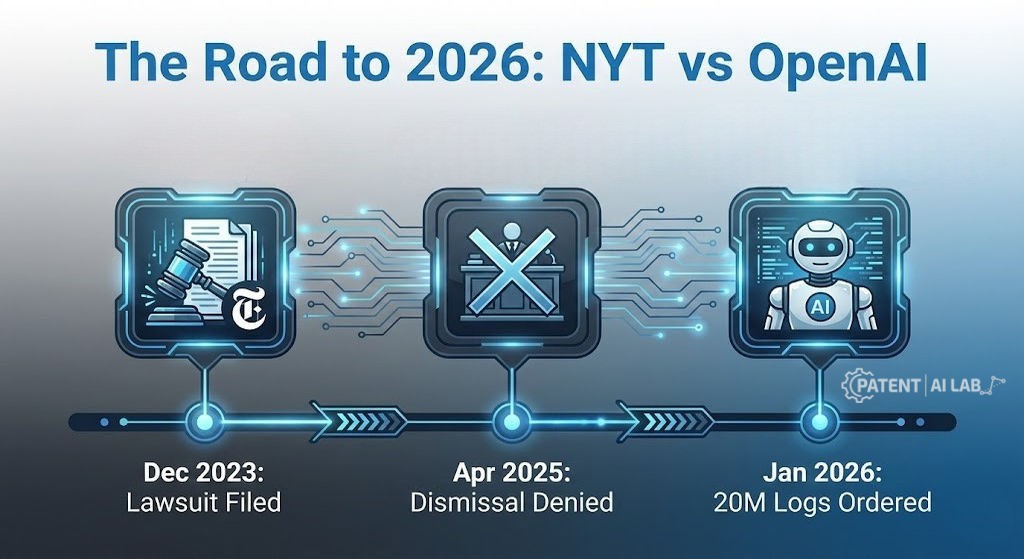
Tracking the case’s actual procedural history matters more than any single ruling, because several early developments (particularly the Exhibit J reversal below) get lost in commentary that treats the case as a straight line toward one outcome.
| Date | Event | What It Actually Established |
|---|---|---|
| Dec 27, 2023 | NYT Sues OpenAI & Microsoft | Filed in SDNY. The complaint included “Exhibit J”: 100 examples of ChatGPT reproducing Times articles nearly verbatim, framed at the time as the case’s central evidence. |
| Apr 4, 2025 | Motion to Dismiss Ruling | Judge Stein allowed direct and contributory copyright infringement claims to proceed in all three consolidated actions (Times, Daily News, CIR). He dismissed the common-law unfair competition claims with prejudice across all three, and dismissed most Section 1202(b) DMCA claims without prejudice, though OpenAI’s 1202(b)(1) claim survived specifically in the Daily News and CIR actions (just not the Times’s own claim). |
| Mid-2025 | The Exhibit J Reversal | The Times told the court it would not present Exhibit J to a jury, conditioned on OpenAI meeting its discovery obligations. The case’s focus shifted from outputs to whether the underlying training use was lawful. |
| May 13, 2025 | Preservation Order | Magistrate Judge Wang ordered OpenAI to preserve output logs across consumer tiers. OpenAI called the scope disproportionate; Judge Stein affirmed it on June 26, 2025. |
| Sep 26, 2025 | Preservation Wind-Down | The parties negotiated an end to the ongoing preservation duty; OpenAI retained a limited historical window and was excluded from further preservation for EEA, Swiss, and UK-origin data. |
| Dec 15, 2025 | The Ziff Davis Ruling | In the broader MDL, Judge Stein allowed Ziff Davis’s contributory infringement and several DMCA claims to proceed, but dismissed its claim that OpenAI circumvented technical measures by ignoring robots.txt files, holding that such files are “mere requests” rather than binding access controls. |
| Jan 5, 2026 | The Log Production Order | Judge Stein affirmed the order requiring OpenAI to produce the full 20 million-log sample, rejecting OpenAI’s proposal to produce only search-filtered results. This was a discovery-scope and privacy-balancing ruling, not a finding on infringement. |
The Core Conflict: Training Inputs vs. Verbatim Outputs
The lawsuit’s center of gravity has moved considerably since 2023. Understanding both where it started and where it sits now is necessary to read any single ruling accurately, since a ruling that made sense as an “outputs” case doesn’t automatically carry the same weight now that the case is substantially about inputs.
1. The Times’s Original Thesis: “The Substitution Engine”
The Times originally built its case around two pillars, and one of them has since been substantially set aside:
- Unauthorized Training: OpenAI scraped millions of articles to build a commercial product without a license. This claim survived the motion to dismiss and remains the core of the case.
- Regurgitation as Substitution (Exhibit J): The original complaint argued that near-verbatim ChatGPT outputs of paywalled Times content proved direct market substitution. OpenAI countered that these outputs required “tens of thousands of attempts” using deliberately manipulated prompts, and the Times itself later told the court it would not present this exhibit to a jury.
2. OpenAI’s Thesis: “Transformative, Non-Expressive Analytical Use”
OpenAI’s central legal argument is that training on copyrighted text is a transformative, non-expressive analytical use protected by fair use. The company frames its position around two claims:
- Pattern Learning, Not Storage: OpenAI contends its models learn mathematical patterns and abstract relationships rather than storing or reproducing source material, and points to two June 2025 rulings, Bartz v. Anthropic and Kadrey v. Meta, where courts found AI training on lawfully acquired works highly transformative on summary judgment.
- The “Bug” Framing: OpenAI characterizes verbatim reproduction as a technical bug rather than an intended feature, and says it has implemented content filters and refusal training to reduce these outputs. The company has also directly disputed the Times’s discovery conduct, telling the court the Times itself deleted evidence of its internal OpenAI usage, a claim the Times did not contest.
One distinction is worth sitting with here: unlike the plaintiffs in Bartz and Kadrey, who could not point to specific infringing outputs, the Times initially could, via Exhibit J, though it has since chosen not to lean on that evidence at trial. Whether the case can still establish the kind of substitutive market harm those other rulings found lacking, now argued primarily through the training-input theory rather than output examples, is the open question the coming summary judgment briefing is meant to resolve.
What “Regurgitation” Means, Technically and Legally
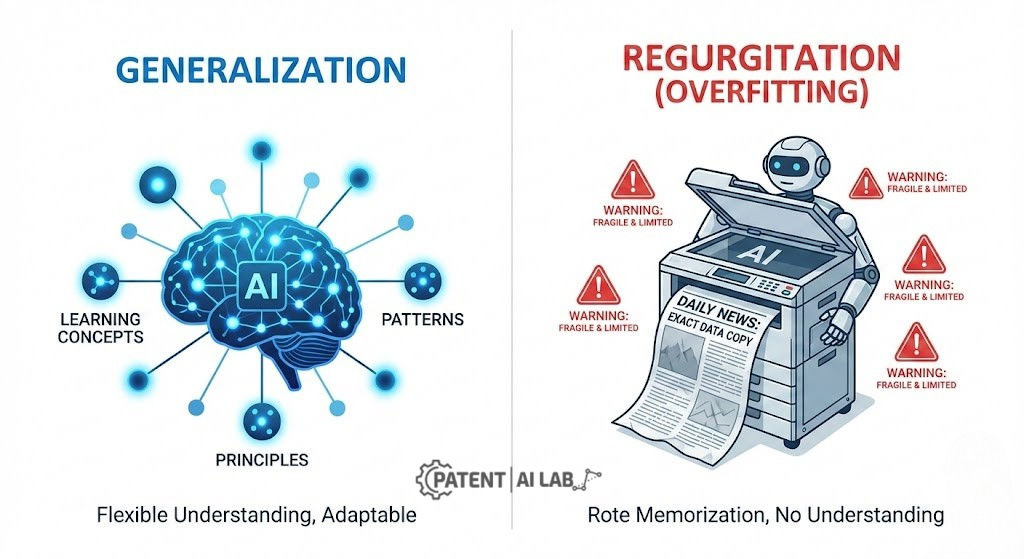
In engineering terms, this behavior is usually called memorization or overfitting. In litigation, it functions as a specific kind of evidence: verbatim output converts an abstract argument about training methodology into a concrete, checkable comparison between two texts. That’s exactly why the Exhibit J reversal matters so much to how this case has developed, and why its withdrawal shifted the argument onto harder-to-visualize but more legally central ground.
The Exhibit J Episode, and Why It Was Set Aside
When the Times filed its original complaint, Exhibit J was its centerpiece: 100 examples of ChatGPT reproducing Times articles nearly verbatim, framed as proof the tool functions as a “copyright infringement machine.” OpenAI’s counter was specific and technical: producing those examples reportedly took tens of thousands of prompt attempts, using techniques designed to force unusual model behavior rather than reflecting how ordinary users interact with the tool. This matters for the legal analysis in a specific way:
- Adversarial Prompting Undercuts “Ordinary Use” Framing: If reproducing an article required deliberately engineered prompts rather than typical queries, it weakens the claim that regurgitation reflects how the product functions for real users.
- The Times Recognized This: Rather than litigating the adversarial-prompting dispute, the Times told the court it would not present Exhibit J to a jury, provided OpenAI met its discovery obligations, and explained it built the exhibit in the first place because OpenAI would not disclose what it trained on.
- The Case Moved to Inputs: OpenAI’s own lawyers acknowledged the shift in a 2024 filing, arguing the case had become “fundamentally about inputs and not outputs.” That reframing is the actual current shape of the litigation, not the output-comparison fight the original complaint suggested.
The Technical Causes of Model Memorization
Independent of how this specific case has developed, the underlying technical question, why models sometimes reproduce training text closely, is well-documented and worth understanding on its own terms:
- Data Duplication: If a widely syndicated article appears many times across a training dataset, the model can over-weight and memorize it more readily than content it saw only once.
- Overfitting: A model that fails to generalize patterns sufficiently can end up memorizing specific token sequences instead of the underlying structure they represent.
- Retrieval-Augmented Pipelines: Systems that pull live text from the internet at query time introduce a separate risk profile from training-time memorization, since the text is being retrieved and surfaced directly rather than reproduced from a trained model’s weights.
A Practical Overlap-Detection Snippet (Python)
For engineers or auditors who want an empirical starting point rather than relying on spot-checks, here is a simple n-gram overlap measurement to flag potential rote reproduction between a model’s output and a reference text. This is a diagnostic heuristic, not a legal determination, and a high overlap score is a signal worth investigating rather than proof of infringement on its own.
def ngram_overlap(a: str, b: str, n: int = 8) -> float:

"""

Calculates the overlap of N-grams between AI output and source text.

Used to flag potential memorization or reproduction risk for manual review.

"""

def ngrams(s):

# Create a set of N-token sequences

tokens = [t for t in s.split() if t.strip()]

return set(tuple(tokens[i:i+n]) for i in range(len(tokens)-n+1))


A, B = ngrams(a), ngrams(b)


# Avoid division by zero

if not A or not B:

return 0.0


# Return the ratio of overlap

return len(A & B) / min(len(A), len(B))


def flag_for_review(output: str, reference: str) -> bool:

# A threshold of 0.35 is a reasonable starting point for manual review,

# not a legal standard; tune it against your own corpus and risk tolerance.

return ngram_overlap(output, reference, n=8) > 0.35
Tools like this are becoming a standard part of technical due diligence for AI companies managing copyright exposure, independent of how any specific lawsuit resolves. Measuring the actual rate of overlap in a system’s outputs is a materially different exercise than assuming the rate based on a handful of adversarially-prompted examples, which is precisely the distinction the Exhibit J episode turned on.
How the Four Fair Use Factors Apply, and Where They’re Genuinely Contested
Fair use analysis under 17 U.S.C. § 107 weighs four factors together rather than treating any one as dispositive. Here is how each factor maps onto this case’s actual arguments, not a prediction of how a court will ultimately weigh them.
Factor 1: Purpose and Character of the Use
- OpenAI’s Position: Training converts expressive text into statistical patterns, which two June 2025 rulings (Bartz, Kadrey) found to be a highly transformative use, at least where the underlying training copies were lawfully acquired.
- The Times’s Position: Whatever transformative value training has in the abstract, specific instances of near-verbatim output (the original basis for Exhibit J) function as unauthorized republishing rather than transformation, even if the Times has chosen not to press that specific evidence at trial.
Factor 2: Nature of the Copyrighted Work
- The Consideration: Basic facts are not copyrightable, but the specific expression, narrative structure, and editorial voice of investigative journalism receive strong copyright protection, which is one reason news-publisher cases are treated somewhat differently from cases like Bartz and Kadrey, which involved books rather than journalism.
Factor 3: Amount and Substantiality of the Portion Used
- The Consideration: Copying even a small fraction of a large dataset can weigh against fair use if that fraction represents the qualitative core of a specific work. This factor was central to the original Exhibit J theory, though the case’s current emphasis on training-data legality argues this factor somewhat differently, at the level of the full dataset rather than individual outputs.
Factor 4: Effect on the Market (Often the Most Weighted Factor)
- The Consideration: Courts in Bartz and Kadrey both rejected the argument that lost licensing fees alone count as market harm, calling that reasoning circular. The Times’s case differs in that it can point to an active licensing market it says it was excluded from (its own publishers’ deals with OpenAI, Amazon, and others), which may give this factor more traction here than it had in those two rulings. Whether it does is precisely what remains unresolved.
The Discovery Battle: What the 20 Million Logs Are Actually For
The January 5, 2026 ruling is the most consequential discovery event in the case so far, but it’s worth being precise about what it decided, and about how the number in dispute actually shrank to get there. Court filings show the news plaintiffs formally moved to compel 120 million logs in July 2025. OpenAI has separately characterized the Times’s original ask as far larger still: in a public blog post, OpenAI’s Chief Information Security Officer stated the Times initially sought all 1.4 billion private ChatGPT conversations OpenAI held at the time. That figure comes from OpenAI’s own account of the dispute rather than a neutral docket filing, so it should be read as OpenAI’s characterization of the opening ask, not an independently confirmed number. OpenAI countered the 120-million-log motion with a proposal to produce a smaller sample of 20 million, roughly 0.5% of OpenAI’s preserved logs, scrubbed of personally identifiable information. Plaintiffs accepted that 20 million figure, but when OpenAI later tried to substitute keyword-search results for the actual log production, plaintiffs went back to court. Magistrate Judge Wang ordered the full sample produced in November 2025, denied OpenAI’s motion for reconsideration in December, and Judge Stein affirmed that decision on January 5, ruling it was “neither clearly erroneous nor contrary to law.”
On the substance, the ruling settled three specific questions:
- Relevance Beyond Direct Matches: Judge Wang found that even logs without any reproduction of the Times’s specific works are discoverable, because they bear on OpenAI’s fair use defense broadly, particularly the market-effect factor, which looks at how the tool is used across a wide range of queries.
- Privacy Was a Real but Outweighed Interest: The court explicitly acknowledged that ChatGPT users have “sincere” privacy interests in their conversations, but found those interests adequately protected by three safeguards: limiting the sample to 20 million logs rather than the tens of billions OpenAI retains, OpenAI’s de-identification process, and the case’s existing protective order.
- The Wiretap Analogy Failed: OpenAI had argued the situation resembled a securities case involving wiretapped calls. Judge Stein rejected that comparison directly, noting that ChatGPT users, unlike wiretap subjects, “voluntarily submitted their communications” to the platform.
None of that constitutes a finding that OpenAI infringed anything. It’s a ruling about who has to hand over what, under what conditions, so that both sides can build the actual record a court will eventually rule on. That distinction gets collapsed in a lot of commentary treating the log order itself as evidence of guilt, which is not what the order says or does.
Licensing and Litigation Are Both Active
Regardless of how this specific case resolves, publishers have already split into two operational paths:
Path A: Licensing Deals
The Associated Press, Axel Springer, the Financial Times, Le Monde, and Prisa Media have all signed content-licensing agreements with OpenAI or other AI companies. News Corp signed deals with both OpenAI and Meta. Reported terms have ranged from roughly $1 million to $5 million annually per publisher, though these figures come from press reporting on individual deals rather than a single disclosed schedule.
- The Trade-Off: Guaranteed near-term revenue, in exchange for setting a price on training data that may undercut future litigation leverage.
Path B: Litigation
The Times, Daily News LP, and the Center for Investigative Reporting chose to litigate rather than license, betting that a favorable ruling would produce better terms, or a broader industry precedent, than a negotiated deal would.
- The Trade-Off: Potentially larger recovery or precedent value, against years of litigation cost and a genuinely uncertain outcome, since no court has yet ruled on the core question.
Legal commentators tracking the case have generally predicted a negotiated settlement is more likely than a full trial, citing the financial exposure on both sides and the settlement precedent set in the separate Bartz v. Anthropic litigation, which closed in September 2025 for $1.5 billion covering roughly 500,000 books, over the piracy claim rather than the training claim Anthropic had already won. Michael Bennett, associate vice chancellor for data science and AI strategy at the University of Illinois Chicago, has pointed to that settlement as a specific incentive for OpenAI, arguing the sheer volume of journalistic content at issue gives both sides reason to reach terms rather than litigate to a verdict.
Where the DMCA Claims Currently Stand
Most Digital Millennium Copyright Act claims under Section 1202(b), concerning removal of copyright management information, were dismissed against the Times specifically, though the court allowed related claims to proceed in the consolidated Daily News and Center for Investigative Reporting actions. A separate December 15, 2025 ruling in the broader multidistrict litigation allowed Ziff Davis’s contributory infringement and several DMCA claims to move forward, while dismissing its claim that OpenAI circumvented technical measures by ignoring robots.txt files, on the ground that such files are “mere requests” rather than binding access controls. The upshot is that CMI-related claims are alive in parts of this litigation, just not currently in the Times’s own claims specifically.
NYT vs OpenAI: Key Arguments and Actual Status
| Issue | The Times’s Position | OpenAI’s Position | Actual Current Status |
|---|---|---|---|
| Training Data | Unauthorized copying at commercial scale. | Transformative, non-expressive analytical use protected by fair use. | Unresolved. Summary judgment briefing concludes April 2026; no ruling yet on this specific question. |
| Verbatim Outputs | Originally central (Exhibit J); withdrawn from trial presentation as the case shifted to inputs. | A rare technical bug, produced only via adversarial prompting, not representative of normal use. | No longer the case’s central evidence; the underlying training-legality question has taken its place. |
| The 20M Logs | Necessary to test real-world frequency of infringing outputs and market substitution. | Disproportionate; a privacy overreach; sought reconsideration and lost. | Production compelled and affirmed on Jan. 5, 2026. This resolved a discovery dispute, not the underlying infringement question. |
| Desired Outcome | Billions in damages, injunctive relief, destruction of infringing datasets. | Continued operation under a fair use finding. | Legal analysts generally consider a negotiated settlement more likely than a full trial verdict, though this is a prediction, not a fact. |
The Patent Angle: Where This Litigation Intersects USPTO Strategy
This is a copyright dispute, not a patent one, but it shapes corporate patent strategy in a specific way. As litigation and licensing costs both compound across the industry, technical safety features, such as anti-memorization filters and data provenance tracking, are shifting from pure compliance overhead into genuinely valuable intellectual property, independent of how any single lawsuit resolves.
Two practical implications follow from that shift:
- Safety as IP: Deduplication algorithms and anti-memorization controls can be patentable when claimed as concrete technical improvements under Section 101, rather than as abstract compliance goals.
- Building a Proprietary Moat: Defending against a specific copyright claim is inherently reactive. Documenting the human inventorship behind these safety tools properly, so they can actually be patented rather than left as undocumented internal engineering, is the proactive counterpart. A related piece on this site walks through the documentation protocol the current USPTO inventorship guidance requires for AI-assisted safety tooling specifically.
What AI Founders and Legal Teams Should Actually Track
The most accurate summary of this case in mid-2026 is that nothing has been decided on the merits, discovery has become the main battleground, and the case’s own theory of harm has shifted substantially since it was filed. Treating the January discovery ruling as a preview of the eventual verdict is a common but mistaken reading; it resolved a dispute about what evidence gets produced, not who wins.
For AI Companies:
- Measure Actual Overlap Rates: The n-gram diagnostic above is a starting point for understanding a system’s real memorization rate, rather than assuming a rate based on adversarially-prompted examples the way Exhibit J originally did.
- Build Provenance Tracking Now: Systems that trace an output back toward its training-data origins are increasingly relevant both for litigation defense and, per the patent angle above, as potential IP in their own right.
- Track the Licensing Market, Not Just the Lawsuit: Deals with the Associated Press, Axel Springer, the Financial Times, and others show a functioning licensing market already exists. That market itself is relevant to how a court will eventually assess market harm in this and similar cases.
For Publishers:
- Track Search and Referral Traffic Changes: Correlating traffic shifts with AI-generated summaries provides the kind of concrete market-harm evidence that carries weight in the fourth fair use factor.
- Weigh Licensing Against Litigation Honestly: Both paths are now well-precedented. Neither is a safe default; the right choice depends on a publisher’s specific leverage, evidence, and risk tolerance, not on which path looks more assertive.
Whatever the eventual ruling, it will shape how AI training data gets sourced and licensed for years. Until then, the honest position is that the case remains open, the evidence is still being assembled, and neither side’s account of what the logs will show has been tested yet.
Podcast
Note: This audio is a condensed intelligence brief. Please review the detailed litigation matrices and Python diagnostics above for granular technical execution.
FAQ
Has a court ruled that ChatGPT violates copyright law?
No. As of mid-2026, no court has issued a ruling on whether training AI models on copyrighted news journalism constitutes fair use. The case survived a motion to dismiss in April 2025 and is currently in discovery, with summary judgment briefing set to conclude in April 2026 and a possible trial in late 2026 or 2027.
What did the January 2026 discovery order actually decide?
The order required OpenAI to produce a full sample of 20 million de-identified ChatGPT logs, rather than the search-filtered subset OpenAI had proposed. It resolved a dispute about discovery scope and user privacy under Federal Rule of Civil Procedure 26, balancing relevance against privacy protections. It did not rule on whether OpenAI infringed the Times’s copyrights.
What happened to the Times’s original verbatim-output evidence?
The Times’s original complaint centered on “Exhibit J,” 100 examples of ChatGPT reproducing its articles nearly verbatim. OpenAI argued these required tens of thousands of adversarial prompt attempts to produce. The Times later told the court it would not present this exhibit to a jury, and the case’s focus shifted toward whether the underlying use of copyrighted articles for training was lawful in the first place.
What is the difference between overfitting and regurgitation?
Overfitting is the machine learning term for a model learning training data too specifically rather than generalizing patterns from it. Regurgitation describes the observable symptom, verbatim or near-verbatim output. In litigation, regurgitation functions as evidence of the underlying technical behavior, though how much weight that evidence carries depends heavily on how it was produced, as the Exhibit J dispute illustrated.
Did Anthropic’s $1.5 billion settlement mean a court found AI training illegal?
No, and this is a common misreading. In Bartz v. Anthropic, Judge William Alsup separately ruled on two different questions: he granted Anthropic summary judgment on fair use for training its models on lawfully acquired books, calling the use “exceedingly transformative,” but denied summary judgment on Anthropic’s use of pirated copies for its internal library, finding that piracy “inherently, irredeemably infringing.” The $1.5 billion settlement, reached in August 2025 and covering roughly 500,000 books, resolved the piracy claim, not the training claim. Anthropic had already won on the training question before it settled. By the March 2026 claims deadline, more than 91% of the eligible works had been claimed by rightsholders, an unusually high participation rate for a class action of this size.
Is this lawsuit likely to result in AI models being banned?
That outcome appears unlikely based on how the litigation and related cases have developed. Legal commentators tracking the docket have generally predicted a negotiated settlement is more probable than a full trial, pointing to the financial exposure on both sides and the settlement precedent in the separate Bartz v. Anthropic litigation.
Sources and Legal References
The federal litigation events, discovery orders, and case history analyzed in this article are sourced directly from court filings and primary legal reporting:
-
1. Order on OpenAI’s Objections to Discovery Orders — Jan. 5, 2026
Judge Sidney H. Stein’s order in the consolidated MDL (In re: OpenAI, Inc. Copyright Infringement Litigation) denying OpenAI’s objections and affirming Magistrate Judge Wang’s orders compelling production of the full 20 million de-identified log sample.
Review the Full Order (PDF via Ars Technica) -
2. Case Docket — The New York Times Company v. Microsoft Corporation, 1:23-cv-11195 (S.D.N.Y.)
The public court docket, including the original complaint, motion to dismiss briefing, and subsequent discovery filings.
Review the Docket (CourtListener) -
3. Bartz v. Anthropic Settlement Documentation
Primary settlement notice and FAQ materials on the $1.5 billion Bartz v. Anthropic settlement, distinguishing the piracy claim (settled) from the training fair-use ruling (won by Anthropic on summary judgment).
Review the Settlement Notice (Class Action Org) -
4. Case Status and Procedural History Summary
A detailed, dated account of the case’s procedural history, including the April 2025 motion-to-dismiss ruling, the Exhibit J reversal, the preservation-order dispute, the Ziff Davis MDL ruling, and the January 2026 log-production ruling, cross-referenced against the primary docket above.
Review the Case Status Summary -
5. OpenAI’s Public Statement on the Times’s Discovery Demands
OpenAI’s own account of the discovery dispute, including its characterization of the Times’s original request for 1.4 billion private ChatGPT conversations before the scope narrowed to the 20 million-log sample. Cited here as OpenAI’s characterization of events, not as a neutral or independently confirmed source.
Review OpenAI’s Statement
Disclaimer & Legal Notice
This article reflects the author’s analytical perspective evaluating enterprise intellectual property strategy, federal litigation events, and copyright compliance frameworks. It is intended strictly for informational and strategic purposes and does not constitute formal legal advisory services. It is not a substitute for the counsel of a qualified, licensed intellectual property attorney. Copyright liability standards, specifically regarding fair use and generative AI training data, change frequently, and this litigation in particular remains active and unresolved. Always consult certified legal counsel before deploying AI tools or initiating intellectual property litigation.





[…] Similar to how fair use is currently being fiercely debated in generative AI, understanding these legal boundaries is critical. To see how these exact arguments are playing out today, you can read our breakdown of the NYT vs. OpenAI Lawsuit Update […]