


 Golam Rabiul Alam, PhD
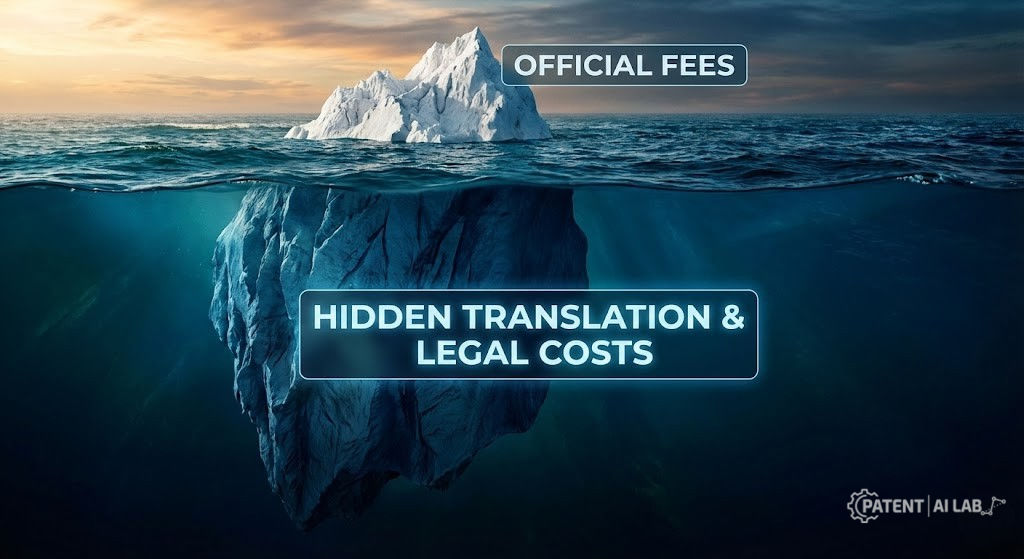
The official WIPO fee covers a fraction of what an AI or software patent actually costs through the international phase. Your real budget is determined by search authority selection, claim architecture complexity, deferred translation obligations, and national phase entry capital — not the government fee schedule alone.
Failing to account for these downstream costs has ended IP strategies at the worst possible moment — month 28 or 29, when national phase deadlines arrive and startup capital is fully committed elsewhere. This breakdown is verified against the May 1, 2026 USPTO and WIPO fee schedules — the same data used to build working patent budgets.
At A Glance
A PCT patent filing cost goes far beyond the base WIPO fee. AI and software founders must plan for five hidden expenses. These include local lawyer retainers, search fees, translations, and country entry costs. Missing these items can double your total budget. Plan early to protect your cash before legal reviews end.
Why PCT Costs Are Almost Always Underestimated
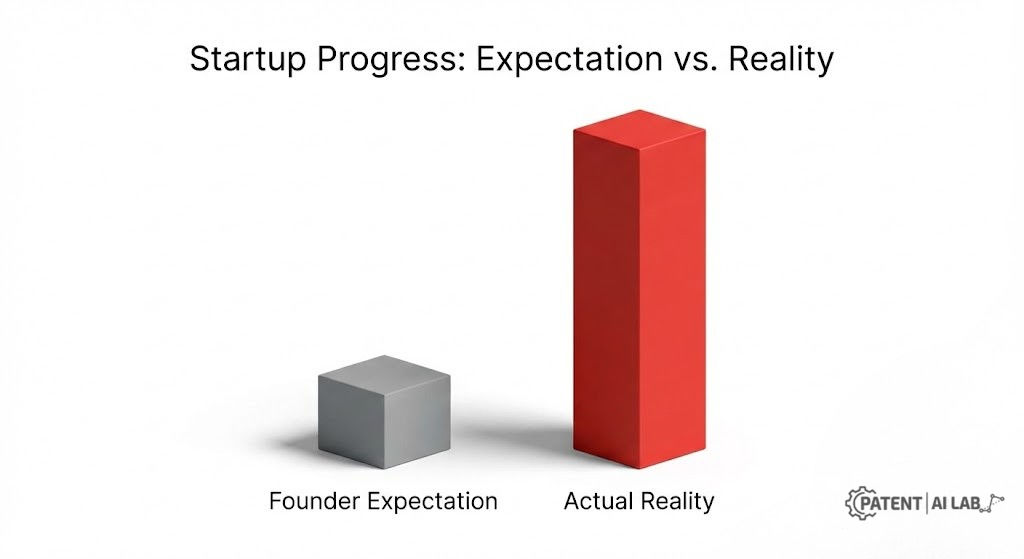
Most founders entering their first PCT filing budget for $4,000 to $6,000 total. That estimate reflects only the WIPO base fee — the smallest item on a much longer invoice.
The PCT system buys you something valuable: a unified international filing date that delays individual country entries by 30 or 31 months. What it does not buy is any of the legal work, certified translations, or local government fees that each of those country entries requires.
The real costs hit in stages. Search fees fall due immediately at filing. Claim drafting complexity fees follow within weeks. Translation and national phase entry capital arrive at month 30 or 31 — precisely when most AI startups are navigating their Series A or bridge financing rounds.
The five hidden fees below map the true PCT patent filing cost for software and AI inventions — and provide a structured framework for budgeting before those costs become unavoidable.
What a PCT Filing Actually Covers (And What It Does Not)
What a PCT Filing Covers
- Saves your priority date
- Gives you an international search report
- Delays country filings by 30 or 31 months
What it Does Not Do
- Grant active patent rights
- Pay for translation costs
- Pay for local country fees
- Pay for local lawyer work
Those exclusions are where the hidden costs live.
PCT Filing Cost Breakdown (2026 Estimates for US Applicants):The Application Size Penalty: Page Count Escalations
WIPO base fees cover only the first 30 pages of your application. A neural network patent covering architecture, training methodology, system integration, and performance benchmarks routinely runs 50 to 80 pages — sometimes more when detailed dataset structures and multi-level claim hierarchies are required for adequate disclosure.
Every page beyond the 30-page threshold carries a $19 surcharge. For an 80-page AI specification, that is a $950 penalty before a single attorney fee is calculated. Keep specification volume as lean as possible without sacrificing claim support — a balance that requires experienced drafting judgment from the first draft.
✅ Key Insight: The WIPO 30-page threshold is a real budget lever. An 80-page AI specification adds $950 in page-count penalties before attorney fees begin. Specification length management starts at the drafting stage, not at submission — work with your attorney to tighten disclosure without weakening claim support.
Hidden Fee #1: International Search Authority Variations
Why This Fee Is Overlooked
The International Searching Authority (ISA) choice is the first major financial decision in any PCT filing — and one of the most commonly made by default. Wherever your attorney’s firm typically routes applications becomes your ISA. That default choice costs or saves thousands in the first 90 days of prosecution.
Current rates: the USPTO charges $2,400 for an international search. The European Patent Office charges $2,237. The Korean Intellectual Property Office charges $842. That is a $1,558 spread between the most and least expensive ISA options available to US applicants filing in English.
Real Impact on AI-Generated Code Patents
For machine learning software patents, the ISA selection carries strategic implications well beyond the immediate cost difference. KIPO offers the lowest search fee — a genuine capital advantage for bootstrapped teams managing pre-seed or seed-stage runway.
The EPO costs more upfront, but European examiners apply a rigorous technical review to software architecture, algorithmic logic, and system-level effects. A thorough EPO search report substantially reduces the risk of broad prior-art rejections at national phase entry, where remediation costs multiply independently per jurisdiction.
Cost Impact
- Immediate Savings: Routing through KIPO instead of the USPTO saves $1,558 in government search fees on the day of filing.
- Long-Term Tradeoff: Lower-cost searches carry a higher risk of missing relevant prior art, which can produce broad rejection patterns at national phase entry requiring expensive per-jurisdiction prosecution responses.
✅ Key Insight: The ISA choice is a one-time decision with multi-year financial consequences. For seed-stage AI startups, KIPO’s $842 search fee saves $1,558 immediately. For startups targeting Europe as a primary market, the EPO’s deeper software review may reduce national-phase prosecution costs enough to justify the higher upfront fee. Discuss both options with your attorney before committing to a default filing office.
Hidden Fee #2: AI-Specific Claim Drafting and Eligibility Requirements
Why AI Patents Require Specialized Drafting
Generic software claims fail under examiner scrutiny, and machine learning patents face particularly concentrated risk. Under the Alice Corp. v. CLS Bank (2014) framework, examiners categorize basic ML concepts as abstract ideas — meaning claims that merely describe data transformation, model execution, or output generation do not survive patent eligibility review. To clear that threshold, claims must do three things:
- Transcend abstract mathematical formulas — claims must describe a concrete technical process, not a mathematical concept applied to generic computing.
- Anchor the improvement to measurable hardware or system-level effects: latency reduction, memory allocation efficiency, throughput gains, or reduced computational overhead.
- Replace generic data-processing descriptions with architecture-specific technical language that ties the claimed functionality to the invention’s distinct configuration.
AI-aware patent drafting demands substantially more engineering analysis hours. The specification must simultaneously satisfy eligibility standards across multiple jurisdictions: the USPTO’s Alice framework, the EPO’s Article 52 EPC technical character requirement, and analogous eligibility doctrines applied by examiners in China and Japan.
Example: AI Code Generation Architecture
Consider a neural network that converts voice commands into backend API code. A weak claim reads: “using a trained model to generate executable code from voice input.” That language fails eligibility review at the USPTO and the EPO — it describes what the system does, not how the architectural configuration produces the technical result.
A defensible claim must specify the architectural components and their interactions — attention layers, context encoders, output format parsers — and quantify the resulting system-level improvement: reduced API call latency, lower memory overhead, or measurable throughput gain. The difference between a rejected and an allowed claim often requires three to five additional pages of engineering specification.
That additional specification is where the AI-specific drafting cost originates.
Cost Impact
- Upfront Cost: Expect an additional $1,500 to $3,500 in attorney fees for AI-specific claim architecture, technical specification depth, and examiner-anticipation work.
- Billing Note: Most patent firms invoice this under “complexity adjustments” — a line item that first-time filers rarely anticipate in initial cost estimates.
Hidden Fee #3: Deferred Patent Translation Costs
Translation fees are structurally invisible at PCT filing — no payment is required at submission, and most founders mentally deprioritize them as a distant obligation. They become compulsory at national phase entry into any non-English target market.
China (CNIPA), Japan (JPO), South Korea (KIPO), and Germany (DPMA/EPO) all require full certified technical translations of the complete patent specification. AI patent specifications are word-dense by nature: neural network architecture descriptions, training data definitions, performance benchmarks, and multi-level claim hierarchies push total word counts substantially higher than traditional mechanical or electrical patents.
Budget translation costs from month one, not month thirty. By the time they are due, operational capital is committed to other runway priorities — and the translation obligation is non-negotiable.
⚠️ Warning: Translation costs are deferred but not avoidable. Entering China, Japan, and Germany alone can add $6,500 to $13,500 in certified translation expenses — due at precisely the moment national phase capital commitments are highest. These figures are derived directly from the per-language cost ranges in the table below. Build this into your budget from day one.
Hidden Fee #4: National Phase Entry Capital Requirements
The Decentralization Phase
The PCT umbrella closes at month 30 or 31. At that point, every target jurisdiction requires a fully independent, locally compliant filing. The centralized process that simplified your first 30 months fragments into simultaneous national applications — each carrying its own government filing fees, mandatory local agent retainers, and jurisdiction-specific technical formatting requirements.
Every national entry also requires a local patent attorney or agent admitted to practice in that jurisdiction — not the same firm that filed your PCT application. These mandatory local retainers are payable in addition to all translation and government fee obligations, and they are not negotiable.
Example: Multi-Regional Entry Cost Breakdown
Entity Status Multipliers: Managing Small and Micro Costs
Standard fee tables are published at large entity rates. Independent inventors and early-stage startups — the majority of AI patent filers — typically qualify for significantly reduced fees under USPTO small or micro entity status designations.
Small entity status reduces USPTO fees by 50%. Micro entity status reduces them by 75%. Applied to the USPTO national phase entry range of $3,000 to $5,000, micro entity eligibility translates to an approximate entry cost of $750 to $1,250. Verify eligibility during the international phase — this designation is prospective and cannot be retroactively applied to fees already paid.
✅ Key Insight: Micro entity status cuts your USPTO national phase entry cost by 75% — from a $3,000–$5,000 large-entity commitment to approximately $750–$1,250. Confirm eligibility with your attorney during the PCT phase, well before the national phase deadline. This is one of the most underutilized cost levers available to AI startup filers.
Hidden Fee #5: Chapter II Demand and International Preliminary Examination
The Utility of a Chapter II Demand
A Chapter II demand initiates an International Preliminary Examination conducted by the International Preliminary Examining Authority (IPEA). This process provides a formal, structured mechanism to amend your patent claims in direct response to the Written Opinion issued during the Chapter I search. For AI patents receiving Section 101 abstract-idea rejections or Article 52 EPC eligibility objections, Chapter II addresses those issues before any national office receives your application.
AI patent applications face higher rates of initial eligibility objections than most other technical fields. Resolving those objections through a single Chapter II proceeding — rather than fighting identical rejections independently across five or six national offices — is almost always the more cost-efficient path for inventors with active Written Opinion objections.
Associated Procedural Expenses
Chapter II triggers two primary cost items: the official IPEA examination fee, and attorney time to draft amended claims. The amended claim language must simultaneously satisfy eligibility standards across your target jurisdictions — clearing the USPTO’s Alice analysis, meeting the EPO’s Article 52 EPC technical character requirement, and conforming to the examination practices applied in China and Japan.
That cross-jurisdictional claim architecture requires expert patent prosecution work and a deep working knowledge of how each jurisdiction’s eligibility doctrine differs in practice. Chapter II is optional — but for AI inventors with active eligibility objections in the Written Opinion, it is the most cost-efficient mechanism available for coordinated global claim resolution.
Financial Allocation
✅ Key Insight: The total cost of a Chapter II proceeding — $600 to $800 in official IPEA fees plus $2,000 to $4,000 in attorney time — ranges from $2,600 to $4,800 all-in. That is a single coordinated resolution of eligibility objections across all target jurisdictions. Addressing the same objection independently in each national office typically costs more in attorney response fees per jurisdiction alone.
- Official IPEA Fee: $600 to $800, depending on the examining authority.
- Attorney Fee for Claim Amendment: $2,000 to $4,000 to draft and file substantive claim amendments and accompanying remarks.
Resolving eligibility objections at the international level prevents those same rejections from arriving independently in multiple national offices — each requiring separate attorney responses, separate response fees, and separate prosecution timelines running in parallel.
Total Real-World Cost Breakdown (AI Startup Example)
This is the true international patent application cost for a serious AI invention — the full cash commitment required to achieve enforceable, professionally drafted patent rights across three major markets with qualified legal representation at every stage.
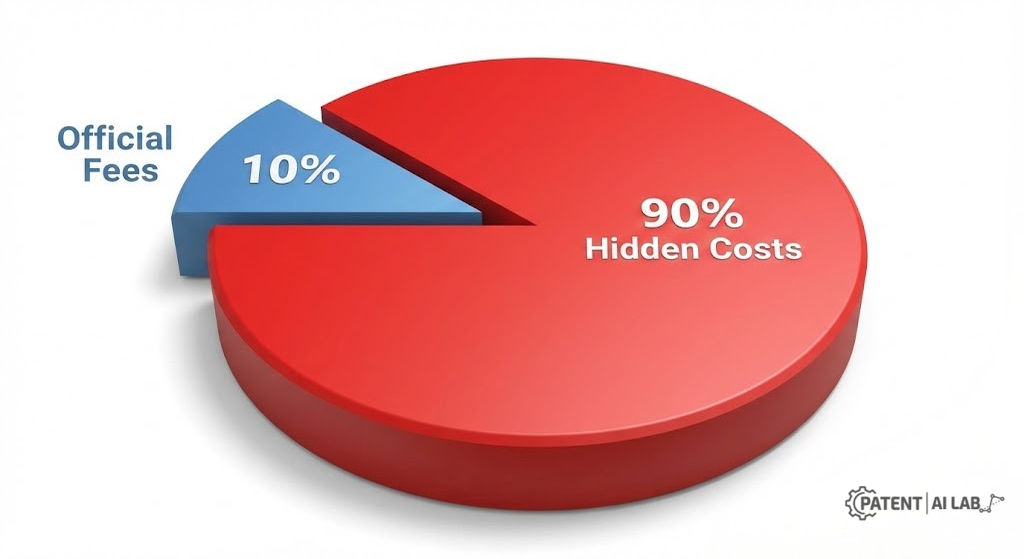
🚨 Critical Alert: The $25,043 to $44,101 range above is the minimum credible budget for multi-market AI patent protection through the PCT route. This is not a worst-case scenario — it is the expected range for a competently executed filing targeting three jurisdictions. The $4,000 to $6,000 estimate that appears in early-stage IP conversations reflects only the government base fees: roughly 10% of the total commitment. Plan for the high end.
Real-World Implications for Startups and Developers
- Filing PCT before product-market fit is confirmed risks committing $25,000 to $44,000 to a prosecution timeline that may outlast the product itself
- Filing without AI-aware claim drafting triggers Alice-framework rejections at the USPTO and Article 52 EPC objections at the EPO, requiring costly per-jurisdiction remediation that compounds total prosecution costs
- Defaulting to the USPTO as ISA instead of KIPO adds $1,558 in immediate search fees — a tangible capital impact for seed-stage teams with constrained runways
- Deferring translation budget planning past month 18 creates a capital call at the worst possible point in most startup funding cycles
For pre-revenue or bootstrapped AI startups, a targeted national filing strategy — concentrating resources on one or two primary commercial markets — often delivers stronger IP coverage per dollar than a broad PCT approach that commits capital across a 30-month prosecution window of uncertain outcome.
Strategic Checklist for Managing International Patent Runway
- Audit Specification Volume Early: Keep the core text under 30 pages prior to WIPO submission to completely eliminate the $19 per-page penalty fee. Every sheet above the threshold is a direct cash cost before attorney billing begins.
- Route via Budget-Efficient Search Authorities: Choose the Korean Intellectual Property Office (KIPO) over the USPTO as your International Searching Authority to immediately save $1,558 in base search fees — a real capital difference for early-stage teams.
- Verify Small or Micro Entity Status: Confirm eligibility during the international phase to claim up to a 75% reduction on downstream USPTO national entry fees. This designation is prospective — verify before filing, not after.
- Phase Translation Budgets: Map translation cost allocations by month 12 rather than waiting for the month-30 national phase deadline, when operational capital is already committed to other runway obligations.
Future Outlook: Where PCT Costs Are Headed
Patent fee schedules are not static — they adjust with institutional budget cycles, currency shifts, and policy changes. For AI inventors specifically, the directional trend is unfavorable: the cost categories that matter most are rising faster than general filing fee inflation.
- WIPO PCT fees in 2026 reflect steady adjustments aligned with institutional inflation metrics.
- Stricter AI Scrutiny: Artificial intelligence and machine learning applications face targeted technical evaluations rather than procedural leniency.
- Rising Translation Multipliers: Specialized multi-jurisdictional translation rates are increasing at a faster pace than base sovereign filing fees.
- EPO Fee Escalations: Regional phase entries, particularly within the European Patent Office (EPO), continue to adjust upward.
As data requirements scale, localized cost predictability is structurally decreasing. Strategic filing routing remains the primary mechanism to protect startup capital.
Real-World Case Study: Mobile Software Expenses
Want to review a transparent, line-item breakdown of how architectural complexities can scale real-world software filing costs to $38,000?
Read the Full BreakdownPodcast
Note: This audio is a condensed summary. Please refer to the written text for precise legal and compliance definitions.
What is the average PCT patent filing cost in 2026?
Most serious filings range from USD 25,000 to 45,000 through national phase for software or AI inventions.
Are PCT filing fees the same worldwide?
No. Official WIPO fees are uniform, but search fees, attorney fees, and national costs vary widely.
Is PCT worth it for software startups?
Only if international enforcement or licensing is realistic. Otherwise, targeted national filings may be cheaper.
Can AI-generated code be patented internationally?
Yes, but only if claims focus on technical improvements and system-level effects, not abstract logic.
Is Chapter II demand mandatory?
No, but it is often cost-effective for AI patents facing eligibility objections.
Sources and Legal References
The international filing metrics, search authority pricing tables, and sovereign national phase frameworks analyzed throughout this guide are sourced directly from global intellectual property authorities and verified legal registries:
-
1. USPTO Official Patent Fee Schedule
The official fee metrics managed by the United States Patent and Trademark Office, verifying the updated May 1, 2026 international search fee structures ($2,400) and large vs small entity transmittal frameworks.
Review Active USPTO Fee Structures -
2. WIPO PCT Fee Matrix Index
The baseline pricing database hosted by the World Intellectual Property Organization, outlining electronic .zip submission reductions, standard sheet count boundaries, and Chapter II Preliminary Examination rules.
Access WIPO Official PCT Fee Tables -
3. European Patent Office (EPO) International Schedule
The continental rate portal deployed by the European Patent Office, utilized to extract active Euro-PCT application search fees ($2,237 adjustment scale) and centralized regional phase boundaries.
Verify EPO International PCT Rates -
4. KIPO Patents and Utility Models Registry
The legislative pricing framework provided by the Korean Intellectual Property Office, validating the baseline international search cost reductions ($842 for English-language specifications) under competitive routing paths.
Review Official KIPO Fee Schedules -
5. USPTO Subject Matter Eligibility Guidance Update for AI (89 FR 58128)
The official Federal Register directive and evaluation framework used by examiners to determine software, neural network, and abstract machine learning claim eligibility under 35 U.S.C. 101.
Access Official AI Patent Eligibility Guidance
Disclaimer & Legal Notice
PatentAILab is an independent educational research platform and is not a licensed law firm or financial advisory service. The data, patent analysis, and strategic insights provided in this article are for informational and educational purposes only and do not constitute legal, investment, or business advice. Intellectual property outcomes depend on specific technical facts, jurisdictional laws, and drafting execution. Always consult a certified patent attorney and a qualified financial advisor before making IP filing or venture capital investment decisions.


1 comment