


 Golam Rabiul Alam, PhD
Launching a product without checking active patents is like shipping code without testing. It works perfectly until a lawsuit breaks your entire business. A formal legal opinion costs over $15,000, but a DIY Freedom to Operate (FTO) search costs zero. Here is the exact framework to map patent claims and eliminate 80% of your infringement risk before writing a single line of code.
At A Glance
Freedom to Operate (FTO) is the process of ensuring your product does not legally step on someone else’s patent rights. While a formal legal opinion costs over $15,000, a DIY search costs zero and can kill 80% of the risk early.
The Strategy:
- Deconstruct: Break your product into technical features.
- Search: Use free databases (Google Patents/Espacenet) with CPC codes.
- Map: Compare your features against active patent claims (not abstracts).
- Pivot: If you find a block, design around it before writing code.
Key Takeaways
- FTO vs. Patentability: FTO checks if you infringe others; Patentability checks if you can get a patent. They are opposites.
- Jurisdiction Matters: A US patent cannot stop you from selling in the UK (unless there is a UK equivalent). Search where you sell.
- Read Claims Only: The abstract is marketing; the claims are the law. Ignore the rest when assessing infringement.
- Design Around: Finding a blocking patent isn’t the end. Removing one element from a claim often avoids infringement completely.

Launching a product without checking patents is like shipping code without running tests. It might work. It might also break everything later.
A Freedom to Operate search, often called an FTO search or patent clearance search, helps you answer one critical question:
Can I legally build, sell, and scale this product without infringing someone else’s patent?
This guide is written for founders, developers, and bootstrapped teams who cannot afford a full law firm opinion yet but still need to reduce risk intelligently.
This is not legal advice. It is a practical, founder-friendly FTO search guide that aligns with how patent attorneys actually think.
If you are also thinking about protecting your own idea, check out our guide on How to File a Provisional Patent Yourself for $65.
What Is a Freedom to Operate (FTO) Search?
An FTO search evaluates whether your product conflicts with active patent claims in a specific country.
Key clarifications many founders miss:
- FTO is about claims, not patent titles
- FTO is jurisdiction-specific
- FTO focuses on issued and active patents, not applications
- FTO is different from novelty or prior art searches
FTO Search vs Patentability Search
FTO Search
Avoid infringement
Active patent claims
Legal and financial (Lawsuit)
Launch, funding, scaling
Patentability Search
Get your own patent
Prior art (expired patents, papers)
Rejection risk (USPTO denial)
Filing a patent application
Why DIY FTO Searches Matter for Startups
A proper FTO search helps with:
- Startup due diligence IP for investors
- Avoiding cease-and-desist letters
- Preventing forced pivots after launch
- Pricing acquisition risk correctly
- Preparing for professional FTO opinions later
Skipping FTO is one of the top reasons startups lose leverage during acquisition talks.
Step 1: Clearly Define What You Are Actually Building
Launching a product requires breaking down your features step-by-step. Patent offices do not care about high-level marketing buzzwords. If you search for broad terms like “AI-powered analytics platform,” you will miss the specific legal roadblocks entirely.
Instead, list your software’s actual technical steps.
Example (SQL Optimization Feature):
- Data Input: How the system receives raw queries from the user interface.
- Processing Logic: How the backend parses syntax and uses a language model to check database indexes.
- Execution Output: How the optimized SQL code is sent back to the client.
Each step carries separate legal risks. A competitor might own a patent on parsing code syntax, even if their product belongs to a completely different industry. This structural overlap is common among major technology holders. We detailed this in our audit of the Google AI Patent Portfolio vs Microsoft. Mapping your specific pipeline prevents these systemic blind spots.
Step 2: Decide Your Jurisdictions Early
Patent rights are strictly territorial. A utility patent granted by the USPTO only offers legal protection and exclusivity within the United States. It cannot stop a company from manufacturing or selling the exact same technology in Germany, the United Kingdom, or Japan, provided no equivalent patents exist in those countries.
Because cross-border software distribution complicates liability, you must search where your target infrastructure and primary customer base reside:
- United States: Monitored through the USPTO database. This is critical if your servers are hosted in the US or if US users generate your main revenue.
- United Kingdom: Verified via the UKIPO registry. Necessary for localized European expansion.
- European Union: Tracked through the European Patent Office (EPO) via Espacenet.
Narrowing your target geographical areas early saves search hours. For bootstrapped software teams, focusing your initial DIY search on the USPTO and UKIPO registries provides a solid baseline for early risk mitigation before seeking global expansion.
Step 3: Identify Relevant Patent Classes
Searching patent databases purely with keywords is inefficient. Patent attorneys frequently use broad legal language to intentionally obscure the actual technology. For example, a patent application might describe a standard computer mouse as a “pointing tactile user interface device.” If you only search for the word “mouse,” you will miss the document entirely.
To bypass this linguistic masking, utilize the Cooperative Patent Classification (CPC) system. The CPC organizes inventions into highly specific categories independent of the wording used in the description. Relevant classes for software engineering include:
- G06F: Electrical digital data processing structures and memory allocation.
- G06N: Computer systems based on specific mathematical models, including machine learning and neural architectures.
- G06Q: Data processing systems designed for business methods or administrative operations.
Locate one competitor patent that mirrors your software logic, identify its assigned CPC codes listed on the cover sheet, and click those codes to view every related filing within that specific technological silo.
Step 4: Conduct Keyword-Based Patent Searches
Once you map out the relevant CPC classifications, combine them with precise keyword strings to filter out unrelated results. Use free public search tools such as Google Patents, Espacenet, and the USPTO Patent Public Search portal. Avoid using basic Google.com queries, as they index marketing copy rather than strict legal claims.
Structure your queries using standard Boolean operators to isolate specific technical workflows:
- Use
"SQL query optimization" AND "machine learning"to pinpoint database structural logic. - Use
"automated code generation" AND "performance tuning"to look for automated optimization platforms. - Use
"predictive text" AND "source code"to analyze background autocomplete systems.
When an relevant document appears, do not stop at the description. Look at the “Cited By” and “Backward Citations” tabs on the interface. This reveals both the older foundational systems that the patent built upon and the newer competitors that referenced this filing during their own application processes. This citation tracking builds a comprehensive map of your technical landscape.
Step 5: Filter for Active, Enforceable Patents
Filtration eliminates 90% of the noise in your search. Patent databases are cluttered with abandoned applications and expired grants that cannot legally block your launch.
What to safely ignore:
- Expired Patents: Patents expire 20 years from their earliest filing date. Once expired, the technology enters the public domain.
- Lapsed Patents: Owners must pay maintenance fees at 3.5, 7.5, and 11.5 years. Missing a payment cancels the patent early.
- Abandoned Applications: Rejections that were never pursued present zero infringement risk.
What to review deeply: Focus entirely on active utility patents granted within the last 20 years in your target market. Google Patents estimates expiration dates, but always cross-verify the status on the USPTO Patent Center or Espacenet. Watch out for Patent Term Adjustments (PTA), which add extra time to a patent’s life due to administrative delays.
Step 6: Read Claims, Not Abstracts
Relying on the abstract or title is a dangerous mistake. The abstract is just a high-level summary for public review. Only the claims section at the end of the document carries legal weight in a lawsuit.
Independent vs. Dependent Claims: Patent claims follow a strict hierarchy. Independent claims stand alone and define the broadest protection. Dependent claims refer back to them and add specific limitations. If your software does not infringe the independent claim (usually Claim 1), it cannot infringe the dependent claims built on it. Save time by reading independent claims first.
The All Elements Rule: To infringe a patent, your product must perform every single step listed in an independent claim. If a claim requires elements A, B, and C, and your product only does A and B, you do not infringe.
Real-World Application: Real patent claims are packed with confusing legal terms, but you must learn to strip them down.
Imagine a real claim describes a system by saying: “A computing apparatus comprising a communication interface configured to capture a user database query…” Don’t panic. Simply break it down into a basic checklist like this:
- Element A: Capturing a user query.
- Element B: Parsing the syntax.
- Element C: Sending it to a cloud-based ML model.
If your tool optimizes code locally using hard-coded rules instead of a cloud ML model, you completely bypass Element C. Under the All Elements Rule, missing that one single element drops your infringement risk to near zero.
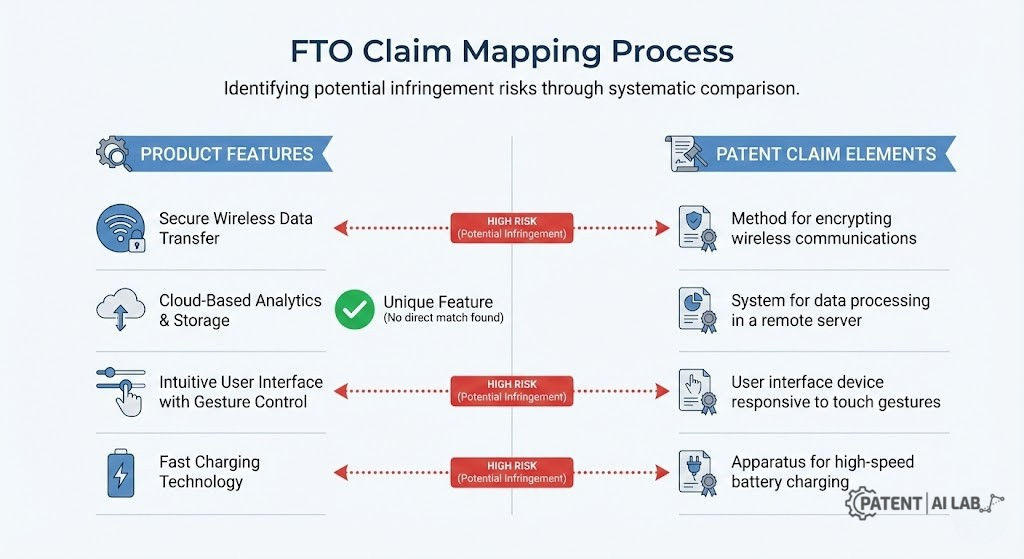
Step 7: Create a Simple FTO Claim Mapping Table
FTO Claim Mapping Analysis
Target Profile: US10846294B2Element A: Capturing a user query via an application interface
Element B: Parsing said query to isolate structural syntax
Element C: Sending structural syntax to a cloud-based ML model
This table saves billable hours when you hire an attorney.
Step 8: Calculate Your Risk Level
Patent infringement risk is not a binary status. When compiling your search results, categorize your findings into three distinct operational risk tiers. This categorization provides a systematic framework for decision-making before you pitch to investors or initiate full-scale production.
High Risk Tier
A filing enters the high-risk category when your technical feature set maps perfectly onto every single structural element of at least one independent claim. The exposure increases significantly if the patent assignment belongs to an active competitor or a non-practicing entity known for systematic litigation. If the patent has been recently asserted in federal court against similar software systems, you must address this block immediately. You cannot launch safely under this tier without engineering changes or licensing procurement.
Medium Risk Tier
Medium risk indicates a partial technical overlap or ambiguous language within the claim boundary. This occurs when your software executes a similar operational outcome, but your engineering methodology uses a different framework. Vague functional claims, which describe what an invention does rather than how it works, often create this gray area. While your actual execution might differ, the patent owner could still argue infringement under the Doctrine of Equivalents. This tier requires close documentation of your engineering choices.
Low Risk Tier
Low risk means your technical pipeline completely lacks at least one essential element found in the independent claim. Under patent law, missing a single element breaks the chain of literal infringement. Filings also fall into this tier if the source document has expired, lapsed for non-payment, or has had its primary claim boundaries narrowed during USPTO prosecution. Document your logical reasoning for each low-risk entry. Institutional investors value a thoroughly documented clearance process over claims of zero total risk.
Step 9: Understand FTO Search vs FTO Opinion
DIY FTO Search
Founder / Internal Team
None (Information only)
Free to Low
Early risk screening
Formal FTO Opinion
Patent Attorney
High (Protects against “Willful Infringement”)
Expensive ($15k – $30k+)
Before Series A, M&A, or Product Launch
DIY searches do not replace legal opinions. They prepare you for them.
Step 10: Design Around Blocking Patents
Discovering a high-risk blocking patent does not mean you must scrap your software project. Instead, use that patent as an engineering roadmap to design around its boundaries. Because patent litigation relies on the presence of every claimed element, removing or altering a single technical step circumvents literal infringement entirely.
Apply these four engineering adjustments to bypass active software barriers safely:
- Alter Workflow Sequences: If an independent claim requires a strict chronological progression (such as Step A then Step B then Step C), restructuring your backend architecture to execute Step B before Step A can eliminate literal infringement, provided the sequence change alters the operational logic.
- Eliminate a Core Claim Element: Evaluate whether the patented feature is truly necessary for your user experience. If a competitor patent covers a multi-step data verification process, removing that specific verification node from your software pipeline detaches your product from their legal boundary.
- Substitute Heuristic Logic for Machine Learning: Many software claims specifically protect the integration of trained neural models or machine learning layers. If your product can achieve a comparable result using local, hard-coded conditional logic or standard heuristic algorithms, you step outside the machine learning claim limitations.
- Shift Processing to Client-Side Infrastructure: If a patent claims a centralized cloud-based architecture that processes data on remote servers, modify your deployment model to execute the data processing locally on the user client machine. This structural change alters the physical layout of the invention.
Successful software startups frequently deploy these technical workarounds early in their development cycles. Designing around a patent prior to writing production code is significantly more cost-effective than rebuilding a deployed system after receiving a formal cease-and-desist notice.
What Happens When You Skip FTO
Launching a software product without a preliminary clearance search introduces hidden liabilities that surface when your company gains market traction. Infringement risks rarely materialize during the initial development phase. Instead, patent holders and non-practicing entities wait until your company triggers public milestones, such as a funding round or an acquisition announcement, to assert their rights.
The Impact on Venture Capital Due Diligence
During institutional investment rounds, institutional investors execute rigorous intellectual property audits. If your startup lacks documentation showing a systematic FTO review, the discovery of a blocking patent can halt the deal. Investors will either adjust your valuation downward to account for future litigation costs or require you to pause operations until you engineer a technical workaround. Demonstrating a proactive DIY screening process proves that you understand operational risk management.
Acquisition Stalls and Indemnity Escrows
Unresolved patent risks destroy enterprise value during acquisition talks. Acquirers will protect themselves by demanding extensive intellectual property indemnification. This often results in a significant portion of your purchase price being locked in an indemnity escrow account for years to cover potential lawsuit expenses. If a court issues an injunction post-acquisition, the buyer can face forced shutdowns of the acquired technology, leading to immediate post-sale legal conflicts.
FTO Rules for AI Code Generators
Modern engineering workflows accelerate software deployment but increase intellectual property exposure. When software engineers use automated coding tools like GitHub Copilot or Devin to generate backend logic, the system frequently produces standard, optimized design patterns. If those patterns mimic patented software methodologies, your product inherits the infringement risk. Code generation tools understand syntax, but they do not check the USPTO database. This makes proactive FTO screening a functional development requirement for software teams.
The Legal Landscape
- AI-related patent applications are increasing rapidly across global registries.
- Patent claims face narrower boundaries after intense USPTO structural scrutiny.
- Section 101 enforcement has significantly reduced the approval of abstract software claims.
- Functional language that describes results rather than technical methods is being challenged more frequently in federal courts.
Strategic Compliance
- Document technical details and database architecture parameters meticulously.
- Avoid generic AI phrasing in internal document repositories and patent definitions.
- Perform preliminary FTO analysis during the initial system design wireframing phase.
- Isolate localized algorithms from cloud-based multi-tenant machine learning models to maximize design-around options.
DIY FTO screening will become a standard founder skill, not a corporate legal luxury.
Podcast:
This automated audio brief outlines the primary data, analysis, and strategic insights covered in this guide.
FAQs
What is a Freedom to Operate search?
A Freedom to Operate search checks whether a product infringes existing active patent claims in a specific jurisdiction.
Can I do an FTO search myself?
Yes, founders can perform a preliminary DIY FTO search using free patent databases, but it does not replace a legal opinion.
Is an FTO search required before launch?
Not legally required, but highly recommended before funding, scaling, or enterprise sales.
Does AI-generated code avoid patent infringement?
No. Patent infringement depends on functionality, not whether code is AI-generated.
How long does a DIY FTO search take?
Typically 1 to 3 days for an initial screening if done methodically.
Sources and Legal References
The search portals, database registries, and classification frameworks analyzed throughout this guide are derived directly from official intellectual property offices and public screening tools required for preliminary clearance validation:
-
1. USPTO Patent Public Search Portal
The official repository managed by the United States government for conducting preliminary patent clearance searches and analyzing active utility claims within the US jurisdiction.
Access USPTO Patent Search Registry -
2. European Patent Office (EPO) Espacenet Index
The global cross-border patent database containing millions of international filings, essential for identifying continental technical tracking and regional software restrictions.
Search Espacenet Global Index -
3. Cooperative Patent Classification (CPC) Silos
The joint categorical framework managed by the USPTO and EPO to organize software logic, G06F/G06N computing structures, and algorithm dependencies independently of keyword variations.
Review Official CPC Classification Structure -
4. MPEP Section 2111 – Claim Interpretation Framework
Official guidelines from the Manual of Patent Examining Procedure specifying the boundaries of the ‘All Elements Rule’ required to break literal infringement chains.
Read MPEP 2111 Interpretative Standards -
5. Warner-Jenkinson Co. v. Hilton Chemical Co. (520 U.S. 17)
The legal precedent established by the Supreme Court of the United States ruling on the boundaries, tests, and operational liabilities of the ‘Doctrine of Equivalents’ in software litigations.
Access Supreme Court Judicial Record (PDF)
Disclaimer & Legal Notice
PatentAILab is an independent educational research platform and is not a licensed law firm or financial advisory service. The data, patent analysis, and strategic insights provided in this article are for informational and educational purposes only and do not constitute legal, investment, or business advice. Intellectual property outcomes depend on specific technical facts, jurisdictional laws, and drafting execution. Always consult a certified patent attorney and a qualified financial advisor before making IP filing or venture capital investment decisions.



[…] invention doesn’t accidentally infringe on existing patents. Here is a step-by-step guide on how to conduct a DIY Freedom to Operate (FTO) search to clear your idea […]
[…] which attorneys charge thousands for. However, bootstrapped founders can save this cost by learning how to perform a DIY Freedom to Operate search using free […]