


 Golam Rabiul Alam, PhD
Editorial note: This article reflects Dr. Golam Rabiul Alam’s technical and engineering analysis of AI drafting technologies. It is intended for informational purposes only and does not constitute legal advice. Patent law is complex and jurisdiction-specific. Always consult a qualified, licensed patent attorney before filing any application or relying on any AI tool for legal claim generation. See disclaimer below.
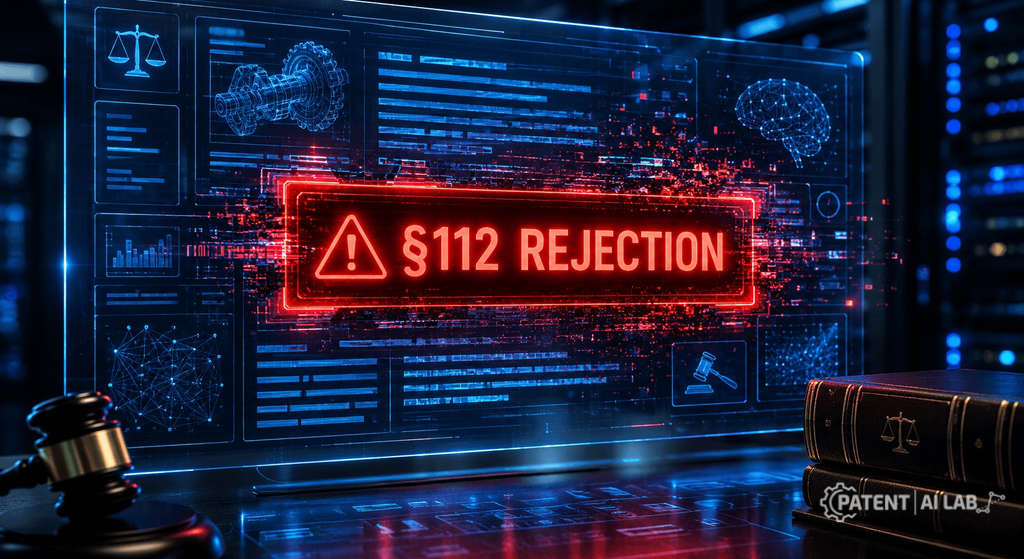
In 2026, using unmodified output from a general-purpose AI system in a patent application carries documented legal risk under 35 U.S.C. §112. The USPTO’s precedential Ex parte Desjardins decision (Nov. 4, 2025) has measurably increased written-description scrutiny across all AI-related applications. This article analyzes the structural reasons why general AI systems are not designed for patent drafting, how specification deficiencies arise in practice, and what role dedicated patent AI tools play in reducing that risk — based on verified USPTO guidance, MPEP standards, and prosecution data through March 2026.
At A Glance
Using general-purpose AI like ChatGPT for patent drafting in 2026 creates a measurable risk of 35 U.S.C. §112 rejection due to AI hallucinations, unclear claim scope, and unsupported technical disclosures. The USPTO’s precedential Ex parte Desjardins decision (Nov. 4, 2025) has already shifted examiner behavior toward increased §112 written-description scrutiny for AI applications. Dedicated patent AI tools reduce these risks by enforcing claim structure, enablement, and prosecution-aware constraints aligned with USPTO, MPEP, and global standards including the EPO 2026 Guidelines and UK Patents Act 1977.
Key Takeaways
- ChatGPT hallucinations directly trigger written-description and enablement rejections under §112
- Fluent language does not equal legal sufficiency under MPEP §2163
- The precedential Ex parte Desjardins ruling (Nov. 2025) has increased written-description scrutiny across all AI applications, not just §101 eligibility
- Dedicated patent AI reduces enablement and clarity risk by enforcing structural disclosure
- Confidentiality and prior art contamination are documented, not theoretical, concerns per USPTO April 2024 AI Guidance (89 Fed. Reg. 25609)
- Hybrid workflows combining attorney oversight with dedicated patent AI outperform AI-only approaches
Why This Debate Is No Longer Theoretical in 2026
AI-assisted patent drafting is no longer experimental. Patent examiners, litigation teams, and due diligence reviewers now assume AI involvement unless proven otherwise.
The real question is not whether to use AI, but which AI is safe to use.
General generative AI systems like ChatGPT are powerful language models. They are not patent systems. That distinction matters because patent law does not tolerate creativity without grounding. The USPTO operates under a strict statutory framework where every word in a claim must be traceable back to the filed specification. General LLMs have no mechanism to enforce that traceability.
Under 35 U.S.C. §112, even a single hallucinated technical detail can invalidate a claim or sink an entire application. And since the USPTO designated Ex parte Desjardins as precedential on November 4, 2025, prosecution data collected through March 2026 shows that written-description rejections have increased relative to §101 rejections across all AI-related applications, according to analysis by PatentNext (April 2026).
According to Dr. Golam Rabiul Alam’s technical analysis, this article explains:
- Why LLM-generated hallucinations are legally dangerous under current USPTO examination practice
- How specification deficiency rejections actually arise in practice following the Desjardins precedent
- Why dedicated patent AI behaves structurally differently from general LLMs
- What USPTO examiners now expect in 2026, and why the EPO 2026 Guidelines raise the bar further
- Practical guidance for attorneys, founders, and developers based on verified regulatory sources
What Hallucination Actually Means for Patent Validity
The Legal Definition, Not the Marketing One
An AI hallucination occurs when a model generates information that sounds correct but is not supported by the invention, specification, or known technical reality.
In patent drafting, hallucinations commonly appear as invented components, unsupported algorithm steps, overgeneralized functional language, claims broader than the actual disclosure, and pseudo-code that would not execute. The USPTO’s April 2024 AI Guidance (89 Fed. Reg. 25609) explicitly flagged that AI models “may be susceptible to hallucinations, resulting in content purportedly from, and references to, non-existent or fictitious documents.”
In ordinary writing, a hallucination is a quality problem that can be corrected before publication. In patents, it becomes a validity problem with permanent consequences the moment the filing date passes. Unlike a published article, a patent application cannot be retroactively supplemented with technical detail that was absent at filing. That asymmetry is what makes AI-generated content uniquely dangerous in this context.
Why Section 112 Is Now the Primary Rejection Vehicle for AI Applications
📊 Prosecution Update
Following the USPTO’s designation of Ex parte Desjardins as precedential on November 4, 2025, prosecution data covering March 2025 through March 2026 shows that written-description rejections have increased relative to §101 rejections across all applications, with the separation widening further in AI-specific applications. USPTO examiners are increasingly issuing Office Actions demanding structural proof when functional terms like “dynamically optimizes” or “intelligent neural node” appear without corresponding hardware or algorithmic flowcharts in the specification (source: PatentNext prosecution data analysis, April 2026).
What 35 U.S.C. §112 Requires, and Where AI Drafts Fail Each Prong
Section 112 governs how clearly and completely an invention must be described. It imposes three requirements, each of which is independently vulnerable to ChatGPT-generated content.
- Enablement: A skilled person must be able to make and use the invention without undue experimentation. Under MPEP §2164, this requires that the specification provide sufficient detail across the full scope of the claim — not merely a single narrow embodiment.
- Written Description: The inventor must demonstrate possession of the claimed invention in the specification as filed. Under MPEP §2163, this is evaluated by asking whether the original disclosure “reasonably conveys to those skilled in the art that the inventor had possession of the claimed subject matter.”
- Definiteness: Claim boundaries must be clear, not ambiguous or speculative. Under MPEP §2173, claims using functional language without structural anchoring are primary targets for indefiniteness rejections.
Hallucinated disclosures undermine all three prongs simultaneously. The critical constraint: once the filing date passes, missing disclosure cannot be added. An amendment that introduces new technical detail constitutes new matter under 35 U.S.C. §132, permanently limiting what the patent can claim.
Three Documented Ways ChatGPT Triggers Section 112 Rejections
Problem 1: Overconfident Technical Language Examiners Cannot Verify
ChatGPT optimizes for plausibility, not truth. A specification that states “the system dynamically adjusts neural weights using a proprietary gradient normalization layer” sounds sophisticated. But if the specification does not describe that layer, the claim fails written description under MPEP §2163. The examiner’s response is straightforward: the claim lacks support in the specification. The practitioner then faces an amendment that cannot add the missing layer without risking a new-matter rejection.
According to Dr. Golam Rabiul Alam’s technical analysis, this is the most common hallucination pattern in AI-drafted specifications: plausible-sounding components that were never part of the actual invention disclosure. Because general LLMs are trained to produce fluent, authoritative text, they will confidently name technical constructs — layers, modules, protocols — that have no referent in the inventor’s actual disclosure. The drafter may not catch the discrepancy until the examiner does.
Problem 2: Invented Algorithm Steps That Create Enablement Failure
A concrete example illustrates the pattern: a general AI, when asked to draft a specification for a model optimization system, may produce pseudo-code referencing a function called quantum_encode(input_data) followed by a call to adaptive_convergence(latent_state). Neither function is defined anywhere in the specification, neither has a corresponding disclosure of how it operates, and neither can be implemented by a person of ordinary skill based on the application as filed. The output reads fluently and appears technically sophisticated, but it satisfies none of the legal requirements of MPEP §2164.
This type of undefined functional reference creates enablement failure under MPEP §2164, indefiniteness under MPEP §2173, and potential subject matter eligibility concerns simultaneously. Dedicated patent AI tools are trained to block or flag undefined functional calls before they reach the specification. General-purpose AI has no such constraint, because its optimization objective is fluent output, not legally sufficient disclosure.
The practical consequence is significant: an examiner reviewing this pseudo-code will issue a compound rejection covering multiple statutory provisions. Each separate rejection requires a separate responsive argument, multiplying prosecution cost and delay. A single undefined function call in an AI-generated specification can cascade into months of additional prosecution.
Problem 3: Functional Claim Inflation Beyond the Actual Disclosure
ChatGPT frequently expands claim scope beyond what the inventor actually built. A claim like “a system configured to optimize any machine learning model across all datasets” triggers a narrow-language mismatch, overbreadth, enablement rejection under §112(a), and §101 eligibility scrutiny under the post-Desjardins framework. USPTO guidance following the 2024 AI Subject Matter Eligibility Update explicitly discourages purely result-oriented claiming without technical grounding. After Desjardins, examiners are now also instructed not to dismiss meaningful technical limitations by evaluating claims “at such a high level of generality” (MPEP §2106.04(d)(1)), meaning overbroad functional claims face scrutiny from both §101 and §112 angles simultaneously.
Vague functional claims do not just fail Section 112. They are also primary targets for eligibility rejections. Learn how to draft defensible claims in our guide: Surviving the ‘Alice’ Nightmare.
What the Post-Desjardins Examination Environment Actually Requires
While the USPTO does not ban generative AI, the post-Desjardins examination environment has produced documented changes in examiner behavior. According to analysis by Today’s General Counsel (June 2026), companies pursuing AI patents should now expect examiners to request specifics about how the AI model is trained, how it processes data, how inference occurs, and how it produces the claimed results. Broad descriptions and high-level claims face longer review cycles and more rejections.
Specifically, examiners are trained to scrutinize inconsistencies between claims and specification, vague AI terms without structural definition, boilerplate “AI does it” language, missing training data disclosure when relevant, and black-box claims lacking algorithmic detail. The shift represents a fundamental change in examiner posture: where §101 rejections could sometimes be addressed by adding a claim element or restructuring the claim, written-description deficiencies under §112 cannot be cured after filing. That makes the stakes of insufficient disclosure categorically higher.
Key point: The burden of clarity is on the applicant, not the AI tool. Practitioners must review AI-generated output line-by-line against the MPEP requirements before filing. Master this skill with our 5-Minute Framework for Reading Patent Claims.
Dedicated Patent AI vs. ChatGPT: Why the Architecture Difference Is the Legal Difference
Why Dedicated Patent AI Exists, and What It Enforces
Dedicated patent AI tools are not general language models. They are constrained systems designed to enforce claim grammar, maintain antecedent basis, map claims to disclosure, track support paragraph-by-paragraph, and align with MPEP logic. They optimize for legal sufficiency, not fluency. The distinction is structural: a general LLM has no mechanism to detect when generated technical content lacks a referent in the actual specification. A dedicated patent AI is trained to treat ungrounded technical language as a rejection risk, not a stylistic enhancement.
This architectural difference has practical consequences at every stage of prosecution. During drafting, dedicated tools alert the drafter when a claim element has no corresponding support paragraph. During review, they flag functional language that lacks structural anchoring. During filing, they produce specifications that are more likely to survive the post-Desjardins examination environment because they were designed around the legal requirements the examiner applies, not around producing fluent prose.

Comparison Table: ChatGPT vs. Dedicated Patent AI Across Eight Critical Dimensions
If you want the speed of AI without the risk of hallucinations, you need a specialized tool. Read our deep dive on The honest PowerPatent Review to see how it enforces MPEP compliance automatically.
Confidentiality and Prior Art Contamination: The Risks the USPTO Put in Writing
Why Client Data in a Public LLM Creates Dual Legal Exposure
Using public LLMs raises two documented issues. The USPTO’s April 2024 AI Guidance (89 Fed. Reg. 25609) explicitly warned that “AI systems may retain information entered by users and use the information in training its models, and portions of the information may filter into outputs the AI system provides to others.” This creates a risk of public disclosure before filing, which can destroy novelty under 35 U.S.C. §102.
The guidance also flagged that ChatGPT cannot verify whether its output mirrors prior art language, creating a proprietary data contamination risk that is separate from, and compounding, the specification-deficiency risk. Dedicated patent AI systems typically run in closed environments, client-isolated instances, and non-training modes, which materially reduces this exposure. This distinction is now a factor in due diligence and litigation discovery, as opposing counsel increasingly targets the AI tools used during drafting to identify potential invalidity arguments.
The following reflects Dr. Golam Rabiul Alam’s technical and engineering analysis of the dual-exposure problem. It is provided for informational purposes only and does not constitute legal advice. Attorneys should advise clients on confidentiality obligations specific to their jurisdiction and firm policies.
The European Bar: How EPO 2026 Guidelines Raise Sufficiency Requirements for AI
EPO 2026: What Changed on April 1, and Why It Matters
The EPO 2026 Guidelines for Examination entered into force on April 1, 2026. They apply stricter sufficiency requirements than the USPTO for AI inventions. Under the updated Section F-III, 3, a lack of sufficiency under Article 83 EPC may result if mathematical methods and training datasets are disclosed in insufficient detail to allow a skilled person to reproduce the technical effect over the whole claimed range. The 2026 update also introduced a new section (“The use of artificial intelligence”) acknowledging that AI-generated content in EPO submissions must be thoroughly reviewed for accuracy, noting the “well-recognised weakness of AI” to hallucinate.
EPO Board of Appeal decisions also constrain result-only claiming: T1998/22 established that claims “merely by a result to be achieved” face rejection under Article 84 EPC clarity requirements, reinforcing the need for detailed technical disclosure that ChatGPT-style functional abstraction will not provide.
UK Patents Act 1977: Concrete Technical Contribution Required
UK law emphasizes clear technical contribution, concrete implementation, and avoidance of abstract AI claims. The UK Intellectual Property Office has consistently applied a standard requiring applicants to demonstrate that their invention provides a technical contribution beyond a mere computer implementation. ChatGPT-style functional abstraction performs poorly under this standard for the same structural reason: general LLMs generate results-oriented language without the technical grounding that UK examination practice requires.
Who Bears the Cost: Real-World Consequences Across Prosecution, Litigation, and M&A
During Prosecution: Longer Cycles and Skeptical Examiners
Today’s General Counsel (June 2026) confirms that companies should plan for longer review cycles and additional requests from examiners in the post-Desjardins environment. Applications relying on high-level, black-box AI descriptions face increased written-description rejections, additional office action rounds, and examiner skepticism that compounds prosecution cost. Every additional office action round means legal fees, and every amendment constrained by the original filing means reduced claim scope. Under MPEP §714, each response to an office action involves substantive legal work that a properly drafted specification could have avoided.
During Litigation: Invalidity Arguments Built on the Specification
A patent granted on a hallucinated disclosure does not become more defensible after grant. Opposing counsel can raise invalidity arguments grounded in the same written-description failures the examiner could have raised. Claim construction uncertainty arising from undefined functional terms creates litigation risk that is entirely avoidable with proper specification drafting. Written description attacks, in particular, are difficult to rebut when the specification itself contains the hallucinated content — because the hallucination is now part of the public record.
During M&A or Fundraising: Red Flags in IP Diligence
Patent portfolio devaluation, red flags in IP diligence, and delayed transactions are compounding consequences of weak AI-drafted applications. Due diligence reviewers now routinely assess whether AI was involved in drafting and whether the resulting specifications can withstand written-description scrutiny. A portfolio with pending rejections or unresolved disclosure vulnerabilities represents a disclosed liability in any acquisition or funding round. Acquirers may discount valuation or require representations and warranties specifically addressing AI-generated specification content.
How to Use AI Safely in Patent Drafting: A Verified Framework
Where ChatGPT Is Safe, and Where It Is Not
Use ChatGPT for: Idea brainstorming, plain-English explanations, and initial prior art summaries. The USPTO’s April 2024 AI Guidance requires that AI-generated IDS references be independently verified by the practitioner before submission; AI-generated prior art summaries must always be cross-checked against real databases. Use our Lens.org Patent Search Guide to cross-check citations and verify they exist.
Use Dedicated Patent AI for: Claim drafting, specification alignment, prosecution-ready language, and post-Desjardins technical disclosure structuring.
For a comparison of safer specialized tools, see our list of 5 Best AI Patent Drafting Software.
Four Prompt Constraints That Reduce Section 112 Risk in Any LLM
According to Dr. Golam Rabiul Alam’s technical analysis of LLM output patterns in patent drafting, four constraint categories reduce specification deficiency risk when any general-purpose AI is used in the drafting process: requiring the AI to cite the specific paragraph in the specification that supports each claim element; locking claim scope to only what is explicitly described in the inventor’s disclosure; rejecting undefined verbs and result-only language per MPEP §2173 indefiniteness standards; and demanding algorithmic steps rather than outcome descriptions. These constraints do not eliminate the need for attorney review but reduce the density of ungrounded content requiring correction.
Practitioner Scenario: The Latent Liability Trap
For example, consider a US AI startup that uses ChatGPT to draft a patent specification for a model that auto-generates network optimization code. The LLM adds a “quantum-assisted preprocessing layer” to make the claims sound more novel. The layer is not in the inventor’s disclosure. The application files. The examiner issues a written-description rejection under §112(b) eighteen months later. The startup cannot amend because the layer was never disclosed. The broadest valid claims are now limited to the narrow embodiment that was actually built. The company’s Series B diligence reveals the pending rejection. The valuation takes a haircut. The attorney’s malpractice carrier gets a call.

Where This Is Headed: Three Trends Shaping AI Patent Drafting Through 2027
What Likely Improves:
Expect expansion in examiner flagging of AI-drafted patterns and increased adoption of hybrid AI plus human workflows. Dedicated systems will systematically block non-enabled functional claims before they reach the USPTO. The EPO 2026 Guidelines and Desjardins together are pushing the industry toward more technically specific disclosures, which benefits applicants who invest in proper drafting tools.
What to Watch (Risks):
Litigation discovery targeting AI drafting methods and insurance scrutiny of AI-assisted patents will escalate through 2026 and 2027. AI will not replace patent attorneys. According to Dr. Golam Rabiul Alam’s analysis, it will instead ruthlessly expose attorneys who rely on generalized LLM output without structural verification, because the post-Desjardins examination environment has less tolerance for specification gaps than at any prior point in the past decade.
Podcast
Note: This audio is a condensed summary. Please refer to the written text for precise legal and compliance definitions.
FAQs
Can ChatGPT be used for patent drafting at all?
Yes, but only as a support tool for brainstorming and plain-English explanations. The USPTO’s April 2024 AI Guidance (89 Fed. Reg. 25609) requires practitioners to verify AI-generated content for technical accuracy and compliance with 35 U.S.C. §112 before filing. Final claims and technical disclosures must not rely on ChatGPT output without line-by-line expert review.
Why is §112 more dangerous than §101 here?
§112 failures are factual and cannot be cured after filing. Once the filing date passes, missing disclosure cannot be added without risking a new-matter rejection under 35 U.S.C. §132. Prosecution data from March 2025 through March 2026 shows §112 written-description rejections increasing relative to §101 rejections across all AI applications, following the precedential Ex parte Desjardins decision (Nov. 4, 2025).
Are dedicated patent AI tools examiner-approved?
No tool is formally approved by the USPTO. However, dedicated patent AI outputs align more closely with MPEP standards and examiner expectations because they are trained on patent prosecution data, not general internet text. The difference is structural: dedicated tools enforce antecedent basis and specification-claim mapping, which general LLMs do not.
Does AI use need to be disclosed to the USPTO?
Yes. Under the USPTO’s April 2024 AI Guidance (89 Fed. Reg. 25609), practitioners have a duty of candor under 37 CFR 1.56(a) that applies regardless of AI involvement. AI cannot be named as an inventor (confirmed by revised inventorship guidance issued Nov. 28, 2025, rescinding the Feb. 2024 guidance). The mental conception of the claimed invention must remain with a human inventor. Practitioners should also verify all AI-generated IDS references independently before submission.
Sources and Legal References
The legal arguments, statutory guidelines, and prosecution risks discussed in this analysis are grounded in verified official USPTO frameworks, precedential decisions, and established patent doctrines:
-
1. USPTO — 35 U.S.C. § 112 Specification Requirements (MPEP §§ 2161, 2163)
The statutory baseline demanding written description, enablement, and definiteness. This is the primary mechanism examiners use to reject unsupported, AI-hallucinated claim boundaries.
Review MPEP § 2161 / § 2163 -
2. USPTO — Guidance on Use of AI-Based Tools in Practice (89 Fed. Reg. 25609, April 11, 2024)
The first federal-agency practitioner-facing AI guidance in the United States, establishing that the duty of candor under 37 CFR 1.56(a) applies regardless of AI involvement and that practitioners must verify technical accuracy of AI-drafted specifications for §112 compliance before filing.
Read Full Federal Register Notice -
3. Ex parte Desjardins, Appeal No. 2024-000567 (USPTO Appeals Review Panel, Sept. 26, 2025; Precedential, Nov. 4, 2025)
The precedential PTAB decision that shifted USPTO examination from §101 eligibility toward §112 written-description scrutiny for AI inventions, embedding into the MPEP (§ 2106.04(d)(1)) that examiners must not dismiss meaningful technical limitations by evaluating claims at an overly general level.
Read Full ARP Decision (PDF) -
4. PatentNext — §112 Written-Description Rejections Increase Following Desjardins (April 23, 2026)
Prosecution data covering March 2025 through March 2026 documenting that §112 written-description rejections have increased relative to §101 rejections across all applications and specifically in AI-related applications, following the Desjardins precedential designation.
Read PatentNext Analysis -
5. European Patent Office — Guidelines for Examination 2026 (in force April 1, 2026): Articles 83 and 84 EPC
The 2026 EPO Guidelines extended sufficiency requirements under Article 83 EPC for AI inventions, requiring that mathematical methods and training datasets be disclosed in sufficient detail for the skilled person to reproduce the technical effect, and introduced an explicit section on AI use by examiners and applicants, including a formal acknowledgment of hallucination risk in AI-generated patent content.
Read EPO 2026 Guidelines Analysis -
6. USPTO — Revised Inventorship Guidance for AI-Assisted Inventions (Nov. 28, 2025, 90 Fed. Reg. 54636)
Rescinded the February 2024 inventorship guidance and replaced it with revised guidance emphasizing that AI may assist but cannot be named as an inventor, that mental conception must remain with a human inventor, and that foreign filings naming an AI as sole inventor can undermine U.S. priority claims.
Read PatentNext Summary of Revised Guidance
Disclaimer & Legal Notice
This article reflects Dr. Golam Rabiul Alam’s technical and engineering perspective evaluating patent drafting technologies from a strategic and technical standpoint. It is intended strictly for informational and educational purposes and does not constitute formal legal, corporate, or financial advisory services. It is not a substitute for the advice of a qualified, licensed patent attorney. Patent law is complex, jurisdiction-specific, and subject to change. The analysis of tools and workflows presented here reflects technical and structural observations, not endorsements of any specific commercial product as legally sufficient or USPTO-approved. Always consult a certified patent attorney before filing applications or relying on automated systems for legal claim generation.


[…] generative models struggle with hallucinations (see our analysis on ChatGPT vs. Dedicated Patent AI Risks), agentic systems go a step further by executing code […]
[…] Remember, AI is a tool, not an inventor. Relying too heavily on automation can lead to legal rejections, as we discussed in ChatGPT vs. Dedicated Patent AI Risks. […]