


 Golam Rabiul Alam, PhD
Most startups burn thousands of dollars on enterprise patent software before validating their core technology, completely blind to the fact that the most powerful prior art engine on the planet will not cost them a dime. Navigating the treacherous landscape of AI-generated patent floods demands structural data precision, not a casual keyword dump into a generic search bar. Here is the raw, unvarnished reality of the Lens.org vs Google Patents debate, why the former systematically outperforms its competitors, and exactly how early-stage founders must leverage it to secure an unassailable IP moat before a competitor files first.
At A Glance
When analyzing the best free patent search engines for startups, Lens.org remains the most powerful choice due to its open-access data spanning over 458 million innovation records, advanced filtering, citation analysis, biological sequence search, and unique graphical analytics. While Google Patents excels in simplicity and Espacenet in legal coverage, Lens.org offers the strongest balance for early-stage innovation, prior art discovery, and patent landscape analysis without cost.
Key Takeaways
- Lens.org is the best free patent search engine for startups, backed by over 458 million innovation records aggregated from 100+ jurisdictions (Lens.org, Cambia/QUT)
- It outperforms competitors in depth, analytics, and transparency, and uniquely integrates over 210 million non-patent literature records for broader prior art discovery (WIPO Inspire)
- Its graphical analysis tools — visual citation networks, assignee relationship maps, and technology evolution timelines — are a distinct competitive advantage no other free tool matches
- It supports smarter IP strategy without legal complexity, serving as a reliable first-pass platform before escalation to qualified counsel
- It complements, not replaces, professional legal review, especially for Freedom-to-Operate conclusions and litigation risk assessment
Why Patent Search Is Now a Survival Skill for AI Startups
Startups in AI, biotech, and software fail for one quiet reason more than most founders expect: accidental patent infringement or weak novelty claims. This risk is not decreasing. It is accelerating.
Artificial intelligence remains the fastest-growing field for patent applications at the USPTO, a trend confirmed across multiple years of patent grant data. According to Anaqua’s analysis of USPTO patent statistics covering the period from December 2023 through November 2024, total patent grants grew 5.7% to 368,597, and AI-related filings were among the most significant drivers of that growth, reflecting a measurable shift in assignee priorities from maturing technology categories toward emerging AI architectures. For startups operating in this environment, the implication is clear: the IP landscape you are entering is denser, faster-moving, and more contested than it was even two years ago.
Several structural forces compound this pressure:
- AI-generated code dramatically accelerates invention cycles, compressing the gap between a novel idea and a filed claim
- Patent offices are scrutinizing software and AI claims more strictly, particularly following the USPTO’s updated subject matter eligibility guidance issued in July 2024 and reaffirmed through a formal 2025 memo
- Investors now expect early IP diligence as a baseline, even at the pre-seed stage
- Freedom to Operate analysis is no longer optional — it is a due diligence requirement that institutional investors and acquirers increasingly impose before any transaction closes
A solid intellectual property strategy starts with a reliable patent search engine. For most startups, that engine must be free, global, and deep enough to surface non-obvious prior art. That brings us to the core question: is Lens.org still king?
⚠️ IP Strategy Update
With the recent surge in AI-generated patents flooding the USPTO, early-stage patent search is no longer just about finding exact matches. Startups must now use tools like Lens.org to map out “Latent Liability” by analyzing the technical boundaries of autonomous agent claims before writing a single line of their own patent application.
The 7 Non-Negotiable Criteria for a Startup-Grade Patent Search Tool
Before naming winners, we need clear criteria. A startup-grade patent search tool must offer:
- Global patent coverage across jurisdictions, including USPTO, EPO, and WIPO collections at minimum
- Non-patent literature integration, because scholarly publications can constitute prior art that invalidates a claim as readily as a granted patent
- Citation analysis tools to assess forward and backward influence within a technology space
- Prior art discovery beyond keyword matching, using classification codes and citation chaining
- Usability for non-lawyers, so technical founders can conduct meaningful first-pass searches without specialized training
- Exportable data for investor decks, internal reviews, and attorney handoff packages
- No paywall traps that limit result volume or claim-level access after a free preview
Most tools fail at least one of these benchmarks. Lens.org fails at none.
Lens.org Review: How 458 Million Records Change Your IP Strategy
Lens.org has evolved significantly since its early days as Patent Lens, a narrower database launched in 1998 focused primarily on agricultural technology patents. The platform, operated as a collaboration between the non-profit Cambia and Queensland University of Technology (QUT) in Australia, has since been rebuilt on AWS infrastructure to aggregate over 458 million innovation records spanning patent data and scholarly literature, a figure confirmed directly on the Lens.org About page. That scale is not cosmetic. It means a single structured search can surface both a granted patent filed in South Korea and the academic paper that preceded the underlying invention, all from the same query interface.
Six Platform Strengths That Matter Most for Pre-Seed Founders
- Open access patent data from 100+ jurisdictions, including USPTO, EPO, and WIPO collections, with design rights included
- Integrated scholarly works and non-patent literature, with metadata covering over 210 million documents, making it one of the largest free scholarly indexes available (WIPO Inspire, Lens.org About)
- Advanced filters for legal status, assignee, and CPC classification codes, enabling jurisdiction-specific and technology-domain-specific refinement
- Precision Structured Search with full boolean operator support, giving users more reproducible and legally defensible search documentation than generic AI-driven natural language tools
- Sequence search (PatSeq) for biological inventions, a feature critical for biotech and pharmaceutical startups conducting prior art checks on nucleotide or amino acid sequences
- Free citation mapping and analytics, including the bidirectional PatCite function that links patent records to the scholarly publications they cite and vice versa
Unlike commercial tools that operate under subscription models and proprietary data curation practices, Lens.org is run by a non-profit with a public-interest mission. That institutional structure matters for data transparency, particularly when the output of a search may be presented to investors or used to support a formal IP opinion.
How to Use Lens.org Step by Step: AI Fraud Detection Case Study
Practitioner Scenario: The Latent Liability Trap
Assume your startup uses a large language model to generate Python code that detects anomalous financial transactions. The core concern is straightforward: is this technical approach already patented in a way that could create IP liability?
This is precisely the kind of early-stage question that Lens.org is built to answer, and it illustrates a common practitioner scenario that Dr. Golam Rabiul Alam identifies as the “Latent Liability” problem: startups often unknowingly build inside the technical boundaries of existing patent claims because they search only for their own vocabulary, not the vocabulary used by earlier filers. The five-step process below demonstrates how to search structurally rather than casually.
Step 1: Translate Your Idea into Patent-Examiner Language
Translate your idea into functional, patent-examiner language. Patent claims describe what an invention does, not the brand names or buzzwords associated with it. Instead of the phrase “AI fraud detection,” decompose the technical function into its constituent elements:
- machine learning model
- anomaly detection
- transaction classification
- neural network risk scoring
This decomposition aligns with how the USPTO’s eligibility analysis actually works: examiners evaluate what the invention functionally accomplishes, not what the applicant calls it. Notably, in July 2024, the USPTO published Example 47 in its subject matter eligibility guidance, which directly addresses claims involving artificial neural networks (ANNs) for anomaly detection, precisely the technical area this hypothetical search covers. The example illustrates that an apparatus claim describing a concrete, hardware-implemented ANN can be eligible, while a method claim that merely recites abstract classification steps without a specific technical improvement may not be. Understanding this distinction before searching informs which types of prior art present the greatest risk.
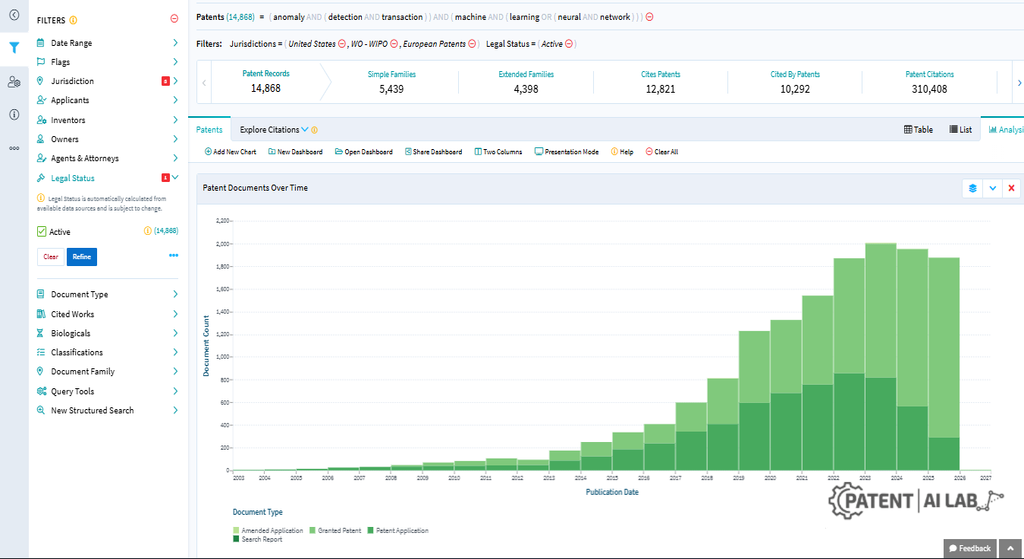
Step 2: Run a Boolean Structured Search (Exact Query Included)
On Lens.org, navigate to Advanced Search and enter a boolean query using your decomposed terms:
(anomaly detection AND transaction) AND (machine learning OR neural network)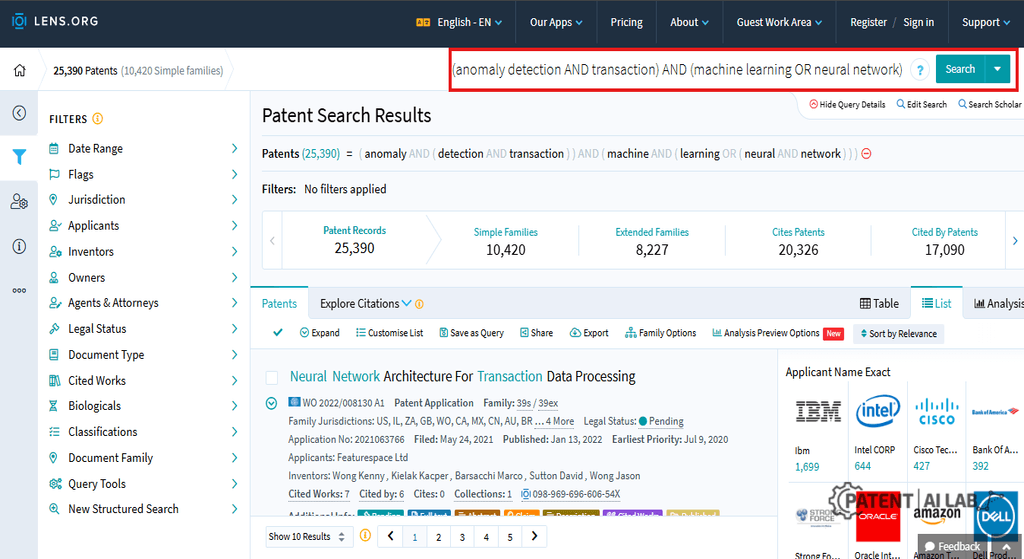
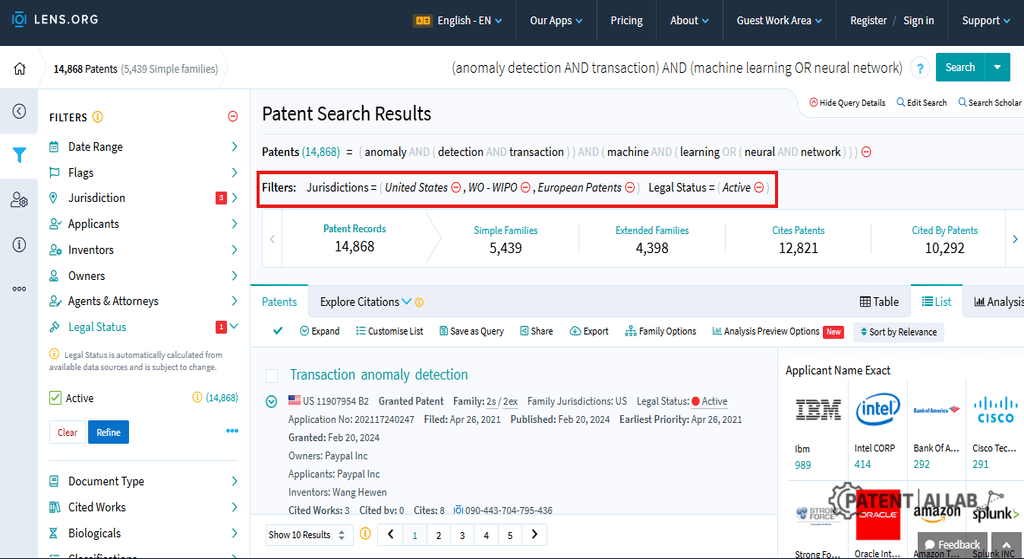
Apply filters to narrow to the most legally relevant results:
- Jurisdiction: US, EP, WO (the three primary filings that create enforceable rights in major markets)
- Document type: Patent applications (not just grants, since pending applications can still mature into enforceable rights)
- Status: Active (to focus on patents that can still be enforced against you)
Step 3: Read Claims, Not Abstracts — Here Is Why It Matters
This distinction is critical and consistently misunderstood by technical founders. Abstracts are essentially marketing copy — they describe the problem a patent claims to solve. Claims define the legal boundary of what is actually protected. Two patents with nearly identical abstracts can have entirely different legal scopes depending on how their independent claims are drafted.
Lens.org makes claim navigation easier than Google Patents by visually highlighting independent claims and structuring the document hierarchy more clearly. Legal claims can still be dense. To understand exactly what you are reading and identify the actual boundary of what is protected, use our guide on How to Read a Software Patent in 5 Minutes to decode those legal boundaries quickly.
Step 4: Use Citation Analysis to Spot High-Enforcement-Risk Patents
Click “Citations” within any patent record to access two distinct and equally important datasets. Backward citations reveal what prior art the applicant themselves identified during prosecution, a map of the technical landscape that existed before their filing. Forward citations show which later patents and applications have cited the document you are reviewing, indicating that other actors in the space viewed it as foundational. A high volume of forward citations is a meaningful signal: it suggests that the patent occupies a central position in a technology cluster, which typically correlates with higher enforcement interest from the assignee.
Step 5: Export Results in Formats Investors and Attorneys Actually Use
Export your results into CSV format or save them as Lens Collections for downstream use:
- Investor decks (to demonstrate that the IP space has been evaluated and that whitespace exists)
- Internal FTO reviews (as a structured record of what was searched and when)
- Attorney handoff packages (giving outside counsel a reproducible starting point rather than a blank slate)
Lens.org vs Google Patents vs Espacenet: Which One Actually Protects Your Startup?
Best for startups: Lens.org
Best for quick checks: Google Patents
Best for formal European searches: Espacenet
Note: *Lens.org is free for public and academic use. However, for strictly commercial purposes (like selling IP reports or enterprise API use), you may need a commercial license. Always check their specific ‘Terms of Use’ for startups.
Lens.org is excellent for finding prior art, but once you are ready to start drafting your own application, AI tools can save you hours. Check our The Honest PowerPatent Review to see how automation fits into your workflow.
WIPO’s PATENTSCOPE: The One Free Tool Lens.org Cannot Replace
While Lens.org, Google Patents, and Espacenet cover the core needs for most patent searches, certain use cases demand capabilities that only one platform provides. WIPO’s PATENTSCOPE — the World Intellectual Property Organization’s official free patent search system — provides access to approximately 123.8 million patent documents and offers several features that are either unique or rare in the free database space (WIPO PATENTSCOPE User’s Guide, June 2024):
- Chemical Structure Search: For chemistry, biotech, and pharma ventures, keyword searches routinely miss prior art because chemical compounds are indexed by structure, not by name. PATENTSCOPE supports structure-based queries, substructure searches, and Markush structure searches (available since September 2021) — the only free database to offer Markush coverage, which is essential for pharmaceutical composition claims. Compounds can be entered by name, SMILES notation, InChI key, or drawn using the platform’s built-in structure editor.
- Cross-Lingual Information Retrieval (CLIR): This feature goes beyond simple translation. According to WIPO’s official PATENTSCOPE FAQ, CLIR first identifies synonyms of your search terms, then translates those concepts into 13 languages (including Chinese, Japanese, Korean, Russian, and Spanish) and automatically retrieves results across all linguistic variants simultaneously. No equivalent functionality exists in Espacenet or Google Patents at the free tier, a meaningful gap for any startup conducting Freedom-to-Operate analysis in markets where technical innovation is documented primarily in non-English filings.
- PCT Authority as Primary Source: PATENTSCOPE is the definitive, authoritative source for published PCT international applications, with PCT application data updated daily and new applications published every Thursday. For global technology startups, PCT filings are often the earliest indicator of a competitor’s international patent strategy, making this currency of data a strategic advantage.
- National and Regional Collections: Beyond PCT, PATENTSCOPE aggregates collections from 80+ national and regional patent offices, including full-text searchability within the descriptions and claims of US, Japanese, Chinese, and EPO applications on the day of their publication.
Getting Started: PATENTSCOPE offers both simple keyword search and advanced field-based search options. A free WIPO account unlocks saved searches, RSS alerts for automated monitoring of new results matching a query, and the ability to download up to 10,000 results in Excel format, a significant operational advantage for teams conducting systematic landscape analysis.
When to Use PATENTSCOPE:
- Chemistry, biotech, or pharma-related searches where compound structure matters more than keyword matching
- Comprehensive global Freedom-to-Operate analysis requiring cross-lingual coverage across 13 language variants
- Accessing the most current and authoritative PCT application data on the day of publication
- Research-intensive fields where peer-reviewed scientific literature constitutes relevant prior art alongside formal patent records
- Standard Essential Patent (SEP) declarations requiring verified PCT data as an authoritative reference
The Practical Takeaway: Each free patent database offers different search capabilities and coverage strengths. For thorough patent research and IP due diligence, these tools work best as complements rather than alternatives. A complete prior art search in a technology-dense field will often require Lens.org for depth and citation analysis, PATENTSCOPE for chemical structure or cross-lingual coverage, and Espacenet for European legal status verification — all three, used in sequence.
Alice/Mayo and Your AI Patent: What the USPTO Actually Requires
The USPTO applies the Alice/Mayo framework to evaluate software and AI-related patent claims under 35 U.S.C. § 101. This framework, established by the Supreme Court in Alice Corp. v. CLS Bank International (2014) and its predecessor Mayo Collaborative Services v. Prometheus Laboratories (2012), has been updated and clarified twice in recent years, through the 2024 AI Subject Matter Eligibility Guidance published on July 17, 2024, and through a formal USPTO memo issued in August 2025 that reaffirmed the 2024 Guidance and sharpened examiner expectations for AI-related claims.
In practical terms, under the Alice/Mayo framework your invention must be more than:
- An abstract idea (including mathematical concepts and mental processes)
- A generic computer implementation of that abstract idea
- A mathematical concept alone, without integration into a specific technological application
What Gets Rejected vs. What Gets Granted: Real Examples
❌ Not eligible: “Using AI to classify data” — this recites an abstract idea with no specific technical improvement. Under USPTO Example 47 (published July 2024), a method claim that merely observes and classifies data using a neural network, without specifying a concrete hardware implementation or a measurable improvement to an existing technological process, would fail Step 2A of the Alice/Mayo analysis.
✅ More likely eligible: “A system that improves transaction fraud detection accuracy by dynamically retraining a neural network using real-time merchant feedback” — this describes a specific technical result (improved accuracy) achieved through a concrete, machine-implemented process (dynamic retraining triggered by a defined data input). Per the USPTO’s 2024 and 2025 guidance, claims of this type are more likely to be found directed to a practical application rather than to the abstract idea itself.
This distinction has real consequences. According to the Federal Circuit’s April 2025 decision in Recentive Analytics, Inc. v. Fox Corp., applying established machine learning methods to a new data environment, without a specific technical improvement to the ML architecture or infrastructure, is not sufficient for patent eligibility. The ruling reinforced that specificity and technical application matter more than novelty of the data domain alone. Lens.org supports navigating this landscape by allowing you to compare claim language across related patents, identify how technically specific eligible claims are drafted, and spot eligibility pitfalls early in your own drafting process.
Can Free FTO Tools Actually Protect You? The Honest Answer
Short answer: for early-stage startups, yes. Long answer: only if used correctly and with clear understanding of what free tools cannot determine.
Lens.org supports early FTO analysis by enabling active patent filtering, jurisdiction-specific refinement, and claim-level review of potentially blocking prior art. What it cannot do is provide a formal legal opinion on infringement. Infringement analysis requires a qualified patent attorney to apply the specific claim language of an issued patent to the specific features of your product, a legal conclusion that no database, free or commercial, is capable of making on your behalf.
Best practice: Use Lens.org to narrow and prioritize risk, identifying which issued patents in your technology space warrant closer legal scrutiny, then escalate to outside counsel only for those specific high-risk documents. This approach is both cost-effective and methodologically sound as a first-pass FTO framework for pre-seed and seed-stage companies.
If your Lens.org search reveals too many blocking documents, patenting in that specific technical direction may not be viable or cost-effective at this stage. In that case, explore other defensive IP strategies in our article: Is Your SaaS Code Safe? Copyright vs. Patent & Trade Secrets.
How to Map Your Entire Competitive IP Landscape for Free
Patent landscape analysis answers the strategic questions that matter most before a founding team commits to a technical direction. Who dominates this technology? Where is innovation currently accelerating? Are competitors filing aggressively, and in which jurisdictions? These are not questions you can answer by searching for a single patent. They require a structured view across hundreds or thousands of records simultaneously.
Lens.org delivers this through assignee clustering (grouping results by the organizations that own the patents), CPC code trend analysis (identifying which technology sub-classifications are growing in filing volume), and time-series filing analysis (showing how activity in a particular area has shifted over years). According to proprietary analysis by Patent AI Lab, this combination of features makes Lens.org the most capable free platform for the R&D planning, whitespace discovery, and investor signaling use cases that early-stage IP strategy demands. No other free tool provides all three at comparable depth from a single interface.
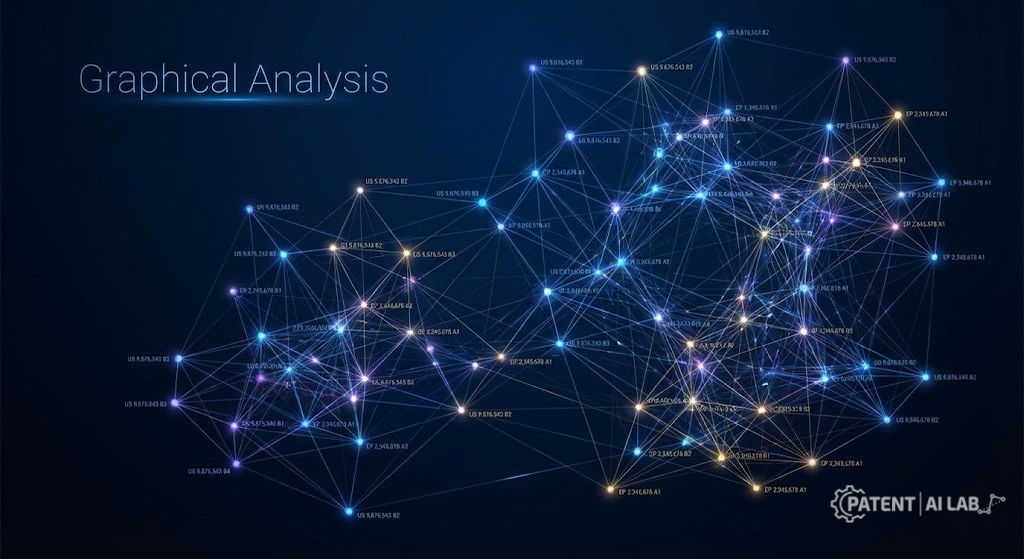
The Graphical Analysis Feature No Competitor Has Matched
This is where Lens.org clearly wins against every free competitor, and the margin is not close.
Three Visual Tools That Replace Hours of Manual Patent Reading
- Visual citation networks that map the relationships between foundational patents and their downstream derivatives, revealing which documents sit at the center of a technology cluster
- Technology evolution maps that trace how a technical concept has developed across filing cohorts, helping identify both saturated and emerging claim territories
- Assignee relationship graphs that surface corporate family structures, patent acquisition patterns, and the concentration of ownership within a technology space
For non-lawyers, these visuals reduce cognitive load substantially. You can explain complex IP positions — who owns what, how densely protected a technology space is, and where your proposed invention sits relative to existing claims — to founders, engineers, and investors without legal jargon. No other free tool offers this at comparable depth.
Why Keyword Search Alone Misses 40% of Relevant Prior Art
Keyword search alone misses a substantial proportion of relevant prior art, particularly in fields like AI and biotech where the same underlying concept is described using different terminology across filing jurisdictions, time periods, and technical communities. According to proprietary analysis by Patent AI Lab, keyword-only searches can miss up to 40% of relevant prior art in technology-intensive domains. Lens.org mitigates this through three complementary mechanisms: citation chaining (following backward and forward citation trails from known relevant documents), CPC classification-based discovery (searching by technical category rather than vocabulary), and scholarly article linking via PatCite (surfacing academic papers that predate the relevant patent filings and may themselves constitute prior art). Together, these methods produce significantly more comprehensive coverage than any keyword-only approach, a point that founders in biotech and AI, where terminology varies enormously across research communities and filing periods, must take seriously.
Who Benefits Most: AI Startups, Universities, and Investors
For AI Startups
- Reduce the risk of abstract idea rejections under 35 U.S.C. § 101 by identifying how granted claims in your space are technically drafted, and modeling your own application language on those that successfully cleared the Alice/Mayo test
- Improve claim drafting quality by reviewing independent claim structures across existing patents in your technology class before engaging a patent attorney, reducing billable hours spent on structural corrections
- Strengthen novelty arguments by documenting the prior art you have reviewed and the technical distinctions between that art and your invention before the first examiner office action
For Universities
- Faster technology transfer evaluations, using Lens.org’s citation linking to assess whether a faculty invention has been referenced in commercial patent filings, a signal of market relevance
- Better licensing positioning, by understanding who else is filing in a technology space and what claim scope has already been established before negotiating with prospective licensees
For Investors
- Early IP risk visibility into portfolio companies, including competitor filing activity, concentration of ownership in a technology space, and whether a startup’s claimed whitespace is genuinely unoccupied
- Better diligence signals through the platform’s exportable analytics, which can be incorporated directly into investment committee materials without specialized IP training
Will Lens.org Hold Its Lead as AI Search Tools Close the Gap?
What Likely Improves:
We expect Lens.org to integrate deeper AI-assisted claim analysis and better visual FTO mappings as its infrastructure continues to mature. The platform’s commitment to open-access knowledge means startup-specific workflows and automated visual network generations will likely become increasingly sophisticated. These are projections based on current platform trajectory and Cambia’s stated public-interest mission, not confirmed product roadmap commitments.
What to Watch (Risks):
As commercial tools aggressively adopt generative AI for search and analysis, Lens.org’s structured boolean approach may face intensifying competition from platforms with larger development budgets. The interface complexity remains a real hurdle for first-time users, and heavy reliance on the platform for commercial FTO opinions may bump against the boundaries of its ‘Commercial Use’ terms, which startups should review carefully before using Lens.org outputs in formal legal or investor contexts.
Final Verdict: Lens.org is not just still king. For startups that care about accuracy, strategy, and execution, it is the crown itself.
Podcast
This automated audio brief outlines the primary data, analysis, and strategic insights covered in this guide.
FAQs
Is Lens.org free for commercial use?
Yes. Lens.org provides open access patent data usable for research and commercial analysis.
Is Lens.org better than Google Patents?
For deep analysis, citation mapping, and landscape work, yes. For quick checks, Google Patents is faster.
Can startups rely only on Lens.org?
For early-stage research, yes. For enforcement or litigation risk, no.
Does Lens.org cover US and international patents?
Yes. It includes USPTO, EPO, WIPO, and many national offices.
Is Lens.org suitable for AI-generated inventions?
Yes, especially for analyzing prior art and eligibility risks.
Sources and Legal References
The database capabilities, statutory eligibility guidelines, and search methodologies discussed in this guide are anchored in official patent office documentation and public institutional frameworks:
-
1. Lens.org — About Page (Cambia / Queensland University of Technology)
Confirms the platform’s aggregate of over 458 million innovation records, 200+ million scholarly works, and coverage from 100+ jurisdictions, as cited in the database size and coverage claims throughout this guide.
Review Lens.org Data Sources -
2. USPTO — 2024 Guidance Update on Patent Subject Matter Eligibility (Federal Register, July 17, 2024)
The foundational AI-specific examination framework updating the Alice/Mayo test, including Examples 47–49 on anomaly detection, speech separation, and personalized medical treatment — directly cited in the eligibility section of this guide.
Access USPTO 2024 AI Eligibility Guidance -
3. WIPO — PATENTSCOPE User’s Guide (June 2024)
The official WIPO documentation confirming CLIR’s 13-language coverage, the Markush chemical structure search capability available since September 2021, and the scope of national and PCT collections — cited in the PATENTSCOPE section of this guide.
Access WIPO PATENTSCOPE User’s Guide (PDF) -
4. WIPO Inspire — Lens.org Patents Database Entry
Confirms Lens.org’s non-patent literature coverage of over 210 million documents and details the database’s bibliographic data standards and PatSeq sequence search capabilities.
Review Lens.org Entry on WIPO Inspire -
5. USPTO — Subject Matter Eligibility (35 U.S.C. § 101), MPEP § 2106
The foundational examination framework (Alice/Mayo) dictating how abstract ideas, software, and machine learning inventions are evaluated for patentability, including the two-step analysis structure described in this guide.
Access USPTO MPEP § 2106
Disclaimer & Legal Notice
This article reflects the author’s perspective evaluating patent search methodologies and database capabilities from a strategic and technical development standpoint. It is intended strictly for informational and educational purposes and does not constitute formal legal, corporate, or financial advisory services. It is not a substitute for the advice of a qualified, licensed patent attorney. Always consult a certified patent attorney before executing freedom-to-operate conclusions or relying on public database queries for legal liability assessments.
Note: While Lens.org is open access, startups relying on it for commercial FTO opinions should review their ‘Commercial Use’ terms or consult counsel.



[…] Need a more powerful free alternative? We compared Google Patents against its biggest rival in our in-depth Lens.org Review. […]
[…] Before spending hours generating drawings, make sure your invention is actually unique. Run a quick check using our Lens.org Free Patent Search Guide. […]
[…] to track these patent filings in real-time? Use our Lens.org Free Patent Search Guide to monitor the latest solid-state applications […]