


 Golam Rabiul Alam, PhD
Looking for Patent Research Software? If you are searching for the easiest tools to search or research patents before drafting, read our guide on Easiest Patent Research Software for Solo Inventors.
Before you start writing, ensuring your research is complete is vital. While Google Patents is popular, solo inventors often find more value in professional tools. For a deeper look, see our comparison of Google Patents Alternatives: Why I Stopped Paying for Expensive Tools.
Quick Summary
In 2026, the best patent writing software utilities for solo inventors include PatentPal (best for claim consistency), Specifio (best for hardware structure), ClaimMaster (best for proofreading), PatentWizard (best for guidance), and PowerPatent (best budget all-in-one).
While automated drafting tools reduce initial capital deployment by up to 70%, they pose severe structural risks if utilized without strict verification limits. This evaluation audits the top five configurations.
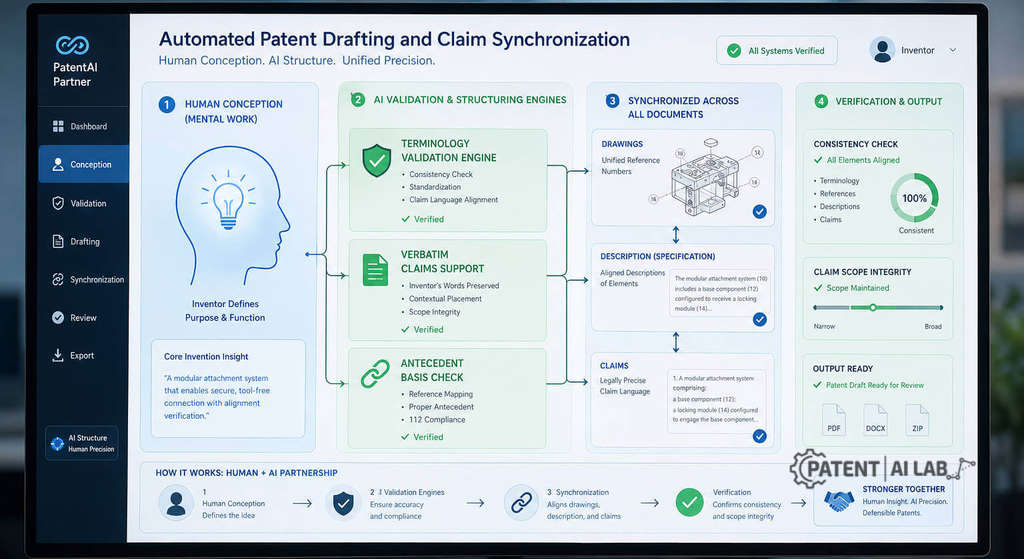
A Field-Tested Analysis of Automated Patent Writing & Drafting Software
Two years ago, I consulted a hardware inventor who spent six months iterating a provisional patent draft. The core issue was not a lack of ideas, but a lack of structural constraint. The claims lacked focus, and the embodiments contradicted each other.
Automated patent drafting software must prioritize constraint over speed. Tools that force structural discipline yield better results than those generating unverified text. This distinction is critical for inventors executing drafts without immediate legal oversight.
2026 Comparison Matrix
PatentPal
$100 – $150 / mo
Specifio
Custom / High
ClaimMaster
~$150 / mo
PatentWizard
~$299 / yr
PowerPatent
~$199 / invention
Are AI Patent Drafting Tools Safe for Solo Inventors?
Yes, but only under strict parameters. Automated drafting tools (often classified as patent writing software) should function as structural consistency engines rather than legal strategists. They are designed to act as a specialized technical writer that forces strict alignment between your claims, descriptions, and figures.
The primary risk involves systems that encourage unstructured input, allowing users to introduce vague terminology that fails under formal examination. Our evaluation confirms that platforms with rigid operational constraints consistently yield more stable applications because they prevent inventors from inserting irrelevant commercial phrasing into a legal document.
The worst tools encourage “over-claiming” and vague language that feels impressive but collapses under examination. What surprised me most during our testing was this: Tools with fewer features often produced better drafts because they constrained user input instead of letting inventors dump raw ideas everywhere.
Under current federal guidance, applications drafted using automated utilities remain valid provided the core mental conception is strictly human. Inventors must comply with the Duty of Candor (37 CFR 1.56) and Signature Rules (37 CFR 11.18) by manually verifying all generated text for technical accuracy. Formal disclosure is only required if the software impacts the actual inventorship of a claim.
How We Evaluated These Tools
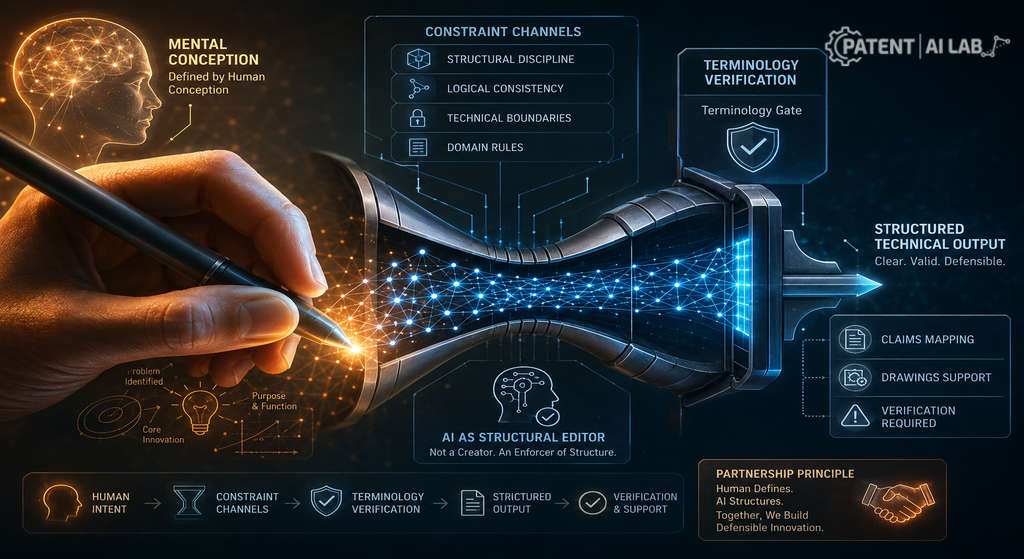
To evaluate these platforms objectively, I tested these tools across five independent inventions from solo creators spanning software architectures, medical devices, and mechanical hardware. Each configuration was restricted to a single core invention without external legal intervention during the initial development phase. Performance was indexed against three primary parameters: terminology synchronization, structural clarity, and required post-draft adjustment time. The following platforms delivered the most stable baselines in 2026.
PatentPal
Best For: Claim ConsistencyPatentPal operates as a deterministic alignment utility, converting structured inputs into standardized claim text. The platform systematically enforces terminology limits, reuse parameters, and phrasing synchronization across the document architecture.
Linguistic Automation: Converts text descriptions into standardized technical flowcharts and block diagrams automatically, removing traditional visualization bottlenecks.
Specifio
Best For: Software FrameworksSpecifio applies rigid architectural templates engineered for software configurations and process methods. By locking the specification directly to an initial independent claim set, the system prevents unstructured descriptive additions.
Processing Velocity: Highly efficient operational speeds, delivering complete structural text frameworks in under ten minutes.
ClaimMaster
Best For: Technical ProofreadingClaimMaster functions strictly as a validation and auditing utility integrated directly into Microsoft Word, focusing entirely on syntax rectification and structural compliance checking rather than original composition.
Error Detection: Outstanding performance in isolating missing antecedent bases and flagging non-statutory or ambiguous phrasing before filing phases.
PatentWizard
Best For: Structural GuidancePatentWizard utilizes an interactive questionnaire framework to prompt independent applicants through mandatory structural sections, focusing technical disclosure on alternative configurations and distinct embodiments.
Methodology Training: Imparts systematic patent engineering discipline by walking creators through defensive drafting logic step-by-step.
PowerPatent
Best For: Cost-Effective FilingsPowerPatent provides a modular, entry-level environment optimized for independent filers managing early provisional structures. It categorizes technical inputs cleanly into corresponding statutory filing fields.
The “Safe Draft” Checklist
If we distill our quality control process into a structural checklist, it forms the framework below. Any configuration that failed to satisfy a minimum of three of these operational criteria was immediately excluded from our final recommendations.
Unified Elements
Calling a component “the screw” in one paragraph and “the bolt” in another can invalidate an application.
Verbatim Claims
The descriptive specification must match the exact terminology used in the claims to provide proper statutory support.
Structural Clarity
You must outline how the structural elements interact mechanically, not just the commercial goals they achieve.
Embodiment Mapping
Every specific limitation listed in the claims must be clearly illustrated within the attached technical drawings.
Fallback Positions
Explicitly detail alternative configurations (e.g., “If Plan A fails, the system operability is maintained via Plan B”) to secure broad protection boundaries.
Antecedent Basis
Ensure every component is formally introduced with an indefinite article (“a” or “an”) before referring to it with a definite article (“the”).
The Risk Most Inventors Miss
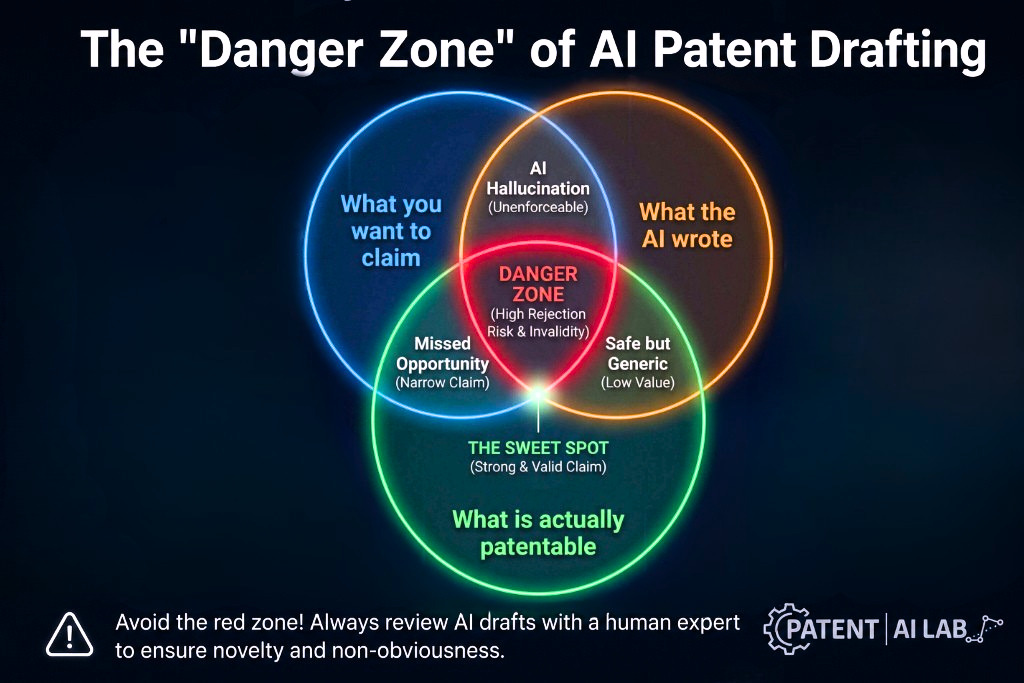
The Primary Vulnerability: Structural Misplaced Confidence
The primary systemic hazard when deploying automated drafting software is the generation of false technical confidence. These platforms output visually polished documents featuring precise margins, clear section headings, and structured legal numbering layouts. This aesthetic execution frequently obscures underlying deficiencies in legal substance. This discrepancy is acute when generative modules populate technical disclosures with generic phrasing, such as “configured to perform operations,” without establishing the specific underlying structural mechanisms.
An additional overlooked risk involves model training data bias. A significant percentage of automated utilities are over-optimized for United States software patent frameworks. Consequently, if you are structuring a physical mechanical hardware application or organizing a filing for European jurisdictions, the software’s default linguistic output may present overly broad or functional limitations, leading to accelerated examiner rejections.
Furthermore, a structurally compliant application framework remains inefficient if total processing expenses exceed your capitalization limits. To preserve long-term financial resources during the submission phase, applicants must incorporate The Patent Claim Optimization Strategy to systematically avoid the USPTO excess claim fee thresholds.
Final Recommendation
Strategic Steps for Independent Inventors in 2026
- Deploy a Singular Automated Tool Only: Avoid combining multiple drafting platforms to prevent cross-specification terminology conflicts.
- Pace the Development Framework: Allow the automated software setup to enforce strict structural discipline across your application sections.
- Integrate an External Review: Reinvest the initial capital conserved during the automated drafting phase to retain a certified patent attorney for a targeted two-hour high-level verification pass.
Adhering to this specific procedural mindset previously prevented an independent hardware developer from encountering four months of extensive corrective reworks while significantly optimizing the downstream practitioner verification cycle.
Budget Constraints: If you prefer utilizing manual configurations over specialized software setups to minimize initial submission fees, review our step-by-step directional tutorial on How to File a Patent Yourself for Only $65.
Have you deployed any of these automated configurations? Share your operational drafting experiences in the comments below.
Podcast
Note: This audio is a condensed summary. Please refer to the written text for precise legal and compliance definitions.
FAQ: Automated Patent Writing Software
Can I file a patent myself using these tools?
Yes, you may file pro se (self-represented). Tools such as PowerPatent and PatentWizard are designed for this purpose. However, for a non-provisional (utility) patent, it is strongly recommended that a registered practitioner review it before filing to avoid “estoppel” (statements that limit your rights later).
How much does AI patent writing & drafting software cost?
Prices vary in 2026.
Budget: PowerPatent (~$199/invention).
Mid-Range: PatentWizard ($299/year).
Pro/Subscription: PatentPal and ClaimMaster often charge monthly fees ($50-$150/month) or per-user licenses intended for frequent filers.
Will the USPTO reject my patent if I use AI?
No. The USPTO accepts patents based on their drafting. They reject them on the basis of clarity, novelty, and non-obviousness. However, if the AI writes “hallucinated” nonsense that isn’t technically accurate, you will be rejected for lack of enablement (Section 112).
Can I use these tools for Patent Research or Prior Art Search?
No. These tools are designed for formatting and writing your patent application. For finding existing patents (Prior Art), you should use dedicated search tools like PatSnap or The Lens. Check out my guide on the Best Patent Research Tools for more details.
Sources and Legal References
The regulatory frameworks, disclosure compliance protocols, and statutory rules cited throughout this evaluation are compiled directly from the official registries of federal patent authorities:
-
1. United States Patent and Trademark Office (USPTO) Guidance
Official 2024–2026 guidelines detailing practitioner obligations, transparency standards, and software verification rules for AI-assisted application drafting.
Read Official Federal Register Notice -
2. Title 37 CFR Section 1.56 (Duty of Candor)
The statutory framework governing the absolute duty of disclosure and candor required from applicants during prosecution.
Review Section 1.56 Statute -
3. Title 37 CFR Section 11.18 (Signature & Certification Rules)
Federal mandates regarding the personal signature certification and human verification of all technical facts presented in a submission.
Access Certification Requirements
Disclaimer & Legal Notice
PatentAILab is an independent educational research platform and is not a licensed law firm or financial advisory service. The data, patent analysis, and strategic insights provided in this article are for informational and educational purposes only and do not constitute legal, investment, or business advice. Intellectual property outcomes depend on specific technical facts, jurisdictional laws, and drafting execution. Always consult a certified patent attorney and a qualified financial advisor before making IP filing or venture capital investment decisions.



A case like this should include Ankar.ai, Patently, and ClaimWise
Hi Sven, thank you for the suggestions! You’re absolutely right. Ankar.ai, Patently, and ClaimWise are making some serious waves in the IP tech space right now. We focused this specific guide on tools we’ve recently field-tested with solo inventors, but those three definitely deserve a deep dive in our next update. Do you have a personal favorite among them?”