


 Golam Rabiul Alam, PhD
Global intellectual property registries indicate a structural shift when analyzing ai patents by country. China now accounts for approximately 60% of all artificial intelligence patent applications, optimizing for volume and application-specific metrics. However, data from citation indexes reveals that United States filings maintain a significant advantage in technical reliance, citation frequency, and cross-border enforceability.
At A Glance
Current data indicates a definitive shift in the US vs China AI patent war as of early 2026. China currently controls approximately 60% of all AI patent filings globally. The strategy heavily favors high-volume filings designed to create immediate legal barriers in specific commercial applications.
Key Metrics (2026 Data)
- Volume Gap: China files nearly four times more AI patents annually compared to the United States.
- Citation Impact: US patents maintain a technical advantage, being cited approximately seven times more frequently than Chinese equivalents.
- Strategic Focus: Chinese filings dominate surveillance and manufacturing applications, while US filings protect foundational generative models and semiconductor architecture.
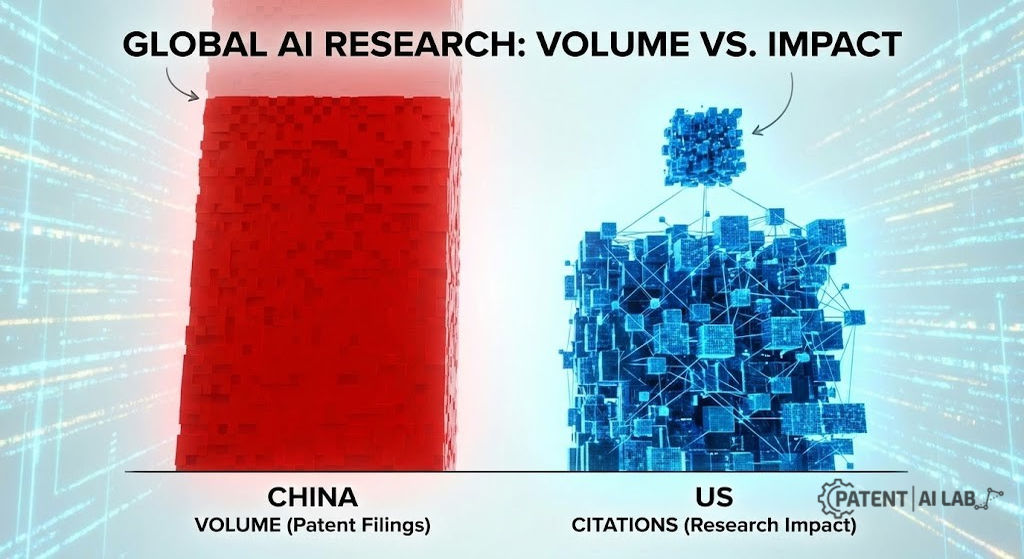
An objective review of global patent registries reveals a significant transition in technological ownership. As of 2026, China effectively controls the volume metric, accounting for approximately 60% of all global AI patents. While the United States continues to lead in foundational algorithmic breakthroughs, China maintains the advantage in filing speed, scale, and supply chain integration.
The previous innovator-versus-copycat paradigm is obsolete. Current data patterns indicate a primary focus on industrial control. The objective is to file narrow, application-specific claims that create a dense legal barrier, increasing the operational costs for foreign competitors.
This analysis details the numerical data driving the global AI patent war, the structural risks involved, and the direct implications for corporate product strategy.
When evaluating ai patents by country, the raw data yields an immediate conclusion. As of 2026, China holds the definitive volume advantage in the ongoing technology landscape.
Global AI Patent Filing Data
Evaluating the specific landscape of ai patents by country requires systematic data. The filing patterns over the past 24 months document this regional distribution and baseline trajectory metrics.
China
~60,000+ FilingsComputer Vision, Surveillance, Autonomous Manufacturing
Market Exclusion: Block competitors from specific industry verticals.
United States
~18,000 FilingsGenerative AI (LLMs), Chip Architecture, Biotechnology
Core Innovation: Protect fundamental algorithmic model logic.
Europe
~12,000 Filings“Trustworthy AI,” Automotive infrastructure, Industrial IoT
Regulation: Define institutional safety and ethical standards.
Citation Analysis: While the United States logs fewer total applications, US filings are cited seven times more frequently than regional equivalents, averaging 13.18 citations per patent against China’s 1.90. This indicates significantly higher technical reliance and foundational importance in downstream AI development.
Factors Driving China’s Filing Velocity
Three primary structural factors explain the current acceleration in Chinese filings when evaluating global ai patents by country. None of these adjustments are accidental.
-
Post-Subsidy Momentum
Following the official phase-out of direct patent subsidies by the China National Intellectual Property Administration (CNIPA) to prioritize filing quality, institutional momentum remains established. Corporate key performance indicators (KPIs) continue to align with volume metrics, and regional municipalities have transitioned from direct cash allocations to structured tax incentives for designated high-tech entities.
-
Streamlined Structural Costs
Filing protocols within regional registries are optimized for accelerated processing. Securing a defensible utility patent within the United States typically requires substantial capital allocations and multi-year review timelines. While domestic creators can optimize drafting expenses via Automated AI Patent Drafting Tools, China utilizes utility models—a secondary streamlined protection tier—granted within months. This structural framework enables regional entities to secure priority dates rapidly.
-
Defensive Saturation
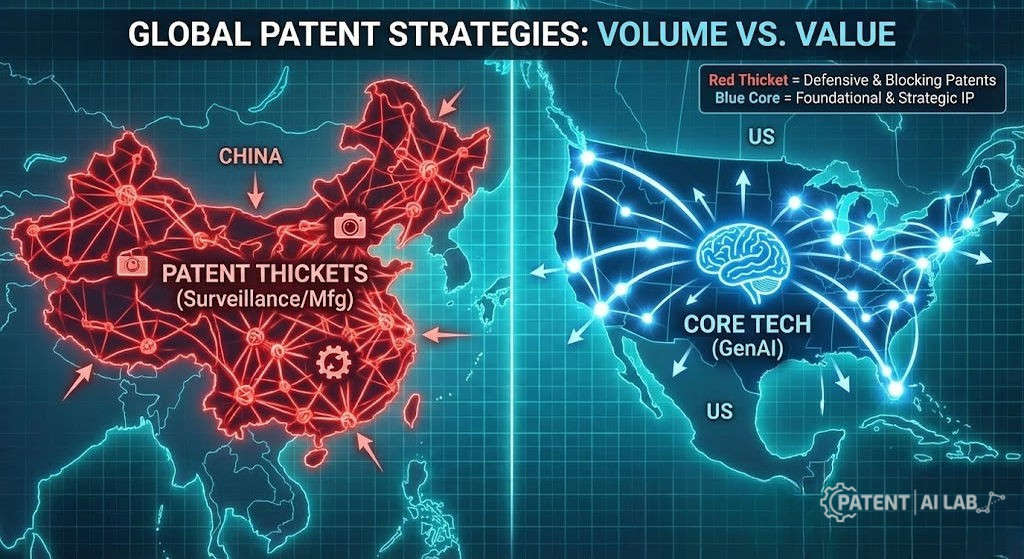
Firms operating within China concentrate applications heavily inside specific technology subdomains, including automated manufacturing and deployment layers. While individual filings represent incremental variations rather than core algorithmic shifts, collectively they construct dense patent thickets. The strategic objective focuses on creating systematic legal barriers that complicate direct infrastructure integration for international manufacturing competitors without formalized joint ventures.
The US Strength Everyone Underrates
Now the statistical analysis shifts directly toward cross-border enforceability and technical impact. The United States still secures the metrics where it counts most: enforceability and downstream market relevance.
One strong US patent on a foundational transformer architecture is worth more than 500 minor application patents. US patents define how the AI thinks. Chinese patents define where the AI is used. Unsure if your code qualifies? Read our simple guide on Can You Patent an Algorithm?
- US Dominance: Generative AI (LLMs), Agentic AI, and Semiconductor design.
- The Problem: Innovation doesn’t guarantee market access. You can own the “brain” of the AI (US patent) but be blocked from deploying it in a “smart city” grid because a local rival owns the patent for “connecting an AI brain to a traffic light” (China patent).
Vulnerabilities in China’s Patent Strategy
High filing volume across global ai patents by country metrics carries specific structural risks that could impact the long-term viability of the regional portfolio.
- Quality and Invalidation Risks: A measurable percentage of the 60% global share consists of utility models or lower-tier filings that may lack commercial applicability. In international litigation, many of these incremental patents face high risks of invalidation when scrutinized under stricter Western novelty standards.
- Hardware Access Dependencies: With strict US limitations on advanced semiconductor exports, Chinese firms are pivoting their software IP strategy toward efficiency optimization and alternative architectures. Without continuous access to frontier physical compute node hardware, patents reliant on sheer processing scale face potential obsolescence.
- Enforcement Metrics: Securing a patent domestically does not guarantee successful enforcement against a foreign entity. While the regional IP court systems are modernizing, international litigation outcomes remain difficult to project reliably.
Methodology and Data Analysis
To quantify the actual distribution of global ai patents by country, this analysis bypassed journalistic metrics and evaluated three primary data signals:
- WIPO and USPTO Filing Data (2024-2026): Tracking the raw dataset distribution of ai patents by country classified under machine learning and computing standards (G06N).
- Citation Index Aggregation: Cross-referencing forward citation frequencies across 140,000 global patent nodes to measure actual downstream engineering reliance.
- Regulatory Policy Tracking: Analysis of the official CNIPA optimization mandates and federal US semiconductor export controls to map systemic corporate operational constraints.
What You Should Do Next
As the AI patent war accelerates, don’t panic. Do plan.
Strategic Action Plan
For US-Based Founders
- Establish Early Priority DatesFile provisional applications during initial development phases to secure an official priority date, particularly if Asian manufacturing setups are anticipated.
- Target Core Technical BottlenecksAvoid allocating intellectual property capital exclusively to high-level application layer claims. Focus documentation on fundamental data processing constraints.
For International Expansion
- Conduct FTO Clearance AuditsBefore entering regional markets, verify that localized entities have not blanketed target features with utility models using verified Prior Art Search Software.
- Capital Allocation for IPClassify patent expenditures as baseline operational deployment costs within international growth infrastructure budgets rather than standard administrative legal fees.
Macroeconomic indicators confirm that China maintains dominance in global filing volume, while the United States retains technical superiority in architectural citation depth. Long-term market advantage belongs to entities recognizing that technical innovation without structured intellectual property protection is commercially non-viable.
Cross-examine structural corporate and state ownership statistics:
Read China vs. USA Data AnalysisPodcast
This automated audio brief outlines the primary data, analysis, and strategic insights covered in this guide.
FAQ: The US-China AI Patent War
Who has more AI patents in 2026, the US or China?
In terms of raw volume, China is the clear leader, holding roughly 60% of the world’s AI patent filings. However, the US maintains a significant lead in high-value patents, those that are cited frequently by other researchers and cover fundamental breakthroughs that strongly influence the AI patent landscape.
Are Chinese AI patents actually high quality?
Filing quality varies. While China files massive numbers, a significant portion consists of utility models, which have lower requirements than invention patents, or narrow applications of existing technology. US patents are cited seven times more frequently on average, suggesting higher core technical value. However, China’s sheer volume creates dense legal barriers that effectively block competitors in specific industries like manufacturing and surveillance.
Why did China end its patent subsidies?
The Chinese government (CNIPA) officially moved to phase out many patent subsidies by 2025 to shift the focus from “quantity” to “quality.” They realized that paying for “junk patents” was inflating numbers without adding economic value. Now, incentives are tied closer to actual commercialization and high-tech enterprise status.
Does a US patent protect me in China?
No. Patents are territorial. A US patent gives you zero protection in China. If you plan to manufacture or sell in China, you must file a separate patent application there (usually via the PCT route) within strict time limits.
Sources and Legal References
The international filing metrics, regional statistical allocations, and comparative citation data cited throughout this analysis are sourced directly from global intellectual property authorities and verified legal frameworks:
-
1. WIPO Intellectual Property Statistics Data Center
Official global dataset tracking international patent applications under IPC section G06N to verify the 60% macro filing allocations.
Access Official WIPO Statistical Database -
2. USPTO Artificial Intelligence Patent Dataset
Federal research repository validating United States AI patent trends, technology models, and the seven-fold citation frequency metrics.
Review Live USPTO AI Dataset -
3. China National Intellectual Property Administration (CNIPA) Portal
Official regulatory data verifying China’s shifting national subsidy structures, high-volume filing frameworks, and utility model guidelines.
Verify CNIPA Regulatory Framework
Disclaimer & Legal Notice
PatentAILab is an independent educational research platform and is not a licensed law firm or financial advisory service. The data, patent analysis, and strategic insights provided in this article are for informational and educational purposes only and do not constitute legal, investment, or business advice. Intellectual property outcomes depend on specific technical facts, jurisdictional laws, and drafting execution. Always consult a certified patent attorney and a qualified financial advisor before making IP filing or venture capital investment decisions.





1 comment