


 Golam Rabiul Alam, PhD
The primary competitive axis in mobile AI has shifted from model parameter counts to hardware execution architecture and regulatory compliance posture. As the EU AI Act (Regulation EU 2024/1689) enters its main enforcement phase on August 2, 2026, the architectural decision of where AI computation occurs — on-device silicon or remote cloud servers — may carry meaningful compliance implications for developers, compliance architects, and IP strategists. This Apple Intelligence vs Google Gemini privacy comparison is a technical and engineering review, not legal advice, examining how Apple uses hardware co-design in pursuit of data containment at the silicon level, how Google navigates the tradeoffs of an open OEM licensing model, and what both approaches could mean for teams building regulated products on either platform.
At A Glance
The Apple Intelligence vs Google Gemini comparison in 2026 is less about model size than about privacy architecture, hardware execution, and patent positioning. Apple Intelligence relies on its Secure Enclave and Private Cloud Compute in an effort to support data isolation. Google Gemini Nano uses Tensor chips and Android OEM licensing for scale. Apple appears stronger on on-device AI privacy architecture and hardware IP; Google appears stronger on AI distribution and ecosystem iteration speed. These are observations about current product design, not a ranking of which approach is “correct.”
Key Takeaways
- On-device edge AI has become a significant competitive and compliance consideration — inference latency and regulatory data residency requirements increasingly function as product requirements rather than purely engineering preferences.
- Apple’s vertical integration supports hardware-enforced data isolation. The privacy property is encoded, at least in part, in silicon architecture rather than solely in a software policy that could be amended without a chip revision.
- Google’s OEM licensing model achieves broad global distribution but can introduce heterogeneous compliance surfaces that may call for per-deployment verification rather than a single unified audit.
- Neural Processing Unit (NPU) silicon patents are generally considered to carry durable long-term IP value. Hardware-anchored patent claims referencing physical circuit configurations tend to fare better under Alice/§ 101 eligibility scrutiny, which has frequently been used to invalidate more abstract software patent claims — though outcomes remain fact-specific and examiner-dependent.
- Data privacy increasingly functions as an architectural design constraint rather than purely a policy document. The EU AI Act’s August 2026 enforcement deadline may make that distinction a relevant legal exposure consideration for products shipping to EU users, depending on the specific use case and jurisdiction.
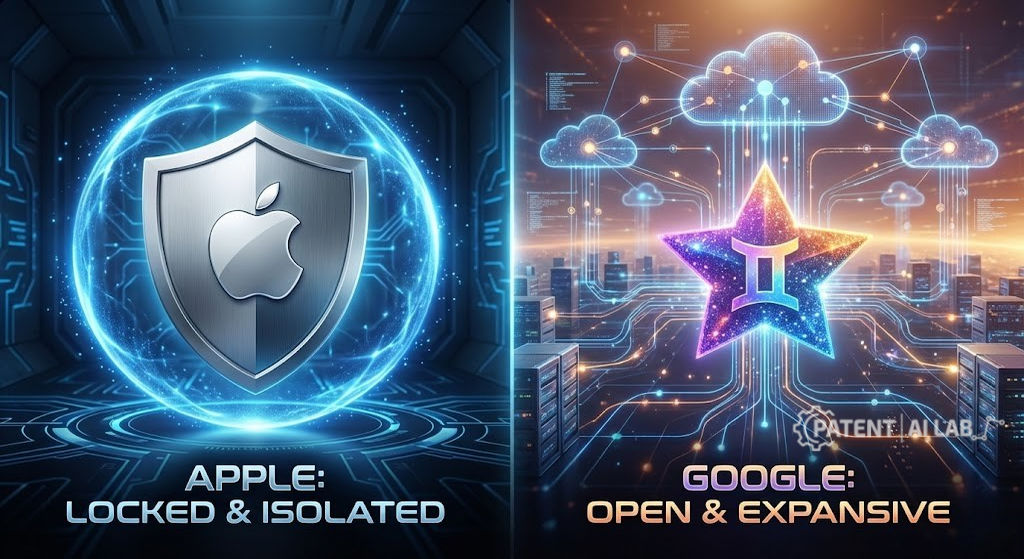
Apple Intelligence vs Google Gemini Privacy Comparison: Core Architecture Divergence
The fundamental strategic divergence between these two platforms reflects a foundational architectural choice: Apple bets on isolation, Google bets on distribution. Apple controls every layer from the application runtime down to the transistor gate, which allows it to pursue hardware-enforced privacy properties that are auditable and physically constrained. Google controls the dominant mobile operating system and a vast OEM licensing network, which allows it to deploy AI capabilities to a global device base that Apple’s closed hardware model does not reach in the same way. Both approaches carry potential tradeoffs at the regulatory, patent, and developer compliance layers — tradeoffs that have become more relevant to product planning as enforcement deadlines approach. None of the observations below should be read as a definitive legal conclusion about either company’s compliance posture; they describe architectural tendencies that compliance teams may wish to investigate further for their own specific deployments.
Google: Distributed inference mapping, pipeline throughput, and multi-tenant data processing efficiency.
Google: High on reference Pixel hardware; subject to variation across OEM Android devices with differing Tensor pipeline implementations.
Google: Low to medium; a hybrid model routes intensive or long-context requests to centralized servers, with data residency determined at runtime.
From Cloud Farms to Smartphone Silicon: Why the AI Compute Battleground Has Shifted
For the first half of this decade, AI capability competition was largely a cloud infrastructure contest. By 2025, a substantial share of the competitive and compliance conversation had migrated toward the silicon inside the device itself. This shift appears to be driven by two converging pressures: global data privacy regulation and the maturation of on-device NPU silicon to a point where latency and capability increasingly do not require cloud offload for many consumer inference workloads.
Traditional cloud AI processing routes user prompts off the physical device, which may introduce cross-border data transfer exposure and potential data controller liability considerations under EU regulatory frameworks. Moving computation to the device can reduce, and in some configurations may help avoid, the third-party processor relationship that GDPR Article 28 generally requires to be formally documented. It may also reduce the breach-notification surface relevant under GDPR Article 33. And it can reduce some of the consent-related infrastructure that GDPR Article 7 imposes on cloud-routed personal data. For regulated industries, that architectural simplification is not merely a product preference — it may represent a meaningful reduction in legal exposure, although the actual degree of benefit will vary by use case, data type, and jurisdiction, and should be assessed with qualified counsel rather than assumed from architecture alone.
With sub-20ms local inference now feasible on flagship silicon and reduced dependency on active network coverage, on-device NPU capability is increasingly viewed as a meaningful technical and competitive advantage for products operating in EU-regulated markets. Teams that treat data residency purely as a configuration option rather than as a design-time architectural consideration may be accumulating compliance debt that is worth resolving well ahead of the August 2026 enforcement deadline, rather than discovering it during an audit.
Apple Intelligence: Hardware Co-Design as a Privacy Enforcement Mechanism
Apple’s privacy architecture is rooted in hardware-software co-design rather than policy commitments alone. By defining explicit data pathways on-die, the silicon is designed to constrain application-layer access to live inference sessions. This is a technically meaningful distinction worth unpacking: a software privacy policy can, at least in principle, be amended by a product decision, whereas a hardware memory boundary generally requires a new chip revision to modify. For compliance architects, that difference may influence whether a given privacy property can be relied upon across a device population without per-update re-verification — though it does not, on its own, resolve every compliance question a regulator might raise.
The practical consequence is that Apple’s privacy properties may carry a degree of architectural permanence that purely cloud-routed AI systems are less likely to replicate. A hardware-enforced data isolation property can, in principle, be documented once and applied fairly uniformly across the device population, whereas a policy-based guarantee typically needs to be re-verified against every software update, API revision, and terms-of-service change. For regulated product teams, that difference in audit burden can be substantial, though the precise compliance value still depends on how a regulator or auditor chooses to weigh architectural evidence against documentary evidence.
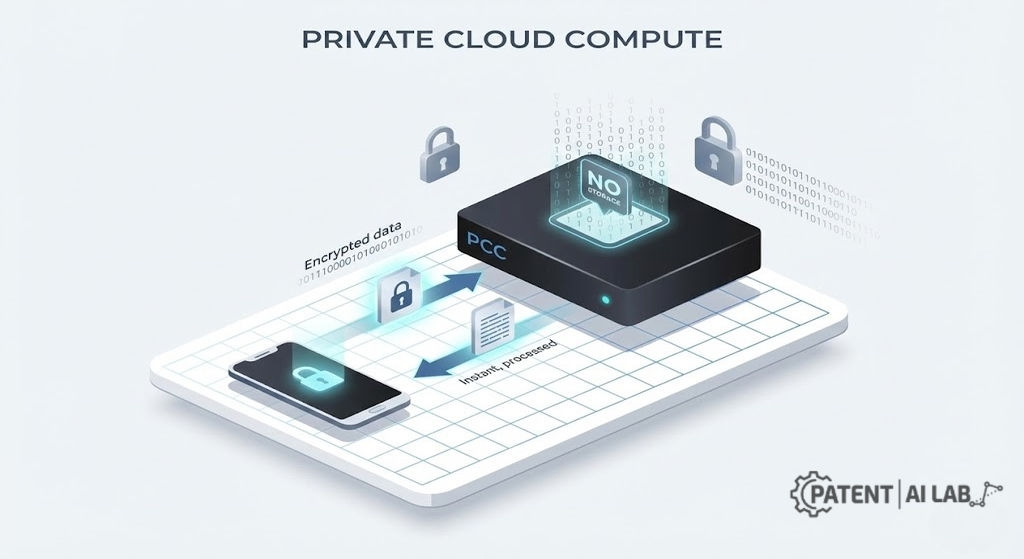
Apple’s Private Cloud Compute (PCC): Stateless Execution as an Architectural Privacy Goal
While the on-device Neural Engine handles the majority of standard inference tasks, complex requests — such as extended multimodal sessions or long-context document summarization — occasionally require external compute capacity. To scale without exposing cleartext data to persistent storage, Apple built its Private Cloud Compute nodes on custom Apple Silicon. According to Apple, these nodes are designed to enforce cryptographic end-to-end encryption, runtime verification via memory tagging, and non-retention of user session data.
According to Apple’s published security architecture documentation, PCC is designed around five core properties:
- Stateless computation — PCC nodes are designed not to retain user data between sessions. Each request is intended to be processed in an ephemeral execution environment that is cryptographically destroyed after the response is returned.
- Enforceable guarantees — Apple describes these privacy properties as enforced by the hardware and software stack architecture rather than by policy commitments that could be modified independently of a chip revision.
- No privileged runtime access — Per Apple’s documentation, Apple engineers are not intended to be able to access user data during active PCC processing sessions.
- Non-targetability — The architecture is designed so that neither Apple nor any external party can direct a specific user’s request to a specific server node in a way that would enable persistent session tracking.
- Verifiable transparency — Apple states that PCC node security properties can be independently reviewed by external security researchers.
These five properties, as described by Apple, are architectural design goals enforced by the hardware and software stack — not standalone policy commitments. That said, they are Apple’s own published claims about its system, and independent verification by outside researchers is the relevant check on whether the implementation matches the design intent. Developers and compliance architects may wish to review the full technical specification directly in Apple’s Private Cloud Compute security documentation rather than relying solely on third-party summaries, including this one.
This hardware strategy is supported by an extensive portfolio of Secure Enclave and key isolation patents oriented toward preventing persistent storage and administrative backdoors. The capital investment required to build and defend this silicon IP is substantial — and many patent strategists view it as a comparatively durable moat relative to model-weight advantages, which tend to depreciate faster as competitors close capability gaps. For teams evaluating hardware IP investment against software-only approaches, our analysis on US vs UK Software Patent Cost: Which is Cheaper? offers a practical cost comparison framework.
Secure Enclave and Apple Neural Engine: Why Vertical Control Functions as the Privacy Boundary
Apple’s privacy architecture is generally able to hold together because the company maintains vertical control across the operating system layer, the localized sandboxing rules, and the silicon die itself. This is reported to allow the processor to isolate individual memory addresses during simultaneous matrix calculations — a property that would be difficult for any purely software security layer to replicate on top of a general-purpose operating system Apple does not control. The isolation property appears to be a consequence of silicon architecture more than of software policy alone, though both layers work together in practice.
The A19 Pro chip, introduced in September 2025, features a 16-core Neural Engine working alongside dedicated Neural Accelerators integrated into each GPU core. Apple’s published specifications for the iPhone 17 Pro line report approximately 45 TOPS (tera-operations per second) of AI performance. This figure reflects Apple’s own published performance claims. Independent third-party laboratory benchmarks had not replicated this figure at the time of writing. Teams relying on TOPS figures for procurement or compliance planning may want to consult independent technical evaluations before drawing architectural conclusions.
To illustrate the practical significance of the architectural approach: consider an on-device health data summarization feature operating under a HIPAA-adjacent compliance framework, purely as a technical illustration. On Apple’s platform, the Secure Enclave’s hardware key insulation is designed so that an active inference session processing that health data cannot ordinarily be accessed by another application process running simultaneously on the same device. The memory boundary is intended to be enforced at the silicon level, and an OS-level software vulnerability alone would generally not be expected to bridge that boundary without an accompanying hardware-level exploit — a meaningfully higher bar than a purely software-based isolation mechanism, though not an absolute guarantee against every conceivable attack vector.
This silicon-level design property is something a policy document alone cannot fully replicate, which is part of why some patent strategists view hardware IP — rather than model weights alone — as a potentially durable asset class in the on-device AI market. Note: The health data scenario above is a technical illustration of architectural properties, not compliance guidance for HIPAA or any specific regulatory framework. Consult qualified healthcare compliance counsel for specific use cases.
Silicon Patent Execution: Apple Neural Engine vs Google Tensor NPU
Google Gemini: Scale-First Architecture and Its Compliance Tradeoffs
Google’s mobile AI strategy centers on Gemini Nano, an efficient Small Language Model (SLM) optimized for on-device execution. The current generation, Gemini Nano v3, powers Google’s Gemini Intelligence feature set and is optimized for Tensor G5 silicon — or equivalent 2026-generation flagship chips — with a minimum of 12GB RAM. Per Google’s published Pixel 10 technical overview (October 2025), the Tensor G5 chip is reported to achieve 2.6x faster and 2x more efficient Gemini Nano execution compared to Tensor G4, a gain Google attributes partly to XLA compiler optimization maturity alongside raw silicon improvements.
Gemini Nano provides high on-device execution throughput and appears to benefit from unified model training lineages shared with Google’s cloud infrastructure. Its core strategic priority looks to be open ecosystem scaling rather than total data containment. The commercial logic seems fairly straightforward: Google is not positioned to match Apple’s hardware vertical integration across the billions of heterogeneous Android devices already in consumer hands. Instead, Google appears to trade vertical hardware control for dominant global device distribution — an asymmetric competitive position that may create regulatory tradeoffs developers will want to account for when building GDPR-relevant products.
This looks like a rational product strategy that has delivered significant market share. But the compliance implications of that distribution model appear concrete enough that they are probably worth designing around proactively, rather than discovering after a product has already shipped.
Google’s OEM Licensing Model: Distribution Scale at the Cost of Fragmented Privacy Control
Android OEMs are not contractually required to default to Gemini architectures. But the commercial economics of the Play Services ecosystem appear to create a strong practical adoption incentive. The foundational Gemini APIs are designed to interface with native Android sub-routines, and an OEM that opts out of Gemini integration would effectively decouple from the Play Services infrastructure that the large majority of consumer applications depend on. That commercial constraint seems to function as a de facto adoption driver without necessarily requiring a formal contractual mandate.
The multi-tenant licensing architecture that results from this model can fragment privacy control in ways that may be relevant to compliance review. Individual OEMs customize local processing pipelines, maintain independent security update schedules, and manage distinct hardware abstraction layers. The practical consequence: a Samsung Galaxy device, a Xiaomi flagship, and an OnePlus handset running the same Android version may carry materially different Gemini inference security postures stemming from their respective OEM customizations. Verifying reasonably uniform end-to-end security parameters across the Android ecosystem appears to be more complex than on Apple’s closed platform, where Apple is the sole hardware manufacturer for the entire device population.
For developers building GDPR-relevant products on Android, that fragmentation may carry compliance implications worth assessing case by case. GDPR Article 28 generally calls for documented assurance of processor-level security controls for any third-party processing relationship. OEM variation across Android deployments can make that documentation harder to standardize — a compliance documentation challenge that seems less likely to arise on iOS, given Apple’s architectural construction. Teams shipping to EU users after August 2026 may benefit from treating this as a design-time consideration rather than leaving it as a deployment-phase checklist item, though the right approach will depend on the specific regulatory posture of each product.
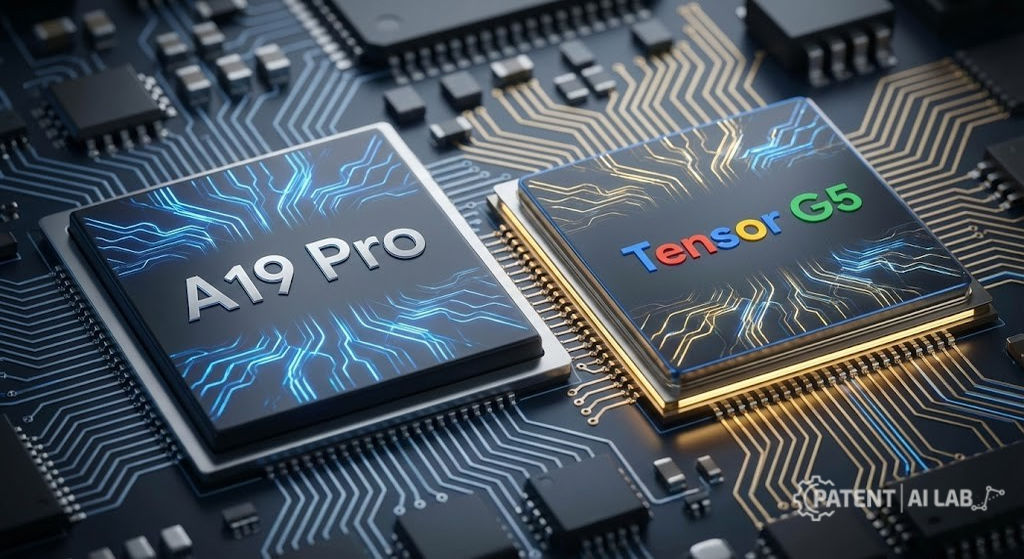
A19 Pro vs Tensor G5: Two Different Silicon Philosophies for On-Device AI
Apple and Google deploy notably different silicon architectures to manage on-device matrix computation. These architectural differences are not merely academic: they appear to influence what patent claims each company can more defensibly assert, what compliance properties each platform can more readily support structurally, and what performance profiles developers may want to architect around when building inference-dependent applications.
Apple’s approach — a spatial or planar architecture — appears to prioritize per-task memory isolation and power efficiency per inference operation. Google’s approach — a systolic array architecture inherited from its enterprise TPU lineage — appears to prioritize raw throughput and compiler-level optimization for large uniform batch workloads. Neither architecture seems categorically superior to the other. The more relevant design question is probably which approach better matches the specific deployment constraints of a given product: hardware-enforced data isolation per task (an apparent structural strength of Apple’s approach) or maximum inference throughput across a heterogeneous global device population (an apparent structural strength of Google’s approach).
Silicon Infrastructure Comparison
Technical Note: Both Apple’s 45 TOPS processing claims and Google’s 2.6x efficiency metrics rely exclusively on first-party corporate documentation. Standardized, third-party technical audits and independent benchmarking lab reports remain absent for these specific silicon revisions, meaning compliance architectures must currently be mapped against manufacturer-verified baselines.
Code Architecture: On-Device Isolation vs Hybrid Cloud Routing at the API Level
The architectural difference between Apple’s on-device privacy model and Google’s hybrid routing approach is visible, and arguably most consequential, at the API level. The decision of where data goes for a given request is effectively made at the call site, in a single configuration parameter or execution mode. That decision can carry GDPR and EU AI Act implications worth thinking through early, since retrofitting data-routing behavior after a product has already shipped tends to be considerably harder than designing for it up front. The two short examples below are illustrative simplifications of publicly described platform behavior, not production-ready code, and are included to make the architectural contrast concrete rather than abstract.
On-Device AI (Apple CoreML)
Apple’s CoreML-based approach is designed to enforce a strict data containment posture at the call site. The privacyLevel: .strict parameter instructs the runtime to execute the request entirely on-device and is designed to refuse routing to Private Cloud Compute even when additional compute capacity might otherwise improve performance. Notably, the system is described as failing closed: if on-device inference is unavailable, the call is designed to return nil rather than silently routing to an alternative endpoint. This behavior may align with data minimization principles reflected in EU AI Act Article 10 data governance provisions, without necessarily requiring server-side configuration or a third-party processor agreement for the on-device path. That said, the architecture itself is a technical design choice, not a compliance certification — whether a given deployment actually satisfies Article 10 in practice will still depend on how the surrounding product, data flows, and documentation are structured.
// On-Device AI (Apple CoreML) — illustrative example
// privacyLevel: .strict is designed to enforce on-device execution — no PCC routing
// Fails closed: returns nil if on-device inference is unavailable
// May support data minimization principles referenced in EU AI Act Art. 10
let summary = OnDeviceLLM.generate(
    input: userNote,
    privacyLevel: .strict
)
It’s worth underlining what this pattern does and does not establish. The fail-closed behavior reduces one specific technical risk: silent, unintended routing of sensitive input to a remote endpoint. It does not, on its own, address every governance obligation a high-risk AI system might carry under the broader AI Act framework, such as documentation, human oversight, or post-market monitoring requirements that apply regardless of where inference happens. Teams building on this pattern may still need a separate compliance review covering logging practices, consent flows, and any downstream processing the app performs on the model’s output once it leaves the privacyLevel: .strict boundary.
Hybrid AI (Google Gemini Nano)
Google’s Execution.AUTO mode is designed to dynamically route inference requests between Gemini Nano running on-device and Google’s cloud servers based on request complexity, device capability, and network availability. This can provide meaningful performance headroom — a complex multimodal request on a mid-range Android device may complete successfully by offloading to cloud infrastructure that would otherwise be unavailable on more constrained local silicon.
The compliance implication here is one worth flagging clearly. Data residency for any given inference call under Execution.AUTO appears to be determined at runtime rather than at compile time. That means developers generally cannot statically audit, just by reading the source code, where a specific user’s data will be processed — instrumenting and logging the runtime routing behavior would likely be necessary to produce that kind of record. For teams with EU data protection obligations, that dynamic routing may call for ongoing monitoring rather than a one-time architectural review at launch.
// Hybrid AI (Google Gemini Nano) — illustrative example
// Execution.AUTO routes dynamically between on-device and cloud
// Data residency per request is determined at runtime, not at compile time
// Cloud routing may apply for multimodal or long-context requests
val result = GeminiClient.generate(
    input = userQuery,
    mode = Execution.AUTO
)
For developers building GDPR-relevant products on Android, one practical implication of Execution.AUTO is that a GDPR Article 28 Data Processing Agreement with Google would likely need to be considered to cover the cloud-routed inference cases — and ideally that agreement should specifically address Gemini Nano cloud inference endpoints, rather than relying on a general-purpose cloud services agreement that may not contemplate this routing behavior. This is largely a documentation and procurement exercise, and it is one that Apple’s on-device architecture tends to reduce, though not necessarily eliminate, for the subset of requests it is able to handle locally. Teams that adopt Execution.AUTO in production may also want to consider exposing the routing decision in their own logs or telemetry, so that a compliance review — internal or external — does not have to reverse-engineer Google’s runtime behavior after the fact.
For teams navigating copyright questions that arise from AI-generated code in production environments, our analysis on The GitHub Copilot Copyright Lawsuit: Is Your SaaS Code Safe? covers how courts are currently approaching AI code authorship disputes.
With sub-20ms local inference now feasible on flagship silicon and reduced dependency on active network coverage, on-device NPU capability is increasingly viewed as a meaningful technical advantage. Shifting execution to edge hardware fundamentally alters the parameters of any Apple Intelligence vs Google Gemini privacy comparison, turning data residency from a software toggle into a hardware constraint.
Regulatory Exposure Compared: Apple’s Contained Compliance Surface vs Google’s OEM Complexity
The regulatory exposure profiles of these two platforms appear structurally asymmetric in ways that may matter for compliance documentation, though “asymmetric” here describes architectural breadth rather than a judgment about which company is more or less compliant overall. Apple’s closed vertical stack tends to create a compliance surface that is comparatively narrow and auditable: one hardware manufacturer, one OS vendor, one cloud provider (Apple itself, via PCC), and one set of hardware-enforced privacy properties to review. Google’s open licensing model tends to create a compliance surface that is broader and more heterogeneous — Google’s base platform, the OEM, the specific Android version, and the OEM’s customization layer all interact in ways that can shape the actual security posture of any given device deployment.
The foregoing reflects technical and engineering analysis of publicly documented architectural and compliance postures, drawing on publicly available regulatory texts and manufacturer-published architectural specifications. It is provided for informational and educational purposes only and does not constitute legal advice. Compliance frameworks are fact-specific and jurisdiction-dependent, and reasonable readings of the same regulatory text can differ. Consult a qualified attorney before structuring compliance strategies around specific architectural decisions, and treat the characterizations above as a starting point for further diligence rather than a conclusion.
What Comes Next: Edge Silicon as the Substrate for Autonomous AI Agents
The silicon and privacy architecture decisions being locked in by Apple and Google today will likely shape the deployment constraints for the next generation of AI applications. As local inference architectures mature and NPU performance continues to improve, edge configurations seem likely to increasingly serve as the execution substrate for autonomous agents — AI systems that act on behalf of users by accessing calendars, emails, health records, and financial accounts, in some designs without requiring explicit per-action authorization.
The security properties of the underlying hardware platform may help determine whether those agents can reasonably be deployed in regulated industries at all. For Apple, the Secure Enclave architecture that today isolates a text summarization request could plausibly extend tomorrow to isolating an agent session with write access to sensitive personal data repositories — though that extension is not automatic and would presumably require its own architectural and compliance review. For Google, the OEM fragmentation that today introduces compliance documentation complexity could plausibly generate comparable audit complexity for future agent deployments that need to demonstrate reasonably consistent data containment across heterogeneous hardware configurations.
The IP and compliance decisions being made at the silicon level in 2025 and 2026 are probably not best thought of as product features subject to easy future iteration. They look more like longer-term architectural constraints that may meaningfully shape what is practically deployable, from both a technical and compliance standpoint, for a number of years to come. Teams that treat these as deferred engineering problems may be accumulating structural debt that becomes harder to unwind as deadlines approach. For a practical primer on IP ownership questions that arise as AI systems act more autonomously on behalf of users, see our guide: Agentic AI & IP Laws: Who Owns the Code?
Podcast
Note: This audio is a condensed summary. Please refer to the written analysis above for precise legal definitions and technical specifications.
FAQs
Is Apple Intelligence fully offline?
Mostly, but not entirely. Foundational operations run locally on the Apple Neural Engine. More complex tasks may route to Private Cloud Compute nodes, where Apple states user data is encrypted end-to-end and not retained after the session ends. The system is designed to fail closed: if Private Cloud Compute is unavailable and on-device inference cannot complete the request, it is designed to return an error rather than route to an unverified third-party endpoint.
Does Google Gemini send data to the cloud?
It depends on the execution mode and request type. Gemini Nano is designed to operate on-device for many standard requests. Complex multimodal prompts or long-context inference on lower-specification devices may regularly route to Google’s cloud infrastructure. Developers using Execution.AUTO generally cannot statically determine data residency per request from source code alone, which is why a documented GDPR Article 28 Data Processing Agreement with Google would likely be advisable to cover cloud-routed inference cases, subject to each team’s own legal review.
Are on-device AI patents easier to defend at the USPTO?
Often, though not automatically. Hardware-linked patent claims that reference specific physical circuit configurations, power reduction mechanisms, and concrete memory boundary architectures tend to be less exposed to the software abstraction rejections associated with Alice Corp. v. CLS Bank and § 101 eligibility doctrine. A patent claiming a specific on-die memory isolation circuit is generally considered more defensible than one claiming an abstract AI inference optimization algorithm, though outcomes still depend heavily on the specific claim language and the examiner involved.
Can Android OEMs build their own on-device AI without Google?
Yes, technically. But native Google Play Services integrations and proprietary Tensor NPU pipeline optimizations create strong commercial incentives to license the default Gemini framework. OEMs that build independent on-device AI stacks would also need to independently maintain security update pipelines and their own GDPR Article 28 processor documentation — compliance overhead that most OEMs appear to absorb into the Google licensing relationship rather than manage on their own.
Sources and References
The hardware architecture claims, regulatory frameworks, and performance figures reviewed in this analysis draw directly on official statutory publications and manufacturer-published technical documentation:
- 1. European Parliament — The European Artificial Intelligence Act (Regulation EU 2024/1689)
The statutory framework establishing compliance thresholds, data controller transparency obligations, and liability structures for generative AI models operating across EU member borders. Article 50 indicates that transparency obligations and GPAI penalty powers are scheduled to activate August 2, 2026. A May 2026 Digital Omnibus provisional agreement proposed extending Annex III high-risk obligations to December 2027; this extension had not been formally enacted as law at time of publication.
Access Official EU AI Act Documentation - 2. European Commission — Digital Markets Act (DMA) Compliance Frameworks
The competition framework governing application gating, ecosystem software pre-installation obligations, and cross-border hardware API bundling constraints. Potentially relevant to Google’s ongoing DMA compliance obligations across its Android and Play Services ecosystem.
Review Digital Markets Act Rules - 3. Apple Security Engineering and Architecture — Private Cloud Compute Technical Documentation
Apple’s official technical specification describing PCC’s five core architectural privacy properties: stateless computation, enforceable guarantees, no privileged runtime access, non-targetability, and verifiable transparency. This is the primary source for all PCC architectural claims in this analysis; the characterizations are Apple’s own published statements about its system.
Read Apple PCC Security Documentation - 4. Google — Tensor G5 and Gemini Nano Technical Overview (Pixel 10, October 2025)
Google’s published technical overview for the Pixel 10 launch, reporting that Tensor G5 executes Gemini Nano 2.6x faster and 2x more efficiently than Tensor G4, and powers over 20 on-device AI features. This is the primary source for all Tensor G5 performance figures cited in this analysis; figures reflect Google’s own published claims.
Review Tensor G5 Technical Coverage
Disclaimer & Legal Notice
This article presents technical and engineering analysis of edge computing architectures and cross-border data protection compliance frameworks. It draws on publicly available regulatory texts, official statutory documentation, and manufacturer-published architectural specifications, and reflects our own interpretation of those public materials as of the publication date. It is intended strictly for informational and educational purposes and does not constitute legal advice or formal legal advisory services, and it is not a substitute for the advice of a qualified, licensed patent attorney or EU regulatory counsel. Regulatory enforcement timelines, IP mandates, and compliance obligations change frequently, and reasonable readings of the same text can differ between practitioners. Always consult a certified patent counsel before structuring IP portfolios, and qualified regulatory counsel before mapping architectural decisions to specific legal obligations. Where this article references EU legislative provisions, readers should independently verify current obligations against the official EU AI Act documentation and the official GDPR text on EUR-Lex, and should consult qualified legal counsel for jurisdiction-specific compliance advice rather than relying on this article alone.





[…] No. The decline in “raw compute” patents does not mean NVIDIA has stopped engineering faster GPUs. It signals that they believe raw speed is becoming a commodity that is harder to defend legally. They are shifting their IP “moat” to the system level (how chips communicate) because that is where they see the long-term profit margin, even if competitors catch up on raw teraflops.However, raw speed isn’t the only metric anymore; the race is shifting toward efficiency and specialized Neural Processing Units (NPUs), which is the core conflict in the Apple Intelligence vs. Google Gemini: The 2026 Battle for Your Data & Privacy. […]