


 Golam Rabiul Alam, PhD
Learning how to file a provisional patent DIY requires one strict rule: speed should never compromise quality. Two years ago, I sat with a hardware startup founder who had a brilliant sensor idea and exactly zero budget for lawyers.
We decided to take the DIY route. Not because it was trendy, but because it was necessary. Everyone online kept repeating the same dangerous advice: “Just file something quickly. You can fix it later.”
That single line of advice almost cost him the invention. To clarify the strategic constraints of this process, here are the foundational pillars of our approach:
At a Glance
✓ The Priority Date Requirement: A provisional application must serve as a strict technical foundation. If a future non-provisional patent cannot clearly trace its claims back to this initial document, the priority date becomes invalid.
✓ Exhaustive Disclosure: Writing a successful DIY application requires treating the document like a technical manual. Inventors must explicitly detail alternative materials, failure modes, and potential variations.
✓ Internal Consistency: The primary risk in DIY filing is contradicting definitions within the text. Using inconsistent terminology can create legal gaps that compromise future patent claims.

Here is the uncomfortable truth I learned while helping draft that provisional at 2:00 AM on a Sunday. Filing fast is not the hard part. Filing something that actually protects you is. That difference is everything.
This guide is written for solo inventors and early-stage founders who want to move fast without sabotaging their own IP.
How to File a Provisional Patent DIY
Short answer: Carefully, slowly, and with way more detail than you think you need.
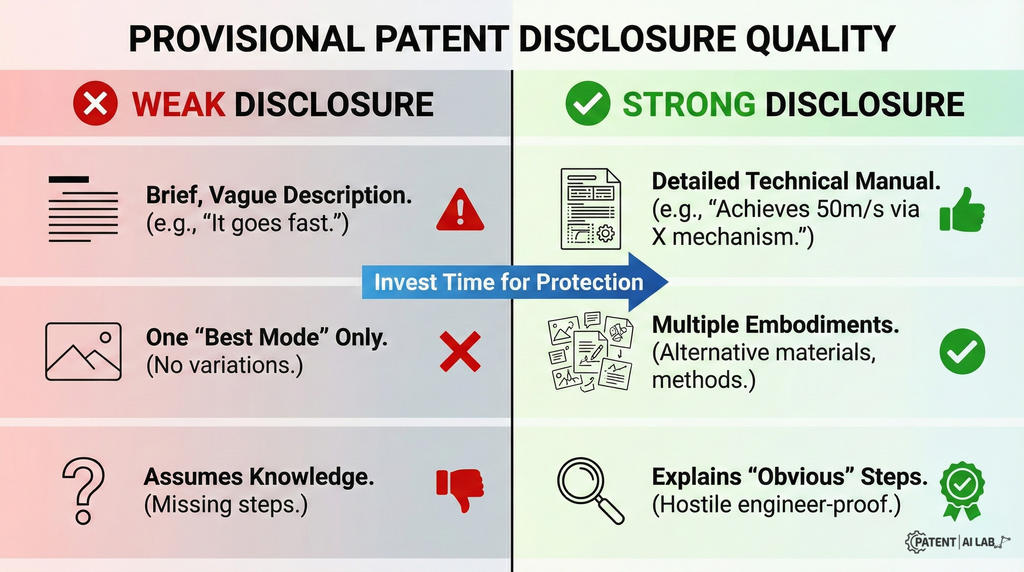
Most guides treat a provisional application like a placeholder. I don’t. A weak provisional is actually worse than no provisional because it gives you false confidence. If your later non-provisional patent cannot clearly trace back to what you disclosed today, your “priority date” is basically a mirage.
So, when people ask me how to file a provisional patent, my answer is this: You are not filling out a form. You are writing a technical disclosure that must survive future legal scrutiny.
The USPTO will not save you from vagueness. Only you can do that.
Getting this wrong means you will pay a lot more later to fix it. If you want to see exactly how much a formal patent process can run up the bill, look at our breakdown of Software Patent Costs.
What We Actually Did (And Why It Worked)
The “Obvious” Trap
We wrote the invention description without thinking about patents. Then we rewrote it, expanding every “obvious” step.
Variations are Vital
We added variations. Alternative materials, different data flows, optional components we weren’t even planning to build yet.
Aggressive Drawings
We used simple, hand-labeled diagrams that matched the text line-by-line. If the text mentioned a component, it appeared in a drawing.
The Administrative Reality Check
Learning how to file a provisional patent DIY means surviving the USPTO’s strict automated compliance checks.
Required Paperwork
You must include Form PTO/SB/16 (Cover Sheet) and Form PTO/SB/15A (Micro Entity Certification) to claim the 80% discount.
The PDF Trap
Uploads require embedded fonts and strict margins (3/4″ top, 3/8″ sides). Exporting without embedding fonts results in an instant portal rejection.
A Practical DIY Checklist
If I were to turn our approach into a simple comparison, here is where the DIY battle is won or lost. To identify specific vulnerabilities, we evaluated our draft against these common errors found in solo filings:
Too short; assumes knowledge.
Over-explained everything. Treated it like a manual.
Describes only the current prototype.
Listed alternatives explicitly (e.g., “Sensor could be optical OR thermal”).
Vague language (“fast,” “strong”).
Defined terms once and reused them consistently.
Missing or artistic renders.
Labeled functional diagrams cross-referenced to text.
The Anatomy of a DIY Specification Document
To maximize your protection and minimize examiner pushback later, your technical document (the PDF you upload) should follow a standard architectural structure. While provisional patents do not legally require formal formatting, ignoring this standard structure is a massive strategic error. Here is the exact outline you should use:
Recommended Document Structure
Title of the Invention
Keep it broad but descriptive. Avoid marketing names.
Background of the Invention
The Problem: Explain current solutions and why they fail. Just set the stage.
Brief Summary
The Solution: A high-level overview of how your invention solves the problem.
Brief Description of the Drawings
A list explaining each figure (e.g., “FIG. 1 is a flowchart…”).
Detailed Description (The Core)
Dump every technical detail. Walk through drawings, component connections, and alternative variations.
The Risk Almost Everyone Ignores
The biggest overlooked risk when you figure out how to file a provisional patent DIY is internal inconsistency. It’s not legal fees or formatting errors. It is contradicting yourself.
If you describe your invention one way in paragraph three and slightly differently in paragraph twelve, that gap can be used against you later. I have seen founders lose claims because of a single undefined term.
Another unpopular opinion: Filing too early can hurt you.
Yes, I said it. Filing before you understand your invention well enough can lock you into a narrow disclosure. Sometimes, waiting three more weeks to test and refine is the smarter move. Provisional patents reward clarity, not speed.
Final Recommendation on DIY Filing
If you choose to handle the provisional filing process without a lawyer, keep these final strategic constraints in mind:
If you are committed to learning how to file a provisional patent DIY, respect the document. Treat it like the foundation of a building, not a sticky note.
Practical Recommendation: Before you file, hand the draft to a technically smart friend and ask them to explain the invention back to you. If they hesitate, your provisional is not ready.
Podcast
This automated audio brief outlines the primary data, analysis, and strategic insights covered in this guide.
FAQ: Common Questions on DIY Provisional Filing
What is the cost when figuring out how to file a provisional patent DIY?
If you qualify as a “Micro Entity” (which most solo inventors do), the USPTO fee is currently $65. If you are a “Small Entity,” it is $130. This fee secures your 12 months of “Patent Pending” status.
Do provisional patent drawings need to be professional?
No, provisional drawings do not need to follow the strict “formal” rules of a non-provisional application. However, they must be clear, legible, and clearly labeled. Hand-drawn sketches are acceptable if they are readable and scanned properly.
Can I add new material to my provisional later?
No. Once filed, you cannot change a provisional application. If you have new improvements, you must file a new provisional application or include them when you file your non-provisional application (but the new parts won’t get the old priority date).
Does a provisional patent turn into a real patent automatically?
No. This is a huge misconception. A provisional patent expires after 12 months. You must file a non-provisional application before that deadline to keep your rights alive.
However, having that 12-month window gives you a massive advantage for early monetization. To see exactly how to make the most of this period, read our step-by-step guide on How to License a Provisional Patent.
Can I use AI to learn how to file a provisional patent DIY in 2026?
While tools like ChatGPT can help summarize your thoughts, using them to draft the actual filing is highly risky. Generative AI can hallucinate technical terms or omit crucial failure modes. The USPTO requires inventors to review all AI-generated content for accuracy, as any inconsistency can be used to invalidate your patent later.
Sources and Legal References
The data, administrative procedures, and technical warnings presented in this guide are derived from official federal documentation. You may verify specific filing requirements via the following resources:
-
1. USPTO Provisional Application Guidelines
The official United States Patent and Trademark Office manual detailing the filing requirements and legal scope of provisional applications.
Read Official USPTO Guidelines -
2. USPTO Official Forms Directory
Direct access to the required administrative paperwork, including Form PTO/SB/16 and Form PTO/SB/15A.
Access Federal Forms Hub -
3. USPTO Patent Center & Document Formatting
The primary portal for electronic submissions and technical guidelines, including strict mandates for embedded fonts and standard PDF margins.
Visit Patent Center -
4. USPTO Official Fee Schedule (2025-2026)
The updated directory for micro-entity, small-entity, and large-entity patent filing fees effective from January 19, 2025.
View Current USPTO Fees
Disclaimer & Legal Notice
PatentAILab is an independent educational research platform and is not a licensed law firm or financial advisory service. The data, patent analysis, and strategic insights provided in this article are for informational and educational purposes only and do not constitute legal, investment, or business advice. Intellectual property outcomes depend on specific technical facts, jurisdictional laws, and drafting execution. Always consult a certified patent attorney and a qualified financial advisor before making IP filing or venture capital investment decisions.



[…] I learned is simple but unpopular: A provisional patent is not a placeholder. It is a technical disclosure […]