

 Golam Rabiul Alam, PhD
In late 2024, my team and I attempted to patent a workflow-optimization engine for a SaaS product. It wasn’t flashy. There was no AI revolution pitch. It was just software that quietly saved enterprise clients time and money.
Yet, the founders kept asking one question, again and again: “What will this actually cost us by the time it is protected?”
That question becomes sharper when you project forward. By the time we reached our filing decisions, we were planning for Software Patent Cost 2026, not today’s numbers. And here is the uncomfortable truth I learned firsthand: most cost estimates people quote are technically correct, yet wildly misleading in practice.
The 2026 Software Patent Cost Baseline
Here is the direct USPTO Software Patent Fees Breakdown based on the latest 2025-2026 fee schedule. This is what you should budget for depending on your filing strategy:
DIY Route
~$65
Attorney Route
$4,000+
Critical 2026 Updates
The RCE Penalty: The USPTO significantly raised fees for ongoing arguments. A second “Request for Continued Examination” (RCE) now costs $2,860.
Micro Entity Advantage: Qualifying for Micro Entity status provides an 80 percent discount on government fees, bringing costs to an all-time low for startup founders.
Risk Factor: Mobile apps face high rejection risks under Section 101; always perform a clearance search before committing to a legal budget.
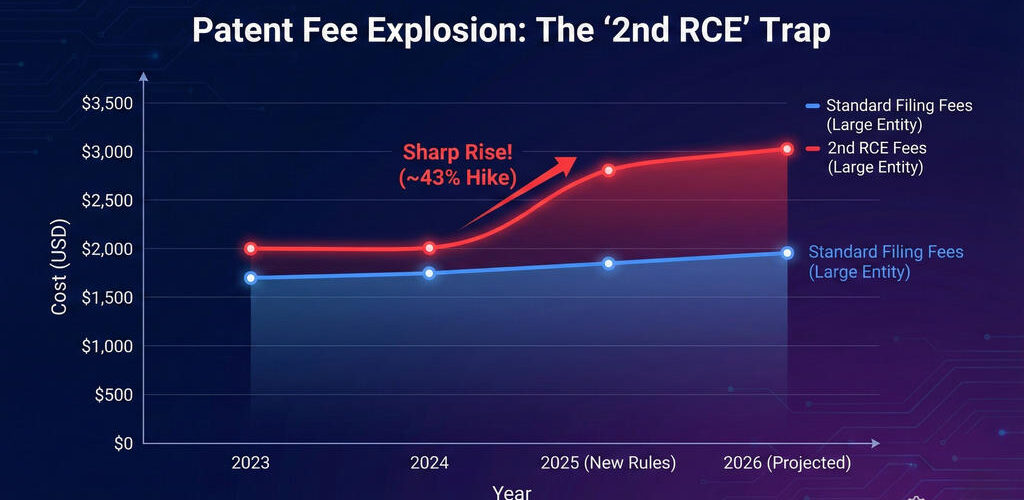
If you are budgeting for a patent in 2026, you need to know about the hidden fee hikes that just hit the system.
Before looking at the official fee schedule below, you must understand that the most expensive trap doesn’t come from the USPTO. It actually comes from the initial clearance search. Attorneys easily charge thousands just to verify if your software idea is already taken. If you are bootstrapping, you need to bypass this markup by learning how to perform a DIY Freedom to Operate search yourself before committing a single dollar to the filing process.
How Much Does It Cost to Patent a Software Idea?
Short answer: The cost to patent a software idea in 2026 will likely fall between $8,000 and $30,000 for a full lifecycle, but only a narrow slice of teams should spend the upper half of that range.
That’s the contrarian part. Most advisors default to “file a full utility patent ASAP.” I don’t agree. In our case, pushing immediately to a full utility filing would have wasted money and locked us into weak claims before the product stabilized. The real cost isn’t filing fees. It’s commitment timing.
To understand the real budget, you must distinguish between “Filing Cost” (Day 1) and “Grant Cost” (Year 3).
The USPTO Software Patent Fees Breakdown (2026 Update)
Effective January 19, 2025, the USPTO raised fees by approximately 7-10%. Here is what you need to pay the government directly (excluding lawyer fees):
The Evidence: What We Actually Paid (and Why)
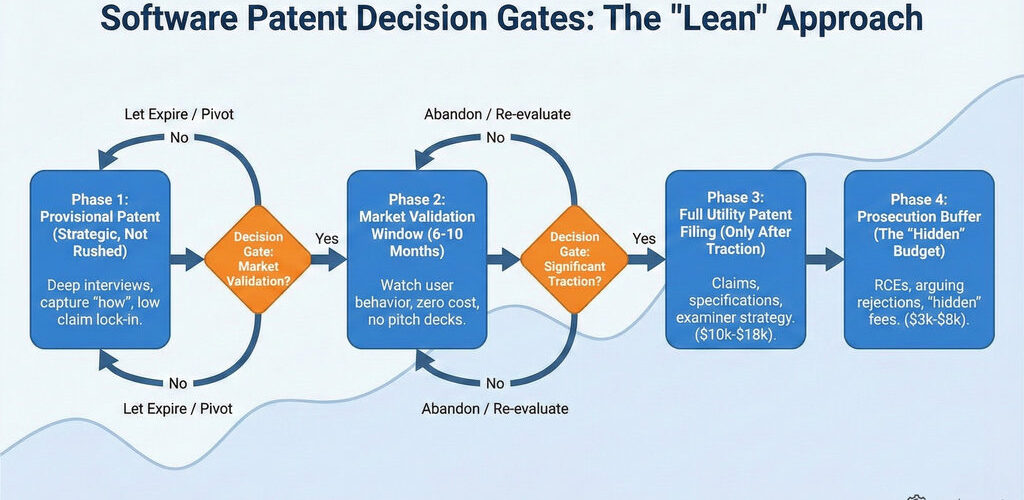
We broke the process into decision gates. Not because lawyers suggested it, but because cash flow forced discipline. Here is how our numbers played out, adjusted for the confirmed Attorney Fees for Software Patent 2026.
Provisional Patent
Instead of a full patent, we started with a provisional. This secured our “Priority Date” for 12 months in a highly strategic, un-rushed manner.
- Attorney Drafting: Deep technical interviews to capture the “how,” not just the “what.”
- DIY Alternative: You could do this for ~$65 if you write it yourself using the Micro Entity discount.
- Outcome: Priority date secured, zero claim lock-in.
Market Validation Window
We utilized the 6 to 10 months following the provisional filing to watch user behavior, not pitch decks. If the feature did not stick, we planned to let the provisional expire. This represents the true “Option Value” of a provisional patent.
Full Utility Patent Filing
Since our product gained traction, we converted the provisional to a non-provisional utility patent.
- Attorney Fees: For formal claims, specifications, and examiner strategy.
- USPTO Fees (2026 Baseline): The “Basic Filing, Search, and Examination” package now totals roughly $2,000 for large entities.
Prosecution Buffer
The USPTO recently raised the cost of arguing against rejections. A “Request for Continued Examination” (RCE), which you file when an examiner rejects your claims twice, now costs $1,500 for the first round and $2,860 for the second.
Timeline: Expect this hidden budget to spread over 2 to 3 years.
How Much Does it Cost to Patent an App Idea?
A common question we get is specifically about mobile apps. How much does it cost to patent an app idea compared to deep-tech software?
The cost is slightly lower for apps because the architecture is often simpler, but the risk is higher.
- Simple App (UI/UX focus): $5,000 – $8,000.
- Complex App (AI/Algorithm focus): $10,000 – $15,000.
Why the difference?
Mobile apps face a higher risk of “Alice” rejections (Section 101), where the USPTO claims the idea is too “abstract.” Overcoming an Alice rejection requires a skilled attorney, which drives up the Attorney Fees for Software Patent 2026 significantly.
Before hiring an attorney, check if your software idea is unique. Attorneys charge for the application process regardless of whether the USPTO approves or rejects your patent.
First Step: Use these 5 Free Patent Search Tools to run an initial clearance check.
The AI Software Patent Premium (2026 Factor)
If your software includes Artificial Intelligence or Machine Learning components, expect your legal fees to increase by 20% to 30%.
In response to the surge of AI applications, the USPTO issued strict new guidelines regarding AI inventorship and technical disclosure. Attorneys now spend significantly more hours mapping out the training data, neural network architecture, and specific hardware interactions to prevent the application from being rejected as a mere “mathematical algorithm.”
- Standard Software Utility Draft: ~$10,000 to $12,000.
- AI/ML Software Utility Draft: ~$13,000 to $16,000.
Attorney Fees for Software Patent 2026: Hourly vs. Flat Fee
When hiring a patent attorney, you will encounter two primary billing models. Understanding this distinction is crucial for managing your total Software Patent Cost 2026.
Hourly Rate
$300 to $800 per hour
- Pros: Suitable for small, specific legal tasks or consultations.
- Cons: Highly unpredictable. A standard “Office Action” response can easily exceed $5,000 if the process is delayed.
- 2026 Trend: Rates are rising due to inflation and the increasing complexity of AI patent reviews.
Flat Fee
Fixed Price
- Pros: You know exactly how much it costs to patent a software idea upfront, securing your budget.
- Typical Rates: Provisional drafts run $2,500 to $4,000. Non-Provisional drafts range from $10,000 to $14,000.
The Overlooked Risk Most Founders Miss
There is a strategic reality that many startup founders overlook during the budgeting phase. In software patenting, the balance between speed and scope is a financial decision.
- Broad patents often face rejection for eligibility.
- Narrow patents are easily bypassed by competitors.
- Premature filings frequently become technically obsolete.
In 2026, USPTO examiners are prioritizing “abstract idea” rejections under Section 101. Poorly timed applications often inflate prosecution costs. We have observed cases where teams spent an additional $7,000 attempting to defend claims that lacked sufficient technical grounding.
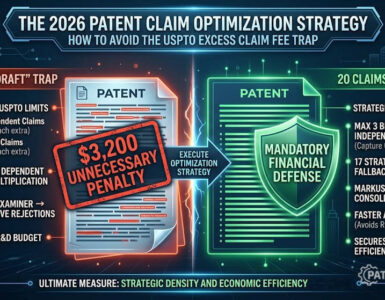
Verbosity is now a direct financial penalty. The USPTO recently set the fee for every claim exceeding twenty at $200 per claim. A “spray and pray” approach with fifty claims will result in thousands of dollars in immediate surcharges.
Choosing the wrong billing model can accidentally double your legal bill. To see the actual math behind the savings, read our detailed breakdown on Hourly Rate vs. Flat Fee Patent Attorney.
Final Strategy: How to Save 80% on Costs
If you are a startup with limited funds, here is the “Lean IP” strategy to keep your Provisional Software Patent Cost for Startups under $100:
The Lean IP Roadmap
If your annual gross income is under $212,000, you are eligible for the 80 percent government discount. This reduces your filing fee to approximately $65.
Instead of paying an initial $3,000 for a draft, utilize AI-assisted tools to generate your technical specification. This provides a strong baseline before seeking legal review.
Submit your application directly through the USPTO Patent Center. Handling the PDF upload yourself eliminates administrative surcharges from third-party services.
Software patenting in 2026 starts with intent, not fees. If your advantage is execution speed, a lean provisional strategy may outperform a full utility filing. Always prioritize your Micro Entity status to protect your capital.
Podcast
This automated audio brief outlines the primary data, analysis, and strategic insights covered in this guide.
FAQ: Software Patent Costs in 2026
Did USPTO fees go up in 2025/2026?
Yes. Effective January 19, 2025, the USPTO raised fees across the board by about 7-10%, with massive hikes for Design Patents (up ~48%) and second RCEs (up 43%).
How much is a “micro entity” discount?
If you qualify as a “micro entity” (gross income limit + fewer than 4 previous applications), you get an 80% discount on most government fees. This brings the provisional filing fee down to about $65.
Why is the “Second RCE” fee important?
The fee for a second Request for Continued Examination jumped from $2,000 to $2,860. This is the USPTO’s way of telling you to get your claims right earlier. It punishes endless arguing.
Can I patent software myself (DIY)?
Technically, yes, but for software, it is dangerous. Software patents face strict eligibility rules (Alice/Mayo). A DIY filing often results in a “dead on arrival” patent that describes an abstract idea rather than a technical process. However, using assisted tools can bridge this gap.
Sources and Legal References
The data presented in this audit is derived from current federal regulations and the updated 2025/2026 USPTO fee structure. You may verify specific figures and legal standards via the following official resources:
-
1. Official USPTO Fee Schedule (2025-2026 Update)
Verifies the current filing, search, examination, and RCE fee increases effective January 19, 2025.
View Official Fee Schedule -
2. Micro Entity Status & Gross Income Limits
Detailed requirements for the 80 percent fee reduction and the current household income threshold.
Check Micro Entity Limits -
3. Section 101: Subject Matter Eligibility (Alice Guidance)
Legal framework for software patentability and “Abstract Idea” rejection criteria (MPEP 2106).
Read Legal Eligibility Guidelines -
4. USPTO Patent Center (Filing Portal)
The official portal for direct PDF submissions and provisional application filings.
Access USPTO Patent Center
Disclaimer & Legal Notice
PatentAILab is an independent educational research platform and is not a licensed law firm or financial advisory service. The data, patent analysis, and strategic insights provided in this article are for informational and educational purposes only and do not constitute legal, investment, or business advice. Intellectual property outcomes depend on specific technical facts, jurisdictional laws, and drafting execution. Always consult a certified patent attorney and a qualified financial advisor before making IP filing or venture capital investment decisions.



[…] Real Software App ($25k – $40k): This is where most serious startups land. It involves backend logic, API […]